Tag: Lesson Planning

  • AI for Language Teachers: A Smart Practical Starting Guide

    AI for Language Teachers: A Smart Practical Starting Guide

    AI for language teachers can be useful, but it can also feel overwhelming. There are many tools, many promises, and many questions. Can AI help with lesson planning? Can it create worksheets? Can it support speaking practice? Can it give feedback on writing? And most importantly, how can teachers use AI without losing the human side of language teaching?

    The simple answer is this: AI works best as a teaching assistant, not as a replacement for the teacher.

    For English teachers, ESL/EFL teachers, and language tutors, AI can help prepare materials faster, generate ideas, adapt texts, create quizzes, draft feedback, and support differentiated practice. But the teacher still decides the lesson aim, checks the language level, protects student privacy, and adapts the material for real learners.

    This guide is a practical starting point. It shows what AI can do for language teachers, what it should not do, and how to start using it in a safe, useful, classroom-friendly way.

    If you want a broader list of tools, read Best AI Teaching Tools for English Teachers. This guide focuses more on how to start using AI in your daily teaching workflow.

    What Does AI for Language Teachers Actually Mean?

    AI for language teachers means using artificial intelligence tools to support language teaching tasks. This may include planning lessons, creating worksheets, designing quizzes, adapting reading texts, generating speaking activities, drafting writing feedback, or creating classroom materials.

    For example, a language teacher might use AI to:

    • plan a B1 speaking lesson;
    • simplify a reading text for A2 learners;
    • create vocabulary practice from a word list;
    • generate comprehension questions from a short video;
    • create a grammar worksheet;
    • draft supportive writing feedback;
    • prepare discussion questions;
    • create an exit ticket;
    • make homework tasks at two difficulty levels.

    This does not mean AI teaches the class for you. It means AI helps with preparation, drafting, adaptation, and idea generation.

    OpenAI’s education resources describe AI as a way to support learning, teaching, skills, and everyday educational work responsibly. You can explore their education page here: OpenAI for Education.

    Why Language Teachers Should Start Slowly with AI

    Many teachers make the mistake of trying too many AI tools at once. They open several platforms, generate many materials, and then feel confused. A better approach is to start with one teaching problem.

    For example, choose one of these:

    • “I need faster lesson planning.”
    • “I need better worksheets.”
    • “I need reading texts at the right level.”
    • “I need quicker quizzes.”
    • “I need clearer writing feedback.”
    • “I need more speaking activity ideas.”

    Then use AI for that one problem first.

    If your biggest problem is lesson preparation, start with ChatGPT Lesson Planning. If your biggest problem is printable resources, start with AI Worksheet Generator for English Teachers.

    Starting slowly helps you build confidence without turning AI into another source of stress.

    What AI Can Do for Language Teachers

    AI can support many parts of language teaching. Here are the most useful areas.

    1. AI Can Help with Lesson Planning

    AI can help language teachers create a first draft of a lesson plan. This is useful when you know the topic but need help organising the lesson stages.

    For example, you can ask AI to create:

    • a lesson aim;
    • a warm-up;
    • a vocabulary stage;
    • a grammar explanation;
    • a reading or listening task;
    • a speaking activity;
    • a short quiz;
    • homework;
    • timing for each stage.

    Use this prompt:

    Act as an experienced language teacher.
    
    Create a lesson plan for [LEVEL] learners.
    
    Language:
    [LANGUAGE]
    
    Lesson topic:
    [TOPIC]
    
    Lesson length:
    [TIME]
    
    Main lesson aim:
    [WHAT STUDENTS SHOULD BE ABLE TO DO]
    
    Target language or skill:
    [GRAMMAR / VOCABULARY / READING / LISTENING / SPEAKING / WRITING]
    
    Class context:
    [AGE GROUP, CLASS SIZE, ONLINE OR FACE-TO-FACE]
    
    Create a realistic lesson plan with:
    1. warm-up;
    2. input stage;
    3. controlled practice;
    4. freer practice;
    5. feedback stage;
    6. quick assessment;
    7. homework;
    8. timing.
    

    A lesson planning prompt like this is much stronger than simply writing “make me a lesson plan.” For a more complete workflow, see Lesson Plan Generator: AI Prompts for Better ESL Lessons.

    2. AI Can Help Create Worksheets

    AI can help language teachers create grammar, vocabulary, reading, listening, speaking, and writing worksheets. The key is to give it the learner level, topic, target language, and question type.

    Use this prompt:

    Create a worksheet for [LEVEL] language learners.
    
    Language:
    [LANGUAGE]
    
    Topic:
    [TOPIC]
    
    Target language:
    [GRAMMAR POINT OR VOCABULARY SET]
    
    Create:
    1. a short warm-up task;
    2. 5 controlled practice questions;
    3. 5 freer practice questions;
    4. one speaking or writing task;
    5. an answer key.
    
    Use clear instructions suitable for [LEVEL].
    

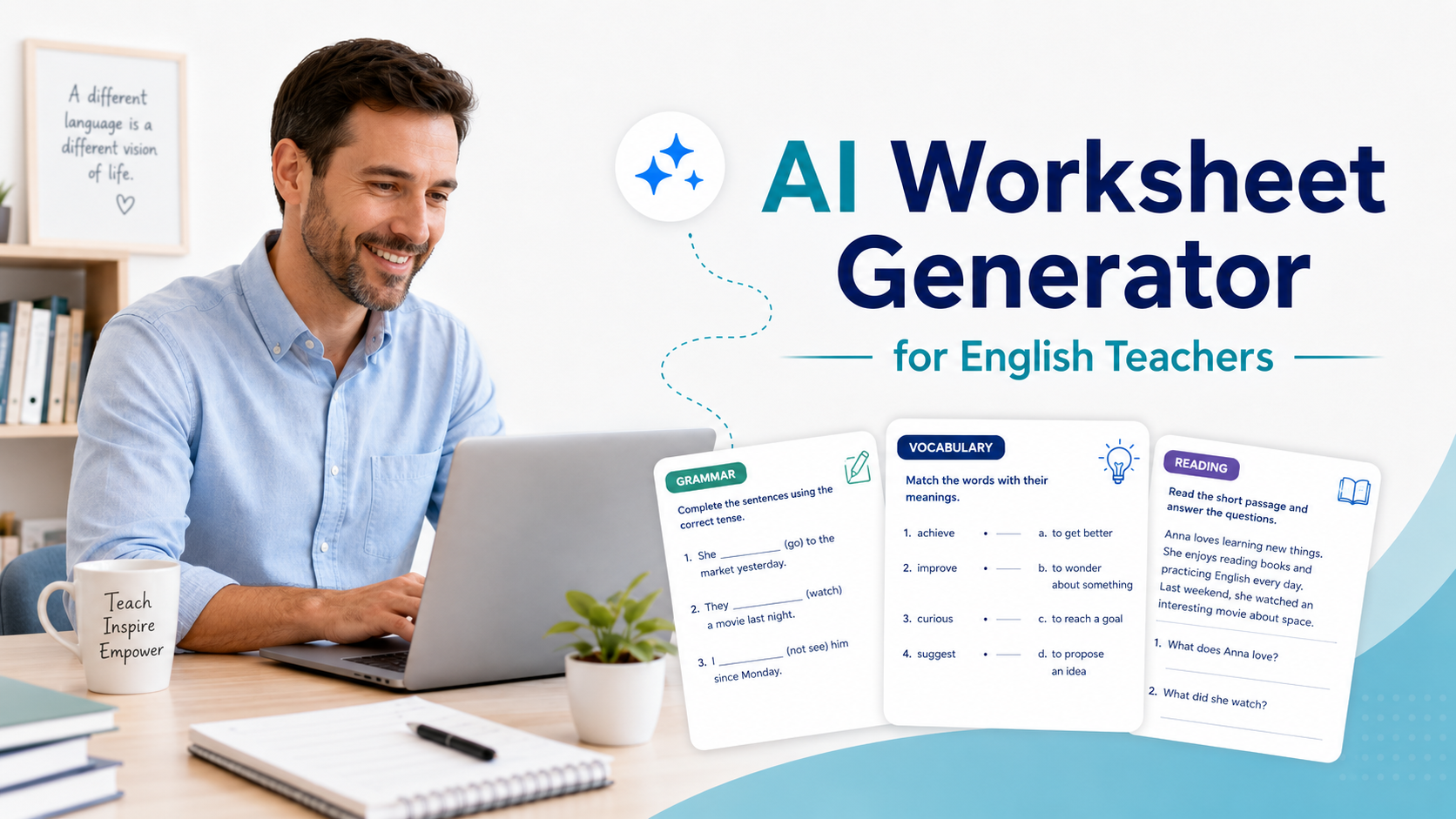
    For English teachers, AI worksheets are especially useful for grammar practice, vocabulary review, reading comprehension, and quiz preparation. The workflow in AI Worksheet Generator for English Teachers can help you create more focused and classroom-ready worksheet prompts.

    3. AI Can Help with Reading Texts and Comprehension Questions

    Reading lessons are often preparation-heavy. Teachers need a suitable text, vocabulary support, comprehension questions, and an answer key.

    AI can help you:

    • simplify a reading text;
    • create a short reading passage;
    • generate gist questions;
    • create detailed comprehension questions;
    • choose vocabulary from the text;
    • create an answer key;
    • adapt the text for different levels.

    Use this prompt:

    Act as a language reading teacher.
    
    Create a reading task for [LEVEL] learners.
    
    Language:
    [LANGUAGE]
    
    Topic:
    [TOPIC]
    
    Text:
    [PASTE TEXT OR ASK FOR A SHORT TEXT]
    
    Create:
    1. 3 pre-reading questions;
    2. 5 useful vocabulary items;
    3. 3 gist questions;
    4. 5 detailed comprehension questions;
    5. 3 post-reading discussion questions;
    6. an answer key.
    
    Make the task suitable for [LEVEL].
    

    For English reading lessons, you can also use the ideas in Reading Worksheet Generator to create stronger comprehension questions and vocabulary-in-context tasks.

    The Common European Framework of Reference describes language proficiency across levels from A1 to C2, which can help teachers think about level adaptation.

    4. AI Can Help with Listening and Video Lessons

    Listening and video lessons need careful preparation. Students may need vocabulary support before listening, gist questions for the first listening, detail questions for the second listening, and discussion after listening.

    AI can help you create:

    • pre-listening questions;
    • vocabulary preparation;
    • gist tasks;
    • detailed listening questions;
    • transcript-based questions;
    • post-listening discussion;
    • short writing tasks;
    • answer keys.

    Use this prompt:

    Create a listening or video lesson task for [LEVEL] language learners.
    
    Language:
    [LANGUAGE]
    
    Video/audio topic:
    [TOPIC]
    
    Transcript or summary:
    [PASTE TRANSCRIPT OR SUMMARY]
    
    Create:
    1. 3 pre-listening questions;
    2. 5 key vocabulary items;
    3. 3 gist questions;
    4. 6 detailed comprehension questions;
    5. 3 discussion questions;
    6. one short writing follow-up;
    7. an answer key.
    

    For English teachers using videos, AI Video Question Maker gives a more detailed workflow for turning video transcripts or summaries into comprehension tasks, vocabulary activities, quizzes, and discussions.

    5. AI Can Help Create ESL Quizzes and Exit Tickets

    AI is useful for quick checks of understanding. You can use it to create grammar quizzes, vocabulary checks, reading comprehension questions, listening questions, and exit tickets.

    Use this prompt:

    Create a short quiz for [LEVEL] language learners.
    
    Language:
    [LANGUAGE]
    
    Lesson topic:
    [TOPIC]
    
    Lesson aim:
    [LESSON AIM]
    
    Create:
    1. 3 vocabulary questions;
    2. 3 grammar or language-use questions;
    3. 2 comprehension questions;
    4. 1 short production task;
    5. an answer key.
    
    Make the quiz short, clear, and level-appropriate.
    

    For more quiz formats, use ESL Quiz Templates. You can also turn AI-generated questions into a quick digital quiz using Google Forms.

    6. AI Can Help with Speaking Activities

    Language teachers often need fresh speaking activities. AI can help create role plays, discussion questions, information-gap tasks, debate prompts, interview tasks, and sentence starters.

    Use this prompt:

    Create a speaking activity for [LEVEL] language learners.
    
    Language:
    [LANGUAGE]
    
    Topic:
    [TOPIC]
    
    Speaking aim:
    [WHAT STUDENTS SHOULD PRACTISE]
    
    Create:
    1. a warm-up question;
    2. useful phrases;
    3. sentence starters;
    4. a pair-work task;
    5. a follow-up group discussion;
    6. teacher feedback notes.
    
    Make it communicative and realistic.
    

    For example, if your topic is “online learning,” AI can create opinion phrases, pair discussion questions, and a short role play. The teacher can then adapt the task to the students’ interests and confidence level.

    7. AI Can Help with Writing Feedback

    AI can support writing feedback by helping teachers draft comments, identify common error patterns, simplify feedback language, and create revision tasks.

    Use this prompt:

    Act as a supportive language teacher.
    
    Review this student writing for feedback.
    
    Student level:
    [LEVEL]
    
    Writing task:
    [PASTE TASK]
    
    Student writing:
    [PASTE ANONYMISED STUDENT TEXT]
    
    Give feedback in three parts:
    1. strengths;
    2. areas to improve;
    3. one clear next step.
    
    Do not give a final grade.
    Use supportive, level-appropriate language.
    

    This is not the same as letting AI grade students automatically. The teacher should review the feedback, correct anything inaccurate, and decide what to share.

    For a safer teacher-led feedback workflow, read AI Writing Feedback: 7 Ways English Teachers Can Give Better Student Feedback.

    8. AI Can Help Differentiate Tasks

    One major benefit of AI for language teachers is differentiation. You can ask AI to create easier and harder versions of the same task.

    Use this prompt:

    Differentiate this language learning activity for mixed-level learners.
    
    Main level:
    [LEVEL]
    
    Activity:
    [PASTE ACTIVITY]
    
    Create:
    1. an easier version with more support;
    2. a standard version;
    3. a challenge version;
    4. a word bank;
    5. sentence starters;
    6. teacher notes for grouping students.
    

    This is useful for mixed-level classes because students can work on the same topic but receive different levels of support.

    What AI Should Not Do for Language Teachers

    AI can help, but it should not take over professional teaching decisions.

    Language teachers should not use AI to:

    • replace teacher judgement;
    • grade students automatically without review;
    • upload private student data without permission;
    • create lessons without checking the level;
    • publish AI-generated materials without editing;
    • ignore curriculum or school policy;
    • replace meaningful classroom interaction;
    • give students answers instead of learning support.

    The British Council notes that AI-generated information can be incorrect and that teachers and learners need to check AI output. This checking process can become part of responsible AI use in language learning. British Council TeachingEnglish discusses this issue in relation to generative AI and language classrooms.

    A Simple Beginner Workflow for Language Teachers

    Here is a simple way to start using AI without feeling overwhelmed.

    Step 1: Choose one teaching task

    Start with one task only.

    For example:

    • create a worksheet;
    • plan a lesson;
    • generate speaking questions;
    • simplify a reading text;
    • create a quiz;
    • draft feedback comments.

    Do not try to automate everything at once.

    Step 2: Give AI clear context

    Tell AI:

    • the language;
    • learner level;
    • topic;
    • age group;
    • class type;
    • lesson aim;
    • time available;
    • target language or skill.

    The more teaching context you provide, the better the output becomes.

    Step 3: Ask for a first draft

    Treat AI output as a draft. Do not expect it to be perfect.

    Step 4: Review the output

    Check:

    • Is the language level appropriate?
    • Are the instructions clear?
    • Is the answer key correct?
    • Does the activity match the lesson aim?
    • Is it suitable for your students?
    • Is there anything inaccurate or culturally inappropriate?

    Step 5: Adapt it for your class

    Add your examples, remove weak tasks, adjust timing, and simplify instructions.

    Step 6: Save your best prompts

    When a prompt works well, save it. You can reuse it with new topics, levels, and classes.

    You can keep your prompts in Google Docs and organise them by lesson planning, worksheets, quizzes, speaking activities, reading, and writing feedback.

    Beginner Prompt Pack: AI for Language Teachers

    Here are useful beginner prompts you can copy and adapt.

    Prompt 1: Create a Lesson Plan

    Act as an experienced language teacher.
    
    Create a [TIME]-minute lesson plan for [LEVEL] learners.
    
    Language:
    [LANGUAGE]
    
    Topic:
    [TOPIC]
    
    Main aim:
    [LESSON AIM]
    
    Class context:
    [AGE GROUP, CLASS SIZE, ONLINE OR FACE-TO-FACE]
    
    Include:
    1. warm-up;
    2. input;
    3. controlled practice;
    4. freer practice;
    5. feedback;
    6. assessment;
    7. homework;
    8. timing.
    

    Prompt 2: Create a Vocabulary Worksheet

    Create a vocabulary worksheet for [LEVEL] learners.
    
    Language:
    [LANGUAGE]
    
    Topic:
    [TOPIC]
    
    Target words:
    [PASTE WORD LIST]
    
    Include:
    1. matching task;
    2. gap-fill task;
    3. sentence-writing task;
    4. speaking practice;
    5. answer key.
    

    Prompt 3: Simplify a Reading Text

    Simplify this text for [LEVEL] language learners.
    
    Keep the meaning clear.
    Use shorter sentences and level-appropriate vocabulary.
    Then create 5 comprehension questions and an answer key.
    
    Text:
    [PASTE TEXT]
    

    Prompt 4: Create Speaking Questions

    Create speaking questions for [LEVEL] learners.
    
    Language:
    [LANGUAGE]
    
    Topic:
    [TOPIC]
    
    Create:
    1. 5 warm-up questions;
    2. 5 pair-work questions;
    3. 3 deeper discussion questions;
    4. useful phrases students can use.
    

    Prompt 5: Create a Quiz

    Create a short quiz for [LEVEL] learners.
    
    Language:
    [LANGUAGE]
    
    Topic:
    [TOPIC]
    
    Target language:
    [GRAMMAR OR VOCABULARY]
    
    Create:
    1. 5 multiple-choice questions;
    2. 5 gap-fill questions;
    3. 2 short-answer questions;
    4. an answer key.
    

    Prompt 6: Create Writing Feedback

    Give supportive feedback on this student writing.
    
    Student level:
    [LEVEL]
    
    Writing task:
    [PASTE TASK]
    
    Student writing:
    [PASTE ANONYMISED TEXT]
    
    Write:
    1. two strengths;
    2. two areas for improvement;
    3. one clear revision task.
    
    Do not rewrite the whole text.
    

    Prompt 7: Differentiate an Activity

    Differentiate this activity for mixed-level learners.
    
    Activity:
    [PASTE ACTIVITY]
    
    Main level:
    [LEVEL]
    
    Create:
    1. easier support;
    2. standard version;
    3. challenge version;
    4. sentence starters;
    5. teacher notes.
    

    Prompt 8: Improve AI Output

    Review this AI-generated teaching material.
    
    Student level:
    [LEVEL]
    
    Material:
    [PASTE MATERIAL]
    
    Check:
    1. level suitability;
    2. clarity of instructions;
    3. accuracy;
    4. answer key;
    5. classroom practicality.
    
    Suggest improvements and rewrite the weak parts.
    

    Practical Example: Using AI for a B1 English Lesson

    Imagine you are teaching B1 students a lesson about healthy habits. Your lesson aim is:

    Students will be able to give simple advice about healthy habits using should and shouldn’t.

    You could use AI like this:

    1. Create a lesson plan with a warm-up, vocabulary stage, grammar focus, speaking practice, and exit ticket.
    2. Generate a short worksheet for should and shouldn’t.
    3. Create a vocabulary matching task with words like sleep, exercise, water, screen time, and routine.
    4. Add a speaking task where students give advice to a partner.
    5. Create a 5-question exit ticket.
    6. Ask AI to review the plan for timing and realism.

    This workflow is simple but useful. It keeps the teacher in control while using AI to reduce preparation time.

    Common Mistakes When Using AI for Language Teaching

    Mistake 1: Asking vague prompts

    A prompt like “create an English lesson” is too broad. Add level, aim, context, timing, and target language.

    Mistake 2: Using the first output without editing

    AI output is a draft. Always review it before using it with learners.

    Mistake 3: Ignoring the learner level

    AI can create language that is too easy, too difficult, or inconsistent. Always check the level.

    Mistake 4: Overloading the lesson

    AI often creates too many activities. Choose only what supports the lesson aim.

    Mistake 5: Uploading private student data

    Do not paste student names, emails, grades, or sensitive information into AI tools unless your institution allows it and the tool is approved.

    Mistake 6: Replacing interaction with automation

    Language learning needs communication. AI can help prepare tasks, but students still need to speak, listen, read, write, interact, and receive human support.

    Mistake 7: Forgetting to check accuracy

    AI can make mistakes. Check facts, language, answer keys, examples, and instructions.

    AI for Language Teachers: Simple Safety Checklist

    Before using AI-generated material, check:

    • Is the material suitable for my learners?
    • Is the language level correct?
    • Are the instructions clear?
    • Are the answers accurate?
    • Does it match my lesson aim?
    • Is it culturally appropriate?
    • Have I removed private student information?
    • Am I following school policy?
    • Have I added my own teacher judgement?

    FAQ: AI for Language Teachers

    What is AI for language teachers?

    AI for language teachers means using AI tools to support language teaching tasks such as lesson planning, worksheet creation, quizzes, reading support, listening tasks, speaking activities, differentiation, and writing feedback.

    How can language teachers use AI?

    Language teachers can use AI to plan lessons, create materials, adapt texts, generate questions, prepare speaking tasks, draft feedback, create quizzes, and differentiate classroom activities.

    Is AI useful for English teachers?

    Yes. AI can be useful for English teachers when it is used as a planning and material-creation assistant. Teachers should still review, edit, and adapt the output before using it with students.

    Can AI create language lesson plans?

    Yes. AI can create language lesson plan drafts if you provide the learner level, topic, lesson aim, class context, lesson length, and target language or skill.

    Can AI help with speaking activities?

    Yes. AI can generate role plays, discussion questions, sentence starters, interview tasks, debates, and pair-work activities.

    Can AI give writing feedback?

    AI can help draft writing feedback, but the teacher should review it carefully. AI should not replace teacher judgement or final assessment decisions.

    What is the best AI tool for language teachers?

    The best tool depends on the task. ChatGPT is flexible for planning and prompts, Twee is useful for ESL/EFL activities, Diffit is strong for reading differentiation, Canva is good for printable design, and quiz tools are useful for assessment and review.

    Should language teachers worry about AI?

    Teachers should not panic, but they should be careful. AI can save time and support teaching, but it can also make mistakes. Use it slowly, check the output, protect student privacy, and keep teaching decisions human-led.

    Final Recommendation

    The best way to start using AI for language teachers is to choose one practical task and improve that task first.

    Start with something simple:

    • one lesson plan;
    • one worksheet;
    • one quiz;
    • one reading task;
    • one speaking activity;
    • one feedback comment bank.

    Then review the output and adapt it for your learners.

    AI can help language teachers plan faster, create more materials, and support different learner needs. But the strongest teaching still comes from clear aims, meaningful interaction, thoughtful feedback, and teacher judgement.
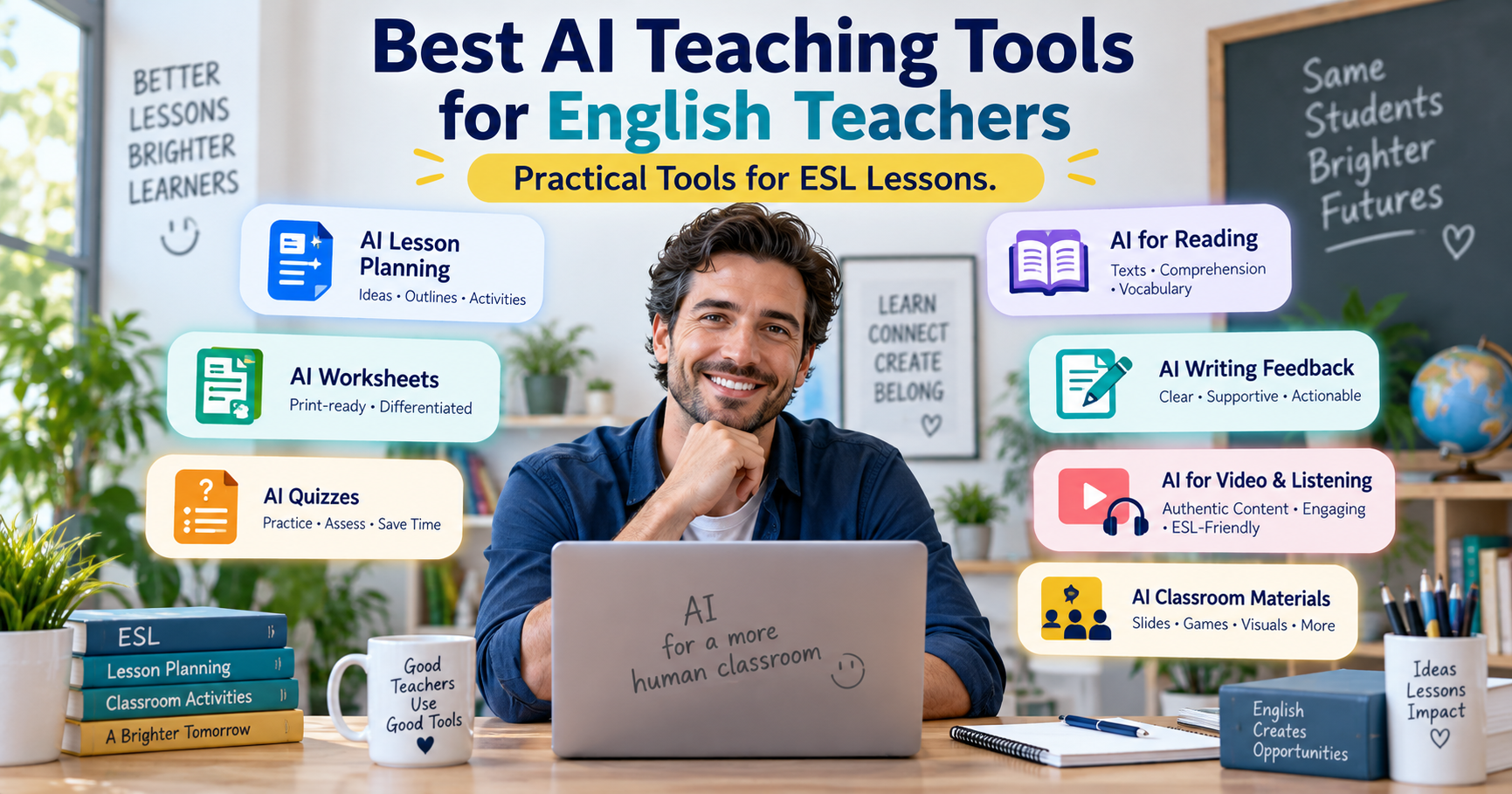

  • Best AI Teaching Tools for English Teachers: Practical Tools for ESL Lessons

    Best AI Teaching Tools for English Teachers: Practical Tools for ESL Lessons

    The best AI teaching tools for English teachers are not always the most popular tools. They are the tools that help teachers plan better lessons, create useful materials, save preparation time, and still keep teacher judgement at the centre of the classroom.

    For ESL/EFL teachers and language tutors, AI can help with many teaching tasks: lesson planning, worksheet creation, reading support, vocabulary practice, quizzes, rubrics, writing feedback, classroom slides, and homework. But not every AI tool is useful for English teaching. Some tools are too general. Some create nice-looking content but weak language tasks. Others are powerful, but only if the teacher gives clear instructions.

    This guide compares practical AI tools for English teachers and explains what each one is best for. It is not a generic list of trendy tools. It is a teacher-focused guide to choosing the right AI tool for the right classroom task.

    If you are mainly looking for worksheet tools, start with Best Customizable Worksheet Software with AI for English Teachers. If you want a full lesson-planning workflow, read Lesson Plan Generator: AI Prompts for Better ESL Lessons.

    Quick Answer: Best AI Teaching Tools by Teaching Need

    The best AI teaching tool depends on what you want to create.

    Teaching needRecommended tool
    General lesson planning and prompt workflowsChatGPT
    ESL/EFL-specific activitiesTwee
    All-in-one teacher AI platformMagicSchool
    Reading differentiation and adapted textsDiffit
    Turning existing resources into lessons and quizzesBrisk Teaching
    Printable worksheet and classroom material designCanva
    Digital quizzes and interactive assessmentWayground / Quizizz
    Broader teaching resources and classroom materialsEduaide
    Digital forms and exit ticketsGoogle Forms

    For most English teachers, the best workflow is not one tool. A stronger approach is to use different tools for different parts of teaching: one for planning, one for worksheet content, one for quizzes, one for design, and one for feedback.

    What Makes an AI Teaching Tool Useful for English Teachers?

    A good AI teaching tool should help English teachers create materials that are practical, level-appropriate, and easy to adapt.

    Before choosing a tool, ask:

    • Can it create ESL/EFL activities?
    • Can I control the learner level?
    • Can I edit the output easily?
    • Can it create answer keys?
    • Can it support grammar, vocabulary, reading, listening, speaking, or writing?
    • Can it create printable or digital materials?
    • Does it save time without weakening lesson quality?
    • Does it protect teacher judgement?
    • Does it fit my real classroom workflow?

    For example, if you teach B1 learners, you need more than a pretty worksheet. You need suitable vocabulary, clear instructions, fair questions, useful examples, and tasks that match the lesson aim.

    The Common European Framework of Reference can help teachers think about learner levels such as A2, B1, and B2, but the teacher still needs to adapt AI output to the real class.

    1. ChatGPT: Best for Flexible Lesson Planning and Prompt Workflows

    ChatGPT is one of the most flexible AI teaching tools because it can help with many parts of lesson preparation. English teachers can use it to brainstorm lesson aims, create activities, generate worksheets, simplify texts, draft quizzes, write feedback comments, create role plays, and adapt tasks for different levels.

    OpenAI also provides education-focused guidance and examples for teachers through OpenAI for Education and its help article on how educators can get started with ChatGPT.

    Best for

    ChatGPT is best for:

    • lesson planning;
    • prompt-based workflows;
    • worksheet drafts;
    • quiz ideas;
    • rubric drafts;
    • writing feedback support;
    • speaking activities;
    • differentiated task ideas;
    • teacher brainstorming.

    Example use for English teachers

    You can use ChatGPT to plan a B1 speaking lesson about online learning:

    Act as an experienced ESL teacher.
    
    Create a 60-minute B1 lesson plan about online learning.
    
    Main aim:
    Students will be able to discuss advantages and disadvantages of online learning using opinion phrases and linking words.
    
    Include:
    1. warm-up;
    2. vocabulary support;
    3. short reading or listening input;
    4. speaking task;
    5. feedback stage;
    6. exit ticket;
    7. homework.
    

    For a more detailed sequence, read ChatGPT Lesson Planning: A Prompt Sequence for Better ESL Lessons.

    Possible limitation

    ChatGPT is powerful, but it depends heavily on your prompt. If you give a vague instruction, you may get generic lesson ideas. Always add the student level, lesson aim, class context, timing, and target language.

    2. Twee: Best for ESL and EFL Activity Creation

    Twee is one of the most relevant AI tools for English teachers because it is designed around language teaching. Its tools cover areas such as reading, vocabulary, writing, speaking, grammar, listening, and utility tasks.

    That makes it especially useful for ESL/EFL teachers who want classroom activities rather than generic educational content.

    Best for

    Twee is best for:

    • ESL grammar exercises;
    • vocabulary activities;
    • reading questions;
    • discussion prompts;
    • listening and video tasks;
    • gap-fill activities;
    • sentence rewriting tasks;
    • speaking activities;
    • text adaptation.

    Example use for English teachers

    A teacher preparing a lesson about travel problems could use Twee to create vocabulary tasks, grammar practice, reading questions, and discussion prompts around the same theme.

    This makes Twee a strong companion to your AI Worksheet Generator for English Teachers workflow because teachers can generate task ideas and then customize them for their own learners.

    Possible limitation

    Twee is strong for ESL/EFL content creation, but teachers may still want to format final worksheets in a design tool such as Canva if they need polished printable handouts.

    3. MagicSchool: Best All-in-One AI Teaching Platform

    MagicSchool is a broad AI platform for teachers. It includes tools for lesson planning, worksheets, assessments, writing feedback, differentiation, and other classroom tasks.

    This makes it useful for teachers who want one workspace rather than switching between many separate tools.

    Best for

    MagicSchool is best for:

    • lesson plan drafts;
    • worksheet generation;
    • assessment ideas;
    • writing feedback;
    • differentiated materials;
    • teacher productivity;
    • classroom support tasks.

    Example use for English teachers

    An English teacher could use MagicSchool to create a lesson plan, generate a worksheet, prepare a short quiz, and draft writing feedback comments.

    For example, after creating a grammar lesson with Lesson Plan Generator, a teacher could use MagicSchool to create a first worksheet draft or checking activity.

    Possible limitation

    MagicSchool is not only for ESL/EFL teachers. Because it is a broad teacher platform, English teachers should still check whether the generated content fits the learner level, language focus, and classroom context.

    4. Diffit: Best for Reading Differentiation and Student-Ready Resources

    Diffit is especially useful when teachers need differentiated reading materials. It can help create or adapt classroom resources from topics, texts, links, videos, PDFs, or vocabulary lists.

    For English teachers, Diffit is useful when a reading text is too difficult and students need vocabulary support, comprehension questions, or adapted versions.

    Best for

    Diffit is best for:

    • reading passages;
    • differentiated texts;
    • vocabulary support;
    • comprehension questions;
    • student-ready resources;
    • adapting materials to different levels;
    • literacy-rich activities.

    Example use for English teachers

    Imagine you want to teach B1 students a reading lesson about healthy habits. Diffit can help you create or adapt a text, then generate supporting activities. After that, you can improve the task using the ideas in Reading Worksheet Generator: 7 AI Prompts for Better ESL Reading Lessons.

    Possible limitation

    Diffit is strongest when the lesson starts with reading, text adaptation, or differentiation. It may not be the first tool you choose for a speaking-only lesson or a full ESL lesson plan.

    5. Brisk Teaching: Best for Turning Existing Resources into Lessons and Activities

    Brisk Teaching is useful when teachers already have a resource and want to turn it into something teachable. It works well for teachers who use web pages, documents, videos, online texts, and classroom materials.

    Brisk can help teachers create lessons, quizzes, activities, feedback, reading-level changes, and instructional materials.

    Best for

    Brisk Teaching is best for:

    • turning existing resources into activities;
    • creating quizzes;
    • creating lessons;
    • giving feedback;
    • adapting reading levels;
    • working with online resources;
    • creating materials from documents or web content.

    Example use for English teachers

    An English teacher could start with a short article, video, or Google Doc, then use Brisk to create classroom questions or activities. If the source is a video, the teacher can also use the ideas in AI Video Question Maker: 9 Prompts for Better ESL Listening Lessons to create pre-watching, while-watching, and post-watching tasks.

    Possible limitation

    Brisk is very useful when you already have a source. If you are starting from only a lesson topic, another tool such as ChatGPT, Twee, or MagicSchool may feel easier as the first step.

    6. Canva: Best for Printable Worksheets and Visual Classroom Materials

    Canva is best when you already have content and want to turn it into a professional-looking worksheet, handout, poster, presentation, or classroom resource.

    Many AI tools can generate text, but the formatting may be plain. Canva helps teachers design the final version so students can use it more easily.

    Best for

    Canva is best for:

    • printable worksheets;
    • classroom posters;
    • handouts;
    • lesson visuals;
    • presentation materials;
    • quiz sheets;
    • vocabulary cards;
    • classroom templates.

    Example use for English teachers

    A teacher might generate quiz questions using ESL Quiz Templates: AI Prompts for Grammar, Vocabulary, Reading, and Listening, then paste the questions into Canva and create a cleaner printable worksheet.

    Canva is also useful when you want your resources to look consistent with your classroom or teaching brand.

    Possible limitation

    Canva is strongest for design and layout. For deeper ESL-specific content, it is often better to create the activity first with ChatGPT, Twee, MagicSchool, or another AI teaching tool, then use Canva for formatting.

    7. Wayground / Quizizz: Best for Digital Quizzes and Interactive Assessment

    Wayground, formerly Quizizz, is useful for interactive quizzes, digital assessments, practice activities, homework, and game-based review. It can help teachers create or adapt questions and run activities live or asynchronously.

    For English teachers, this is useful when the task is question-based: grammar review, vocabulary checks, reading comprehension, listening checks, or exit tickets.

    Best for

    Wayground / Quizizz is best for:

    • digital quizzes;
    • interactive assessment;
    • homework practice;
    • vocabulary review;
    • grammar checks;
    • live classroom games;
    • student-paced practice;
    • formative assessment.

    Example use for English teachers

    After creating questions with ESL Quiz Templates, a teacher could move selected questions into Wayground / Quizizz for live review or homework practice.

    This is especially useful when students need repeated practice and instant feedback.

    Possible limitation

    Wayground / Quizizz is not the best choice for long-form writing worksheets or detailed printable handouts. It is strongest when the learning activity is built around questions, answers, review, and practice.

    8. Eduaide: Best for Broad Teacher Resource Creation

    Eduaide is a broad AI teaching resource tool. It can help teachers create lesson plans, instructional materials, worksheets, discussion activities, rubrics, and other classroom resources.

    This makes it useful for teachers who want one tool for several resource types.

    Best for

    Eduaide is best for:

    • teaching resources;
    • worksheets;
    • lesson materials;
    • rubrics;
    • classroom activities;
    • planning support;
    • discussion tasks;
    • instructional materials.

    Example use for English teachers

    An English teacher could use Eduaide to generate classroom activities, worksheet ideas, discussion prompts, or a simple rubric. For assessment-related tasks, you can also connect this with Rubric Creator: 7 AI Prompts to Build Better English Marking Rubrics and AI Writing Feedback: 7 Ways English Teachers Can Give Better Student Feedback.

    Possible limitation

    Eduaide is broad, so ESL/EFL teachers should still adapt the output for learner level, language focus, classroom timing, and student needs.

    9. Google Forms: Best for Simple Digital Quizzes and Exit Tickets

    Google Forms is not an AI teaching tool in the same way as ChatGPT or Twee, but it is very useful when you want to turn AI-generated questions into a simple digital quiz, survey, exit ticket, or homework check.

    For English teachers, Google Forms is practical because it is easy to share and works well for quick classroom checks.

    Best for

    Google Forms is best for:

    • exit tickets;
    • short quizzes;
    • homework checks;
    • student surveys;
    • reading comprehension checks;
    • vocabulary review;
    • grammar practice;
    • self-assessment forms.

    Example use for English teachers

    You can create quiz questions with ChatGPT or use the templates in ESL Quiz Templates, then paste them into Google Forms. This is useful for quick checks after a lesson or for homework practice.

    Possible limitation

    Google Forms does not create a full ESL lesson for you. It is best used as a delivery tool for quizzes, surveys, and checking activities.

    Best AI Teaching Tools by Classroom Task

    Here is a practical way to choose your tool.

    Best for lesson planning

    Use ChatGPT, MagicSchool, or Eduaide when you need lesson aims, stages, timing, and activity ideas.

    For a complete workflow, use Lesson Plan Generator or ChatGPT Lesson Planning.

    Best for ESL worksheets

    Use Twee, MagicSchool, or Eduaide when you need grammar, vocabulary, reading, or classroom activity worksheets.

    For a broader worksheet process, read AI Worksheet Generator for English Teachers.

    Best for reading lessons

    Use Diffit when you need adapted readings, vocabulary support, and comprehension activities. Then use Reading Worksheet Generator to improve the reading task.

    Best for video and listening lessons

    Use ChatGPT, Twee, Brisk, or Wayground / Quizizz when you want to turn a video or transcript into questions. The workflow in AI Video Question Maker can help you create pre-watching questions, comprehension tasks, vocabulary activities, and discussion prompts.

    Best for quizzes

    Use Wayground / Quizizz, Google Forms, MagicSchool, or ChatGPT when you need grammar quizzes, vocabulary checks, exit tickets, or review tasks.

    Best for writing feedback

    Use ChatGPT, MagicSchool, Brisk, or Eduaide to draft comments, identify patterns, create feedback banks, or turn feedback into revision tasks. For a safer teacher-led workflow, read AI Writing Feedback.

    Best for printable design

    Use Canva when you want to turn AI-generated content into a clean, printable resource.

    A Practical AI Teaching Workflow for English Teachers

    A smart AI workflow usually looks like this:

    Step 1: Start with the lesson aim

    Do not begin with the tool. Begin with what students should be able to do.

    Example:

    By the end of the lesson, students will be able to describe travel problems and make simple complaints using past simple verbs.

    Step 2: Create the lesson plan

    Use ChatGPT, MagicSchool, or Eduaide to draft the lesson stages, timing, warm-up, input, practice, feedback, and homework.

    Step 3: Create the worksheet

    Use Twee, MagicSchool, ChatGPT, or Eduaide to generate grammar, vocabulary, reading, or speaking tasks.

    Step 4: Add a quiz or exit ticket

    Use ChatGPT, Wayground / Quizizz, Google Forms, or your ESL Quiz Templates workflow to check learning.

    Step 5: Design the final resource

    Use Canva to make the worksheet or handout clearer and more printable.

    Step 6: Review everything

    Check the level, instructions, examples, answer key, timing, and student suitability.

    AI can create drafts quickly, but teacher judgement turns those drafts into real learning materials.

    Common Mistakes When Choosing AI Teaching Tools

    Mistake 1: Looking for one perfect tool

    There is no single perfect AI teaching tool for every task. Use different tools for different teaching needs.

    Mistake 2: Choosing tools before defining the lesson aim

    The lesson aim should decide the tool, not the other way around.

    Mistake 3: Trusting AI output without review

    Always check accuracy, level, tone, answer keys, and classroom suitability.

    Mistake 4: Using generic prompts

    A generic prompt creates generic output. Add learner level, class context, topic, target language, lesson aim, and task type.

    Mistake 5: Ignoring privacy and school policy

    Be careful when using student work, names, grades, or personal information. Remove identifying details and follow your school’s rules.

    Mistake 6: Creating too many materials

    AI makes it easy to generate too much. A focused worksheet, quiz, or lesson is usually better than an overloaded one.

    Mistake 7: Forgetting the students

    A tool can save time, but the final material must still fit your learners, their level, their interests, and their needs.

    Simple Checklist Before Using an AI Teaching Tool

    Before using an AI tool in your English teaching workflow, ask:

    • What problem am I trying to solve?
    • Is this for planning, worksheets, quizzes, feedback, or design?
    • Does the tool fit ESL/EFL teaching?
    • Can I control the learner level?
    • Can I edit the output?
    • Can I check the answer key?
    • Is the content suitable for my class?
    • Am I protecting student privacy?
    • Does this save time without reducing quality?

    FAQ: Best AI Teaching Tools for English Teachers

    What are the best AI teaching tools for English teachers?

    The best AI teaching tools for English teachers include tools for lesson planning, worksheet creation, reading differentiation, quizzes, writing feedback, and printable design. Useful options include ChatGPT, Twee, MagicSchool, Diffit, Brisk Teaching, Canva, Wayground / Quizizz, Eduaide, and Google Forms.

    What is the best AI tool for ESL lesson planning?

    ChatGPT, MagicSchool, and Eduaide can all help with ESL lesson planning. The best choice depends on whether you want a flexible prompt workflow, an all-in-one teacher platform, or broader teaching resource generation.

    What is the best AI worksheet generator for English teachers?

    Twee is strong for ESL/EFL-specific activities, MagicSchool is useful for fast worksheet drafts, and Eduaide can help with broader classroom materials. Canva is useful when you want to design the final printable worksheet.

    Can AI tools create ESL quizzes?

    Yes. AI tools can help create grammar quizzes, vocabulary checks, reading comprehension questions, listening tasks, video questions, exit tickets, and answer keys. Teachers should always review the questions before using them.

    Can AI help with writing feedback?

    Yes. AI can help draft writing feedback, identify repeated errors, create feedback comment banks, and turn comments into revision tasks. Teachers should review the feedback before sharing it with students.

    Are AI teaching tools safe to use with student work?

    Teachers should be careful with student data. Avoid uploading names, emails, private details, grades, or sensitive information unless your school allows the tool and the use case. When possible, anonymise student writing before using AI feedback tools.

    Should AI replace lesson planning?

    No. AI should support lesson planning, not replace the teacher. The teacher still decides the lesson aim, checks the material, adapts the activities, and makes the final classroom decisions.

    Final Recommendation

    The best AI teaching tools are the ones that solve real teaching problems.

    For English teachers:

    • use ChatGPT for flexible planning and prompt workflows;
    • use Twee for ESL/EFL-specific activities;
    • use MagicSchool for an all-in-one teacher AI workspace;
    • use Diffit for reading differentiation;
    • use Brisk Teaching for turning existing resources into activities;
    • use Canva for printable worksheet and classroom material design;
    • use Wayground / Quizizz for digital quizzes and review;
    • use Eduaide for broader teacher resource creation;
    • use Google Forms for simple digital quizzes and exit tickets.

    The strongest approach is not to chase every new AI tool. Start with your lesson aim, choose the tool that fits the task, and then review everything before using it with students.

    AI can help English teachers plan faster, create better resources, and save preparation time. But the best classroom results still come from clear teaching goals, thoughtful adaptation, and human judgement.

  • ChatGPT Lesson Planning: A Prompt Sequence for Better ESL Lessons

    ChatGPT Lesson Planning: A Prompt Sequence for Better ESL Lessons

    ChatGPT lesson planning works best when teachers use a clear prompt sequence instead of asking one vague question such as “Create a lesson plan.” A single prompt can give you a basic lesson outline, but a sequence of prompts helps you build a better ESL lesson step by step.

    For English teachers, lesson planning is not only about filling time. You need a clear aim, suitable activities, student-friendly instructions, worksheets, quizzes, timing, differentiation, homework, and a way to check learning. ChatGPT can help with each of these parts, but the teacher should still make the final decisions.

    This article shows a practical ChatGPT lesson planning sequence for ESL/EFL teachers, private tutors, and online English teachers. You can use it to plan one lesson from start to finish, then adapt it for your students, level, materials, and teaching context.

    If you want a broader AI lesson planning guide first, read Lesson Plan Generator: AI Prompts for Better ESL Lessons. If you want to plan several connected lessons, see ESL Lesson Plans: How to Build a Full Week of Lessons with AI.

    Why ChatGPT Lesson Planning Needs a Sequence

    Many teachers try ChatGPT once, get a generic lesson plan, and then feel disappointed. The problem is usually not ChatGPT itself. The problem is the prompt.

    A weak prompt looks like this:

    Create a lesson plan about travel.
    

    This gives ChatGPT too little information. It does not know the students’ level, lesson length, class size, lesson aim, target language, materials, or teaching context.

    A stronger approach is to build the lesson in stages. First, define the lesson aim. Then describe the learners. Then create the lesson flow. After that, add worksheets, quizzes, differentiation, timing, and homework.

    OpenAI’s educator guidance also encourages teachers to adapt prompts for lesson planning, teaching aids, and student support, which fits this step-by-step approach. You can explore the official guide here: OpenAI: How can educators get started with ChatGPT?.

    What Makes a Good ChatGPT Prompt for ESL Lesson Planning?

    A good ChatGPT lesson planning prompt gives context. The more useful context you provide, the more useful the lesson plan becomes.

    Include:

    • student level;
    • age group;
    • class size;
    • lesson length;
    • online or face-to-face format;
    • lesson topic;
    • main lesson aim;
    • target grammar, vocabulary, or skill;
    • materials available;
    • student difficulties;
    • preferred lesson style.

    For level decisions, teachers can use the Common European Framework of Reference as a general guide for levels such as A2, B1, and B2.

    The Basic ChatGPT Lesson Planning Prompt

    Start with this prompt when you want a first draft.

    Act as an experienced ESL teacher.
    
    Create a lesson plan for [LEVEL] English learners.
    
    Lesson topic:
    [TOPIC]
    
    Lesson length:
    [TIME]
    
    Class context:
    [AGE GROUP, CLASS SIZE, ONLINE OR FACE-TO-FACE]
    
    Main lesson aim:
    [WHAT STUDENTS SHOULD BE ABLE TO DO BY THE END]
    
    Target language or skill:
    [GRAMMAR / VOCABULARY / READING / LISTENING / SPEAKING / WRITING]
    
    Materials available:
    [TEXT, VIDEO, WORKSHEET, COURSEBOOK PAGE, IMAGES, NONE]
    
    Create a practical lesson plan with:
    1. lesson aim;
    2. warm-up;
    3. input stage;
    4. controlled practice;
    5. freer practice;
    6. feedback stage;
    7. assessment or checking activity;
    8. homework;
    9. timing for each stage.
    
    Make it realistic, level-appropriate, and easy for a teacher to follow.
    

    This is useful, but it is still only the first step. The prompts below help you improve the lesson plan one stage at a time.

    Prompt 1: Define the Lesson Aim

    A clear lesson aim keeps the lesson focused. Without it, ChatGPT may produce activities that look interesting but do not lead to a clear learning outcome.

    Use this prompt:

    Help me create a clear ESL lesson aim.
    
    Student level:
    [LEVEL]
    
    Lesson topic:
    [TOPIC]
    
    Target language or skill:
    [GRAMMAR / VOCABULARY / READING / LISTENING / SPEAKING / WRITING]
    
    By the end of the lesson, students should be able to:
    [DESCRIBE THE DESIRED OUTCOME]
    
    Write:
    1. one main lesson aim;
    2. two supporting aims;
    3. one measurable outcome;
    4. one quick checking activity.
    

    Example

    Help me create a clear ESL lesson aim.
    
    Student level:
    B1
    
    Lesson topic:
    Online learning
    
    Target language:
    Opinion phrases and linking words
    
    By the end of the lesson, students should be able to discuss the advantages and disadvantages of online learning.
    

    A good output might be:

    By the end of the lesson, students will be able to express opinions about online learning using opinion phrases, linking words, and examples.

    That is stronger than “teach online learning vocabulary.”

    Prompt 2: Describe Your Students

    ChatGPT does not know your students unless you explain them. This step helps make the lesson more realistic.

    Use this prompt:

    Before creating the lesson plan, ask me useful questions about my students.
    
    I am planning an ESL lesson.
    
    Topic:
    [TOPIC]
    
    Student level:
    [LEVEL]
    
    Ask me 8 short questions about:
    1. student age;
    2. class size;
    3. lesson length;
    4. student interests;
    5. common difficulties;
    6. classroom format;
    7. available materials;
    8. final lesson goal.
    
    After I answer, use the information to create a better lesson plan.
    

    This is especially useful for private tutors, mixed-level classes, or online lessons. If you teach several groups, you can save these details in a planning document using Google Docs and reuse them later.

    Prompt 3: Create the Lesson Flow

    Once the aim and student context are clear, ask ChatGPT to build the lesson flow.

    Use this prompt:

    Create a clear ESL lesson flow based on this information.
    
    Student level:
    [LEVEL]
    
    Lesson topic:
    [TOPIC]
    
    Lesson aim:
    [LESSON AIM]
    
    Class context:
    [CLASS DETAILS]
    
    Lesson length:
    [TIME]
    
    Create a lesson flow with:
    1. warm-up;
    2. presentation or input;
    3. guided practice;
    4. freer practice;
    5. feedback;
    6. quick assessment;
    7. homework.
    
    For each stage, include:
    - timing;
    - teacher role;
    - student role;
    - instructions;
    - reason for the stage.
    

    Teacher tip

    Check the timing carefully. ChatGPT often includes too many activities. Remove anything that does not support the lesson aim.

    For more lesson flow ideas, you can explore teacher development resources from British Council TeachingEnglish, then adapt the ideas to your own class.

    Prompt 4: Generate Better Warm-Up Activities

    A warm-up should connect to the lesson aim. It should not be a random game.

    Use this prompt:

    Create 5 possible warm-up activities for this ESL lesson.
    
    Student level:
    [LEVEL]
    
    Lesson topic:
    [TOPIC]
    
    Lesson aim:
    [LESSON AIM]
    
    Class type:
    [ONLINE / FACE-TO-FACE]
    
    Each warm-up should:
    1. take 5 minutes or less;
    2. activate prior knowledge;
    3. prepare students for the main lesson;
    4. include clear teacher instructions.
    
    After listing them, recommend the best one and explain why.
    

    Example

    For a B1 lesson about online learning, ChatGPT might suggest a quick pair discussion:

    Students discuss: “What is one thing you like and one thing you dislike about online classes?”

    This prepares students for opinion language and later discussion.

    Prompt 5: Create the Main Activity

    The main activity should help students use the target language or skill meaningfully.

    Use this prompt:

    Create the main activity for this ESL lesson.
    
    Student level:
    [LEVEL]
    
    Lesson aim:
    [LESSON AIM]
    
    Target language or skill:
    [TARGET LANGUAGE OR SKILL]
    
    Class context:
    [CLASS DETAILS]
    
    Create:
    1. one controlled practice activity;
    2. one freer practice activity;
    3. student instructions;
    4. teacher instructions;
    5. examples;
    6. common mistakes to watch for.
    
    Make the activities communicative and realistic.
    

    If the lesson needs a reading text, you can combine this with the Reading Worksheet Generator workflow to create comprehension questions and vocabulary tasks. If the lesson uses a video, the AI Video Question Maker guide can help you create listening questions, discussion prompts, and answer keys.

    Prompt 6: Create a Worksheet from the Lesson Plan

    After you have a lesson flow, you can ask ChatGPT to create a worksheet that supports the lesson aim.

    Use this prompt:

    Create a printable ESL worksheet for this lesson plan.
    
    Lesson plan:
    [PASTE LESSON PLAN]
    
    Student level:
    [LEVEL]
    
    The worksheet should include:
    1. title;
    2. short student instructions;
    3. vocabulary or language focus section;
    4. controlled practice task;
    5. freer practice task;
    6. reflection or exit ticket;
    7. answer key.
    
    Make the worksheet clear, printable, and connected to the lesson aim.
    

    For a complete worksheet workflow, link this step to AI Worksheet Generator for English Teachers. After ChatGPT creates the worksheet content, you can design a cleaner printable version in Canva.

    Prompt 7: Add a Quiz or Exit Ticket

    A short quiz or exit ticket helps you check whether students understood the lesson.

    Use this prompt:

    Create a 5-minute quiz or exit ticket for this ESL lesson.
    
    Lesson plan:
    [PASTE LESSON PLAN]
    
    Student level:
    [LEVEL]
    
    Lesson aim:
    [LESSON AIM]
    
    Create:
    1. 3 quick checking questions;
    2. 2 language-use questions;
    3. 1 student self-assessment question;
    4. an answer key.
    
    Make it easy to complete at the end of class.
    

    For more quiz formats, use the templates in ESL Quiz Templates. You can also turn short quizzes into digital forms using Google Forms.

    Prompt 8: Differentiate the Lesson for Mixed Levels

    Many English teachers teach mixed-level classes. Some students need extra support, while others need extra challenge.

    Use this prompt:

    Differentiate this ESL lesson plan for mixed-level learners.
    
    Lesson plan:
    [PASTE LESSON PLAN]
    
    Main student level:
    [LEVEL]
    
    Class situation:
    [DESCRIBE DIFFERENCES BETWEEN STUDENTS]
    
    Create:
    1. easier support for weaker students;
    2. extension tasks for stronger students;
    3. alternative instructions;
    4. grouping suggestions;
    5. homework options at two difficulty levels.
    
    Keep the main lesson aim the same.
    

    Teacher tip

    Differentiation does not always mean creating a completely different lesson. It can mean giving sentence starters, reducing the number of questions, adding a word bank, or giving stronger students a challenge task.

    Prompt 9: Review the Timing and Realism

    ChatGPT lesson plans often look good on paper but include too much for one class. This prompt helps you make the plan realistic.

    Review this ESL lesson plan for timing and realism.
    
    Lesson length:
    [TIME]
    
    Lesson plan:
    [PASTE LESSON PLAN]
    
    Tell me:
    1. which stages are too long;
    2. which stages are unnecessary;
    3. which instructions are unclear;
    4. where students may need more support;
    5. how to improve the lesson flow.
    
    Then give me a revised timing plan.
    

    This is one of the most important prompts in the sequence. It helps move the plan from “AI-generated” to “actually teachable.”

    Prompt 10: Improve Teacher Instructions

    A good lesson plan should tell the teacher what to do, not only list activities.

    Use this prompt:

    Improve the teacher instructions in this ESL lesson plan.
    
    Lesson plan:
    [PASTE LESSON PLAN]
    
    For each stage, add:
    1. what the teacher says;
    2. what students do;
    3. how long it takes;
    4. how to check understanding;
    5. what to do if students struggle.
    
    Keep the instructions practical and concise.
    

    This is useful when you want a lesson plan that is easy to follow during class.

    Prompt 11: Add Homework or Follow-Up Practice

    Homework should connect to the lesson. It should not feel like an unrelated extra task.

    Use this prompt:

    Create homework or follow-up practice for this ESL lesson.
    
    Lesson topic:
    [TOPIC]
    
    Student level:
    [LEVEL]
    
    Lesson aim:
    [LESSON AIM]
    
    What students practised in class:
    [PASTE SUMMARY]
    
    Create:
    1. one short homework task;
    2. one optional challenge task;
    3. one review question;
    4. one self-reflection question.
    
    Make the homework useful and easy to complete.
    

    For writing-focused lessons, you can also connect homework to feedback. The AI Writing Feedback guide can help teachers turn student writing into clearer comments, revision tasks, and next steps.

    Prompt 12: Create the Final Lesson Plan

    After using the prompts above, ask ChatGPT to combine everything into one clean lesson plan.

    Combine everything into one final ESL lesson plan.
    
    Include:
    1. lesson title;
    2. student level;
    3. lesson length;
    4. main aim;
    5. materials;
    6. target language or skill;
    7. lesson stages with timing;
    8. teacher instructions;
    9. student instructions;
    10. worksheet or handout notes;
    11. quiz or exit ticket;
    12. differentiation;
    13. homework.
    
    Make the final plan clear, realistic, and ready for teacher review.
    

    This final prompt gives you a complete draft, but you should still review the lesson before teaching it.

    Example: ChatGPT Lesson Planning Sequence for a B1 ESL Lesson

    Imagine you want to teach a 60-minute B1 lesson about giving advice for healthy habits.

    You could start with this prompt:

    Act as an experienced ESL teacher.
    
    Create a 60-minute lesson plan for B1 learners.
    
    Topic:
    Healthy habits
    
    Main aim:
    Students will be able to give advice about healthy habits using should and shouldn’t.
    
    Class context:
    Face-to-face class, 20 university students
    
    Create a clear lesson flow with warm-up, input, controlled practice, freer speaking practice, feedback, exit ticket, and homework.
    

    Then you could follow up with:

    Create a printable worksheet for this lesson with a vocabulary section, controlled practice using should and shouldn’t, a speaking task, and an answer key.
    

    Then:

    Create a 5-minute exit ticket to check whether students can give advice using should and shouldn’t.
    

    Then:

    Review the full lesson plan for timing and remove anything unrealistic for a 60-minute class.
    

    This sequence creates a better lesson than one single prompt because each step improves one part of the plan.

    Common Mistakes in ChatGPT Lesson Planning

    Mistake 1: Asking one vague question

    “Create a lesson plan” is not enough. Add level, aim, context, timing, target language, and student needs.

    Mistake 2: Accepting the first output

    ChatGPT gives a first draft. The teacher improves it. Always review the timing, level, instructions, and classroom practicality.

    Mistake 3: Planning activities before the aim

    Start with the learning aim. Then choose activities that support it.

    Mistake 4: Including too much in one lesson

    AI often suggests more activities than one class can handle. Remove unnecessary stages.

    Mistake 5: Forgetting assessment

    Every lesson needs a way to check learning. Use a short quiz, exit ticket, speaking task, written response, or quick self-assessment.

    Mistake 6: Ignoring student level

    A2, B1, and B2 lessons need different instructions, texts, questions, and expectations.

    Mistake 7: Letting AI replace teacher judgement

    ChatGPT can help you plan faster, but you know your learners, classroom, curriculum, and teaching goals better than the tool does.

    Simple ChatGPT Lesson Planning Checklist

    Before using your AI-generated lesson, check:

    • Is the lesson aim clear?
    • Is the lesson suitable for the student level?
    • Does each stage support the aim?
    • Are the instructions simple?
    • Is the timing realistic?
    • Is there enough student interaction?
    • Is there a checking activity?
    • Are worksheets and quizzes connected to the lesson?
    • Is the homework useful?
    • Have I adapted the plan for my real students?

    FAQ: ChatGPT Lesson Planning for English Teachers

    What is ChatGPT lesson planning?

    ChatGPT lesson planning means using ChatGPT to help create lesson aims, lesson stages, activities, worksheets, quizzes, differentiation, timing, and homework.

    Can ChatGPT create ESL lesson plans?

    Yes. ChatGPT can create ESL lesson plan drafts when teachers provide the learner level, lesson topic, aim, class context, lesson length, and target language or skill.

    What is the best ChatGPT prompt for lesson planning?

    The best prompt includes the student level, lesson topic, lesson length, class context, main aim, target language or skill, materials, and the type of lesson plan you want.

    Should teachers use ChatGPT lesson plans without editing?

    No. Teachers should review and adapt ChatGPT lesson plans before using them. Check the level, timing, activities, instructions, and assessment.

    Can ChatGPT create worksheets and quizzes?

    Yes. ChatGPT can help create worksheet drafts, quizzes, exit tickets, answer keys, homework tasks, and differentiated activities.

    How can I make ChatGPT lesson plans more realistic?

    Ask ChatGPT to review the plan for timing, remove unnecessary activities, simplify instructions, and revise the lesson for your exact class length and student level.

    Is ChatGPT useful for private English tutors?

    Yes. Private tutors can use ChatGPT to create personalised lesson plans, speaking tasks, review quizzes, homework, and student-specific practice.

    Conclusion

    ChatGPT lesson planning is most useful when teachers use a clear prompt sequence. Instead of asking for one complete lesson plan immediately, start with the lesson aim, describe the students, create the lesson flow, build activities, add worksheets, include a quiz or exit ticket, differentiate the lesson, and review the timing.

    This step-by-step process gives you a stronger, more realistic ESL lesson plan. ChatGPT helps you move faster, but teacher judgement makes the plan suitable, fair, and useful for real learners.

    Used well, ChatGPT does not replace lesson planning. It helps English teachers plan smarter, create better classroom materials, and spend more time focusing on students.

  • ESL Lesson Plans: How to Build a Full Week of Lessons with AI

    ESL Lesson Plans: How to Build a Full Week of Lessons with AI

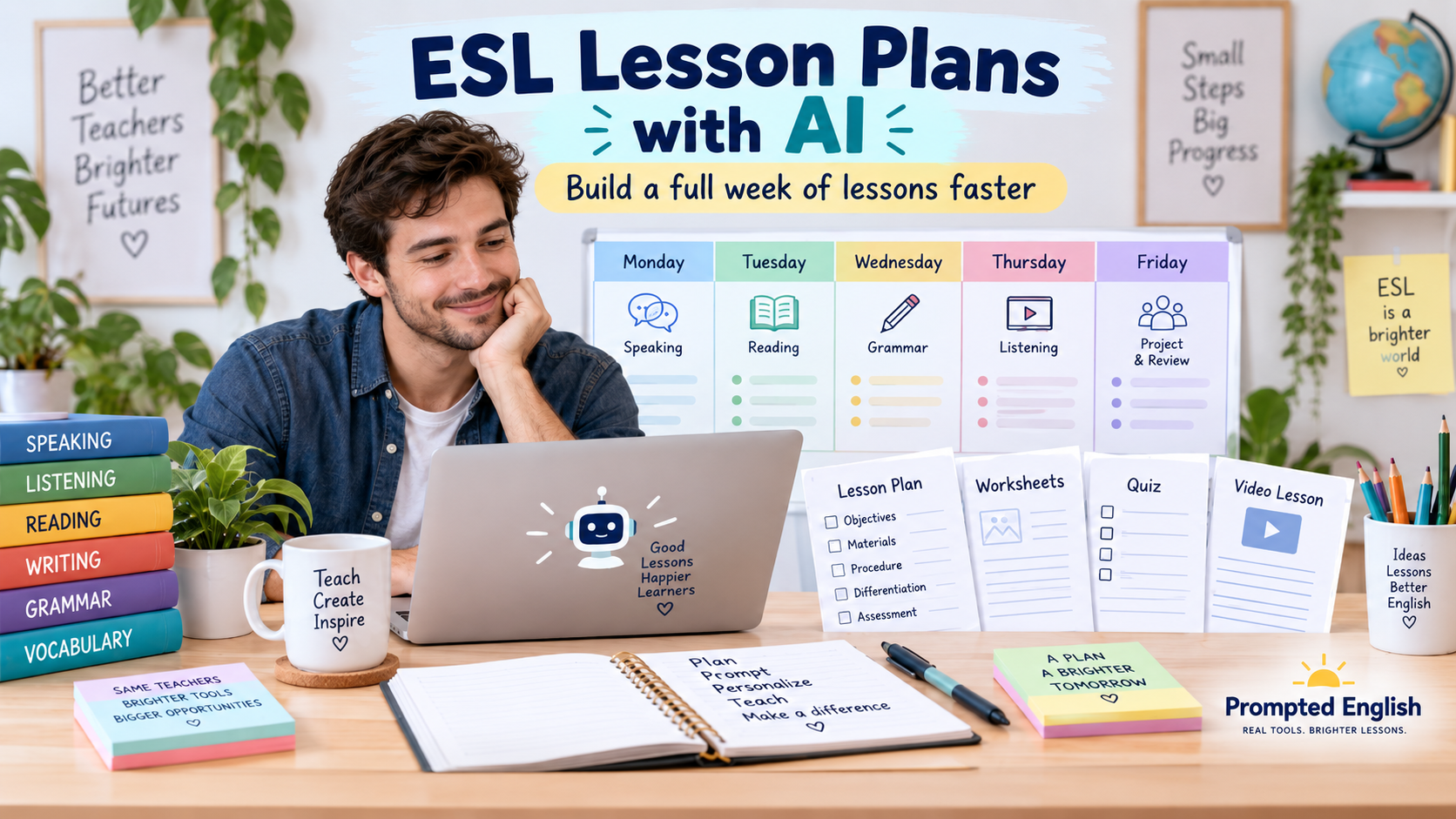
    Creating ESL lesson plans for one class can take time. Creating a full week of connected lessons can take even longer. English teachers need to think about lesson aims, grammar, vocabulary, reading, listening, speaking, writing, worksheets, quizzes, homework, review, and student progress.

    This is where AI can help.

    Instead of planning five separate lessons from zero, teachers can use AI to create a connected weekly plan. The goal is not to let AI decide everything. The goal is to use AI as a planning assistant that helps you organise your ideas, create first drafts, and connect each lesson to the next one.

    A strong weekly plan should not feel like five random activities. It should have a clear theme, repeated language practice, skill development, review opportunities, and simple assessment points. AI can help you build that structure faster.

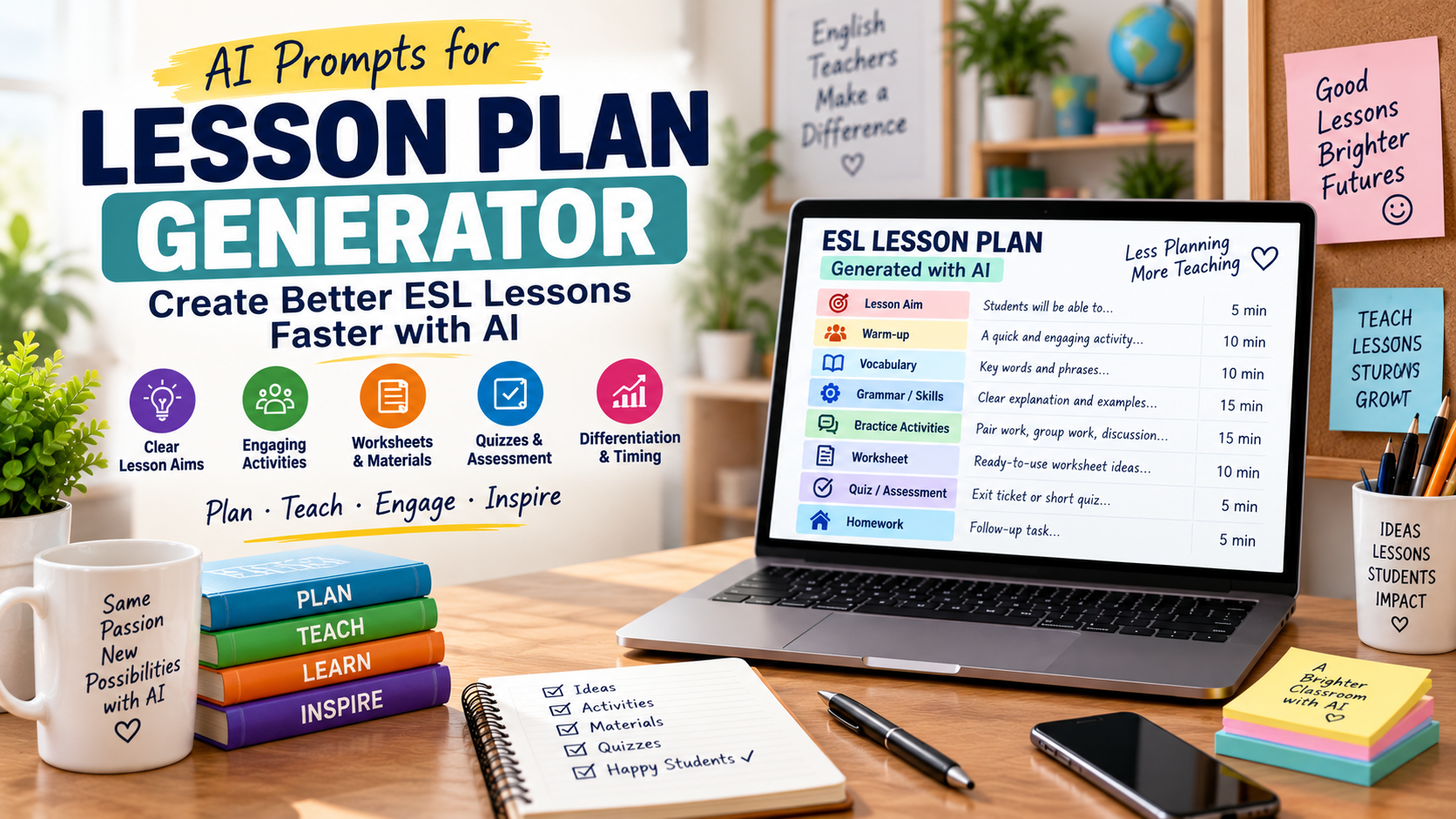
    If you are still learning how to use AI for individual lessons, start with Lesson Plan Generator: AI Prompts for Better ESL Lessons. This article goes one step further and shows how to plan a full week of ESL lessons with AI.

    What Makes Good ESL Lesson Plans for a Full Week?

    Good ESL lesson plans should help students build language step by step. A weekly plan should not simply repeat the same activity every day. It should move learners from input to practice, from controlled activities to freer communication, and from teacher support to student independence.

    A useful weekly ESL plan usually includes:

    • a weekly theme;
    • a clear language focus;
    • vocabulary input;
    • grammar or functional language;
    • reading or listening practice;
    • speaking or writing production;
    • review and recycling;
    • a short quiz or exit ticket;
    • homework or independent practice;
    • differentiation for mixed levels.

    For example, a week about travel problems could include vocabulary on Monday, grammar practice on Tuesday, a reading text on Wednesday, a video or listening task on Thursday, and a speaking or writing task on Friday.

    The lessons are separate, but they connect.

    When choosing the level, you can use the Common European Framework of Reference as a general guide for A2, B1, B2, and other learner levels.

    Why Use AI to Create Weekly ESL Lesson Plans?

    AI can make weekly planning faster because it helps you see the structure of the week before you prepare each lesson in detail.

    AI can help you:

    • choose a weekly theme;
    • create lesson aims;
    • sequence lessons logically;
    • generate vocabulary and grammar stages;
    • create reading and listening tasks;
    • prepare speaking activities;
    • design worksheets;
    • build quizzes and exit tickets;
    • adapt lessons for mixed levels;
    • create homework tasks;
    • review the weekly flow.

    For example, you can use AI to create the weekly structure, then use AI Worksheet Generator for English Teachers to create printable activities and ESL Quiz Templates to create review quizzes or exit tickets.

    You can also draft the weekly plan in Google Docs so you can edit it, duplicate it for future weeks, and share it with colleagues.

    Basic Prompt: Create a Full Week of ESL Lesson Plans

    Use this prompt when you want AI to create the first draft of a weekly plan.

    Act as an experienced ESL teacher.
    
    Create a full week of ESL lesson plans for [LEVEL] English learners.
    
    Weekly theme:
    [THEME]
    
    Class context:
    [AGE GROUP, NUMBER OF STUDENTS, ONLINE OR FACE-TO-FACE, LESSON LENGTH]
    
    Main weekly goal:
    [WHAT STUDENTS SHOULD BE ABLE TO DO BY THE END OF THE WEEK]
    
    Target language:
    [GRAMMAR, VOCABULARY, FUNCTIONS, OR SKILLS]
    
    Create a Monday-to-Friday plan.
    
    For each day, include:
    1. lesson aim;
    2. warm-up;
    3. main activity;
    4. language focus;
    5. worksheet or task idea;
    6. speaking or writing practice;
    7. assessment/checking activity;
    8. homework;
    9. timing.
    
    Make the week connected, realistic, and suitable for [LEVEL] learners.
    

    This gives you a full structure before you create each lesson in detail. After AI generates the weekly plan, check whether the lessons are realistic, connected, and not overloaded.

    Step 1: Choose a Weekly Theme

    The weekly theme gives the lessons a sense of direction. A theme can be practical, academic, personal, or exam-related.

    Good ESL weekly themes include:

    • travel problems;
    • healthy habits;
    • online learning;
    • job interviews;
    • daily routines;
    • environmental problems;
    • food and culture;
    • technology in everyday life;
    • university life;
    • making complaints;
    • giving advice.

    Use this prompt to choose a strong weekly theme:

    Suggest 10 weekly ESL lesson themes for [LEVEL] learners.
    
    Class context:
    [DESCRIBE STUDENTS]
    
    The themes should:
    1. be useful for real communication;
    2. support vocabulary, grammar, reading, listening, speaking, and writing;
    3. be interesting for learners;
    4. allow a clear Monday-to-Friday lesson sequence.
    
    For each theme, suggest one final speaking or writing task.
    

    Example

    For B1 university students, AI might suggest:

    • online learning;
    • part-time jobs;
    • study habits;
    • technology and communication;
    • future careers.

    A theme like online learning works well because students can read about it, discuss advantages and disadvantages, learn opinion phrases, practise linking words, and write a short opinion paragraph.

    Step 2: Create a Weekly Learning Goal

    Before planning each day, decide what students should be able to do by the end of the week.

    A weak weekly goal is:

    Students will study travel vocabulary.

    A stronger weekly goal is:

    By the end of the week, students will be able to describe common travel problems, give advice, and write a short complaint message.

    Use this prompt:

    Help me write a clear weekly learning goal for an ESL class.
    
    Student level:
    [LEVEL]
    
    Weekly theme:
    [THEME]
    
    Target language:
    [GRAMMAR / VOCABULARY / FUNCTIONS]
    
    Final task:
    [SPEAKING OR WRITING TASK]
    
    Write:
    1. one main weekly goal;
    2. three supporting lesson goals;
    3. one final assessment task;
    4. one simple success checklist for students.
    

    A clear weekly goal helps you avoid random activities. It also makes it easier to choose worksheets, quizzes, and homework tasks.

    Step 3: Plan Monday — Vocabulary and Topic Introduction

    Monday should introduce the theme and give students useful language for the rest of the week. This lesson should not be too heavy. It should build interest and prepare learners for future tasks.

    Use this prompt:

    Create a Monday ESL lesson plan to introduce the weekly theme.
    
    Student level:
    [LEVEL]
    
    Weekly theme:
    [THEME]
    
    Lesson length:
    [TIME]
    
    Target vocabulary:
    [WORD LIST OR TOPIC VOCABULARY]
    
    Create:
    1. a warm-up activity;
    2. a vocabulary presentation stage;
    3. a meaning-checking activity;
    4. a pronunciation or word stress focus;
    5. a short controlled practice task;
    6. a pair-work speaking activity;
    7. a quick exit ticket;
    8. homework.
    
    Make the lesson practical and connected to the rest of the week.
    

    Example Monday lesson

    For a B1 week about travel problems, Monday could include:

    • warm-up: students discuss their last trip;
    • vocabulary: delayed flight, lost luggage, refund, booking, complaint;
    • practice: match words to definitions;
    • speaking: describe a travel problem;
    • exit ticket: write three new words and one sentence.

    You can turn the vocabulary stage into a printable task using AI Worksheet Generator for English Teachers.

    Step 4: Plan Tuesday — Grammar or Functional Language

    Tuesday can focus on grammar or useful phrases connected to the weekly theme. The grammar should support communication, not exist separately from the topic.

    For example:

    • travel problems → past simple and complaint phrases;
    • healthy habits → should/shouldn’t and advice;
    • online learning → opinion phrases and linking words;
    • job interviews → present perfect and experience phrases.

    Use this prompt:

    Create a Tuesday ESL lesson plan focused on grammar or functional language.
    
    Student level:
    [LEVEL]
    
    Weekly theme:
    [THEME]
    
    Lesson length:
    [TIME]
    
    Target language:
    [GRAMMAR POINT OR FUNCTIONAL PHRASES]
    
    Students already learned:
    [WHAT THEY DID ON MONDAY]
    
    Create:
    1. a short review of Monday’s vocabulary;
    2. a context for the target language;
    3. a simple meaning and form explanation;
    4. controlled practice;
    5. freer practice connected to the weekly theme;
    6. common mistakes to watch for;
    7. a short checking activity;
    8. homework.
    
    Make the lesson communicative and realistic.
    

    Teacher tip

    Do not overload the grammar lesson. One useful grammar point taught clearly is better than three grammar points taught quickly.

    Step 5: Plan Wednesday — Reading Lesson

    Wednesday can give students input through a reading text. The reading should recycle Monday’s vocabulary and Tuesday’s language focus.

    Use this prompt:

    Create a Wednesday ESL reading lesson plan.
    
    Student level:
    [LEVEL]
    
    Weekly theme:
    [THEME]
    
    Lesson length:
    [TIME]
    
    Target vocabulary from earlier lessons:
    [PASTE WORDS]
    
    Target grammar or language from Tuesday:
    [PASTE LANGUAGE FOCUS]
    
    Reading text topic:
    [TOPIC]
    
    Create:
    1. pre-reading discussion questions;
    2. vocabulary review;
    3. gist reading task;
    4. detailed reading task;
    5. vocabulary-in-context task;
    6. post-reading speaking or writing task;
    7. answer key;
    8. homework.
    
    Make the lesson connected to Monday and Tuesday.
    

    If you already have a text, paste it into the prompt. If you need a reading worksheet, use the workflow in Reading Worksheet Generator to create comprehension questions, vocabulary tasks, and answer keys.

    For extra lesson ideas and teacher development resources, British Council TeachingEnglish can also help you think about lesson structure and classroom activities.

    Step 6: Plan Thursday — Listening or Video Lesson

    Thursday can focus on listening or video. This gives students another form of input and prepares them for a final speaking or writing task.

    Use this prompt:

    Create a Thursday ESL listening or video lesson plan.
    
    Student level:
    [LEVEL]
    
    Weekly theme:
    [THEME]
    
    Lesson length:
    [TIME]
    
    Audio/video topic:
    [TOPIC]
    
    Transcript or summary:
    [PASTE TRANSCRIPT OR SUMMARY]
    
    Language to recycle:
    [PASTE VOCABULARY OR GRAMMAR FROM MONDAY-WEDNESDAY]
    
    Create:
    1. pre-listening or pre-watching discussion questions;
    2. key vocabulary review;
    3. first listening/watching gist task;
    4. second listening/watching detail task;
    5. vocabulary-in-context task;
    6. post-listening discussion;
    7. short writing follow-up;
    8. answer key;
    9. homework.
    
    Make the lesson suitable for [LEVEL] learners.
    

    For video lessons, you can use the prompts in AI Video Question Maker to create comprehension questions, discussion prompts, and answer keys from a transcript or video summary.

    Step 7: Plan Friday — Speaking, Writing, and Review

    Friday should bring the week together. Students should use the vocabulary, grammar, and ideas they practised during the week.

    Friday can include:

    • a review quiz;
    • a speaking task;
    • a writing task;
    • a project;
    • a presentation;
    • peer feedback;
    • self-assessment.

    Use this prompt:

    Create a Friday ESL lesson plan that reviews the week and includes a final speaking or writing task.
    
    Student level:
    [LEVEL]
    
    Weekly theme:
    [THEME]
    
    Vocabulary studied:
    [PASTE VOCABULARY]
    
    Grammar or language studied:
    [PASTE LANGUAGE FOCUS]
    
    Reading/listening topics:
    [PASTE TOPICS]
    
    Final task:
    [SPEAKING / WRITING / PRESENTATION / ROLE PLAY]
    
    Create:
    1. warm-up review activity;
    2. short quiz or exit ticket;
    3. preparation stage for the final task;
    4. final speaking or writing activity;
    5. peer or teacher feedback stage;
    6. student self-assessment;
    7. homework or reflection.
    
    Make the lesson feel like a natural conclusion to the week.
    

    For the review stage, you can adapt one of the templates from ESL Quiz Templates to create a short grammar, vocabulary, reading, or listening quiz.

    Example: Full Week of ESL Lesson Plans with AI

    Here is an example of how a full week could look.

    Level: B1
    Theme: Online learning
    Weekly goal: By the end of the week, students will be able to discuss the advantages and disadvantages of online learning and write a short opinion paragraph.
    Target language: opinion phrases, linking words, advantages and disadvantages vocabulary.

    Monday: Introduce the Topic and Vocabulary

    Lesson aim: Students can understand and use key vocabulary about online learning.

    Activities:

    • warm-up discussion: “Do you prefer online or face-to-face classes?”
    • vocabulary: flexible, convenient, distracting, independent, interaction, motivation;
    • matching activity;
    • sentence completion;
    • pair discussion;
    • exit ticket: students write two advantages and one disadvantage.

    Tuesday: Opinion Phrases and Linking Words

    Lesson aim: Students can express simple opinions using useful phrases and linking words.

    Target language:

    • I think that…
    • In my opinion…
    • One advantage is…
    • One disadvantage is…
    • however;
    • because;
    • for example.

    Activities:

    • review Monday vocabulary;
    • analyse model opinion sentences;
    • gap-fill practice;
    • sentence transformation;
    • pair discussion;
    • homework: write five opinion sentences.

    Wednesday: Reading About Online Learning

    Lesson aim: Students can read a short text about online learning and identify main ideas and supporting details.

    Activities:

    • pre-reading prediction;
    • vocabulary review;
    • gist question;
    • detail questions;
    • vocabulary-in-context task;
    • short response: “Which point do you agree with most?”

    A teacher could prepare this lesson faster by using the reading workflow in Reading Worksheet Generator.

    Thursday: Listening or Video Lesson

    Lesson aim: Students can understand opinions about online learning in a short video or audio clip.

    Activities:

    • pre-listening discussion;
    • key vocabulary;
    • first listening for main idea;
    • second listening for details;
    • note-taking task;
    • pair discussion;
    • short written reflection.

    If the teacher uses a video, the prompts in AI Video Question Maker can help create gist questions, detailed comprehension questions, vocabulary tasks, and discussion prompts.

    Friday: Final Speaking and Writing Task

    Lesson aim: Students can discuss online learning and write a short opinion paragraph.

    Activities:

    • quick review quiz;
    • planning ideas in pairs;
    • group discussion;
    • write a short opinion paragraph;
    • peer feedback;
    • self-assessment checklist;
    • homework: revise the paragraph.

    If the final task needs simple assessment criteria, the teacher can create a short rubric using Rubric Creator.

    AI Prompt: Create This Full Week Automatically

    You can ask AI to create the full week using this prompt:

    Act as an experienced ESL teacher.
    
    Create a full week of ESL lesson plans for B1 learners.
    
    Weekly theme:
    Online learning
    
    Main weekly goal:
    By the end of the week, students will be able to discuss the advantages and disadvantages of online learning and write a short opinion paragraph.
    
    Target language:
    opinion phrases, linking words, advantages and disadvantages vocabulary
    
    Class context:
    Face-to-face class, 24 university students, 60 minutes per lesson
    
    Create a Monday-to-Friday plan:
    - Monday: vocabulary and topic introduction
    - Tuesday: opinion phrases and linking words
    - Wednesday: reading lesson
    - Thursday: listening or video lesson
    - Friday: review, speaking, and writing task
    
    For each day, include:
    1. lesson aim;
    2. warm-up;
    3. main activities;
    4. worksheet idea;
    5. quiz or checking activity;
    6. homework;
    7. timing.
    
    Make the week connected and realistic.
    

    This gives you a strong first draft. Then you can edit each day and add the materials you need.

    How to Add Worksheets to the Weekly Plan

    Worksheets should support the lesson aim. They should not feel like extra pages added just to fill time.

    Use this prompt:

    Create worksheet ideas for this full week of ESL lesson plans.
    
    Weekly plan:
    [PASTE WEEKLY PLAN]
    
    Student level:
    [LEVEL]
    
    For each day, suggest:
    1. one printable worksheet idea;
    2. one digital activity idea;
    3. one homework task;
    4. one answer key requirement.
    
    Make sure each worksheet supports that day’s lesson aim.
    

    You can design the final worksheets in Canva if you want printable resources with clear sections, headings, icons, and answer spaces.

    How to Add Quizzes and Exit Tickets

    A weekly plan should include quick checks. These do not need to be stressful tests. They can be short, low-stakes activities that help you see what students understood.

    Use this prompt:

    Create short quizzes and exit tickets for this weekly ESL lesson plan.
    
    Weekly plan:
    [PASTE WEEKLY PLAN]
    
    Student level:
    [LEVEL]
    
    Create:
    1. a 5-question vocabulary quiz for Monday;
    2. a 5-question grammar or language quiz for Tuesday;
    3. a reading exit ticket for Wednesday;
    4. a listening/video exit ticket for Thursday;
    5. a final review quiz for Friday.
    
    Add answer keys where needed.
    Keep the quizzes short and useful.
    

    These quizzes can be turned into printable worksheets or digital forms depending on how you teach.

    How to Differentiate a Full Week of ESL Lessons

    Many ESL classes include mixed levels. Some students need more support, while others need extra challenge. AI can help you create different versions of tasks without changing the whole weekly plan.

    Use this prompt:

    Differentiate this full week of ESL lesson plans for mixed-level learners.
    
    Weekly plan:
    [PASTE WEEKLY PLAN]
    
    Main level:
    [LEVEL]
    
    Class situation:
    [DESCRIBE STUDENT DIFFERENCES]
    
    For each day, suggest:
    1. easier support for weaker students;
    2. extension tasks for stronger students;
    3. grouping suggestions;
    4. homework options at two difficulty levels.
    
    Keep the weekly goal the same.
    

    Differentiation does not always mean creating a new lesson. Sometimes it means giving sentence starters, reducing the number of questions, offering a word bank, or adding a challenge task.

    How to Review the Weekly Plan Before Teaching

    AI may create a plan that looks good but is unrealistic. Before using it, review the plan carefully.

    Use this prompt:

    Review this weekly ESL lesson plan for quality and practicality.
    
    Weekly plan:
    [PASTE WEEKLY PLAN]
    
    Student level:
    [LEVEL]
    
    Class context:
    [DESCRIBE CONTEXT]
    
    Check:
    1. whether the weekly goal is clear;
    2. whether each day connects to the next;
    3. whether the timing is realistic;
    4. whether the activities match the student level;
    5. whether there is enough review;
    6. whether the final task matches the week;
    7. what should be removed or simplified.
    
    Give me a revised version of the plan.
    

    This review step is important. AI can generate many ideas, but a teacher decides what is realistic.

    Common Mistakes When Creating ESL Lesson Plans with AI

    Mistake 1: Planning five disconnected lessons

    A weekly plan should feel connected. Students should reuse vocabulary, grammar, and ideas throughout the week.

    Mistake 2: Starting with activities instead of goals

    Do not begin with “make activities about travel.” Start with what students should be able to do by the end of the week.

    Mistake 3: Including too much content

    AI often creates plans that are too full. Remove extra activities and keep the week realistic.

    Mistake 4: Forgetting review

    Students need repeated exposure. Recycle language from Monday on Tuesday, Wednesday, Thursday, and Friday.

    Mistake 5: Ignoring learner level

    A2, B1, and B2 learners need different texts, tasks, instructions, and expectations. Use level guidance carefully.

    Mistake 6: Making the final task too difficult

    The final Friday task should use language students practised during the week. It should not introduce a completely new challenge.

    Mistake 7: Using AI output without teacher judgement

    AI can help you plan faster, but you know your learners better than the tool does. Always adapt the plan.

    Simple Weekly ESL Lesson Plan Template

    You can reuse this structure for many weekly themes.

    Weekly theme: [Theme]
    Level: [A2/B1/B2]
    Weekly goal: By the end of the week, students will be able to [final communicative task].
    Target vocabulary: [Vocabulary]
    Target grammar/functions: [Language focus]
    Final task: [Speaking/writing/project task]

    Monday: Vocabulary and topic introduction
    Students learn key vocabulary and discuss the theme.

    Tuesday: Grammar or functional language
    Students study useful language connected to the theme.

    Wednesday: Reading lesson
    Students read a text related to the theme and practise comprehension.

    Thursday: Listening or video lesson
    Students listen to or watch content related to the theme.

    Friday: Review and final task
    Students review the week and complete a speaking, writing, or project task.

    FAQ: ESL Lesson Plans with AI

    What are ESL lesson plans?

    ESL lesson plans are structured plans that help English teachers organise lesson aims, activities, materials, timing, practice, assessment, and homework for English learners.

    Can AI create ESL lesson plans?

    Yes. AI can create ESL lesson plan drafts when you provide the student level, topic, lesson length, class context, language focus, and learning goals.

    How can I use AI to plan a full week of ESL lessons?

    Start with a weekly theme and final learning goal. Then ask AI to create a Monday-to-Friday plan with vocabulary, grammar, reading, listening, speaking, review, and assessment.

    What should a weekly ESL plan include?

    A weekly ESL plan should include a theme, weekly goal, target vocabulary, target grammar or functions, daily lesson aims, activities, worksheets, quizzes, homework, and a final task.

    Should I use AI-generated lesson plans without editing?

    No. AI-generated lesson plans should be reviewed and adapted. Check the timing, level, task sequence, instructions, and classroom practicality.

    Can AI help with ESL worksheets and quizzes?

    Yes. AI can help create worksheets, quizzes, exit tickets, answer keys, homework, and differentiated tasks. These should still be checked by the teacher.

    What is the best way to make weekly ESL lessons connected?

    Use one weekly theme, recycle vocabulary and grammar across the week, and build toward a final speaking or writing task.

    Conclusion

    Creating ESL lesson plans for a full week becomes easier when you start with a clear theme, weekly goal, and final task. AI can help you organise Monday-to-Friday lessons, generate activity ideas, create worksheets, prepare quizzes, differentiate tasks, and review the weekly flow.

    The strongest weekly plans are connected. Monday introduces useful language. Tuesday develops grammar or functional phrases. Wednesday gives reading input. Thursday adds listening or video practice. Friday brings everything together through review and a final speaking or writing task.

    Used well, AI does not replace teacher planning. It helps English teachers plan faster, connect lessons more clearly, and create weekly ESL lessons that feel more purposeful for students.

  • Lesson Plan Generator: AI Prompts for Better ESL Lessons

    Lesson Plan Generator: AI Prompts for Better ESL Lessons

    A lesson plan generator can help English teachers prepare ESL lessons faster, but it should not produce a generic plan that ignores your students, lesson aims, timing, materials, and classroom reality. The best way to use AI for lesson planning is to guide it with clear information and then adapt the output with your own teacher judgement.

    For ESL/EFL teachers and language tutors, lesson planning often involves many small decisions. You need a lesson aim, warm-up, vocabulary support, grammar or skills practice, worksheets, pair work, timing, assessment, and sometimes homework. AI can help you organise these parts into a clear lesson flow.

    But AI is not the teacher. It does not know your students unless you describe them. It does not know your classroom limits unless you explain them. It may also suggest too many activities for one lesson. That is why a good AI lesson plan generator workflow starts with strong prompts and ends with careful teacher review.

    In this guide, you will learn how to use AI to create better ESL lesson plans with practical prompts for aims, warm-ups, vocabulary, grammar, reading, listening, speaking, worksheets, quizzes, timing, differentiation, and homework.

    If you already create classroom materials with AI, you may also find these guides useful: AI Worksheet Generator for English Teachers, Reading Worksheet Generator, and ESL Quiz Templates.

    What Is a Lesson Plan Generator?

    A lesson plan generator is an AI tool or prompt workflow that helps teachers create a structured lesson plan. For English teachers, it can help organise the lesson aim, stages, timing, activities, materials, student interaction, assessment, and follow-up tasks.

    A lesson plan generator can help you create:

    • lesson aims;
    • warm-up activities;
    • vocabulary presentation stages;
    • grammar practice stages;
    • reading or listening tasks;
    • speaking activities;
    • writing tasks;
    • worksheets;
    • quizzes;
    • homework;
    • differentiation ideas;
    • lesson timing;
    • teacher instructions.

    However, the quality of the lesson plan depends on the quality of the information you give the AI. A vague prompt creates a vague lesson. A clear prompt creates a much better first draft.

    Why English Teachers Should Use AI for Lesson Planning

    Lesson planning takes time because teachers are not only choosing activities. They are thinking about sequence, level, classroom management, student needs, language goals, and assessment.

    An AI lesson plan generator can help you:

    • save preparation time;
    • create a clearer lesson structure;
    • generate activity ideas quickly;
    • adapt one lesson for different levels;
    • connect worksheets and quizzes to the lesson aim;
    • create homework or extension tasks;
    • plan reading, listening, speaking, and writing lessons;
    • avoid starting from a blank page.

    For example, after creating a quiz with the ESL Quiz Templates workflow, you can ask AI to place that quiz inside a complete lesson plan as a review activity, exit ticket, or homework task.

    You can also draft your plan in Google Docs so it is easy to edit, reuse, and share with other teachers.

    What Makes a Good ESL Lesson Plan?

    A good ESL lesson plan is not just a list of activities. It should have a clear purpose and a logical flow.

    A strong ESL lesson plan usually includes:

    • learner level;
    • lesson aim;
    • target language or skill;
    • lesson context;
    • materials;
    • warm-up;
    • presentation or input stage;
    • controlled practice;
    • freer practice;
    • feedback stage;
    • assessment or checking task;
    • homework or follow-up;
    • timing for each stage.

    For example, if the lesson aim is “Students will be able to give advice using should and shouldn’t,” the lesson should not become a random vocabulary lesson. Every stage should support that aim.

    You can use the Common European Framework of Reference as a general guide when thinking about learner levels such as A2, B1, or B2.

    Basic AI Lesson Plan Generator Prompt

    Start with this prompt when you want a complete lesson plan.

    Act as an experienced ESL teacher.
    
    Create a lesson plan for [LEVEL] English learners.
    
    Lesson topic:
    [TOPIC]
    
    Lesson length:
    [TIME]
    
    Main lesson aim:
    [LESSON AIM]
    
    Target language or skill:
    [GRAMMAR / VOCABULARY / READING / LISTENING / SPEAKING / WRITING]
    
    Class context:
    [NUMBER OF STUDENTS, AGE GROUP, ONLINE OR FACE-TO-FACE, ANY IMPORTANT DETAILS]
    
    Create a clear lesson plan with:
    1. lesson aim;
    2. materials needed;
    3. warm-up;
    4. presentation or input stage;
    5. controlled practice;
    6. freer practice;
    7. feedback stage;
    8. assessment/checking activity;
    9. homework or follow-up;
    10. timing for each stage.
    
    Make the lesson realistic, level-appropriate, and easy for a teacher to follow.
    

    This prompt gives AI enough information to create a useful first draft. You can then review the timing, simplify activities, remove unnecessary stages, and add your own teaching style.

    Prompt 1: Create a Clear Lesson Aim

    A lesson plan becomes weak when the lesson aim is too broad. “Teach vocabulary” is not specific enough. A better aim explains what students will be able to do by the end of the lesson.

    Use this prompt:

    Act as an ESL lesson planning assistant.
    
    Help me write a clear lesson aim.
    
    Student level:
    [LEVEL]
    
    Lesson topic:
    [TOPIC]
    
    Target language or skill:
    [LANGUAGE OR SKILL]
    
    By the end of the lesson, students should be able to:
    [DESCRIBE WHAT STUDENTS SHOULD DO]
    
    Write:
    1. one main lesson aim;
    2. two supporting aims;
    3. one measurable outcome;
    4. one simple checking activity.
    

    Example

    Student level:
    A2
    
    Lesson topic:
    Giving advice
    
    Target language:
    should / shouldn’t
    
    By the end of the lesson, students should be able to give simple advice about health problems.
    

    AI might suggest:

    By the end of the lesson, students will be able to give simple advice about common health problems using should and shouldn’t.

    That aim is clearer than “teach should.”

    Prompt 2: Generate a Warm-Up Activity

    A warm-up should prepare students for the lesson, not waste time. It should activate prior knowledge, introduce the topic, or create interest.

    Use this prompt:

    Create a 5-minute ESL warm-up activity.
    
    Student level:
    [LEVEL]
    
    Lesson topic:
    [TOPIC]
    
    Main lesson aim:
    [LESSON AIM]
    
    Class type:
    [ONLINE / FACE-TO-FACE]
    
    Create:
    1. a quick activity;
    2. teacher instructions;
    3. student instructions;
    4. two possible follow-up questions.
    
    Make the warm-up simple, communicative, and connected to the lesson aim.
    

    Teacher tip

    Avoid warm-ups that are too long. If the warm-up takes 20 minutes, it is no longer a warm-up. It becomes the lesson.

    For more activity inspiration, you can explore teacher-development resources on British Council TeachingEnglish, then adapt ideas to your own learners.

    Prompt 3: Plan a Vocabulary Stage

    Vocabulary stages work best when students see words in context, practise meaning, and then use the words in a speaking or writing task.

    Use this prompt:

    Create a vocabulary stage for an ESL lesson.
    
    Student level:
    [LEVEL]
    
    Lesson topic:
    [TOPIC]
    
    Target vocabulary:
    [PASTE WORD LIST]
    
    Create:
    1. a short lead-in;
    2. a meaning-checking activity;
    3. pronunciation notes;
    4. a controlled practice activity;
    5. a short speaking or writing task using the words.
    
    Use clear teacher instructions and student instructions.
    

    Example

    Student level:
    B1
    
    Lesson topic:
    Travel problems
    
    Target vocabulary:
    delayed flight, lost luggage, refund, complaint, booking, customer service
    

    If the vocabulary needs extra practice, you can turn the word list into a worksheet using the AI Worksheet Generator for English Teachers workflow.

    Prompt 4: Plan a Grammar Lesson

    AI can help structure a grammar lesson, but you should make sure the lesson includes meaning, form, pronunciation, and use.

    Use this prompt:

    Create a grammar lesson plan for [LEVEL] ESL learners.
    
    Grammar focus:
    [GRAMMAR POINT]
    
    Lesson topic:
    [TOPIC]
    
    Lesson length:
    [TIME]
    
    Create a lesson plan with:
    1. context/lead-in;
    2. meaning explanation;
    3. form explanation;
    4. pronunciation focus if relevant;
    5. controlled practice;
    6. freer practice;
    7. common learner mistakes;
    8. quick assessment activity;
    9. homework idea.
    
    Make the explanation simple and suitable for [LEVEL].
    

    Example

    Create a grammar lesson plan for A2 ESL learners.
    
    Grammar focus:
    Past simple irregular verbs
    
    Lesson topic:
    Weekend activities
    
    Lesson length:
    60 minutes
    

    This kind of prompt helps AI create a full grammar lesson rather than only a grammar explanation.

    Prompt 5: Plan a Reading Lesson

    A reading lesson should include pre-reading, while-reading, and post-reading stages. It should not only ask students to answer questions.

    Use this prompt:

    Create an ESL reading lesson plan.
    
    Student level:
    [LEVEL]
    
    Reading topic:
    [TOPIC]
    
    Reading text:
    [PASTE TEXT OR SUMMARY]
    
    Lesson length:
    [TIME]
    
    Create:
    1. pre-reading activity;
    2. vocabulary preparation;
    3. gist reading task;
    4. detailed reading task;
    5. vocabulary-in-context task;
    6. post-reading speaking or writing task;
    7. answer key;
    8. timing for each stage.
    
    Make the lesson suitable for [LEVEL] learners.
    

    This connects naturally with the Reading Worksheet Generator article, where teachers can create comprehension questions, vocabulary tasks, and answer keys from a reading text.

    Prompt 6: Plan a Listening or Video Lesson

    Listening and video lessons need careful staging. Students often need support before listening, a simple first task, and a more detailed second task.

    Use this prompt:

    Create an ESL listening or video lesson plan.
    
    Student level:
    [LEVEL]
    
    Video/audio topic:
    [TOPIC]
    
    Transcript or summary:
    [PASTE TRANSCRIPT OR SUMMARY]
    
    Lesson length:
    [TIME]
    
    Create:
    1. pre-listening/pre-watching discussion questions;
    2. key vocabulary;
    3. first listening/watching gist task;
    4. second listening/watching detail task;
    5. post-listening/post-watching discussion task;
    6. short writing follow-up;
    7. answer key;
    8. timing for each stage.
    
    Make the lesson realistic and suitable for [LEVEL].
    

    For video-based lessons, you can combine this with the AI Video Question Maker workflow to create comprehension questions, vocabulary tasks, discussion prompts, and answer keys from a transcript or summary.

    Prompt 7: Plan a Speaking Lesson

    A speaking lesson should give students enough language support before asking them to speak. AI can help create sentence starters, role plays, discussion questions, and pair-work tasks.

    Use this prompt:

    Create an ESL speaking lesson plan.
    
    Student level:
    [LEVEL]
    
    Speaking topic:
    [TOPIC]
    
    Lesson aim:
    [LESSON AIM]
    
    Create:
    1. warm-up question;
    2. useful vocabulary and phrases;
    3. sentence starters;
    4. controlled speaking practice;
    5. pair-work or group-work activity;
    6. feedback stage;
    7. optional extension task.
    
    Make the speaking tasks realistic, communicative, and suitable for [LEVEL].
    

    Example

    Student level:
    B1
    
    Speaking topic:
    Online learning
    
    Lesson aim:
    Students can express opinions about the advantages and disadvantages of online learning.
    

    A good speaking lesson gives students the words and structures they need before asking them to discuss the topic.

    Prompt 8: Add Worksheets to a Lesson Plan

    Worksheets are useful when they support the lesson aim. They should not feel like disconnected extra pages.

    Use this prompt:

    Add a worksheet to this ESL lesson plan.
    
    Lesson plan:
    [PASTE LESSON PLAN]
    
    Student level:
    [LEVEL]
    
    Create a worksheet that includes:
    1. title;
    2. short student instructions;
    3. one vocabulary activity;
    4. one controlled practice activity;
    5. one freer practice activity;
    6. one short reflection or exit ticket;
    7. answer key.
    
    Make the worksheet match the lesson aim and lesson stages.
    

    You can design the final worksheet in Canva if you want a more polished printable layout for your students.

    Prompt 9: Add a Quiz or Exit Ticket

    A short quiz or exit ticket helps you check whether students understood the lesson. It can also help you decide what to review next.

    Use this prompt:

    Create a short quiz or exit ticket for this ESL lesson.
    
    Lesson plan:
    [PASTE LESSON PLAN]
    
    Student level:
    [LEVEL]
    
    Create:
    1. 3 quick checking questions;
    2. 2 language-use questions;
    3. 1 short self-assessment question;
    4. an answer key.
    
    The quiz should take no more than 5 minutes.
    

    If you want more quiz formats, use the templates in ESL Quiz Templates and adapt them to your lesson aim.

    Prompt 10: Differentiate the Lesson for Mixed Levels

    Many ESL teachers have mixed-level classes. AI can help you create easier and harder versions of tasks.

    Use this prompt:

    Differentiate this ESL lesson plan for mixed-level learners.
    
    Lesson plan:
    [PASTE LESSON PLAN]
    
    Main level:
    [LEVEL]
    
    Class situation:
    [DESCRIBE MIXED LEVELS OR STUDENT NEEDS]
    
    Create:
    1. easier support for weaker students;
    2. extension tasks for stronger students;
    3. alternative instructions;
    4. grouping suggestions;
    5. homework options at two difficulty levels.
    
    Keep the main lesson aim the same.
    

    Teacher tip

    Differentiation does not always mean creating a completely different lesson. Sometimes it means changing the support, examples, time, or expected output.

    Prompt 11: Improve Lesson Timing and Flow

    AI lesson plans often include too many activities. Ask AI to check the timing and remove what is unnecessary.

    Use this prompt:

    Review this ESL lesson plan for timing and flow.
    
    Lesson length:
    [TIME]
    
    Lesson plan:
    [PASTE LESSON PLAN]
    
    Tell me:
    1. which stages are too long;
    2. which stages are unnecessary;
    3. where students may need more support;
    4. how to make the lesson flow better;
    5. a revised timing plan.
    
    Make the final plan realistic for one lesson.
    

    This is one of the most useful follow-up prompts because it makes the lesson plan more practical.

    Prompt 12: Create a Complete ESL Lesson Plan from One Topic

    Use this prompt when you have only a topic and need a complete first draft.

    Create a complete ESL lesson plan.
    
    Student level:
    [LEVEL]
    
    Topic:
    [TOPIC]
    
    Lesson length:
    [TIME]
    
    Class type:
    [ONLINE / FACE-TO-FACE]
    
    Main skill:
    [READING / LISTENING / SPEAKING / WRITING / GRAMMAR / VOCABULARY]
    
    Create:
    1. lesson aim;
    2. target language;
    3. materials;
    4. warm-up;
    5. main activity stages;
    6. worksheet or handout idea;
    7. quiz or exit ticket;
    8. homework;
    9. timing;
    10. teacher notes.
    
    Make the lesson practical, communicative, and easy to adapt.
    

    This prompt is useful when you need a quick starting point. After AI creates the plan, you should still revise it for your real students.

    Practical Example: B1 ESL Lesson Plan with AI

    Imagine you want to teach a 60-minute B1 lesson about online learning.

    You could use this prompt:

    Act as an experienced ESL teacher.
    
    Create a 60-minute lesson plan for B1 learners.
    
    Topic:
    Online learning
    
    Main aim:
    Students will be able to discuss the advantages and disadvantages of online learning.
    
    Target language:
    opinion phrases, advantage/disadvantage vocabulary, linking words
    
    Class context:
    Face-to-face class, 24 university students
    
    Create:
    1. warm-up;
    2. vocabulary stage;
    3. short reading or listening input;
    4. controlled practice;
    5. pair discussion;
    6. group feedback;
    7. exit ticket;
    8. homework;
    9. timing for each stage.
    

    The AI might create a lesson with:

    • a warm-up question about online classes;
    • vocabulary such as flexible, convenient, distracting, independent learning;
    • a short reading text about online learning;
    • a matching activity;
    • pair discussion using sentence starters;
    • an exit ticket asking students to write one advantage and one disadvantage.

    You can then improve the lesson by adding a worksheet, a short quiz, or a rubric for the speaking task. For speaking or presentation assessment, the Rubric Creator guide can help you build simple criteria for fluency, vocabulary, clarity, and interaction.

    How to Improve an AI-Generated Lesson Plan

    AI-generated plans are useful, but they are often too general. Use follow-up prompts to improve the result.

    Make the lesson more communicative

    Revise this lesson plan to make it more communicative.
    
    Add more pair-work, student interaction, and meaningful language use.
    Reduce teacher talking time.
    

    Make the lesson easier

    Simplify this lesson plan for [LEVEL] learners.
    
    Use easier instructions, shorter tasks, and more examples.
    

    Make the lesson more realistic

    Review this lesson plan and remove any activities that are unrealistic for a [TIME]-minute class.
    
    Give me a revised version with practical timing.
    

    Add teacher instructions

    Add clear teacher instructions to each stage of this lesson plan.
    
    Include what the teacher says, what students do, and how long each stage takes.
    

    Add online teaching adaptations

    Adapt this ESL lesson plan for online teaching.
    
    Include ideas for breakout rooms, chat responses, screen sharing, and digital worksheets.
    

    Common Mistakes to Avoid When Using a Lesson Plan Generator

    Mistake 1: Giving AI too little context

    Do not only write “create a lesson plan about food.” Add level, aim, lesson length, class type, target language, and student needs.

    Mistake 2: Accepting the first lesson plan without editing

    AI gives a draft. The teacher turns it into a real lesson. Always check timing, level, and classroom practicality.

    Mistake 3: Planning too many activities

    AI often creates long plans with too many stages. Remove anything that does not support the lesson aim.

    Mistake 4: Ignoring student level

    An A2 lesson and a B2 lesson need different texts, questions, instructions, and speaking tasks.

    Mistake 5: Forgetting assessment

    Every lesson should include a way to check learning. This can be a short quiz, exit ticket, speaking task, or written response.

    Mistake 6: Making worksheets before the aim is clear

    Start with the lesson aim first. Then create worksheets, quizzes, or handouts that support that aim.

    Mistake 7: Letting AI replace teacher judgement

    AI can organise ideas quickly, but you know your students, classroom, curriculum, and teaching context better than the tool does.

    Simple ESL Lesson Plan Template

    You can reuse this structure with any lesson topic.

    Lesson title: [Topic]
    Level: [A2/B1/B2]
    Length: [Time]
    Main aim: By the end of the lesson, students will be able to [do something specific].
    Target language/skill: [Grammar, vocabulary, reading, listening, speaking, writing]
    Materials: [Text, video, worksheet, slides, quiz]

    1. Warm-up
    Students discuss or respond to a simple topic question.

    2. Input stage
    Students read, listen, watch, or study examples.

    3. Language focus
    Teacher highlights useful vocabulary, grammar, phrases, or strategies.

    4. Controlled practice
    Students complete a guided task.

    5. Freer practice
    Students use the language in speaking, writing, discussion, or problem-solving.

    6. Feedback
    Teacher reviews common errors, strong examples, and useful language.

    7. Assessment/checking task
    Students complete a quiz, exit ticket, short answer, or performance task.

    8. Homework/follow-up
    Students practise or extend the lesson outside class.

    FAQ: Lesson Plan Generator for English Teachers

    What is a lesson plan generator?

    A lesson plan generator is an AI tool or prompt workflow that helps teachers create structured lesson plans with aims, activities, timing, materials, assessment, and homework.

    Can AI create ESL lesson plans?

    Yes. AI can create ESL lesson plan drafts if you provide the student level, topic, lesson aim, lesson length, class context, and target language or skill.

    How do I create a lesson plan with AI?

    Start by giving AI the learner level, topic, lesson length, main aim, class type, target language, and materials. Then ask for stages, timing, instructions, assessment, and homework.

    Should English teachers use AI lesson plans without editing?

    No. Teachers should review AI-generated lesson plans carefully. Check the timing, level, instructions, activities, and assessment before using the plan in class.

    Can AI help with worksheets and quizzes?

    Yes. AI can create worksheets, quizzes, exit tickets, answer keys, and homework tasks. You can combine lesson planning prompts with your worksheet and quiz workflows.

    What should every ESL lesson plan include?

    An ESL lesson plan should include a learner level, main aim, target language or skill, warm-up, input stage, practice activities, feedback, assessment, homework, and realistic timing.

    Is a lesson plan generator useful for private tutors?

    Yes. Private tutors can use AI to create personalised lessons, homework, conversation tasks, vocabulary practice, and review quizzes for individual learners.

    Conclusion

    A lesson plan generator can help English teachers save time and organise better ESL lessons, but it works best when the teacher gives clear instructions and reviews the output carefully. AI can help with lesson aims, warm-ups, vocabulary stages, grammar lessons, reading lessons, listening lessons, speaking practice, worksheets, quizzes, differentiation, and homework.

    The most important rule is simple: start with the lesson aim. Then use AI to build activities that support that aim. After that, edit the plan so it fits your students, timing, classroom, and teaching style.

    Used well, AI does not replace lesson planning. It helps English teachers plan faster, connect activities more clearly, and create lessons that are easier to teach and more useful for students.

  • AI Worksheet Generator for English Teachers: 7 Ways to Create Better ESL Worksheets

    AI Worksheet Generator for English Teachers: 7 Ways to Create Better ESL Worksheets

    An AI worksheet generator can help English teachers create vocabulary, grammar, reading, writing, and speaking worksheets faster. But the best results do not come from simply asking AI to “make a worksheet.” They come from giving the tool clear teaching context: the level, lesson aim, target language, activity type, timing, and answer key format.

    For ESL/EFL teachers and language tutors, AI can be especially useful because worksheets often need to be adapted for different levels, topics, skills, and classroom situations. A worksheet for A2 teenagers is not the same as a worksheet for B2 adult learners, even if both lessons teach the same grammar point.

    This guide shows you how to use AI practically, safely, and professionally to create better English worksheets without producing generic filler.

    What Is an AI Worksheet Generator?

    An AI worksheet generator is any AI tool or chatbot that helps teachers produce worksheet content from instructions. This could include vocabulary exercises, grammar practice, reading comprehension questions, gap-fill tasks, matching activities, speaking prompts, writing tasks, or review quizzes.

    Some teachers use dedicated worksheet tools. Others use general AI tools such as ChatGPT to design worksheet content, adapt texts, create answer keys, or differentiate activities. OpenAI’s education resources describe ChatGPT as useful for teaching workflows such as lesson planning and feedback, but teachers still need to review and adapt the output before using it with students.

    The important point is this: AI should support your teaching judgement, not replace it.

    A good teacher still decides:

    • what students need to practise;
    • whether the task matches the lesson aim;
    • whether the language level is appropriate;
    • whether the instructions are clear;
    • whether the worksheet is useful in a real classroom.

    Why English Teachers Should Use an AI Worksheet Generator

    English teachers often create or adapt worksheets under time pressure. You may need a quick vocabulary review, a grammar worksheet, a reading task, or extra practice for fast finishers.

    An AI worksheet generator can help you:

    • turn a lesson aim into practice activities;
    • create different versions for different levels;
    • generate answer keys;
    • adapt texts for ESL/EFL learners;
    • create vocabulary and grammar exercises quickly;
    • prepare homework or revision sheets;
    • build worksheets around students’ interests.

    For example, instead of spending 30 minutes creating a worksheet on the present perfect, you can ask AI to draft a first version in two minutes. Then you spend your time improving, checking, and adapting it.

    That is the best use of AI: not replacing the teacher, but reducing repetitive preparation work.

    The Best AI Worksheet Generator Workflow for English Teachers

    The biggest mistake teachers make is using prompts that are too general. A weak prompt gives you a weak worksheet.

    Compare these two prompts:

    Weak prompt:

    Create a worksheet about the present perfect.
    

    Better prompt:

    Create an ESL worksheet for B1 learners practising the present perfect for life experiences. The lesson context is travel and personal achievements. Include:
    1. a short warm-up question section;
    2. a controlled gap-fill activity;
    3. a sentence transformation activity;
    4. a short speaking task;
    5. an answer key.
    Use clear instructions and avoid difficult vocabulary.
    

    The second prompt gives the AI a teaching situation. That produces a much more useful result.

    Step 1: Define the Teaching Aim

    Before using an AI worksheet maker, write one clear teaching aim.

    Examples:

    • Students will practise using past simple vs present perfect.
    • Students will learn 10 vocabulary items related to travel problems.
    • Students will read a short text and answer gist and detail questions.
    • Students will practise giving advice using should and shouldn’t.
    • Students will write a short opinion paragraph using linking words.

    If you cannot explain the aim, the AI will probably create a random worksheet.

    Step 2: Add the Learner Level

    Always include the learner level. For English teaching, CEFR levels can be helpful because they give you a common language for difficulty, such as A1, A2, B1, B2, C1, and C2. The Council of Europe’s CEFR Companion Volume is the official reference for updated CEFR descriptors and language education guidance.

    Example:

    The students are A2 ESL learners. Keep sentences short and use familiar vocabulary.
    

    Or:

    The students are B2 EFL learners. Include more natural expressions and a short discussion task.
    

    This helps the AI control vocabulary, grammar, sentence length, and task difficulty.

    Step 3: Choose the Worksheet Type

    Different worksheet types serve different purposes. Tell the AI exactly what you want.

    Useful worksheet types for English teachers include:

    • vocabulary matching worksheet;
    • grammar gap-fill worksheet;
    • reading comprehension worksheet;
    • spelling worksheet;
    • pronunciation practice sheet;
    • speaking cards;
    • writing practice worksheet;
    • error correction worksheet;
    • multiple-choice quiz;
    • exit ticket;
    • homework review sheet.

    If you want to create worksheets with AI for a complete lesson, ask for a sequence: controlled practice, semi-controlled practice, then freer practice.

    Step 4: Give the AI Your Content

    The best worksheets come from your lesson material, not from random AI-generated examples.

    You can provide:

    • a reading text;
    • a vocabulary list;
    • a grammar point;
    • a coursebook unit topic;
    • student errors;
    • a video transcript;
    • a dialogue;
    • a list of exam skills;
    • a lesson objective.

    For example:

    Use these vocabulary items: delayed, cancelled, luggage, boarding pass, gate, passenger, refund, accommodation. Create an A2 travel vocabulary worksheet with matching, gap-fill, and a short speaking task.
    

    This gives you a worksheet that fits your actual lesson.

    Copy-Paste AI Worksheet Prompts for English Teachers

    Below are practical prompts you can copy, paste, and adapt.

    Prompt 1: General ESL Worksheet Generator

    Act as an experienced ESL worksheet designer.
    
    Create a worksheet for [LEVEL] learners on [TOPIC / LANGUAGE POINT].
    
    Lesson aim:
    [WRITE AIM]
    
    Include:
    1. a short warm-up activity;
    2. a controlled practice task;
    3. a semi-controlled practice task;
    4. a communicative activity;
    5. an answer key.
    
    Make the instructions clear and teacher-friendly. Keep the language appropriate for [LEVEL] learners.
    

    Prompt 2: Vocabulary Worksheet Generator

    Create an ESL vocabulary worksheet for [LEVEL] learners.
    
    Target vocabulary:
    [PASTE WORD LIST]
    
    Topic:
    [TOPIC]
    
    Include:
    1. a matching activity;
    2. a gap-fill activity;
    3. a sentence-writing task;
    4. a speaking task using the vocabulary;
    5. an answer key.
    
    Avoid unnatural example sentences. Make the worksheet useful for a real English lesson.
    

    Prompt 3: Grammar Worksheet Generator

    Create a grammar worksheet for [LEVEL] English learners practising [GRAMMAR POINT].
    
    Context:
    [TOPIC]
    
    Include:
    1. a short explanation in simple English;
    2. 8 controlled practice questions;
    3. 6 sentence transformation questions;
    4. 5 personalised speaking questions;
    5. an answer key.
    
    Use examples that sound natural in everyday English.
    

    Prompt 4: Reading Worksheet Generator

    Create a reading worksheet for [LEVEL] ESL learners based on the text below.
    
    Text:
    [PASTE TEXT]
    
    Include:
    1. 3 pre-reading discussion questions;
    2. 5 gist/detail comprehension questions;
    3. 5 vocabulary-in-context questions;
    4. 3 follow-up speaking questions;
    5. an answer key.
    
    Make sure the questions test understanding, not only word matching.
    

    Prompt 5: Spelling Worksheet Generator for English Words

    Create a spelling worksheet for English learners using these words:
    [PASTE SPELLING WORDS]
    
    Level:
    [LEVEL]
    
    Include:
    1. word unscramble;
    2. missing letters;
    3. sentence completion;
    4. a short dictation section;
    5. an answer key.
    
    Use clear formatting and simple instructions.
    

    This prompt works well if you are targeting future articles around “worksheet generator for spelling words” or “spelling worksheet maker.”

    Practical Example: Creating a Vocabulary Worksheet with AI

    Imagine you are teaching a B1 lesson about job interviews. Your target vocabulary is:

    • apply for;
    • candidate;
    • qualification;
    • experience;
    • strengths;
    • weaknesses;
    • deadline;
    • employer.

    A strong prompt would be:

    Create a B1 ESL vocabulary worksheet about job interviews.
    
    Target vocabulary:
    apply for, candidate, qualification, experience, strengths, weaknesses, deadline, employer
    
    Include:
    1. a matching activity with simple definitions;
    2. a gap-fill activity using realistic sentences;
    3. a short dialogue completion task;
    4. 5 speaking questions for pair work;
    5. an answer key.
    
    Make the worksheet suitable for adult learners.
    

    The AI may produce a solid first draft. But your job is to check it.

    Ask yourself:

    • Are the definitions accurate?
    • Are the example sentences natural?
    • Is the level really B1?
    • Are the speaking questions useful?
    • Would my students understand the instructions?
    • Does the worksheet connect to the lesson aim?

    If the answer is no, ask AI to revise.

    For example:

    Revise this worksheet. Make the example sentences more natural, reduce difficult vocabulary, and make the speaking questions more useful for adult ESL learners.
    

    How to Improve AI-Generated Worksheets

    AI can create a worksheet quickly, but the first version is rarely the best version. Use follow-up prompts to improve it.

    Ask AI to Simplify the Language

    Simplify this worksheet for A2 learners. Keep the same activities, but use shorter sentences and easier vocabulary.
    

    Ask AI to Make It More Communicative

    Add a communicative pair-work activity at the end of this worksheet so students use the target language in a realistic conversation.
    

    Ask AI to Add Differentiation

    Create two versions of this worksheet: one easier version for lower-level students and one challenge version for faster finishers.
    

    Ask AI to Add an Answer Key

    Create a clear answer key for this worksheet. If more than one answer is possible, mention that.
    

    Ask AI to Check for Level

    Review this worksheet for B1 ESL learners. Identify any vocabulary, grammar, or instructions that may be too difficult.
    

    These follow-up prompts are often more important than the first prompt.

    AI Worksheet Ideas by English Teaching Skill

    An AI worksheet generator for teachers becomes more useful when you connect it to specific language skills.

    Vocabulary Worksheets

    Use AI to create:

    • matching tasks;
    • word families;
    • collocations;
    • gap-fill sentences;
    • vocabulary review quizzes;
    • speaking questions using target words.

    Example prompt:

    Create a B1 vocabulary worksheet on travel problems. Include collocations, gap-fill sentences, and a speaking task where students describe a bad travel experience.
    

    Grammar Worksheets

    Use AI to practise:

    • tense contrast;
    • conditionals;
    • modals;
    • passive voice;
    • reported speech;
    • articles;
    • prepositions.

    Example prompt:

    Create an A2 grammar worksheet practising should and shouldn’t for health advice. Include controlled practice and a final role-play.
    

    Reading Worksheets

    Use AI to generate questions from a text you already have. This is better than asking AI to invent a reading passage from nothing.

    Example prompt:

    Create reading comprehension questions for this text. Include 3 gist questions, 5 detail questions, and 4 vocabulary-in-context questions.
    

    Speaking Worksheets

    Use AI to create:

    • discussion cards;
    • role-play cards;
    • information-gap tasks;
    • debate prompts;
    • problem-solving tasks.

    Example prompt:

    Create 12 speaking cards for B1 learners practising giving opinions about technology in education.
    

    Writing Worksheets

    Use AI to design:

    • paragraph planning sheets;
    • model text analysis;
    • sentence starters;
    • linking word practice;
    • peer review checklists.

    Example prompt:

    Create a B1 writing worksheet that helps students write an opinion paragraph about online learning. Include a planning table, useful phrases, and a checklist.
    

    Common Mistakes to Avoid When Using AI to Create Worksheets

    Mistake 1: Using Prompts That Are Too Short

    “Make a worksheet about food” is not enough. Add level, aim, topic, activity type, number of questions, and answer key requirements.

    Mistake 2: Trusting the First Draft

    AI can make mistakes. It may create unnatural sentences, unclear instructions, wrong answers, or tasks that do not match the level. Always review before using the worksheet.

    Mistake 3: Creating Worksheets Without a Lesson Aim

    A worksheet should not just fill time. It should help students practise something specific.

    Mistake 4: Making Everything Written Practice

    English learners need communication. Add speaking, pair work, personalisation, or discussion whenever possible.

    Mistake 5: Ignoring Student Context

    A worksheet for young learners, university students, business English learners, and private tutoring clients should look different. Give AI the context.

    Mistake 6: Forgetting the Answer Key

    Always ask for an answer key. It saves time and helps you notice weak or ambiguous questions.

    A Simple Quality Checklist for AI-Generated Worksheets

    Before using an AI-generated worksheet, check these points:

    • Does it match the lesson aim?
    • Is the level appropriate?
    • Are the instructions clear?
    • Are the examples natural?
    • Are the answers correct?
    • Is there enough progression from easy to harder tasks?
    • Is there at least one communicative or personalised activity?
    • Does the worksheet avoid unnecessary complexity?
    • Is the formatting easy to read?
    • Would I be comfortable giving this to students?

    This checklist is what separates a useful AI-assisted worksheet from generic AI content.

    FAQ: AI Worksheet Generator for English Teachers

    What is the best AI worksheet generator for English teachers?

    The best option depends on what you need. Some teachers prefer dedicated worksheet tools, while others use general AI tools with strong prompts. For English teachers, the most important feature is not the tool name; it is whether you can control the level, language point, activity type, and answer key.

    Can ChatGPT create ESL worksheets?

    Yes, ChatGPT can help draft ESL worksheet content, including vocabulary tasks, grammar practice, reading questions, speaking prompts, and answer keys. However, teachers should review the output carefully before using it with students.

    How do I create worksheets with AI?

    Start with a clear teaching aim, add the learner level, specify the worksheet type, provide your target language or text, and ask for an answer key. Then revise the output for accuracy, level, and classroom usefulness.

    Can AI create worksheets for different CEFR levels?

    AI can help adapt worksheets for CEFR levels such as A1, A2, B1, and B2, but the teacher should still check the difficulty. CEFR descriptors can guide level expectations, but AI output is not automatically accurate.

    Is an AI worksheet maker better than a traditional worksheet template?

    Not always. A traditional template is useful for structure. AI is useful for generating examples, adapting language, creating variations, and saving preparation time. The best approach is to combine both.

    Can AI make spelling worksheets?

    Yes. You can give AI a spelling list and ask it to create missing-letter tasks, word unscrambles, dictation sentences, sentence completion exercises, and an answer key.

    Should teachers use AI-generated worksheets without editing?

    No. AI-generated worksheets should be checked and edited before classroom use. Teachers should verify accuracy, level, instructions, answer keys, and suitability for their students.

    Conclusion

    An AI worksheet generator can save English teachers a lot of preparation time, but only when it is used with clear teaching purpose. The quality of the worksheet depends on the quality of your prompt, your lesson aim, and your final review.

    For ESL/EFL teachers and language tutors, the best approach is simple: use AI to create a strong first draft, then use your teaching judgement to improve it. Add the learner level, target language, activity type, examples, and answer key. Then check whether the worksheet is clear, accurate, communicative, and useful for your real students.

    Used well, AI does not replace your teaching. It gives you more time to focus on what matters most: helping learners practise English in a meaningful way.