Tag: ESL Tools

  • AI for Language Teachers: A Smart Practical Starting Guide

    AI for Language Teachers: A Smart Practical Starting Guide

    AI for language teachers can be useful, but it can also feel overwhelming. There are many tools, many promises, and many questions. Can AI help with lesson planning? Can it create worksheets? Can it support speaking practice? Can it give feedback on writing? And most importantly, how can teachers use AI without losing the human side of language teaching?

    The simple answer is this: AI works best as a teaching assistant, not as a replacement for the teacher.

    For English teachers, ESL/EFL teachers, and language tutors, AI can help prepare materials faster, generate ideas, adapt texts, create quizzes, draft feedback, and support differentiated practice. But the teacher still decides the lesson aim, checks the language level, protects student privacy, and adapts the material for real learners.

    This guide is a practical starting point. It shows what AI can do for language teachers, what it should not do, and how to start using it in a safe, useful, classroom-friendly way.

    If you want a broader list of tools, read Best AI Teaching Tools for English Teachers. This guide focuses more on how to start using AI in your daily teaching workflow.

    What Does AI for Language Teachers Actually Mean?

    AI for language teachers means using artificial intelligence tools to support language teaching tasks. This may include planning lessons, creating worksheets, designing quizzes, adapting reading texts, generating speaking activities, drafting writing feedback, or creating classroom materials.

    For example, a language teacher might use AI to:

    • plan a B1 speaking lesson;
    • simplify a reading text for A2 learners;
    • create vocabulary practice from a word list;
    • generate comprehension questions from a short video;
    • create a grammar worksheet;
    • draft supportive writing feedback;
    • prepare discussion questions;
    • create an exit ticket;
    • make homework tasks at two difficulty levels.

    This does not mean AI teaches the class for you. It means AI helps with preparation, drafting, adaptation, and idea generation.

    OpenAI’s education resources describe AI as a way to support learning, teaching, skills, and everyday educational work responsibly. You can explore their education page here: OpenAI for Education.

    Why Language Teachers Should Start Slowly with AI

    Many teachers make the mistake of trying too many AI tools at once. They open several platforms, generate many materials, and then feel confused. A better approach is to start with one teaching problem.

    For example, choose one of these:

    • “I need faster lesson planning.”
    • “I need better worksheets.”
    • “I need reading texts at the right level.”
    • “I need quicker quizzes.”
    • “I need clearer writing feedback.”
    • “I need more speaking activity ideas.”

    Then use AI for that one problem first.

    If your biggest problem is lesson preparation, start with ChatGPT Lesson Planning. If your biggest problem is printable resources, start with AI Worksheet Generator for English Teachers.

    Starting slowly helps you build confidence without turning AI into another source of stress.

    What AI Can Do for Language Teachers

    AI can support many parts of language teaching. Here are the most useful areas.

    1. AI Can Help with Lesson Planning

    AI can help language teachers create a first draft of a lesson plan. This is useful when you know the topic but need help organising the lesson stages.

    For example, you can ask AI to create:

    • a lesson aim;
    • a warm-up;
    • a vocabulary stage;
    • a grammar explanation;
    • a reading or listening task;
    • a speaking activity;
    • a short quiz;
    • homework;
    • timing for each stage.

    Use this prompt:

    Act as an experienced language teacher.
    
    Create a lesson plan for [LEVEL] learners.
    
    Language:
    [LANGUAGE]
    
    Lesson topic:
    [TOPIC]
    
    Lesson length:
    [TIME]
    
    Main lesson aim:
    [WHAT STUDENTS SHOULD BE ABLE TO DO]
    
    Target language or skill:
    [GRAMMAR / VOCABULARY / READING / LISTENING / SPEAKING / WRITING]
    
    Class context:
    [AGE GROUP, CLASS SIZE, ONLINE OR FACE-TO-FACE]
    
    Create a realistic lesson plan with:
    1. warm-up;
    2. input stage;
    3. controlled practice;
    4. freer practice;
    5. feedback stage;
    6. quick assessment;
    7. homework;
    8. timing.
    

    A lesson planning prompt like this is much stronger than simply writing “make me a lesson plan.” For a more complete workflow, see Lesson Plan Generator: AI Prompts for Better ESL Lessons.

    2. AI Can Help Create Worksheets

    AI can help language teachers create grammar, vocabulary, reading, listening, speaking, and writing worksheets. The key is to give it the learner level, topic, target language, and question type.

    Use this prompt:

    Create a worksheet for [LEVEL] language learners.
    
    Language:
    [LANGUAGE]
    
    Topic:
    [TOPIC]
    
    Target language:
    [GRAMMAR POINT OR VOCABULARY SET]
    
    Create:
    1. a short warm-up task;
    2. 5 controlled practice questions;
    3. 5 freer practice questions;
    4. one speaking or writing task;
    5. an answer key.
    
    Use clear instructions suitable for [LEVEL].
    

    For English teachers, AI worksheets are especially useful for grammar practice, vocabulary review, reading comprehension, and quiz preparation. The workflow in AI Worksheet Generator for English Teachers can help you create more focused and classroom-ready worksheet prompts.

    3. AI Can Help with Reading Texts and Comprehension Questions

    Reading lessons are often preparation-heavy. Teachers need a suitable text, vocabulary support, comprehension questions, and an answer key.

    AI can help you:

    • simplify a reading text;
    • create a short reading passage;
    • generate gist questions;
    • create detailed comprehension questions;
    • choose vocabulary from the text;
    • create an answer key;
    • adapt the text for different levels.

    Use this prompt:

    Act as a language reading teacher.
    
    Create a reading task for [LEVEL] learners.
    
    Language:
    [LANGUAGE]
    
    Topic:
    [TOPIC]
    
    Text:
    [PASTE TEXT OR ASK FOR A SHORT TEXT]
    
    Create:
    1. 3 pre-reading questions;
    2. 5 useful vocabulary items;
    3. 3 gist questions;
    4. 5 detailed comprehension questions;
    5. 3 post-reading discussion questions;
    6. an answer key.
    
    Make the task suitable for [LEVEL].
    

    For English reading lessons, you can also use the ideas in Reading Worksheet Generator to create stronger comprehension questions and vocabulary-in-context tasks.

    The Common European Framework of Reference describes language proficiency across levels from A1 to C2, which can help teachers think about level adaptation.

    4. AI Can Help with Listening and Video Lessons

    Listening and video lessons need careful preparation. Students may need vocabulary support before listening, gist questions for the first listening, detail questions for the second listening, and discussion after listening.

    AI can help you create:

    • pre-listening questions;
    • vocabulary preparation;
    • gist tasks;
    • detailed listening questions;
    • transcript-based questions;
    • post-listening discussion;
    • short writing tasks;
    • answer keys.

    Use this prompt:

    Create a listening or video lesson task for [LEVEL] language learners.
    
    Language:
    [LANGUAGE]
    
    Video/audio topic:
    [TOPIC]
    
    Transcript or summary:
    [PASTE TRANSCRIPT OR SUMMARY]
    
    Create:
    1. 3 pre-listening questions;
    2. 5 key vocabulary items;
    3. 3 gist questions;
    4. 6 detailed comprehension questions;
    5. 3 discussion questions;
    6. one short writing follow-up;
    7. an answer key.
    

    For English teachers using videos, AI Video Question Maker gives a more detailed workflow for turning video transcripts or summaries into comprehension tasks, vocabulary activities, quizzes, and discussions.

    5. AI Can Help Create ESL Quizzes and Exit Tickets

    AI is useful for quick checks of understanding. You can use it to create grammar quizzes, vocabulary checks, reading comprehension questions, listening questions, and exit tickets.

    Use this prompt:

    Create a short quiz for [LEVEL] language learners.
    
    Language:
    [LANGUAGE]
    
    Lesson topic:
    [TOPIC]
    
    Lesson aim:
    [LESSON AIM]
    
    Create:
    1. 3 vocabulary questions;
    2. 3 grammar or language-use questions;
    3. 2 comprehension questions;
    4. 1 short production task;
    5. an answer key.
    
    Make the quiz short, clear, and level-appropriate.
    

    For more quiz formats, use ESL Quiz Templates. You can also turn AI-generated questions into a quick digital quiz using Google Forms.

    6. AI Can Help with Speaking Activities

    Language teachers often need fresh speaking activities. AI can help create role plays, discussion questions, information-gap tasks, debate prompts, interview tasks, and sentence starters.

    Use this prompt:

    Create a speaking activity for [LEVEL] language learners.
    
    Language:
    [LANGUAGE]
    
    Topic:
    [TOPIC]
    
    Speaking aim:
    [WHAT STUDENTS SHOULD PRACTISE]
    
    Create:
    1. a warm-up question;
    2. useful phrases;
    3. sentence starters;
    4. a pair-work task;
    5. a follow-up group discussion;
    6. teacher feedback notes.
    
    Make it communicative and realistic.
    

    For example, if your topic is “online learning,” AI can create opinion phrases, pair discussion questions, and a short role play. The teacher can then adapt the task to the students’ interests and confidence level.

    7. AI Can Help with Writing Feedback

    AI can support writing feedback by helping teachers draft comments, identify common error patterns, simplify feedback language, and create revision tasks.

    Use this prompt:

    Act as a supportive language teacher.
    
    Review this student writing for feedback.
    
    Student level:
    [LEVEL]
    
    Writing task:
    [PASTE TASK]
    
    Student writing:
    [PASTE ANONYMISED STUDENT TEXT]
    
    Give feedback in three parts:
    1. strengths;
    2. areas to improve;
    3. one clear next step.
    
    Do not give a final grade.
    Use supportive, level-appropriate language.
    

    This is not the same as letting AI grade students automatically. The teacher should review the feedback, correct anything inaccurate, and decide what to share.

    For a safer teacher-led feedback workflow, read AI Writing Feedback: 7 Ways English Teachers Can Give Better Student Feedback.

    8. AI Can Help Differentiate Tasks

    One major benefit of AI for language teachers is differentiation. You can ask AI to create easier and harder versions of the same task.

    Use this prompt:

    Differentiate this language learning activity for mixed-level learners.
    
    Main level:
    [LEVEL]
    
    Activity:
    [PASTE ACTIVITY]
    
    Create:
    1. an easier version with more support;
    2. a standard version;
    3. a challenge version;
    4. a word bank;
    5. sentence starters;
    6. teacher notes for grouping students.
    

    This is useful for mixed-level classes because students can work on the same topic but receive different levels of support.

    What AI Should Not Do for Language Teachers

    AI can help, but it should not take over professional teaching decisions.

    Language teachers should not use AI to:

    • replace teacher judgement;
    • grade students automatically without review;
    • upload private student data without permission;
    • create lessons without checking the level;
    • publish AI-generated materials without editing;
    • ignore curriculum or school policy;
    • replace meaningful classroom interaction;
    • give students answers instead of learning support.

    The British Council notes that AI-generated information can be incorrect and that teachers and learners need to check AI output. This checking process can become part of responsible AI use in language learning. British Council TeachingEnglish discusses this issue in relation to generative AI and language classrooms.

    A Simple Beginner Workflow for Language Teachers

    Here is a simple way to start using AI without feeling overwhelmed.

    Step 1: Choose one teaching task

    Start with one task only.

    For example:

    • create a worksheet;
    • plan a lesson;
    • generate speaking questions;
    • simplify a reading text;
    • create a quiz;
    • draft feedback comments.

    Do not try to automate everything at once.

    Step 2: Give AI clear context

    Tell AI:

    • the language;
    • learner level;
    • topic;
    • age group;
    • class type;
    • lesson aim;
    • time available;
    • target language or skill.

    The more teaching context you provide, the better the output becomes.

    Step 3: Ask for a first draft

    Treat AI output as a draft. Do not expect it to be perfect.

    Step 4: Review the output

    Check:

    • Is the language level appropriate?
    • Are the instructions clear?
    • Is the answer key correct?
    • Does the activity match the lesson aim?
    • Is it suitable for your students?
    • Is there anything inaccurate or culturally inappropriate?

    Step 5: Adapt it for your class

    Add your examples, remove weak tasks, adjust timing, and simplify instructions.

    Step 6: Save your best prompts

    When a prompt works well, save it. You can reuse it with new topics, levels, and classes.

    You can keep your prompts in Google Docs and organise them by lesson planning, worksheets, quizzes, speaking activities, reading, and writing feedback.

    Beginner Prompt Pack: AI for Language Teachers

    Here are useful beginner prompts you can copy and adapt.

    Prompt 1: Create a Lesson Plan

    Act as an experienced language teacher.
    
    Create a [TIME]-minute lesson plan for [LEVEL] learners.
    
    Language:
    [LANGUAGE]
    
    Topic:
    [TOPIC]
    
    Main aim:
    [LESSON AIM]
    
    Class context:
    [AGE GROUP, CLASS SIZE, ONLINE OR FACE-TO-FACE]
    
    Include:
    1. warm-up;
    2. input;
    3. controlled practice;
    4. freer practice;
    5. feedback;
    6. assessment;
    7. homework;
    8. timing.
    

    Prompt 2: Create a Vocabulary Worksheet

    Create a vocabulary worksheet for [LEVEL] learners.
    
    Language:
    [LANGUAGE]
    
    Topic:
    [TOPIC]
    
    Target words:
    [PASTE WORD LIST]
    
    Include:
    1. matching task;
    2. gap-fill task;
    3. sentence-writing task;
    4. speaking practice;
    5. answer key.
    

    Prompt 3: Simplify a Reading Text

    Simplify this text for [LEVEL] language learners.
    
    Keep the meaning clear.
    Use shorter sentences and level-appropriate vocabulary.
    Then create 5 comprehension questions and an answer key.
    
    Text:
    [PASTE TEXT]
    

    Prompt 4: Create Speaking Questions

    Create speaking questions for [LEVEL] learners.
    
    Language:
    [LANGUAGE]
    
    Topic:
    [TOPIC]
    
    Create:
    1. 5 warm-up questions;
    2. 5 pair-work questions;
    3. 3 deeper discussion questions;
    4. useful phrases students can use.
    

    Prompt 5: Create a Quiz

    Create a short quiz for [LEVEL] learners.
    
    Language:
    [LANGUAGE]
    
    Topic:
    [TOPIC]
    
    Target language:
    [GRAMMAR OR VOCABULARY]
    
    Create:
    1. 5 multiple-choice questions;
    2. 5 gap-fill questions;
    3. 2 short-answer questions;
    4. an answer key.
    

    Prompt 6: Create Writing Feedback

    Give supportive feedback on this student writing.
    
    Student level:
    [LEVEL]
    
    Writing task:
    [PASTE TASK]
    
    Student writing:
    [PASTE ANONYMISED TEXT]
    
    Write:
    1. two strengths;
    2. two areas for improvement;
    3. one clear revision task.
    
    Do not rewrite the whole text.
    

    Prompt 7: Differentiate an Activity

    Differentiate this activity for mixed-level learners.
    
    Activity:
    [PASTE ACTIVITY]
    
    Main level:
    [LEVEL]
    
    Create:
    1. easier support;
    2. standard version;
    3. challenge version;
    4. sentence starters;
    5. teacher notes.
    

    Prompt 8: Improve AI Output

    Review this AI-generated teaching material.
    
    Student level:
    [LEVEL]
    
    Material:
    [PASTE MATERIAL]
    
    Check:
    1. level suitability;
    2. clarity of instructions;
    3. accuracy;
    4. answer key;
    5. classroom practicality.
    
    Suggest improvements and rewrite the weak parts.
    

    Practical Example: Using AI for a B1 English Lesson

    Imagine you are teaching B1 students a lesson about healthy habits. Your lesson aim is:

    Students will be able to give simple advice about healthy habits using should and shouldn’t.

    You could use AI like this:

    1. Create a lesson plan with a warm-up, vocabulary stage, grammar focus, speaking practice, and exit ticket.
    2. Generate a short worksheet for should and shouldn’t.
    3. Create a vocabulary matching task with words like sleep, exercise, water, screen time, and routine.
    4. Add a speaking task where students give advice to a partner.
    5. Create a 5-question exit ticket.
    6. Ask AI to review the plan for timing and realism.

    This workflow is simple but useful. It keeps the teacher in control while using AI to reduce preparation time.

    Common Mistakes When Using AI for Language Teaching

    Mistake 1: Asking vague prompts

    A prompt like “create an English lesson” is too broad. Add level, aim, context, timing, and target language.

    Mistake 2: Using the first output without editing

    AI output is a draft. Always review it before using it with learners.

    Mistake 3: Ignoring the learner level

    AI can create language that is too easy, too difficult, or inconsistent. Always check the level.

    Mistake 4: Overloading the lesson

    AI often creates too many activities. Choose only what supports the lesson aim.

    Mistake 5: Uploading private student data

    Do not paste student names, emails, grades, or sensitive information into AI tools unless your institution allows it and the tool is approved.

    Mistake 6: Replacing interaction with automation

    Language learning needs communication. AI can help prepare tasks, but students still need to speak, listen, read, write, interact, and receive human support.

    Mistake 7: Forgetting to check accuracy

    AI can make mistakes. Check facts, language, answer keys, examples, and instructions.

    AI for Language Teachers: Simple Safety Checklist

    Before using AI-generated material, check:

    • Is the material suitable for my learners?
    • Is the language level correct?
    • Are the instructions clear?
    • Are the answers accurate?
    • Does it match my lesson aim?
    • Is it culturally appropriate?
    • Have I removed private student information?
    • Am I following school policy?
    • Have I added my own teacher judgement?

    FAQ: AI for Language Teachers

    What is AI for language teachers?

    AI for language teachers means using AI tools to support language teaching tasks such as lesson planning, worksheet creation, quizzes, reading support, listening tasks, speaking activities, differentiation, and writing feedback.

    How can language teachers use AI?

    Language teachers can use AI to plan lessons, create materials, adapt texts, generate questions, prepare speaking tasks, draft feedback, create quizzes, and differentiate classroom activities.

    Is AI useful for English teachers?

    Yes. AI can be useful for English teachers when it is used as a planning and material-creation assistant. Teachers should still review, edit, and adapt the output before using it with students.

    Can AI create language lesson plans?

    Yes. AI can create language lesson plan drafts if you provide the learner level, topic, lesson aim, class context, lesson length, and target language or skill.

    Can AI help with speaking activities?

    Yes. AI can generate role plays, discussion questions, sentence starters, interview tasks, debates, and pair-work activities.

    Can AI give writing feedback?

    AI can help draft writing feedback, but the teacher should review it carefully. AI should not replace teacher judgement or final assessment decisions.

    What is the best AI tool for language teachers?

    The best tool depends on the task. ChatGPT is flexible for planning and prompts, Twee is useful for ESL/EFL activities, Diffit is strong for reading differentiation, Canva is good for printable design, and quiz tools are useful for assessment and review.

    Should language teachers worry about AI?

    Teachers should not panic, but they should be careful. AI can save time and support teaching, but it can also make mistakes. Use it slowly, check the output, protect student privacy, and keep teaching decisions human-led.

    Final Recommendation

    The best way to start using AI for language teachers is to choose one practical task and improve that task first.

    Start with something simple:

    • one lesson plan;
    • one worksheet;
    • one quiz;
    • one reading task;
    • one speaking activity;
    • one feedback comment bank.

    Then review the output and adapt it for your learners.

    AI can help language teachers plan faster, create more materials, and support different learner needs. But the strongest teaching still comes from clear aims, meaningful interaction, thoughtful feedback, and teacher judgement.
  • Best AI Teaching Tools for English Teachers: Practical Tools for ESL Lessons

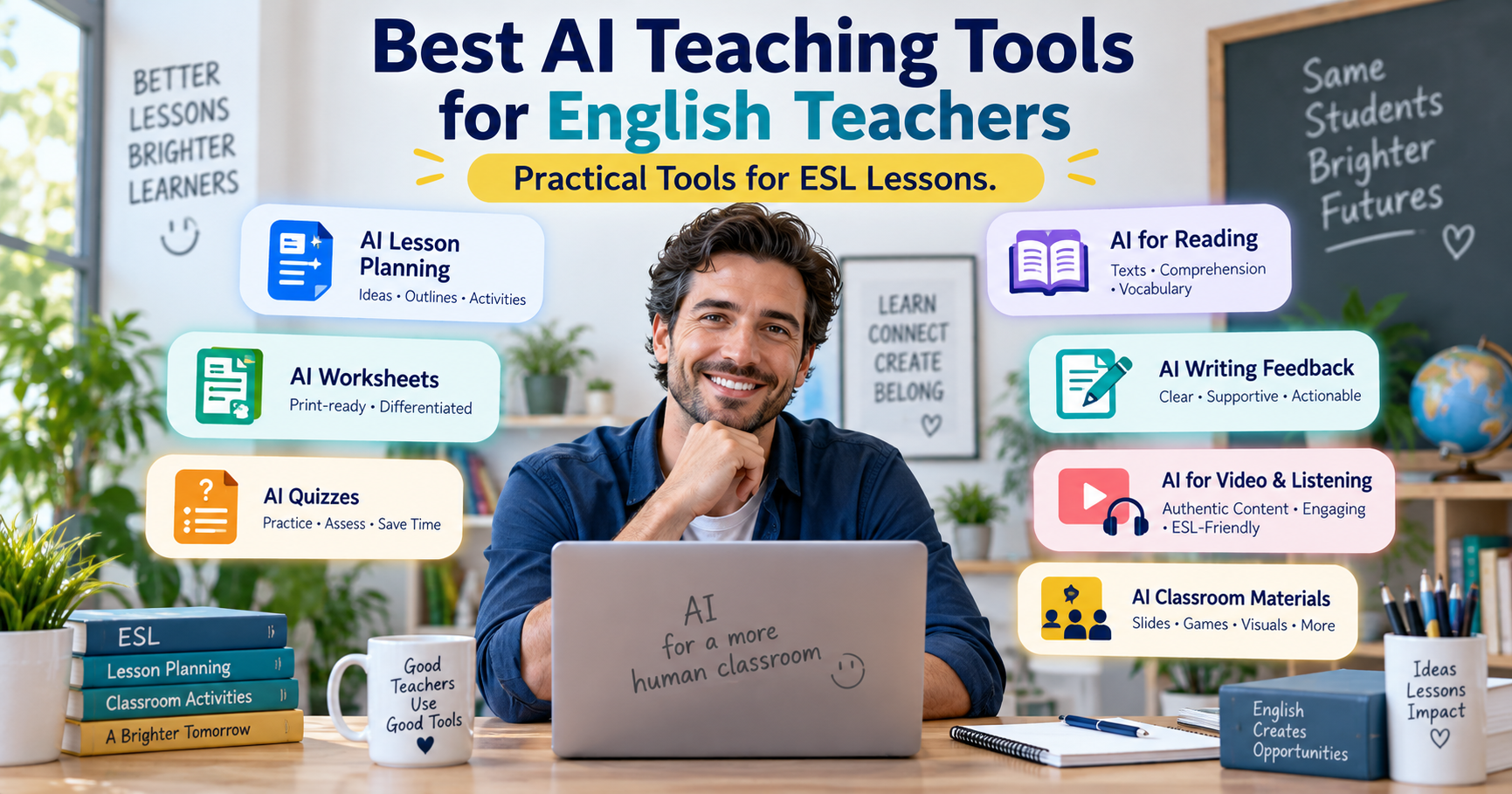
    Best AI Teaching Tools for English Teachers: Practical Tools for ESL Lessons

    The best AI teaching tools for English teachers are not always the most popular tools. They are the tools that help teachers plan better lessons, create useful materials, save preparation time, and still keep teacher judgement at the centre of the classroom.

    For ESL/EFL teachers and language tutors, AI can help with many teaching tasks: lesson planning, worksheet creation, reading support, vocabulary practice, quizzes, rubrics, writing feedback, classroom slides, and homework. But not every AI tool is useful for English teaching. Some tools are too general. Some create nice-looking content but weak language tasks. Others are powerful, but only if the teacher gives clear instructions.

    This guide compares practical AI tools for English teachers and explains what each one is best for. It is not a generic list of trendy tools. It is a teacher-focused guide to choosing the right AI tool for the right classroom task.

    If you are mainly looking for worksheet tools, start with Best Customizable Worksheet Software with AI for English Teachers. If you want a full lesson-planning workflow, read Lesson Plan Generator: AI Prompts for Better ESL Lessons.

    Quick Answer: Best AI Teaching Tools by Teaching Need

    The best AI teaching tool depends on what you want to create.

    Teaching needRecommended tool
    General lesson planning and prompt workflowsChatGPT
    ESL/EFL-specific activitiesTwee
    All-in-one teacher AI platformMagicSchool
    Reading differentiation and adapted textsDiffit
    Turning existing resources into lessons and quizzesBrisk Teaching
    Printable worksheet and classroom material designCanva
    Digital quizzes and interactive assessmentWayground / Quizizz
    Broader teaching resources and classroom materialsEduaide
    Digital forms and exit ticketsGoogle Forms

    For most English teachers, the best workflow is not one tool. A stronger approach is to use different tools for different parts of teaching: one for planning, one for worksheet content, one for quizzes, one for design, and one for feedback.

    What Makes an AI Teaching Tool Useful for English Teachers?

    A good AI teaching tool should help English teachers create materials that are practical, level-appropriate, and easy to adapt.

    Before choosing a tool, ask:

    • Can it create ESL/EFL activities?
    • Can I control the learner level?
    • Can I edit the output easily?
    • Can it create answer keys?
    • Can it support grammar, vocabulary, reading, listening, speaking, or writing?
    • Can it create printable or digital materials?
    • Does it save time without weakening lesson quality?
    • Does it protect teacher judgement?
    • Does it fit my real classroom workflow?

    For example, if you teach B1 learners, you need more than a pretty worksheet. You need suitable vocabulary, clear instructions, fair questions, useful examples, and tasks that match the lesson aim.

    The Common European Framework of Reference can help teachers think about learner levels such as A2, B1, and B2, but the teacher still needs to adapt AI output to the real class.

    1. ChatGPT: Best for Flexible Lesson Planning and Prompt Workflows

    ChatGPT is one of the most flexible AI teaching tools because it can help with many parts of lesson preparation. English teachers can use it to brainstorm lesson aims, create activities, generate worksheets, simplify texts, draft quizzes, write feedback comments, create role plays, and adapt tasks for different levels.

    OpenAI also provides education-focused guidance and examples for teachers through OpenAI for Education and its help article on how educators can get started with ChatGPT.

    Best for

    ChatGPT is best for:

    • lesson planning;
    • prompt-based workflows;
    • worksheet drafts;
    • quiz ideas;
    • rubric drafts;
    • writing feedback support;
    • speaking activities;
    • differentiated task ideas;
    • teacher brainstorming.

    Example use for English teachers

    You can use ChatGPT to plan a B1 speaking lesson about online learning:

    Act as an experienced ESL teacher.
    
    Create a 60-minute B1 lesson plan about online learning.
    
    Main aim:
    Students will be able to discuss advantages and disadvantages of online learning using opinion phrases and linking words.
    
    Include:
    1. warm-up;
    2. vocabulary support;
    3. short reading or listening input;
    4. speaking task;
    5. feedback stage;
    6. exit ticket;
    7. homework.
    

    For a more detailed sequence, read ChatGPT Lesson Planning: A Prompt Sequence for Better ESL Lessons.

    Possible limitation

    ChatGPT is powerful, but it depends heavily on your prompt. If you give a vague instruction, you may get generic lesson ideas. Always add the student level, lesson aim, class context, timing, and target language.

    2. Twee: Best for ESL and EFL Activity Creation

    Twee is one of the most relevant AI tools for English teachers because it is designed around language teaching. Its tools cover areas such as reading, vocabulary, writing, speaking, grammar, listening, and utility tasks.

    That makes it especially useful for ESL/EFL teachers who want classroom activities rather than generic educational content.

    Best for

    Twee is best for:

    • ESL grammar exercises;
    • vocabulary activities;
    • reading questions;
    • discussion prompts;
    • listening and video tasks;
    • gap-fill activities;
    • sentence rewriting tasks;
    • speaking activities;
    • text adaptation.

    Example use for English teachers

    A teacher preparing a lesson about travel problems could use Twee to create vocabulary tasks, grammar practice, reading questions, and discussion prompts around the same theme.

    This makes Twee a strong companion to your AI Worksheet Generator for English Teachers workflow because teachers can generate task ideas and then customize them for their own learners.

    Possible limitation

    Twee is strong for ESL/EFL content creation, but teachers may still want to format final worksheets in a design tool such as Canva if they need polished printable handouts.

    3. MagicSchool: Best All-in-One AI Teaching Platform

    MagicSchool is a broad AI platform for teachers. It includes tools for lesson planning, worksheets, assessments, writing feedback, differentiation, and other classroom tasks.

    This makes it useful for teachers who want one workspace rather than switching between many separate tools.

    Best for

    MagicSchool is best for:

    • lesson plan drafts;
    • worksheet generation;
    • assessment ideas;
    • writing feedback;
    • differentiated materials;
    • teacher productivity;
    • classroom support tasks.

    Example use for English teachers

    An English teacher could use MagicSchool to create a lesson plan, generate a worksheet, prepare a short quiz, and draft writing feedback comments.

    For example, after creating a grammar lesson with Lesson Plan Generator, a teacher could use MagicSchool to create a first worksheet draft or checking activity.

    Possible limitation

    MagicSchool is not only for ESL/EFL teachers. Because it is a broad teacher platform, English teachers should still check whether the generated content fits the learner level, language focus, and classroom context.

    4. Diffit: Best for Reading Differentiation and Student-Ready Resources

    Diffit is especially useful when teachers need differentiated reading materials. It can help create or adapt classroom resources from topics, texts, links, videos, PDFs, or vocabulary lists.

    For English teachers, Diffit is useful when a reading text is too difficult and students need vocabulary support, comprehension questions, or adapted versions.

    Best for

    Diffit is best for:

    • reading passages;
    • differentiated texts;
    • vocabulary support;
    • comprehension questions;
    • student-ready resources;
    • adapting materials to different levels;
    • literacy-rich activities.

    Example use for English teachers

    Imagine you want to teach B1 students a reading lesson about healthy habits. Diffit can help you create or adapt a text, then generate supporting activities. After that, you can improve the task using the ideas in Reading Worksheet Generator: 7 AI Prompts for Better ESL Reading Lessons.

    Possible limitation

    Diffit is strongest when the lesson starts with reading, text adaptation, or differentiation. It may not be the first tool you choose for a speaking-only lesson or a full ESL lesson plan.

    5. Brisk Teaching: Best for Turning Existing Resources into Lessons and Activities

    Brisk Teaching is useful when teachers already have a resource and want to turn it into something teachable. It works well for teachers who use web pages, documents, videos, online texts, and classroom materials.

    Brisk can help teachers create lessons, quizzes, activities, feedback, reading-level changes, and instructional materials.

    Best for

    Brisk Teaching is best for:

    • turning existing resources into activities;
    • creating quizzes;
    • creating lessons;
    • giving feedback;
    • adapting reading levels;
    • working with online resources;
    • creating materials from documents or web content.

    Example use for English teachers

    An English teacher could start with a short article, video, or Google Doc, then use Brisk to create classroom questions or activities. If the source is a video, the teacher can also use the ideas in AI Video Question Maker: 9 Prompts for Better ESL Listening Lessons to create pre-watching, while-watching, and post-watching tasks.

    Possible limitation

    Brisk is very useful when you already have a source. If you are starting from only a lesson topic, another tool such as ChatGPT, Twee, or MagicSchool may feel easier as the first step.

    6. Canva: Best for Printable Worksheets and Visual Classroom Materials

    Canva is best when you already have content and want to turn it into a professional-looking worksheet, handout, poster, presentation, or classroom resource.

    Many AI tools can generate text, but the formatting may be plain. Canva helps teachers design the final version so students can use it more easily.

    Best for

    Canva is best for:

    • printable worksheets;
    • classroom posters;
    • handouts;
    • lesson visuals;
    • presentation materials;
    • quiz sheets;
    • vocabulary cards;
    • classroom templates.

    Example use for English teachers

    A teacher might generate quiz questions using ESL Quiz Templates: AI Prompts for Grammar, Vocabulary, Reading, and Listening, then paste the questions into Canva and create a cleaner printable worksheet.

    Canva is also useful when you want your resources to look consistent with your classroom or teaching brand.

    Possible limitation

    Canva is strongest for design and layout. For deeper ESL-specific content, it is often better to create the activity first with ChatGPT, Twee, MagicSchool, or another AI teaching tool, then use Canva for formatting.

    7. Wayground / Quizizz: Best for Digital Quizzes and Interactive Assessment

    Wayground, formerly Quizizz, is useful for interactive quizzes, digital assessments, practice activities, homework, and game-based review. It can help teachers create or adapt questions and run activities live or asynchronously.

    For English teachers, this is useful when the task is question-based: grammar review, vocabulary checks, reading comprehension, listening checks, or exit tickets.

    Best for

    Wayground / Quizizz is best for:

    • digital quizzes;
    • interactive assessment;
    • homework practice;
    • vocabulary review;
    • grammar checks;
    • live classroom games;
    • student-paced practice;
    • formative assessment.

    Example use for English teachers

    After creating questions with ESL Quiz Templates, a teacher could move selected questions into Wayground / Quizizz for live review or homework practice.

    This is especially useful when students need repeated practice and instant feedback.

    Possible limitation

    Wayground / Quizizz is not the best choice for long-form writing worksheets or detailed printable handouts. It is strongest when the learning activity is built around questions, answers, review, and practice.

    8. Eduaide: Best for Broad Teacher Resource Creation

    Eduaide is a broad AI teaching resource tool. It can help teachers create lesson plans, instructional materials, worksheets, discussion activities, rubrics, and other classroom resources.

    This makes it useful for teachers who want one tool for several resource types.

    Best for

    Eduaide is best for:

    • teaching resources;
    • worksheets;
    • lesson materials;
    • rubrics;
    • classroom activities;
    • planning support;
    • discussion tasks;
    • instructional materials.

    Example use for English teachers

    An English teacher could use Eduaide to generate classroom activities, worksheet ideas, discussion prompts, or a simple rubric. For assessment-related tasks, you can also connect this with Rubric Creator: 7 AI Prompts to Build Better English Marking Rubrics and AI Writing Feedback: 7 Ways English Teachers Can Give Better Student Feedback.

    Possible limitation

    Eduaide is broad, so ESL/EFL teachers should still adapt the output for learner level, language focus, classroom timing, and student needs.

    9. Google Forms: Best for Simple Digital Quizzes and Exit Tickets

    Google Forms is not an AI teaching tool in the same way as ChatGPT or Twee, but it is very useful when you want to turn AI-generated questions into a simple digital quiz, survey, exit ticket, or homework check.

    For English teachers, Google Forms is practical because it is easy to share and works well for quick classroom checks.

    Best for

    Google Forms is best for:

    • exit tickets;
    • short quizzes;
    • homework checks;
    • student surveys;
    • reading comprehension checks;
    • vocabulary review;
    • grammar practice;
    • self-assessment forms.

    Example use for English teachers

    You can create quiz questions with ChatGPT or use the templates in ESL Quiz Templates, then paste them into Google Forms. This is useful for quick checks after a lesson or for homework practice.

    Possible limitation

    Google Forms does not create a full ESL lesson for you. It is best used as a delivery tool for quizzes, surveys, and checking activities.

    Best AI Teaching Tools by Classroom Task

    Here is a practical way to choose your tool.

    Best for lesson planning

    Use ChatGPT, MagicSchool, or Eduaide when you need lesson aims, stages, timing, and activity ideas.

    For a complete workflow, use Lesson Plan Generator or ChatGPT Lesson Planning.

    Best for ESL worksheets

    Use Twee, MagicSchool, or Eduaide when you need grammar, vocabulary, reading, or classroom activity worksheets.

    For a broader worksheet process, read AI Worksheet Generator for English Teachers.

    Best for reading lessons

    Use Diffit when you need adapted readings, vocabulary support, and comprehension activities. Then use Reading Worksheet Generator to improve the reading task.

    Best for video and listening lessons

    Use ChatGPT, Twee, Brisk, or Wayground / Quizizz when you want to turn a video or transcript into questions. The workflow in AI Video Question Maker can help you create pre-watching questions, comprehension tasks, vocabulary activities, and discussion prompts.

    Best for quizzes

    Use Wayground / Quizizz, Google Forms, MagicSchool, or ChatGPT when you need grammar quizzes, vocabulary checks, exit tickets, or review tasks.

    Best for writing feedback

    Use ChatGPT, MagicSchool, Brisk, or Eduaide to draft comments, identify patterns, create feedback banks, or turn feedback into revision tasks. For a safer teacher-led workflow, read AI Writing Feedback.

    Best for printable design

    Use Canva when you want to turn AI-generated content into a clean, printable resource.

    A Practical AI Teaching Workflow for English Teachers

    A smart AI workflow usually looks like this:

    Step 1: Start with the lesson aim

    Do not begin with the tool. Begin with what students should be able to do.

    Example:

    By the end of the lesson, students will be able to describe travel problems and make simple complaints using past simple verbs.

    Step 2: Create the lesson plan

    Use ChatGPT, MagicSchool, or Eduaide to draft the lesson stages, timing, warm-up, input, practice, feedback, and homework.

    Step 3: Create the worksheet

    Use Twee, MagicSchool, ChatGPT, or Eduaide to generate grammar, vocabulary, reading, or speaking tasks.

    Step 4: Add a quiz or exit ticket

    Use ChatGPT, Wayground / Quizizz, Google Forms, or your ESL Quiz Templates workflow to check learning.

    Step 5: Design the final resource

    Use Canva to make the worksheet or handout clearer and more printable.

    Step 6: Review everything

    Check the level, instructions, examples, answer key, timing, and student suitability.

    AI can create drafts quickly, but teacher judgement turns those drafts into real learning materials.

    Common Mistakes When Choosing AI Teaching Tools

    Mistake 1: Looking for one perfect tool

    There is no single perfect AI teaching tool for every task. Use different tools for different teaching needs.

    Mistake 2: Choosing tools before defining the lesson aim

    The lesson aim should decide the tool, not the other way around.

    Mistake 3: Trusting AI output without review

    Always check accuracy, level, tone, answer keys, and classroom suitability.

    Mistake 4: Using generic prompts

    A generic prompt creates generic output. Add learner level, class context, topic, target language, lesson aim, and task type.

    Mistake 5: Ignoring privacy and school policy

    Be careful when using student work, names, grades, or personal information. Remove identifying details and follow your school’s rules.

    Mistake 6: Creating too many materials

    AI makes it easy to generate too much. A focused worksheet, quiz, or lesson is usually better than an overloaded one.

    Mistake 7: Forgetting the students

    A tool can save time, but the final material must still fit your learners, their level, their interests, and their needs.

    Simple Checklist Before Using an AI Teaching Tool

    Before using an AI tool in your English teaching workflow, ask:

    • What problem am I trying to solve?
    • Is this for planning, worksheets, quizzes, feedback, or design?
    • Does the tool fit ESL/EFL teaching?
    • Can I control the learner level?
    • Can I edit the output?
    • Can I check the answer key?
    • Is the content suitable for my class?
    • Am I protecting student privacy?
    • Does this save time without reducing quality?

    FAQ: Best AI Teaching Tools for English Teachers

    What are the best AI teaching tools for English teachers?

    The best AI teaching tools for English teachers include tools for lesson planning, worksheet creation, reading differentiation, quizzes, writing feedback, and printable design. Useful options include ChatGPT, Twee, MagicSchool, Diffit, Brisk Teaching, Canva, Wayground / Quizizz, Eduaide, and Google Forms.

    What is the best AI tool for ESL lesson planning?

    ChatGPT, MagicSchool, and Eduaide can all help with ESL lesson planning. The best choice depends on whether you want a flexible prompt workflow, an all-in-one teacher platform, or broader teaching resource generation.

    What is the best AI worksheet generator for English teachers?

    Twee is strong for ESL/EFL-specific activities, MagicSchool is useful for fast worksheet drafts, and Eduaide can help with broader classroom materials. Canva is useful when you want to design the final printable worksheet.

    Can AI tools create ESL quizzes?

    Yes. AI tools can help create grammar quizzes, vocabulary checks, reading comprehension questions, listening tasks, video questions, exit tickets, and answer keys. Teachers should always review the questions before using them.

    Can AI help with writing feedback?

    Yes. AI can help draft writing feedback, identify repeated errors, create feedback comment banks, and turn comments into revision tasks. Teachers should review the feedback before sharing it with students.

    Are AI teaching tools safe to use with student work?

    Teachers should be careful with student data. Avoid uploading names, emails, private details, grades, or sensitive information unless your school allows the tool and the use case. When possible, anonymise student writing before using AI feedback tools.

    Should AI replace lesson planning?

    No. AI should support lesson planning, not replace the teacher. The teacher still decides the lesson aim, checks the material, adapts the activities, and makes the final classroom decisions.

    Final Recommendation

    The best AI teaching tools are the ones that solve real teaching problems.

    For English teachers:

    • use ChatGPT for flexible planning and prompt workflows;
    • use Twee for ESL/EFL-specific activities;
    • use MagicSchool for an all-in-one teacher AI workspace;
    • use Diffit for reading differentiation;
    • use Brisk Teaching for turning existing resources into activities;
    • use Canva for printable worksheet and classroom material design;
    • use Wayground / Quizizz for digital quizzes and review;
    • use Eduaide for broader teacher resource creation;
    • use Google Forms for simple digital quizzes and exit tickets.

    The strongest approach is not to chase every new AI tool. Start with your lesson aim, choose the tool that fits the task, and then review everything before using it with students.

    AI can help English teachers plan faster, create better resources, and save preparation time. But the best classroom results still come from clear teaching goals, thoughtful adaptation, and human judgement.