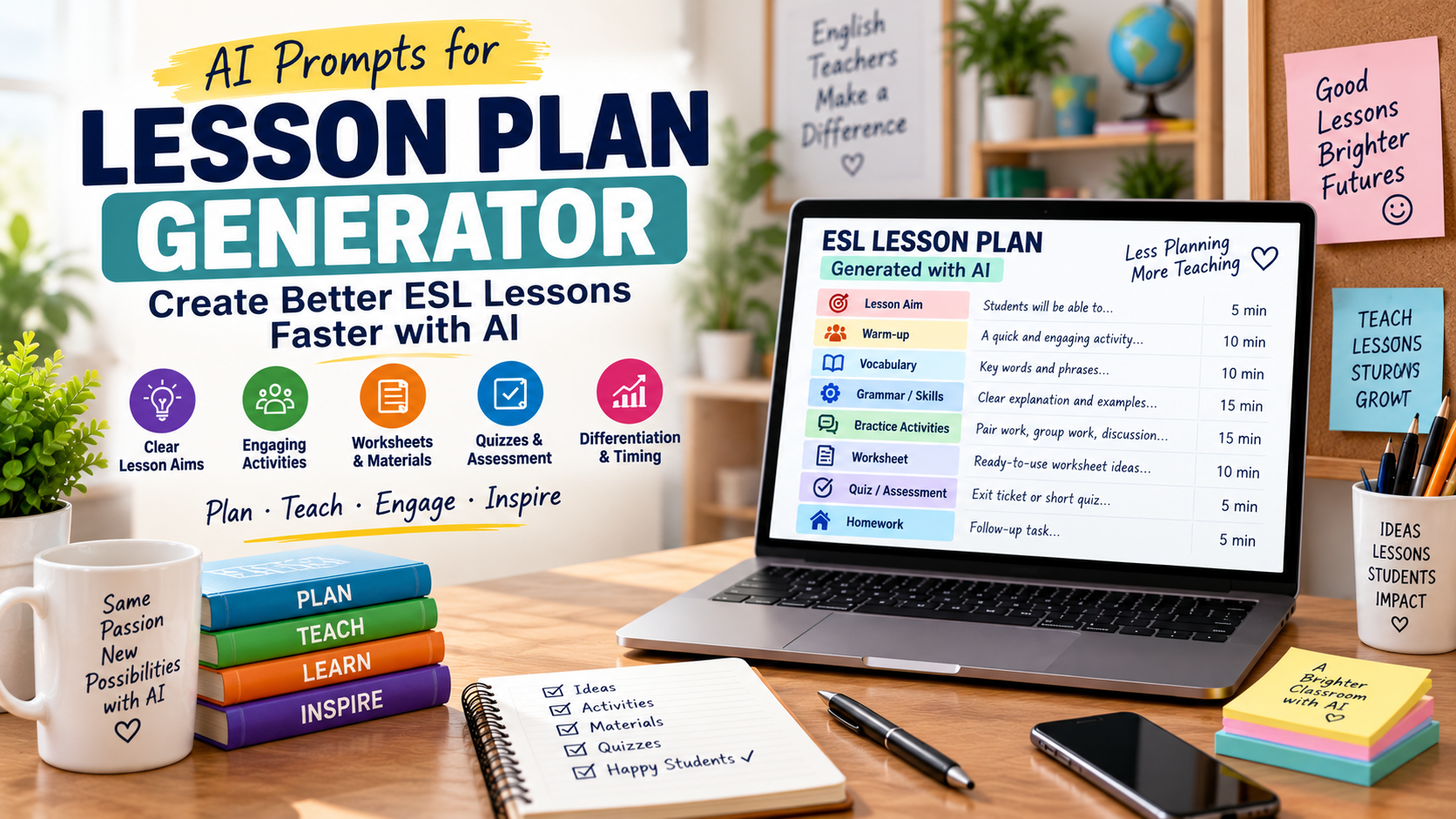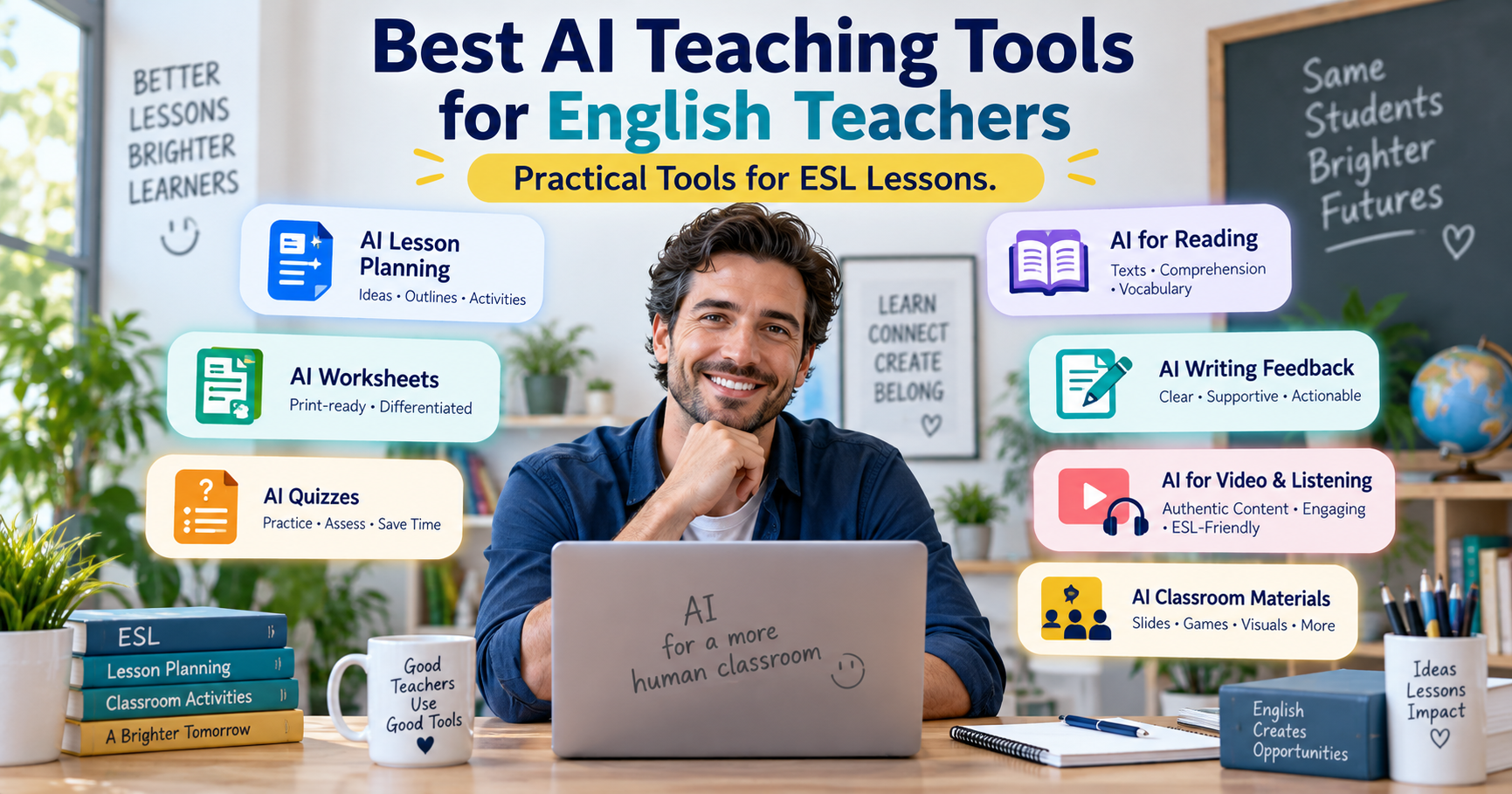
The best AI teaching tools for English teachers are not always the most popular tools. They are the tools that help teachers plan better lessons, create useful materials, save preparation time, and still keep teacher judgement at the centre of the classroom.
For ESL/EFL teachers and language tutors, AI can help with many teaching tasks: lesson planning, worksheet creation, reading support, vocabulary practice, quizzes, rubrics, writing feedback, classroom slides, and homework. But not every AI tool is useful for English teaching. Some tools are too general. Some create nice-looking content but weak language tasks. Others are powerful, but only if the teacher gives clear instructions.
This guide compares practical AI tools for English teachers and explains what each one is best for. It is not a generic list of trendy tools. It is a teacher-focused guide to choosing the right AI tool for the right classroom task.
If you are mainly looking for worksheet tools, start with Best Customizable Worksheet Software with AI for English Teachers. If you want a full lesson-planning workflow, read Lesson Plan Generator: AI Prompts for Better ESL Lessons.
Quick Answer: Best AI Teaching Tools by Teaching Need
The best AI teaching tool depends on what you want to create.
| Teaching need | Recommended tool |
|---|---|
| General lesson planning and prompt workflows | ChatGPT |
| ESL/EFL-specific activities | Twee |
| All-in-one teacher AI platform | MagicSchool |
| Reading differentiation and adapted texts | Diffit |
| Turning existing resources into lessons and quizzes | Brisk Teaching |
| Printable worksheet and classroom material design | Canva |
| Digital quizzes and interactive assessment | Wayground / Quizizz |
| Broader teaching resources and classroom materials | Eduaide |
| Digital forms and exit tickets | Google Forms |
For most English teachers, the best workflow is not one tool. A stronger approach is to use different tools for different parts of teaching: one for planning, one for worksheet content, one for quizzes, one for design, and one for feedback.
What Makes an AI Teaching Tool Useful for English Teachers?
A good AI teaching tool should help English teachers create materials that are practical, level-appropriate, and easy to adapt.
Before choosing a tool, ask:
- Can it create ESL/EFL activities?
- Can I control the learner level?
- Can I edit the output easily?
- Can it create answer keys?
- Can it support grammar, vocabulary, reading, listening, speaking, or writing?
- Can it create printable or digital materials?
- Does it save time without weakening lesson quality?
- Does it protect teacher judgement?
- Does it fit my real classroom workflow?
For example, if you teach B1 learners, you need more than a pretty worksheet. You need suitable vocabulary, clear instructions, fair questions, useful examples, and tasks that match the lesson aim.
The Common European Framework of Reference can help teachers think about learner levels such as A2, B1, and B2, but the teacher still needs to adapt AI output to the real class.
1. ChatGPT: Best for Flexible Lesson Planning and Prompt Workflows
ChatGPT is one of the most flexible AI teaching tools because it can help with many parts of lesson preparation. English teachers can use it to brainstorm lesson aims, create activities, generate worksheets, simplify texts, draft quizzes, write feedback comments, create role plays, and adapt tasks for different levels.
OpenAI also provides education-focused guidance and examples for teachers through OpenAI for Education and its help article on how educators can get started with ChatGPT.
Best for
ChatGPT is best for:
- lesson planning;
- prompt-based workflows;
- worksheet drafts;
- quiz ideas;
- rubric drafts;
- writing feedback support;
- speaking activities;
- differentiated task ideas;
- teacher brainstorming.
Example use for English teachers
You can use ChatGPT to plan a B1 speaking lesson about online learning:
Act as an experienced ESL teacher.

Create a 60-minute B1 lesson plan about online learning.

Main aim:
Students will be able to discuss advantages and disadvantages of online learning using opinion phrases and linking words.

Include:
1. warm-up;
2. vocabulary support;
3. short reading or listening input;
4. speaking task;
5. feedback stage;
6. exit ticket;
7. homework.
For a more detailed sequence, read ChatGPT Lesson Planning: A Prompt Sequence for Better ESL Lessons.
Possible limitation
ChatGPT is powerful, but it depends heavily on your prompt. If you give a vague instruction, you may get generic lesson ideas. Always add the student level, lesson aim, class context, timing, and target language.
2. Twee: Best for ESL and EFL Activity Creation
Twee is one of the most relevant AI tools for English teachers because it is designed around language teaching. Its tools cover areas such as reading, vocabulary, writing, speaking, grammar, listening, and utility tasks.
That makes it especially useful for ESL/EFL teachers who want classroom activities rather than generic educational content.
Best for
Twee is best for:
- ESL grammar exercises;
- vocabulary activities;
- reading questions;
- discussion prompts;
- listening and video tasks;
- gap-fill activities;
- sentence rewriting tasks;
- speaking activities;
- text adaptation.
Example use for English teachers
A teacher preparing a lesson about travel problems could use Twee to create vocabulary tasks, grammar practice, reading questions, and discussion prompts around the same theme.
This makes Twee a strong companion to your AI Worksheet Generator for English Teachers workflow because teachers can generate task ideas and then customize them for their own learners.
Possible limitation
Twee is strong for ESL/EFL content creation, but teachers may still want to format final worksheets in a design tool such as Canva if they need polished printable handouts.
3. MagicSchool: Best All-in-One AI Teaching Platform
MagicSchool is a broad AI platform for teachers. It includes tools for lesson planning, worksheets, assessments, writing feedback, differentiation, and other classroom tasks.
This makes it useful for teachers who want one workspace rather than switching between many separate tools.
Best for
MagicSchool is best for:
- lesson plan drafts;
- worksheet generation;
- assessment ideas;
- writing feedback;
- differentiated materials;
- teacher productivity;
- classroom support tasks.
Example use for English teachers
An English teacher could use MagicSchool to create a lesson plan, generate a worksheet, prepare a short quiz, and draft writing feedback comments.
For example, after creating a grammar lesson with Lesson Plan Generator, a teacher could use MagicSchool to create a first worksheet draft or checking activity.
Possible limitation
MagicSchool is not only for ESL/EFL teachers. Because it is a broad teacher platform, English teachers should still check whether the generated content fits the learner level, language focus, and classroom context.
4. Diffit: Best for Reading Differentiation and Student-Ready Resources
Diffit is especially useful when teachers need differentiated reading materials. It can help create or adapt classroom resources from topics, texts, links, videos, PDFs, or vocabulary lists.
For English teachers, Diffit is useful when a reading text is too difficult and students need vocabulary support, comprehension questions, or adapted versions.
Best for
Diffit is best for:
- reading passages;
- differentiated texts;
- vocabulary support;
- comprehension questions;
- student-ready resources;
- adapting materials to different levels;
- literacy-rich activities.
Example use for English teachers
Imagine you want to teach B1 students a reading lesson about healthy habits. Diffit can help you create or adapt a text, then generate supporting activities. After that, you can improve the task using the ideas in Reading Worksheet Generator: 7 AI Prompts for Better ESL Reading Lessons.
Possible limitation
Diffit is strongest when the lesson starts with reading, text adaptation, or differentiation. It may not be the first tool you choose for a speaking-only lesson or a full ESL lesson plan.
5. Brisk Teaching: Best for Turning Existing Resources into Lessons and Activities
Brisk Teaching is useful when teachers already have a resource and want to turn it into something teachable. It works well for teachers who use web pages, documents, videos, online texts, and classroom materials.
Brisk can help teachers create lessons, quizzes, activities, feedback, reading-level changes, and instructional materials.
Best for
Brisk Teaching is best for:
- turning existing resources into activities;
- creating quizzes;
- creating lessons;
- giving feedback;
- adapting reading levels;
- working with online resources;
- creating materials from documents or web content.
Example use for English teachers
An English teacher could start with a short article, video, or Google Doc, then use Brisk to create classroom questions or activities. If the source is a video, the teacher can also use the ideas in AI Video Question Maker: 9 Prompts for Better ESL Listening Lessons to create pre-watching, while-watching, and post-watching tasks.
Possible limitation
Brisk is very useful when you already have a source. If you are starting from only a lesson topic, another tool such as ChatGPT, Twee, or MagicSchool may feel easier as the first step.
6. Canva: Best for Printable Worksheets and Visual Classroom Materials
Canva is best when you already have content and want to turn it into a professional-looking worksheet, handout, poster, presentation, or classroom resource.
Many AI tools can generate text, but the formatting may be plain. Canva helps teachers design the final version so students can use it more easily.
Best for
Canva is best for:
- printable worksheets;
- classroom posters;
- handouts;
- lesson visuals;
- presentation materials;
- quiz sheets;
- vocabulary cards;
- classroom templates.
Example use for English teachers
A teacher might generate quiz questions using ESL Quiz Templates: AI Prompts for Grammar, Vocabulary, Reading, and Listening, then paste the questions into Canva and create a cleaner printable worksheet.
Canva is also useful when you want your resources to look consistent with your classroom or teaching brand.
Possible limitation
Canva is strongest for design and layout. For deeper ESL-specific content, it is often better to create the activity first with ChatGPT, Twee, MagicSchool, or another AI teaching tool, then use Canva for formatting.
7. Wayground / Quizizz: Best for Digital Quizzes and Interactive Assessment
Wayground, formerly Quizizz, is useful for interactive quizzes, digital assessments, practice activities, homework, and game-based review. It can help teachers create or adapt questions and run activities live or asynchronously.
For English teachers, this is useful when the task is question-based: grammar review, vocabulary checks, reading comprehension, listening checks, or exit tickets.
Best for
Wayground / Quizizz is best for:
- digital quizzes;
- interactive assessment;
- homework practice;
- vocabulary review;
- grammar checks;
- live classroom games;
- student-paced practice;
- formative assessment.
Example use for English teachers
After creating questions with ESL Quiz Templates, a teacher could move selected questions into Wayground / Quizizz for live review or homework practice.
This is especially useful when students need repeated practice and instant feedback.
Possible limitation
Wayground / Quizizz is not the best choice for long-form writing worksheets or detailed printable handouts. It is strongest when the learning activity is built around questions, answers, review, and practice.
8. Eduaide: Best for Broad Teacher Resource Creation
Eduaide is a broad AI teaching resource tool. It can help teachers create lesson plans, instructional materials, worksheets, discussion activities, rubrics, and other classroom resources.
This makes it useful for teachers who want one tool for several resource types.
Best for
Eduaide is best for:
- teaching resources;
- worksheets;
- lesson materials;
- rubrics;
- classroom activities;
- planning support;
- discussion tasks;
- instructional materials.
Example use for English teachers
An English teacher could use Eduaide to generate classroom activities, worksheet ideas, discussion prompts, or a simple rubric. For assessment-related tasks, you can also connect this with Rubric Creator: 7 AI Prompts to Build Better English Marking Rubrics and AI Writing Feedback: 7 Ways English Teachers Can Give Better Student Feedback.
Possible limitation
Eduaide is broad, so ESL/EFL teachers should still adapt the output for learner level, language focus, classroom timing, and student needs.
9. Google Forms: Best for Simple Digital Quizzes and Exit Tickets
Google Forms is not an AI teaching tool in the same way as ChatGPT or Twee, but it is very useful when you want to turn AI-generated questions into a simple digital quiz, survey, exit ticket, or homework check.
For English teachers, Google Forms is practical because it is easy to share and works well for quick classroom checks.
Best for
Google Forms is best for:
- exit tickets;
- short quizzes;
- homework checks;
- student surveys;
- reading comprehension checks;
- vocabulary review;
- grammar practice;
- self-assessment forms.
Example use for English teachers
You can create quiz questions with ChatGPT or use the templates in ESL Quiz Templates, then paste them into Google Forms. This is useful for quick checks after a lesson or for homework practice.
Possible limitation
Google Forms does not create a full ESL lesson for you. It is best used as a delivery tool for quizzes, surveys, and checking activities.
Best AI Teaching Tools by Classroom Task
Here is a practical way to choose your tool.
Best for lesson planning
Use ChatGPT, MagicSchool, or Eduaide when you need lesson aims, stages, timing, and activity ideas.
For a complete workflow, use Lesson Plan Generator or ChatGPT Lesson Planning.
Best for ESL worksheets
Use Twee, MagicSchool, or Eduaide when you need grammar, vocabulary, reading, or classroom activity worksheets.
For a broader worksheet process, read AI Worksheet Generator for English Teachers.
Best for reading lessons
Use Diffit when you need adapted readings, vocabulary support, and comprehension activities. Then use Reading Worksheet Generator to improve the reading task.
Best for video and listening lessons
Use ChatGPT, Twee, Brisk, or Wayground / Quizizz when you want to turn a video or transcript into questions. The workflow in AI Video Question Maker can help you create pre-watching questions, comprehension tasks, vocabulary activities, and discussion prompts.
Best for quizzes
Use Wayground / Quizizz, Google Forms, MagicSchool, or ChatGPT when you need grammar quizzes, vocabulary checks, exit tickets, or review tasks.
Best for writing feedback
Use ChatGPT, MagicSchool, Brisk, or Eduaide to draft comments, identify patterns, create feedback banks, or turn feedback into revision tasks. For a safer teacher-led workflow, read AI Writing Feedback.
Best for printable design
Use Canva when you want to turn AI-generated content into a clean, printable resource.
A Practical AI Teaching Workflow for English Teachers
A smart AI workflow usually looks like this:
Step 1: Start with the lesson aim
Do not begin with the tool. Begin with what students should be able to do.
Example:
By the end of the lesson, students will be able to describe travel problems and make simple complaints using past simple verbs.
Step 2: Create the lesson plan
Use ChatGPT, MagicSchool, or Eduaide to draft the lesson stages, timing, warm-up, input, practice, feedback, and homework.
Step 3: Create the worksheet
Use Twee, MagicSchool, ChatGPT, or Eduaide to generate grammar, vocabulary, reading, or speaking tasks.
Step 4: Add a quiz or exit ticket
Use ChatGPT, Wayground / Quizizz, Google Forms, or your ESL Quiz Templates workflow to check learning.
Step 5: Design the final resource
Use Canva to make the worksheet or handout clearer and more printable.
Step 6: Review everything
Check the level, instructions, examples, answer key, timing, and student suitability.
AI can create drafts quickly, but teacher judgement turns those drafts into real learning materials.
Common Mistakes When Choosing AI Teaching Tools
Mistake 1: Looking for one perfect tool
There is no single perfect AI teaching tool for every task. Use different tools for different teaching needs.
Mistake 2: Choosing tools before defining the lesson aim
The lesson aim should decide the tool, not the other way around.
Mistake 3: Trusting AI output without review
Always check accuracy, level, tone, answer keys, and classroom suitability.
Mistake 4: Using generic prompts
A generic prompt creates generic output. Add learner level, class context, topic, target language, lesson aim, and task type.
Mistake 5: Ignoring privacy and school policy
Be careful when using student work, names, grades, or personal information. Remove identifying details and follow your school’s rules.
Mistake 6: Creating too many materials
AI makes it easy to generate too much. A focused worksheet, quiz, or lesson is usually better than an overloaded one.
Mistake 7: Forgetting the students
A tool can save time, but the final material must still fit your learners, their level, their interests, and their needs.
Simple Checklist Before Using an AI Teaching Tool
Before using an AI tool in your English teaching workflow, ask:
- What problem am I trying to solve?
- Is this for planning, worksheets, quizzes, feedback, or design?
- Does the tool fit ESL/EFL teaching?
- Can I control the learner level?
- Can I edit the output?
- Can I check the answer key?
- Is the content suitable for my class?
- Am I protecting student privacy?
- Does this save time without reducing quality?
FAQ: Best AI Teaching Tools for English Teachers
What are the best AI teaching tools for English teachers?
The best AI teaching tools for English teachers include tools for lesson planning, worksheet creation, reading differentiation, quizzes, writing feedback, and printable design. Useful options include ChatGPT, Twee, MagicSchool, Diffit, Brisk Teaching, Canva, Wayground / Quizizz, Eduaide, and Google Forms.
What is the best AI tool for ESL lesson planning?
ChatGPT, MagicSchool, and Eduaide can all help with ESL lesson planning. The best choice depends on whether you want a flexible prompt workflow, an all-in-one teacher platform, or broader teaching resource generation.
What is the best AI worksheet generator for English teachers?
Twee is strong for ESL/EFL-specific activities, MagicSchool is useful for fast worksheet drafts, and Eduaide can help with broader classroom materials. Canva is useful when you want to design the final printable worksheet.
Can AI tools create ESL quizzes?
Yes. AI tools can help create grammar quizzes, vocabulary checks, reading comprehension questions, listening tasks, video questions, exit tickets, and answer keys. Teachers should always review the questions before using them.
Can AI help with writing feedback?
Yes. AI can help draft writing feedback, identify repeated errors, create feedback comment banks, and turn comments into revision tasks. Teachers should review the feedback before sharing it with students.
Are AI teaching tools safe to use with student work?
Teachers should be careful with student data. Avoid uploading names, emails, private details, grades, or sensitive information unless your school allows the tool and the use case. When possible, anonymise student writing before using AI feedback tools.
Should AI replace lesson planning?
No. AI should support lesson planning, not replace the teacher. The teacher still decides the lesson aim, checks the material, adapts the activities, and makes the final classroom decisions.
Final Recommendation
The best AI teaching tools are the ones that solve real teaching problems.
For English teachers:
- use ChatGPT for flexible planning and prompt workflows;
- use Twee for ESL/EFL-specific activities;
- use MagicSchool for an all-in-one teacher AI workspace;
- use Diffit for reading differentiation;
- use Brisk Teaching for turning existing resources into activities;
- use Canva for printable worksheet and classroom material design;
- use Wayground / Quizizz for digital quizzes and review;
- use Eduaide for broader teacher resource creation;
- use Google Forms for simple digital quizzes and exit tickets.
The strongest approach is not to chase every new AI tool. Start with your lesson aim, choose the tool that fits the task, and then review everything before using it with students.
AI can help English teachers plan faster, create better resources, and save preparation time. But the best classroom results still come from clear teaching goals, thoughtful adaptation, and human judgement.