Tag: AI for English Teachers

  • Rubric Creator: 7 AI Prompts to Build Better English Marking Rubrics

    Rubric Creator: 7 AI Prompts to Build Better English Marking Rubrics

    A rubric creator can help English teachers build clear marking criteria for writing tasks, speaking activities, presentations, projects, and classroom assessment. Instead of grading students with vague comments like “good grammar” or “needs more detail,” a rubric gives both the teacher and the student a clearer picture of what good performance looks like.

    For ESL/EFL teachers and language tutors, rubrics are especially useful because language performance is complex. A student’s writing or speaking may involve grammar, vocabulary, fluency, pronunciation, organisation, task achievement, interaction, and accuracy at the same time. Without a rubric, assessment can become inconsistent or unclear.

    AI can help you create rubrics faster, but it should not replace your judgement. A good AI-generated rubric still needs teacher review. You need to check whether the criteria match the task, the level is appropriate, the descriptors are clear, and the scoring system is fair.

    In this guide, you will learn how to use AI as a practical rubric creator for English teaching, with seven copy-paste prompts you can adapt for your own classes.

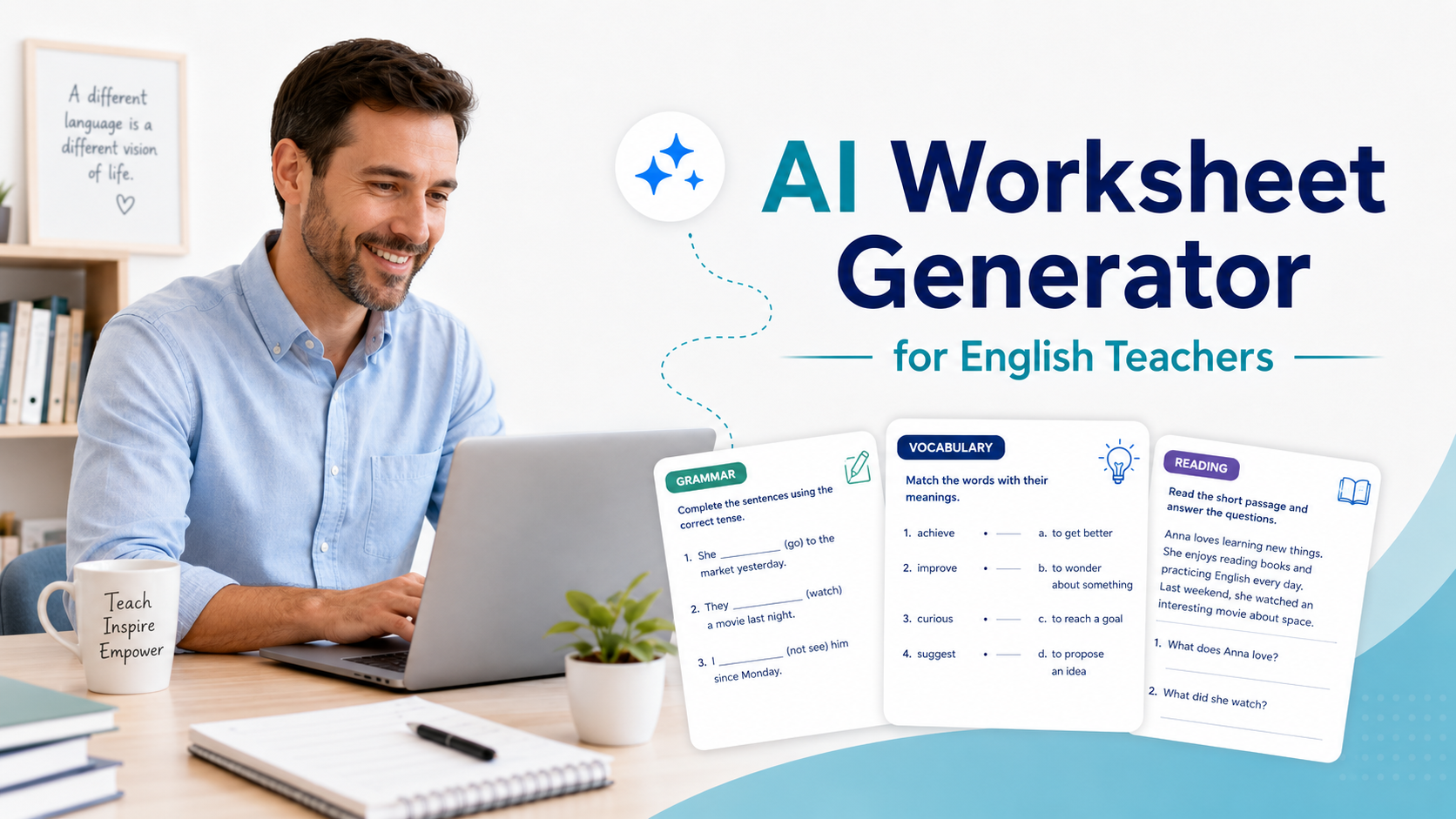
    If you are also creating lesson materials, you may want to read AI Worksheet Generator for English Teachers: 7 Ways to Create Better ESL Worksheets. For reading lessons, see Reading Worksheet Generator: 7 AI Prompts for Better ESL Reading Lessons. If you are comparing worksheet tools, read 7 Best Customizable Worksheet Software with AI for English Teachers.

    What Is a Rubric Creator?

    A rubric creator is a tool or workflow that helps teachers create assessment criteria for student work. In English teaching, a rubric can be used to assess writing, speaking, presentations, projects, role-plays, reading responses, listening tasks, or portfolios.

    A rubric usually includes:

    • assessment criteria;
    • performance levels;
    • clear descriptors;
    • point values or bands;
    • teacher comments;
    • sometimes a student self-assessment section.

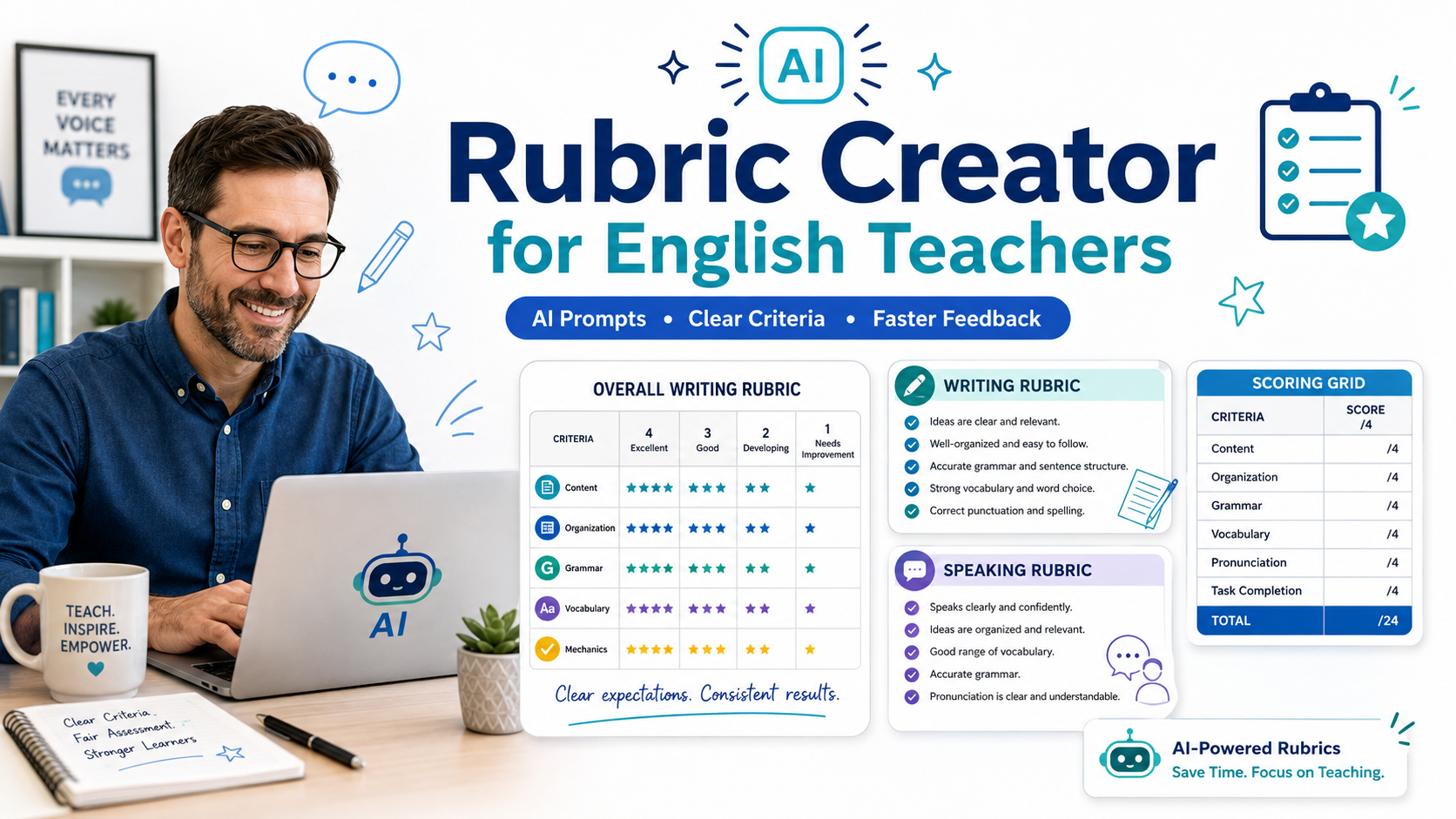
    For example, a writing rubric may assess:

    • task response;
    • organisation;
    • grammar accuracy;
    • vocabulary range;
    • mechanics such as spelling and punctuation.

    A speaking rubric may assess:

    • fluency;
    • pronunciation;
    • grammar;
    • vocabulary;
    • interaction;
    • task completion.

    With AI, teachers can generate a first draft quickly. But the rubric should always be adapted to your learners, task, level, and teaching context.

    Why English Teachers Should Use AI as a Rubric Creator

    Creating a good rubric takes time. You need to decide what matters, describe performance clearly, avoid vague wording, and make sure the rubric is fair for the level.

    AI can help English teachers:

    • create a first draft of a rubric;
    • adapt a rubric for different levels;
    • simplify rubric language for students;
    • create analytic or holistic rubrics;
    • build speaking and writing assessment criteria;
    • turn lesson aims into assessment criteria;
    • create self-assessment checklists;
    • make feedback more consistent.

    For example, if your B1 students are writing an opinion paragraph, you can ask AI to create a simple writing rubric with criteria for content, organisation, grammar, vocabulary, and mechanics. Then you can revise the rubric to fit your exact assignment.

    The goal is not to let AI decide grades. The goal is to use AI to save preparation time and make your assessment clearer.

    What Makes a Good English Marking Rubric?

    A good English marking rubric should be clear, level-appropriate, and directly connected to the task.

    A useful rubric should answer these questions:

    • What exactly are students being assessed on?
    • What does excellent work look like?
    • What does acceptable work look like?
    • What does weak work look like?
    • Are the criteria suitable for the learner level?
    • Can students understand the descriptors?
    • Can the teacher use it consistently?

    For ESL/EFL classes, rubric language should be practical. Avoid unclear phrases such as:

    • “excellent linguistic competence”;
    • “sophisticated lexical control”;
    • “adequate communicative performance.”

    Instead, use clearer language:

    • “uses topic vocabulary accurately”;
    • “organises ideas in a clear order”;
    • “speaks clearly enough to be understood”;
    • “uses simple linking words such as because, but, and so.”

    A good rubric should help students improve, not only give them a score.

    Analytic vs Holistic Rubrics

    Before using AI as a rubric creator, decide whether you need an analytic rubric or a holistic rubric.

    Analytic rubric

    An analytic rubric separates performance into different criteria. For example, a writing rubric may include content, organisation, grammar, vocabulary, and spelling.

    This is useful when you want detailed feedback.

    Example:

    CriteriaExcellentGoodNeeds Work
    ContentIdeas are clear and fully answer the taskIdeas mostly answer the taskIdeas are unclear or incomplete
    OrganisationParagraph is well organisedParagraph has some organisationParagraph is difficult to follow
    GrammarUses target grammar accuratelySome grammar errors, but meaning is clearFrequent errors make meaning unclear

    Holistic rubric

    A holistic rubric gives one overall score or band for the whole task. It is faster to use but gives less detailed feedback.

    This is useful for quick assessment, speaking fluency tasks, or classroom observation.

    For English teachers, analytic rubrics are usually better for writing and formal speaking tasks. Holistic rubrics are useful for quick classroom assessment.

    How to Use AI as a Rubric Creator

    The quality of your rubric depends on the prompt. A weak prompt gives generic criteria.

    A weak prompt would be:

    Create a rubric for writing.
    

    A stronger prompt would be:

    Create an analytic writing rubric for B1 ESL learners writing a 120-word opinion paragraph about online learning.
    
    Assess these criteria:
    1. task response;
    2. organisation;
    3. grammar accuracy;
    4. vocabulary;
    5. spelling and punctuation.
    
    Use 4 performance levels: Excellent, Good, Developing, Needs Work.
    Use student-friendly language and include points out of 20.
    

    The second prompt gives AI the level, task, criteria, performance bands, language style, and scoring system.

    Prompt 1: Basic Rubric Creator Prompt

    Use this prompt when you want a general rubric for an English task.

    Act as an experienced English teacher.
    
    Create an analytic rubric for [LEVEL] ESL/EFL learners completing this task:
    
    [TASK DESCRIPTION]
    
    The rubric should include:
    1. 4–5 assessment criteria;
    2. 4 performance levels;
    3. clear descriptors for each level;
    4. total score out of [POINTS];
    5. student-friendly language.
    
    Make the rubric practical, fair, and appropriate for [LEVEL] learners.
    

    Example

    Create an analytic rubric for B1 ESL learners writing a 120-word opinion paragraph about social media.
    
    Use 5 criteria:
    1. task response;
    2. organisation;
    3. grammar;
    4. vocabulary;
    5. spelling and punctuation.
    
    Use 4 performance levels and a total score out of 20.
    

    This prompt is useful for most writing, speaking, and project-based tasks.

    Prompt 2: ESL Writing Rubric Prompt

    Writing rubrics are very useful for English teachers because writing assessment can feel subjective. A rubric helps students understand what they need to improve.

    Create a writing rubric for [LEVEL] ESL learners.
    
    Writing task:
    [DESCRIBE WRITING TASK]
    
    Text length:
    [WORD COUNT]
    
    Assess:
    1. task response;
    2. organisation and paragraph structure;
    3. grammar accuracy;
    4. vocabulary range and accuracy;
    5. spelling and punctuation.
    
    Use 4 levels:
    Excellent, Good, Developing, Needs Work.
    
    Give points for each criterion and include a total score out of 20.
    Use clear language students can understand.
    

    Example classroom use

    For a B1 opinion paragraph, the rubric could include:

    • Does the student clearly give an opinion?
    • Does the paragraph have a topic sentence?
    • Are ideas supported with reasons or examples?
    • Is the grammar accurate enough for clear meaning?
    • Is vocabulary appropriate for the topic?

    This gives students a clear target before they write and clearer feedback after they submit.

    Teacher tip

    Give the rubric before the writing task, not only after marking. Students can use it as a planning checklist.

    Prompt 3: ESL Speaking Rubric Prompt

    Speaking assessment can be difficult because teachers need to listen to many things at once. A speaking rubric helps you focus on specific criteria.

    Create a speaking rubric for [LEVEL] ESL/EFL learners.
    
    Speaking task:
    [DESCRIBE SPEAKING TASK]
    
    Assess:
    1. fluency;
    2. pronunciation;
    3. grammar accuracy;
    4. vocabulary;
    5. interaction or task completion.
    
    Use 4 performance levels:
    Excellent, Good, Developing, Needs Work.
    
    Use teacher-friendly descriptors and a total score out of 20.
    Add a short student self-reflection section at the end.
    

    Example speaking task

    Students work in pairs and discuss this question:

    Should students use AI tools for homework?

    The rubric might assess whether students:

    • speak clearly;
    • use topic vocabulary;
    • give reasons;
    • respond to their partner;
    • keep the conversation going.

    Teacher tip

    For lower-level learners, do not over-assess. If the task is simple, use fewer criteria. For example: fluency, vocabulary, pronunciation, and task completion.

    Prompt 4: Student-Friendly Rubric Prompt

    Sometimes AI-generated rubrics sound too formal. Students may not understand phrases like “cohesive devices” or “lexical resource.”

    Use this prompt to simplify rubric language.

    Rewrite this rubric in student-friendly language for [LEVEL] English learners.
    
    Keep the same criteria and scores, but make the descriptors easier to understand.
    
    Avoid technical terms unless they are explained simply.
    
    Rubric:
    [PASTE RUBRIC]
    

    Example

    Instead of:

    Demonstrates effective control of cohesive devices.

    Use:

    Uses linking words such as first, because, but, and finally to connect ideas clearly.

    Instead of:

    Shows limited lexical range.

    Use:

    Uses only basic words and repeats the same vocabulary often.

    This makes the rubric more useful for students.

    Prompt 5: CEFR-Level Rubric Prompt

    If you teach using CEFR levels, you can ask AI to adapt a rubric to A2, B1, B2, or another level. However, you should still review the descriptors carefully.

    Create a rubric for [A1/A2/B1/B2/C1] English learners.
    
    Task:
    [DESCRIBE TASK]
    
    Make the descriptors appropriate for this CEFR level.
    
    Include:
    1. task achievement;
    2. grammar;
    3. vocabulary;
    4. organisation or fluency;
    5. pronunciation, spelling, or mechanics if relevant.
    
    Use clear teacher-friendly language and a total score out of [POINTS].
    

    Example

    For A2 learners, descriptors should focus on simple, achievable language:

    • uses simple sentences;
    • gives basic information;
    • uses familiar vocabulary;
    • makes some mistakes, but meaning is usually clear.

    For B2 learners, descriptors can include more complexity:

    • supports ideas with examples;
    • uses a range of linking words;
    • expresses opinions clearly;
    • uses topic vocabulary accurately.

    Teacher tip

    Do not make the rubric too advanced for the level. If A2 students are expected to write like B2 students, the rubric becomes unfair.

    Prompt 6: Rubric + Feedback Comments Prompt

    A rubric gives scores, but students also need comments. AI can help you create a feedback bank connected to rubric criteria.

    Create a feedback comment bank for this English rubric.
    
    Rubric:
    [PASTE RUBRIC]
    
    For each criterion, write:
    1. 3 positive feedback comments;
    2. 3 improvement comments;
    3. 2 short next-step suggestions.
    
    Use supportive teacher language. Keep comments specific and useful.
    

    Example feedback comments

    For organisation:

    • Your ideas are in a clear order.
    • Try to use linking words to connect your sentences.
    • Next time, add a clearer topic sentence.

    For vocabulary:

    • You used useful topic words.
    • Try not to repeat the same word too often.
    • Next time, add two new words from the lesson.

    This is useful if you mark many similar assignments and want consistent feedback.

    Prompt 7: Self-Assessment Rubric Prompt

    Rubrics are not only for teachers. Students can use simplified rubrics to check their own work before submitting it.

    Create a student self-assessment checklist for [LEVEL] ESL learners.
    
    Task:
    [DESCRIBE TASK]
    
    Base it on these criteria:
    [PASTE CRITERIA]
    
    Use simple yes/no checklist statements.
    
    Add one reflection question:
    “What should I improve next time?”
    

    Example self-assessment checklist

    For an opinion paragraph:

    • I gave my opinion clearly.
    • I gave at least two reasons.
    • I used linking words.
    • I checked my verbs.
    • I checked spelling and punctuation.
    • I wrote the correct number of words.

    This helps students take more responsibility for their work.

    Practical Example: AI Rubric for an ESL Writing Task

    Imagine your B1 students are writing a 120-word opinion paragraph:

    Do you think students should use smartphones in class?

    You can use this prompt:

    Create an analytic writing rubric for B1 ESL learners.
    
    Task:
    Students write a 120-word opinion paragraph answering this question:
    “Do you think students should use smartphones in class?”
    
    Assess:
    1. opinion and task response;
    2. organisation;
    3. reasons and examples;
    4. grammar;
    5. vocabulary;
    6. spelling and punctuation.
    
    Use 4 levels:
    Excellent, Good, Developing, Needs Work.
    
    Total score: 24 points.
    Use student-friendly language.
    

    The AI may create a useful first version. Then you should improve it with follow-up prompts:

    Make the rubric shorter and easier for B1 students to understand.
    

    Or:

    Add a student checklist version of this rubric that students can use before submitting their paragraph.
    

    This creates a full assessment workflow: rubric, teacher marking criteria, and student self-check.

    How to Improve an AI-Generated Rubric

    The first AI-generated rubric may be too long, too formal, or too generic. Use follow-up prompts to refine it.

    Make the rubric simpler

    Simplify this rubric. Keep the same criteria, but make the descriptors shorter and easier to use while marking.
    

    Make it more specific

    Make this rubric more specific to the task. Remove generic criteria and connect the descriptors directly to the assignment.
    

    Add point values

    Add point values to this rubric. The total score should be 20 points.
    

    Create a student version

    Create a student-friendly version of this rubric as a checklist before submission.
    

    Create a teacher marking version

    Create a compact teacher marking version of this rubric that fits on one page.
    

    These follow-up prompts help turn a generic rubric into a useful classroom tool.

    Common Mistakes to Avoid When Using AI as a Rubric Creator

    Mistake 1: Using a generic rubric for every task

    A speaking presentation, opinion paragraph, role-play, and reading response need different rubrics. Start from the task, not from a generic template.

    Mistake 2: Including too many criteria

    If you include ten criteria, marking becomes slow and students become confused. For most classroom tasks, four to six criteria are enough.

    Mistake 3: Using language students cannot understand

    If students do not understand the rubric, they cannot use it to improve. Create a teacher version and a student-friendly version if needed.

    Mistake 4: Making the rubric too difficult for the level

    Do not expect A2 students to use complex grammar, advanced vocabulary, or sophisticated argument structure. Keep criteria level-appropriate.

    Mistake 5: Forgetting the task aim

    If the aim is fluency practice, do not over-focus on tiny grammar errors. If the aim is accurate use of past tense, grammar should be more important.

    Mistake 6: Using AI comments without checking them

    AI feedback may sound nice but still be vague. Make comments specific, accurate, and connected to the rubric.

    Mistake 7: Not showing students the rubric before the task

    A rubric is more useful when students see it before they complete the assignment. It helps them understand expectations.

    A Simple Rubric Template for English Teachers

    You can reuse this structure for many English tasks:

    Task: [Describe task]
    Level: [A1/A2/B1/B2]
    Total score: [20 points]

    CriterionExcellentGoodDevelopingNeeds Work
    Task ResponseFully answers the taskMostly answers the taskPartly answers the taskDoes not answer the task clearly
    OrganisationIdeas are clear and well orderedIdeas are mostly clearIdeas are sometimes hard to followIdeas are unclear
    GrammarUses target grammar accuratelySome errors, but meaning is clearFrequent errors sometimes affect meaningErrors often make meaning unclear
    VocabularyUses useful topic vocabularyUses some topic vocabularyUses limited vocabularyVocabulary is too limited or unclear
    Mechanics / PronunciationMostly accurate and clearSome mistakes, but understandableMistakes sometimes distractMistakes make meaning difficult

    You can adapt the final criterion depending on the task. For writing, use spelling and punctuation. For speaking, use pronunciation and fluency.

    FAQ: Rubric Creator for English Teachers

    What is a rubric creator?

    A rubric creator is a tool or workflow that helps teachers build assessment criteria for student work. In English teaching, it can be used for writing, speaking, presentations, projects, role-plays, and classroom tasks.

    Can AI create rubrics for English teachers?

    Yes. AI can create first-draft rubrics for ESL/EFL writing, speaking, projects, and assessment tasks. Teachers should review and adapt the rubric before using it.

    What should an English writing rubric include?

    An English writing rubric usually includes task response, organisation, grammar, vocabulary, and spelling or punctuation. The exact criteria should match the writing task and learner level.

    What should an ESL speaking rubric include?

    An ESL speaking rubric may include fluency, pronunciation, grammar, vocabulary, interaction, and task completion. For lower-level learners, fewer criteria may be easier to use.

    Is an analytic rubric better than a holistic rubric?

    An analytic rubric is better when you want detailed feedback on separate criteria. A holistic rubric is faster when you want one overall score. For English writing and formal speaking assessment, analytic rubrics are usually more useful.

    Can students use rubrics for self-assessment?

    Yes. Student-friendly rubrics and checklists help learners review their own work before submitting it. This can improve independence and make expectations clearer.

    Should teachers use AI-generated rubrics without editing?

    No. AI-generated rubrics should always be checked for task fit, level, fairness, clarity, and scoring accuracy before classroom use.

    Conclusion

    A rubric creator can save English teachers time and make assessment clearer, but the best rubrics still need teacher judgement. AI can help you create a first draft, simplify descriptors, adapt criteria by level, build feedback comments, and create student self-assessment checklists.

    For ESL/EFL teachers and language tutors, the most useful rubrics are specific, clear, level-appropriate, and connected to the task. Whether you are assessing a writing paragraph, speaking activity, presentation, or project, AI can help you build a better starting point.

    Use the prompts in this guide to create rubrics faster, but always review the final version before using it with students. A strong rubric does more than produce a grade. It helps students understand what they did well, what they need to improve, and how to perform better next time.
  • Reading Worksheet Generator: 7 AI Prompts for Better ESL Reading Lessons

    Reading Worksheet Generator: 7 AI Prompts for Better ESL Reading Lessons

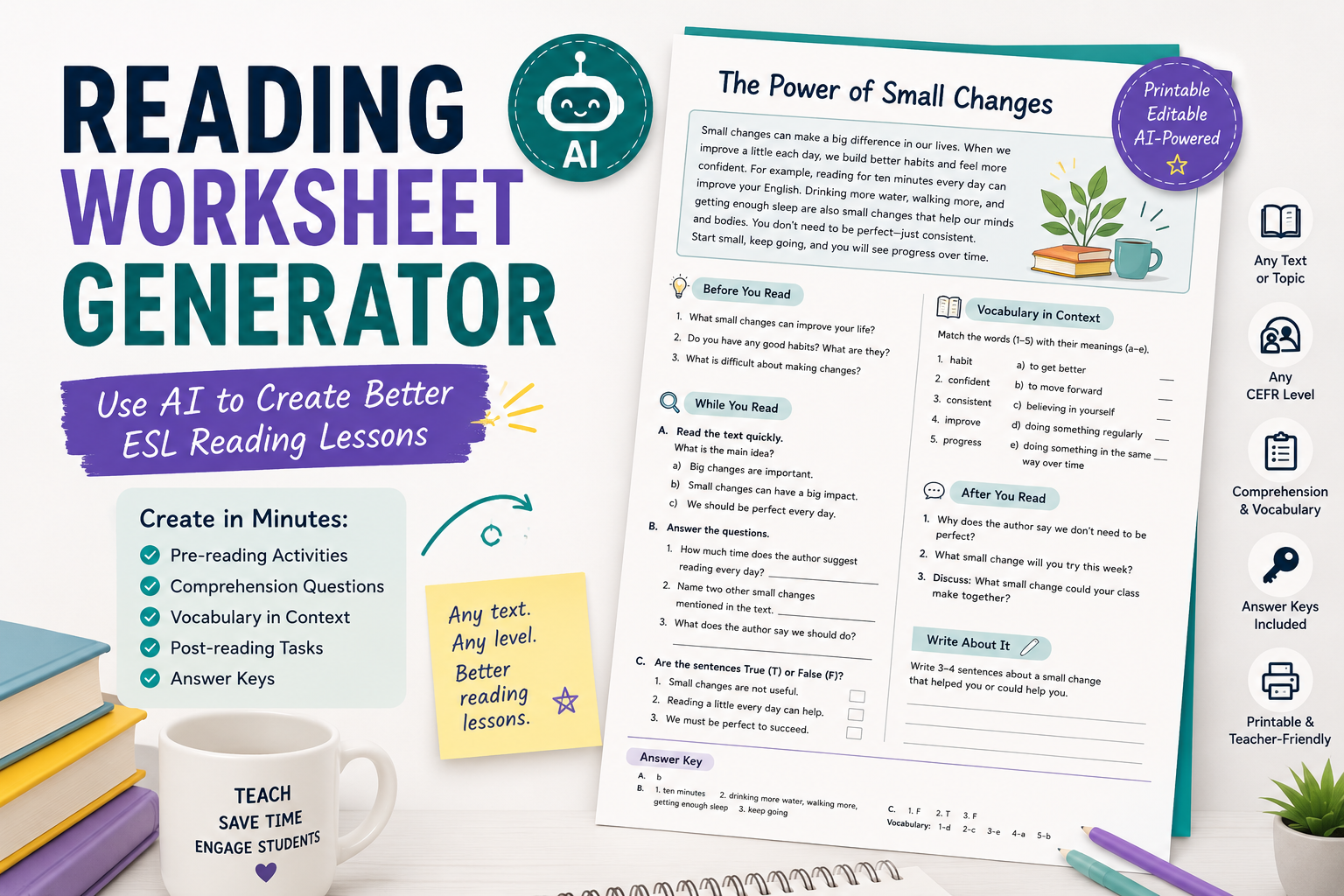
    A reading worksheet generator can help English teachers turn almost any text into a useful ESL reading lesson. Instead of manually writing comprehension questions, vocabulary tasks, pre-reading activities, and answer keys from scratch, you can use AI to create a strong first draft in minutes.

    But there is an important difference between a random AI-generated worksheet and a good reading lesson. A good ESL reading worksheet should help students understand the text, notice useful language, practise reading skills, and respond to the topic in a meaningful way.

    For English teachers, ESL/EFL teachers, and language tutors, AI works best when you give it clear teaching instructions. You need to specify the learner level, text type, lesson aim, reading skill, question type, vocabulary focus, and answer key format.

    In this guide, you will learn how to use AI as a practical reading worksheet generator, with copy-paste prompts you can adapt for your own classes.

    If you are building a wider worksheet workflow, you may also want to read AI Worksheet Generator for English Teachers: 7 Ways to Create Better ESL Worksheets. For tool options, see 7 Best Customizable Worksheet Software with AI for English Teachers. For vocabulary-focused worksheets, read Spelling Worksheet Maker: 7 AI Prompts to Create Better English Worksheets.

    What Is a Reading Worksheet Generator?

    A reading worksheet generator is a tool or AI workflow that helps teachers create reading activities from a text, topic, article, passage, story, dialogue, or lesson theme.

    For English teachers, a reading worksheet generator can help create:

    • pre-reading discussion questions;
    • prediction tasks;
    • gist questions;
    • detailed comprehension questions;
    • true/false questions;
    • multiple-choice questions;
    • vocabulary-in-context tasks;
    • inference questions;
    • sequencing activities;
    • post-reading speaking tasks;
    • short writing tasks;
    • answer keys.

    With AI, you are not limited to one worksheet format. You can ask for a reading worksheet for A2 learners, a B1 reading comprehension task, a simplified version of a text, or a more challenging worksheet for advanced students.

    The key is to treat AI as a teaching assistant, not as the final decision-maker.

    Why English Teachers Should Use AI for Reading Worksheets

    Reading lessons take time to prepare. You need a suitable text, clear questions, useful vocabulary tasks, and follow-up activities. If the text is too difficult, students become frustrated. If the questions are too easy, the lesson feels shallow.

    AI can help English teachers save time by generating a first draft of reading activities. It can also help you adapt the same text for different levels or create different types of questions from one passage.

    An AI reading worksheet workflow can help you:

    • create comprehension questions quickly;
    • adapt a text for different CEFR levels;
    • generate vocabulary questions from context;
    • create pre-reading and post-reading tasks;
    • produce answer keys;
    • prepare homework worksheets;
    • create differentiated worksheets for mixed-level classes;
    • turn a reading text into a full lesson sequence.

    This is especially useful for ESL/EFL teachers because reading lessons often need careful level control. A text that works well for B2 students may need major adaptation for A2 learners.

    What Makes a Good ESL Reading Worksheet?

    A good ESL reading worksheet is not just a list of questions. It should guide students through the reading process.

    A useful reading worksheet usually includes three stages:

    1. Before reading: activate background knowledge and introduce the topic.
    2. While reading: help students understand the main idea, details, vocabulary, and meaning.
    3. After reading: give students a chance to speak, write, react, or connect the text to their own experience.

    A strong ESL reading worksheet may include:

    • a short warm-up;
    • a prediction task;
    • gist questions;
    • detail questions;
    • vocabulary-in-context questions;
    • inference or opinion questions;
    • a speaking or writing follow-up;
    • an answer key.

    For example, if students read a short text about online learning, they should not only answer “true or false” questions. They should also discuss whether online learning works for them, identify useful vocabulary, and maybe write a short opinion paragraph.

    AI can help you build this structure quickly.

    How to Use AI as a Reading Worksheet Generator

    The biggest mistake is asking AI for something too general.

    A weak prompt would be:

    Create a reading worksheet.
    

    A stronger prompt would be:

    Create a reading worksheet for B1 ESL learners based on the text below.
    
    Include:
    1. 3 pre-reading discussion questions;
    2. 2 gist questions;
    3. 5 detailed comprehension questions;
    4. 5 vocabulary-in-context questions;
    5. 3 post-reading speaking questions;
    6. an answer key.
    
    Use clear instructions and make the questions appropriate for B1 learners.
    
    Text:
    [PASTE TEXT]
    

    The second prompt gives AI the learner level, worksheet structure, question types, and source text. This produces a much more useful result.

    Prompt 1: Basic Reading Worksheet Generator Prompt

    Use this prompt when you already have a reading text and want a complete worksheet.

    Act as an experienced ESL reading teacher.
    
    Create a reading worksheet for [LEVEL] learners based on the text below.
    
    Text:
    [PASTE TEXT]
    
    Include:
    1. a short pre-reading warm-up;
    2. 2 prediction questions;
    3. 3 gist questions;
    4. 6 detailed comprehension questions;
    5. 5 vocabulary-in-context questions;
    6. 3 post-reading speaking questions;
    7. an answer key.
    
    Use clear instructions and make the worksheet suitable for [LEVEL] ESL learners.
    

    When to use this prompt

    Use this when you want a balanced reading worksheet with several activity types. It works well for:

    • classroom reading lessons;
    • private tutoring sessions;
    • homework tasks;
    • exam preparation;
    • reading practice from short articles or stories.

    Teacher tip

    Always paste the actual text if possible. Asking AI to create questions from a real text usually gives better results than asking it to invent everything from nothing.

    Prompt 2: Gist and Detail Reading Questions

    Students need to practise different reading skills. Two important ones are reading for gist and reading for detail.

    Gist questions ask students to understand the main idea.
    Detail questions ask students to find specific information.

    Use this prompt when you want focused comprehension practice.

    Create reading comprehension questions for [LEVEL] ESL learners.
    
    Text:
    [PASTE TEXT]
    
    Create:
    1. 3 gist questions about the main idea;
    2. 6 detail questions about specific information;
    3. an answer key.
    
    Make sure the gist questions cannot be answered by copying only one sentence. Make the detail questions clear and fair.
    

    Example

    If the text is about a student moving to a new city, gist questions might include:

    • What is the main topic of the text?
    • How does the student feel about the move?
    • What is the general message of the story?

    Detail questions might include:

    • Why did the student move?
    • What problem did the student have on the first day?
    • Who helped the student?

    This helps learners practise both global understanding and specific comprehension.

    Prompt 3: Vocabulary-in-Context Worksheet

    Vocabulary is one of the most useful parts of a reading lesson. But vocabulary questions should not only ask for dictionary definitions. Students should learn how words work inside the text.

    Use this prompt to create vocabulary-in-context tasks.

    Create a vocabulary-in-context section for a reading worksheet.
    
    Level:
    [LEVEL]
    
    Text:
    [PASTE TEXT]
    
    Choose 8 useful words or phrases from the text. For each item:
    1. write the word or phrase;
    2. give the sentence from the text where it appears;
    3. ask students to guess the meaning from context;
    4. provide 3 simple answer choices;
    5. include the correct answer key.
    
    Choose vocabulary that is useful for English learners, not rare or unnecessary words.
    

    Why this works

    This type of task helps students notice vocabulary naturally. They see how a word is used in a sentence, not just as an isolated item.

    For example, from a text about travel, AI might choose:

    • delayed;
    • luggage;
    • passenger;
    • comfortable;
    • crowded;
    • journey;
    • arrive;
    • ticket.

    These words are useful, common, and easy to connect to real communication.

    For vocabulary-focused practice, you can internally connect this article to your spelling worksheet maker article when the worksheet includes spelling or word-form review.

    Prompt 4: True/False and Correction Reading Worksheet

    True/false questions are common in reading worksheets, but they become more useful when students have to correct the false statements.

    Use this prompt:

    Create a true/false reading activity for [LEVEL] ESL learners.
    
    Text:
    [PASTE TEXT]
    
    Create 8 statements:
    - Some should be true.
    - Some should be false.
    - For false statements, students must correct the information.
    
    Add an answer key with corrected versions of the false statements.
    Make the statements test comprehension, not tiny details.
    

    Example instruction for students

    Read the text. Write True or False. If the sentence is false, correct it.

    This is better than a simple true/false task because students need to show understanding.

    Teacher tip

    Check that the false statements are not confusing. AI sometimes creates false statements that are too close to the original text or too ambiguous.

    Prompt 5: Inference Questions for Stronger Readers

    Inference questions ask students to understand meaning that is not stated directly. These questions are useful for B1, B2, and higher-level learners.

    Use this prompt when you want deeper reading practice.

    Create inference questions for [LEVEL] English learners based on the text below.
    
    Text:
    [PASTE TEXT]
    
    Create:
    1. 5 inference questions;
    2. a short explanation of what students should notice in the text;
    3. an answer key with possible answers.
    
    Make the questions suitable for [LEVEL] learners. Avoid questions that are too vague.
    

    Example inference questions

    For a story about a nervous student before an exam, inference questions might include:

    • How do we know the student is worried?
    • Why does the teacher probably smile at the student?
    • What can we guess about the student’s preparation?

    These questions help students read between the lines.

    Teacher tip

    Inference questions often have more than one possible answer. In the answer key, allow reasonable alternatives.

    Prompt 6: Differentiated Reading Worksheet

    If your class has mixed abilities, AI can help you create two versions of the same reading worksheet.

    Create two versions of a reading worksheet based on the same text.
    
    Text:
    [PASTE TEXT]
    
    Version A:
    For lower-level [LEVEL] learners. Include simpler instructions, gist questions, basic detail questions, and vocabulary support.
    
    Version B:
    For stronger learners. Include detail questions, inference questions, vocabulary-in-context, and a short written response.
    
    Add answer keys for both versions.
    

    Why this is useful

    In many ESL/EFL classes, students are not all at the same level. Some need support with basic comprehension. Others need challenge.

    A differentiated reading worksheet lets students work with the same topic while completing tasks at the right level.

    Example

    For a text about healthy habits:

    • Version A could ask students to match habits with pictures and answer simple detail questions.
    • Version B could ask students to infer the writer’s opinion and write advice for a friend.

    This keeps the class connected while giving students appropriate support.

    Prompt 7: Full Reading Lesson Worksheet

    Sometimes you do not only need reading questions. You need a complete reading lesson worksheet from start to finish.

    Use this prompt:

    Create a complete ESL reading lesson worksheet for [LEVEL] learners.
    
    Topic:
    [TOPIC]
    
    Text:
    [PASTE TEXT]
    
    Include:
    1. lesson aim;
    2. pre-reading discussion questions;
    3. vocabulary preview;
    4. gist reading task;
    5. detailed comprehension questions;
    6. vocabulary-in-context task;
    7. post-reading speaking activity;
    8. short writing task;
    9. answer key.
    
    Make the worksheet practical, clear, and suitable for a real English lesson.
    

    When to use this prompt

    Use this when you are preparing:

    • a full reading lesson;
    • a private tutoring session;
    • a homework worksheet;
    • a substitute teacher lesson;
    • a printable classroom resource.

    This prompt gives you a complete structure, not just a set of comprehension questions.

    Practical Example: Turning a Short Text into a Reading Worksheet

    Here is a sample text for A2/B1 learners:

    Anna started learning English two years ago. At first, she was afraid to speak because she did not want to make mistakes. Then she joined an online speaking club. Every week, she talked with learners from different countries. Slowly, she became more confident. Now, she still makes mistakes, but she enjoys speaking English and learning from other people.
    

    A useful AI prompt would be:

    Create a reading worksheet for A2/B1 ESL learners based on this text.
    
    Include:
    1. 3 pre-reading questions;
    2. 2 gist questions;
    3. 5 detail questions;
    4. 5 vocabulary-in-context questions;
    5. 3 post-reading speaking questions;
    6. an answer key.
    
    Keep the worksheet simple and classroom-friendly.
    
    Text:
    Anna started learning English two years ago. At first, she was afraid to speak because she did not want to make mistakes. Then she joined an online speaking club. Every week, she talked with learners from different countries. Slowly, she became more confident. Now, she still makes mistakes, but she enjoys speaking English and learning from other people.
    

    The AI could generate questions such as:

    Pre-reading:

    • Do you like speaking English?
    • Why are some learners afraid to speak?
    • What helps people become more confident?

    Gist:

    • What is the text mainly about?
    • How does Anna change during the story?

    Detail:

    • When did Anna start learning English?
    • Why was she afraid to speak?
    • What club did she join?
    • Who did she talk with?
    • How does she feel now?

    Post-reading:

    • What helps you feel more confident in English?
    • Do you prefer speaking online or face-to-face?
    • What advice would you give Anna?

    This creates a simple but complete reading worksheet.

    How to Improve an AI-Generated Reading Worksheet

    The first AI output may be useful, but it is not always ready for students. Use follow-up prompts to improve it.

    Make the worksheet easier

    Simplify this reading worksheet for A2 learners. Use shorter instructions, easier vocabulary, and fewer questions.
    

    Make the worksheet more challenging

    Make this reading worksheet more challenging for B2 learners. Add inference questions, vocabulary-in-context, and a short written response task.
    

    Improve the answer key

    Improve the answer key. Add short explanations for any questions where students may give different correct answers.
    

    Add a speaking task

    Add a post-reading speaking activity where students discuss the topic in pairs using simple discussion questions.
    

    Add a writing task

    Add a short post-reading writing task. Students should write 80–100 words giving their opinion about the topic.
    

    These follow-up prompts help turn a basic worksheet into a stronger ESL reading lesson.

    Common Mistakes to Avoid When Using AI for Reading Worksheets

    Mistake 1: Asking AI to create questions without giving the text

    If you already have a text, paste it into the prompt. This gives more accurate and relevant questions.

    Mistake 2: Using only detail questions

    Detail questions are useful, but students also need gist, vocabulary, inference, and response tasks.

    Mistake 3: Making the worksheet too difficult

    AI may choose vocabulary or questions that are too advanced. Always specify the learner level and check the output.

    Mistake 4: Forgetting pre-reading tasks

    Pre-reading activities help students prepare for the topic. They activate background knowledge and make the text easier to approach.

    Mistake 5: Ignoring vocabulary

    Reading lessons are a great opportunity to teach useful vocabulary in context. Do not skip this section.

    Mistake 6: Not checking the answer key

    AI can create wrong, incomplete, or unclear answers. Always review the answer key before using the worksheet.

    Mistake 7: Creating worksheets with no follow-up

    A reading worksheet should usually end with speaking, writing, or personal response. This helps students connect the text to communication.

    Simple Reading Worksheet Template for English Teachers

    You can use this structure again and again:

    Title: Reading Worksheet: [Topic]

    Level: [A1 / A2 / B1 / B2]

    Lesson aim: Students will practise reading for [gist/detail/vocabulary/inference] and discuss [topic].

    Before Reading

    1. Discuss these questions.
    2. Look at the title and predict the topic.
    3. Match key vocabulary with meanings.

    While Reading

    1. Read quickly and answer gist questions.
    2. Read again and answer detail questions.
    3. Find words or phrases in the text.

    After Reading

    1. Discuss opinion questions.
    2. Complete a short writing task.
    3. Review useful vocabulary.

    Answer Key

    Include answers for comprehension and vocabulary questions. For opinion questions, mention that answers will vary.

    This template keeps your reading worksheets organised and teacher-friendly.

    FAQ: Reading Worksheet Generator

    What is a reading worksheet generator?

    A reading worksheet generator is a tool or AI workflow that helps teachers create reading activities from a text, topic, passage, article, or lesson material. It can generate comprehension questions, vocabulary tasks, discussion prompts, and answer keys.

    Can AI create reading comprehension worksheets?

    Yes. AI can create reading comprehension worksheets from a text you provide. For best results, include the learner level, text, question types, and answer key requirements.

    How do I create reading worksheets with AI?

    Paste your text into an AI tool, specify the learner level, and ask for pre-reading questions, gist questions, detail questions, vocabulary-in-context tasks, post-reading activities, and an answer key.

    What should an ESL reading worksheet include?

    A useful ESL reading worksheet should include pre-reading activities, while-reading comprehension questions, vocabulary work, and post-reading speaking or writing tasks.

    Can AI adapt reading worksheets for different levels?

    Yes. You can ask AI to create easier and harder versions of the same reading worksheet. However, teachers should check that the adapted versions are accurate and appropriate.

    Should reading worksheets include answer keys?

    Yes. Answer keys save time and help teachers check whether the questions are clear and fair. For opinion or inference questions, the answer key should allow reasonable alternatives.

    Can I use AI to create reading worksheets from online articles?

    Yes, but you should respect copyright and usage rights. Instead of copying long copyrighted articles into public resources, use short excerpts you are allowed to use, your own texts, public-domain texts, or links/resources permitted for classroom use.

    Conclusion

    A reading worksheet generator can save English teachers a lot of preparation time, especially when you need comprehension questions, vocabulary tasks, discussion prompts, and answer keys quickly. But the best worksheets still need a teacher’s judgement.

    For ESL/EFL teachers and language tutors, AI is most useful when you provide the text, level, lesson aim, and question types. Ask for pre-reading tasks, gist questions, detail questions, vocabulary-in-context practice, inference questions, and a post-reading follow-up. Then review the output carefully before using it with students.

    Used well, AI can help you turn almost any suitable text into a clear, practical, and engaging reading worksheet for English learners.

  • Spelling Worksheet Maker: 7 AI Prompts to Create Better English Worksheets

    Spelling Worksheet Maker: 7 AI Prompts to Create Better English Worksheets

    A spelling worksheet maker can help English teachers create spelling practice quickly, but the best worksheets are not just lists of words with blank lines. Good spelling worksheets help students notice sounds, patterns, meanings, word families, and correct usage in context.

    For ESL/EFL teachers and language tutors, spelling practice is especially important because learners are not only memorising letters. They are also connecting spelling with pronunciation, vocabulary, grammar, and meaning. A student may spell a word correctly in isolation but still struggle to use it naturally in a sentence.

    This is where AI can help. You can use AI as a spelling worksheet maker to create word practice, dictation tasks, missing-letter activities, sentence completion exercises, vocabulary review, and short quizzes. But you need to guide it carefully.

    In this article, you will learn how to create better spelling worksheets with AI, using practical prompts you can copy, paste, and adapt for your own English lessons.

    If you are new to AI worksheet creation, you may also want to read AI Worksheet Generator for English Teachers: 7 Ways to Create Better ESL Worksheets. If you are comparing different tools, see 7 Best Customizable Worksheet Software with AI for English Teachers.

    What Is a Spelling Worksheet Maker?

    A spelling worksheet maker is a tool or workflow that helps teachers create spelling activities from a list of words. Traditionally, this might mean a worksheet generator where you enter words and receive printable practice sheets.

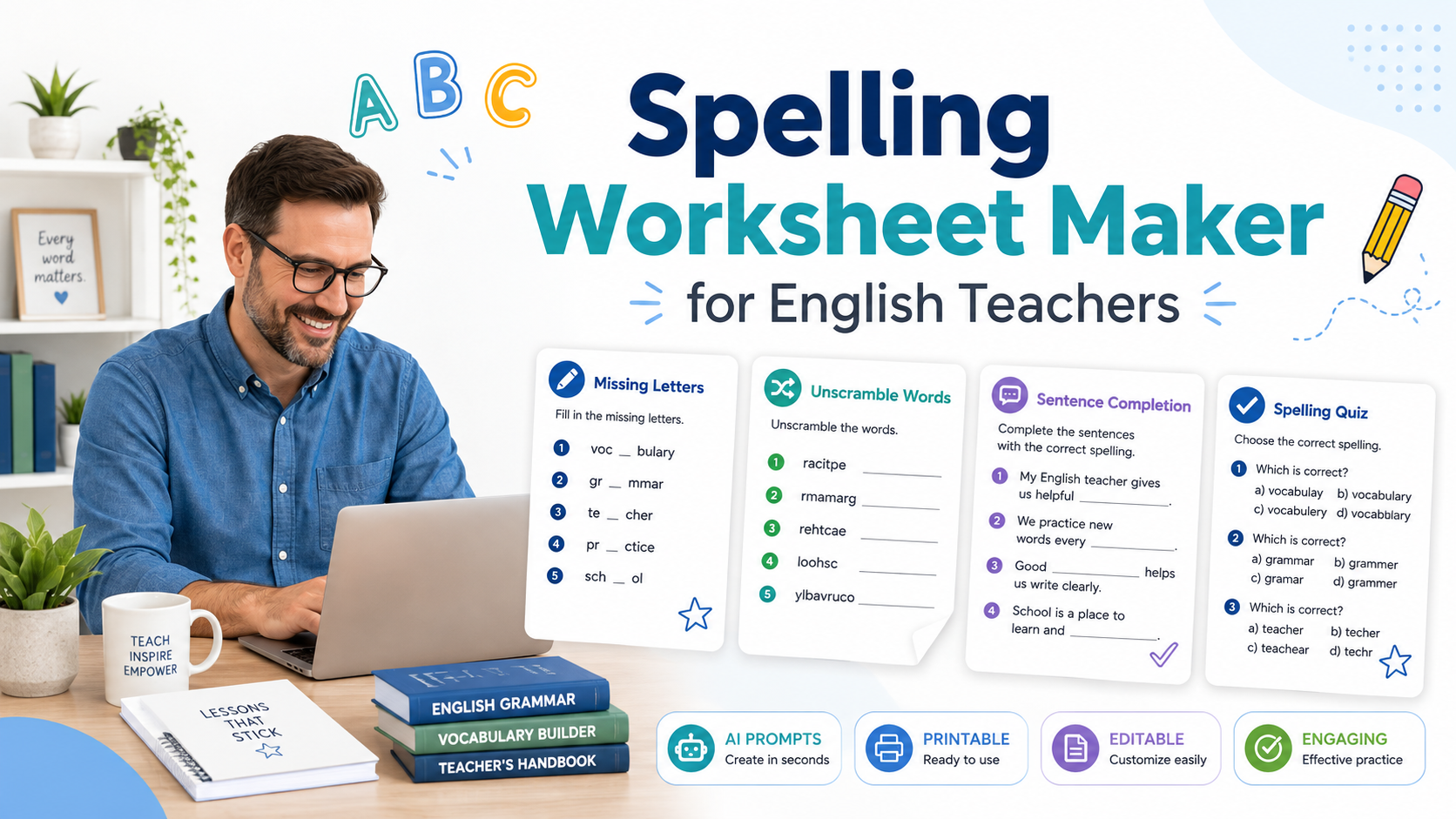
    With AI, a spelling worksheet maker can do more. It can help you create:

    • missing-letter activities;
    • word unscramble tasks;
    • sentence completion exercises;
    • dictation sentences;
    • word-family practice;
    • pronunciation-focused spelling practice;
    • vocabulary review;
    • differentiated spelling worksheets;
    • answer keys;
    • short spelling quizzes.

    For English teachers, the advantage is flexibility. Instead of using the same worksheet format every time, you can ask AI to create spelling practice that matches the level, topic, and lesson aim.

    For example, a spelling worksheet for A1 learners may focus on simple classroom words such as book, pen, desk, and teacher. A worksheet for B1 learners may practise more complex vocabulary such as environment, recycling, pollution, and solution.

    Why English Teachers Should Use AI for Spelling Worksheets

    Spelling worksheets can take time to prepare, especially if you want them to be more useful than simple copying practice. AI can help you create a first draft faster.

    A spelling worksheet generator can help English teachers:

    • prepare vocabulary review quickly;
    • create practice from a word list;
    • generate example sentences;
    • make differentiated worksheets;
    • create spelling quizzes;
    • add answer keys;
    • connect spelling with meaning and usage;
    • adapt the same words for different student levels.

    This is especially helpful for private tutors and busy classroom teachers. You can take words from a textbook unit, reading text, speaking lesson, or vocabulary list and turn them into a complete worksheet in minutes.

    However, AI should not be used blindly. Teachers still need to check the spelling, sentence quality, word meaning, level, and answer key before using the worksheet with students.

    What Makes a Good Spelling Worksheet?

    A good spelling worksheet should do more than ask students to copy words five times. Copying can help with handwriting and memory, but it is not enough for meaningful vocabulary learning.

    A useful spelling worksheet should include some of these elements:

    • the target words;
    • clear instructions;
    • a simple task progression;
    • spelling pattern practice;
    • meaning-based practice;
    • sentence-level use;
    • pronunciation awareness;
    • review or quiz section;
    • answer key;
    • optional speaking or writing follow-up.

    For ESL/EFL learners, it is useful to connect spelling with meaning. For example, if the target word is improve, students should not only spell it correctly. They should also understand how to use it:

    I want to improve my English speaking skills.

    This is why AI can be helpful. It can quickly turn a spelling list into example sentences, short dialogues, matching tasks, or review questions.

    How to Use AI as a Spelling Worksheet Maker

    The quality of your spelling worksheet depends on your prompt. A weak prompt gives weak results.

    A weak prompt would be:

    Create a spelling worksheet.
    

    A better prompt would be:

    Create a spelling worksheet for A2 ESL learners using these words: improve, practise, mistake, listen, repeat, sentence, grammar, vocabulary.
    
    Include:
    1. missing letters;
    2. word unscramble;
    3. sentence completion;
    4. a short dictation section;
    5. an answer key.
    
    Use simple instructions and natural example sentences.
    

    The second prompt gives AI the information it needs: level, learner type, target words, activity types, and answer key.

    Prompt 1: Basic Spelling Worksheet Maker Prompt

    Use this prompt when you want a simple spelling worksheet from a word list.

    Act as an experienced English teacher.
    
    Create a spelling worksheet for [LEVEL] ESL learners using the following words:
    
    [PASTE WORD LIST]
    
    Include:
    1. a word list section;
    2. missing-letter practice;
    3. word unscramble;
    4. sentence completion;
    5. an answer key.
    
    Use clear instructions and keep the example sentences appropriate for [LEVEL] learners.
    

    Example

    If your students are A2 learners studying school vocabulary, you could use:

    Create a spelling worksheet for A2 ESL learners using these words:
    
    subject, classroom, homework, notebook, teacher, student, lesson, question
    
    Include missing-letter practice, word unscramble, sentence completion, and an answer key.
    

    This gives students different ways to practise the same words. They recognise the spelling, reconstruct the spelling, and use the words in context.

    Prompt 2: Missing-Letter Spelling Worksheet

    Missing-letter activities are useful because students have to pay attention to word structure. They are also easy to adapt for different levels.

    Create a missing-letter spelling worksheet for [LEVEL] English learners.
    
    Target words:
    [PASTE WORD LIST]
    
    For each word:
    1. remove 2–4 letters depending on word difficulty;
    2. provide a short clue or simple definition;
    3. include space for students to write the full word.
    
    Add an answer key at the end.
    

    Example

    For the words weather, cloudy, rainy, and sunny, AI might create:

    • w _ _ th _ r — the condition outside, such as rain or sun
    • c _ ou _ y — when there are many clouds
    • r _ _ ny — when water falls from the sky
    • s _ nn _ — when there is a lot of sun

    This works well for younger learners, beginner ESL students, and quick review activities.

    Teacher tip

    Do not remove too many letters. If the word becomes impossible to recognise, the activity becomes frustrating rather than useful.

    Prompt 3: Word Unscramble Worksheet

    Word unscramble tasks are simple but effective for spelling recognition. They work well as warm-ups, revision tasks, or homework.

    Create a word unscramble spelling worksheet for [LEVEL] ESL learners.
    
    Use these words:
    [PASTE WORD LIST]
    
    For each item:
    1. scramble the letters;
    2. give a short meaning clue;
    3. leave a blank line for the correct spelling.
    
    Add an answer key.
    

    Example

    For a travel lesson, you could use:

    Create a word unscramble worksheet for A2 ESL learners using these words:
    
    ticket, airport, luggage, passport, hotel, journey, tourist, station
    
    Add simple meaning clues and an answer key.
    

    This helps students review vocabulary while focusing on correct spelling.

    Prompt 4: Spelling Worksheet Generator for Spelling Words in Context

    A common problem with spelling worksheets is that words are practised in isolation. But English learners need to use words in meaningful sentences.

    Use this prompt when you want spelling and vocabulary practice together.

    Create a spelling worksheet for [LEVEL] ESL learners using these spelling words:
    
    [PASTE WORD LIST]
    
    For each word:
    1. write one natural example sentence with a blank;
    2. provide the first letter of the missing word;
    3. make sure the sentence gives enough context;
    4. include an answer key.
    
    After the sentence section, add 5 personalised questions using the same words.
    

    Example

    Target words:

    • improve;
    • practise;
    • mistake;
    • remember;
    • difficult.

    AI could create sentences like:

    1. I want to i________ my English speaking this year.
    2. It is normal to make a m________ when you learn a new language.
    3. This word is d________ to spell.

    This kind of worksheet is more useful because it connects spelling with meaning.

    Prompt 5: Dictation-Based Spelling Worksheet

    Dictation is useful for connecting spelling with listening. For English learners, this is important because English spelling and pronunciation are not always simple.

    Use this prompt to create a spelling worksheet with dictation sentences.

    Create a dictation-based spelling worksheet for [LEVEL] ESL learners.
    
    Target words:
    [PASTE WORD LIST]
    
    Include:
    1. a short preparation section where students read the words;
    2. 8 dictation sentences using the target words;
    3. a student self-check section;
    4. a short reflection question;
    5. an answer key for the teacher.
    
    Keep the sentences natural and appropriate for [LEVEL].
    

    Example classroom use

    You can use this in three steps:

    1. Students read the target words silently.
    2. You read the sentences aloud.
    3. Students write the full sentence or only the missing target word.
    4. Students compare with a partner.
    5. You review common spelling mistakes on the board.

    This is especially useful for words that students often hear but misspell.

    Prompt 6: Differentiated Spelling Worksheet

    If you teach mixed-level classes, one spelling worksheet may not fit everyone. AI can help create easier and harder versions from the same word list.

    Create two versions of a spelling worksheet using the same word list.
    
    Target words:
    [PASTE WORD LIST]
    
    Version A:
    For lower-level students. Include missing letters, matching, and simple sentence completion.
    
    Version B:
    For stronger students. Include word families, sentence writing, and a short paragraph task.
    
    Add answer keys for both versions.
    

    Why this works

    This allows all students to practise the same vocabulary, but at different levels of challenge.

    For example, with the word communicate:

    • Version A may ask students to complete: c _ m m _ n _ c _ t e
    • Version B may ask students to write a sentence using communication or communicative.

    This is much more useful than giving every student the exact same task.

    Prompt 7: Spelling Quiz Maker Prompt

    Sometimes you do not need a full worksheet. You need a quick quiz or review sheet. AI can help create one from your word list.

    Create a short spelling quiz for [LEVEL] ESL learners.
    
    Target words:
    [PASTE WORD LIST]
    
    Include:
    1. 5 missing-letter questions;
    2. 5 sentence completion questions;
    3. 5 choose-the-correct-spelling questions;
    4. a bonus sentence-writing question;
    5. an answer key.
    
    Make the quiz clear and printable.
    

    Example quiz item types

    Missing letters:
    v _ c _ b _ l _ r y

    Sentence completion:
    I keep new words in my __________ notebook.

    Choose the correct spelling:
    a) grammer
    b) grammar
    c) gramar

    These item types are easy to mark and useful for review.

    A Complete AI Spelling Worksheet Workflow

    Here is a simple workflow English teachers can use.

    Step 1: Choose the words

    Use words from your lesson, reading text, coursebook unit, or student errors. Avoid random word lists unless your goal is general review.

    Step 2: Decide the purpose

    Ask yourself:

    • Is this for vocabulary review?
    • Is this for spelling correction?
    • Is this for pronunciation support?
    • Is this for homework?
    • Is this for a quiz?
    • Is this for weaker students or stronger students?

    Step 3: Choose the activity types

    For a balanced spelling worksheet, include three types:

    1. recognition activity;
    2. controlled spelling practice;
    3. meaningful sentence use.

    For example:

    • word unscramble;
    • missing letters;
    • sentence completion.

    Step 4: Generate the worksheet with AI

    Use one of the prompts above.

    Step 5: Review the output

    Check:

    • Are all words spelled correctly?
    • Are the example sentences natural?
    • Are the clues clear?
    • Is the level appropriate?
    • Is the answer key correct?
    • Is there enough space for students to write?
    • Are the instructions simple?

    Step 6: Add a communicative follow-up

    Even a spelling worksheet can end with speaking or writing.

    For example:

    Add a short pair-work activity where students ask and answer questions using five of the spelling words.
    

    This helps students move from spelling practice to real language use.

    Example: AI Spelling Worksheet for ESL Vocabulary Review

    Let’s say you are teaching A2 students vocabulary about daily routines.

    Target words:

    • breakfast;
    • shower;
    • school;
    • homework;
    • evening;
    • usually;
    • sometimes;
    • early.

    You could use this prompt:

    Create an A2 ESL spelling worksheet about daily routines.
    
    Target words:
    breakfast, shower, school, homework, evening, usually, sometimes, early
    
    Include:
    1. missing letters;
    2. word unscramble;
    3. sentence completion;
    4. 4 speaking questions using the target words;
    5. an answer key.
    
    Use simple instructions and natural examples.
    

    The result could include spelling practice and questions like:

    • What do you usually do in the evening?
    • Do you sometimes wake up early?
    • When do you do your homework?
    • What do you usually eat for breakfast?

    This makes the worksheet more communicative and more useful for English learning.

    Common Mistakes to Avoid When Creating Spelling Worksheets with AI

    Mistake 1: Using random word lists

    A spelling worksheet should connect to your lesson. If the words are random, students may practise spelling but not improve useful vocabulary.

    Mistake 2: Making students only copy words

    Copying words can be part of the worksheet, but it should not be the whole worksheet. Add meaning, sentence use, or dictation.

    Mistake 3: Ignoring pronunciation

    English spelling is connected to sound, even when the connection is difficult. For ESL/EFL learners, dictation and pronunciation awareness can make spelling practice stronger.

    Mistake 4: Not checking the answer key

    AI can make mistakes. Always check the spelling, grammar, and answers before using the worksheet.

    Mistake 5: Making the worksheet too long

    A spelling worksheet does not need to be huge. A short, focused worksheet is often better than a long worksheet with repeated tasks.

    Mistake 6: Forgetting student level

    Words like environment, achievement, and communication may be useful, but they are not suitable for every level. Always tell AI the learner level.

    Mistake 7: Not adding context

    Students remember spelling better when words appear in meaningful sentences, topics, or personal questions.

    Mini Template: Printable Spelling Worksheet Structure

    You can use this structure for many English lessons:

    Title: Spelling Practice: [Topic]

    Section 1: Read the Words
    Students read the target words.

    Section 2: Complete the Missing Letters
    Students complete partial words.

    Section 3: Unscramble the Words
    Students put letters in the correct order.

    Section 4: Complete the Sentences
    Students choose the correct word from the list.

    Section 5: Use the Words
    Students write their own sentences or answer speaking questions.

    Section 6: Check Your Work
    Students compare answers with a partner or use a teacher-provided answer key.

    This structure is simple, but it works well for ESL/EFL classes.

    FAQ: Spelling Worksheet Maker

    What is a spelling worksheet maker?

    A spelling worksheet maker is a tool or workflow that helps teachers create spelling practice activities from a list of words. With AI, it can also create missing-letter tasks, word scrambles, sentence completion exercises, dictation sentences, quizzes, and answer keys.

    Can AI create spelling worksheets?

    Yes, AI can create spelling worksheets from your word list. For best results, give the AI the learner level, target words, topic, activity types, and answer key requirements.

    How do I create spelling worksheets with AI?

    Start with a word list, choose the learner level, decide the activity types, and ask AI to create a worksheet with clear instructions and an answer key. Then review the output before using it with students.

    What is the best spelling worksheet format for ESL students?

    A useful format includes word recognition, spelling practice, and sentence use. For example: missing letters, word unscramble, sentence completion, and a short speaking or writing task.

    Can I make spelling worksheets for different levels?

    Yes. You can ask AI to create easier and harder versions of the same worksheet. Lower-level students can practise missing letters and matching, while stronger students can write sentences or short paragraphs.

    Should spelling worksheets include answer keys?

    Yes. An answer key saves time and helps teachers check the worksheet for mistakes before using it.

    Are spelling worksheets useful for adult English learners?

    Yes, if they are meaningful and relevant. Adult learners usually benefit more from spelling practice connected to useful vocabulary, work situations, travel, study, or real communication.

    Conclusion

    A spelling worksheet maker can save English teachers time, but the goal is not just to generate a printable page. The goal is to create spelling practice that helps students notice word forms, understand meaning, use vocabulary in context, and become more confident English learners.

    AI can help you create missing-letter tasks, word scrambles, dictation sentences, spelling quizzes, and differentiated worksheets. But your teaching judgement is still essential. Choose useful words, set a clear level, review the answer key, and add meaningful sentence or speaking practice.

    Used well, AI becomes more than a spelling worksheet generator. It becomes a practical assistant that helps you create better vocabulary and spelling materials for your English lessons.

  • 7 Best Customizable Worksheet Software with AI for English Teachers

    7 Best Customizable Worksheet Software with AI for English Teachers

    Choosing the best customizable worksheet software can save English teachers hours of preparation time. The right tool should help you create editable worksheets, adapt tasks to student level, change question types, add answer keys, and prepare printable or digital activities for ESL lessons.

    For English teachers, the best worksheet software is not only the tool that creates a worksheet quickly. It is the tool that lets you customize the worksheet so it actually fits your students, your lesson aim, your classroom format, and your teaching style.

    In this guide, we compare seven AI and teacher-friendly worksheet tools. You will see which tools are useful for ESL worksheets, reading activities, quizzes, vocabulary practice, printable handouts, differentiated tasks, and classroom-ready materials.

    If you want a broader workflow for creating worksheet content with prompts, start with AI Worksheet Generator for English Teachers. This article focuses more specifically on where to find the best customizable worksheet software and how to choose the right tool.

    Best Software for Teacher Worksheet Customization: Quick Answer

    The best software for teacher worksheet customization depends on what you need.

    For ESL and English teachers, a strong worksheet tool should help you:

    • create editable worksheet content;
    • adapt questions to learner level;
    • generate grammar, vocabulary, reading, listening, or quiz tasks;
    • add answer keys;
    • change instructions;
    • export or print the final worksheet;
    • reuse the worksheet in future lessons.

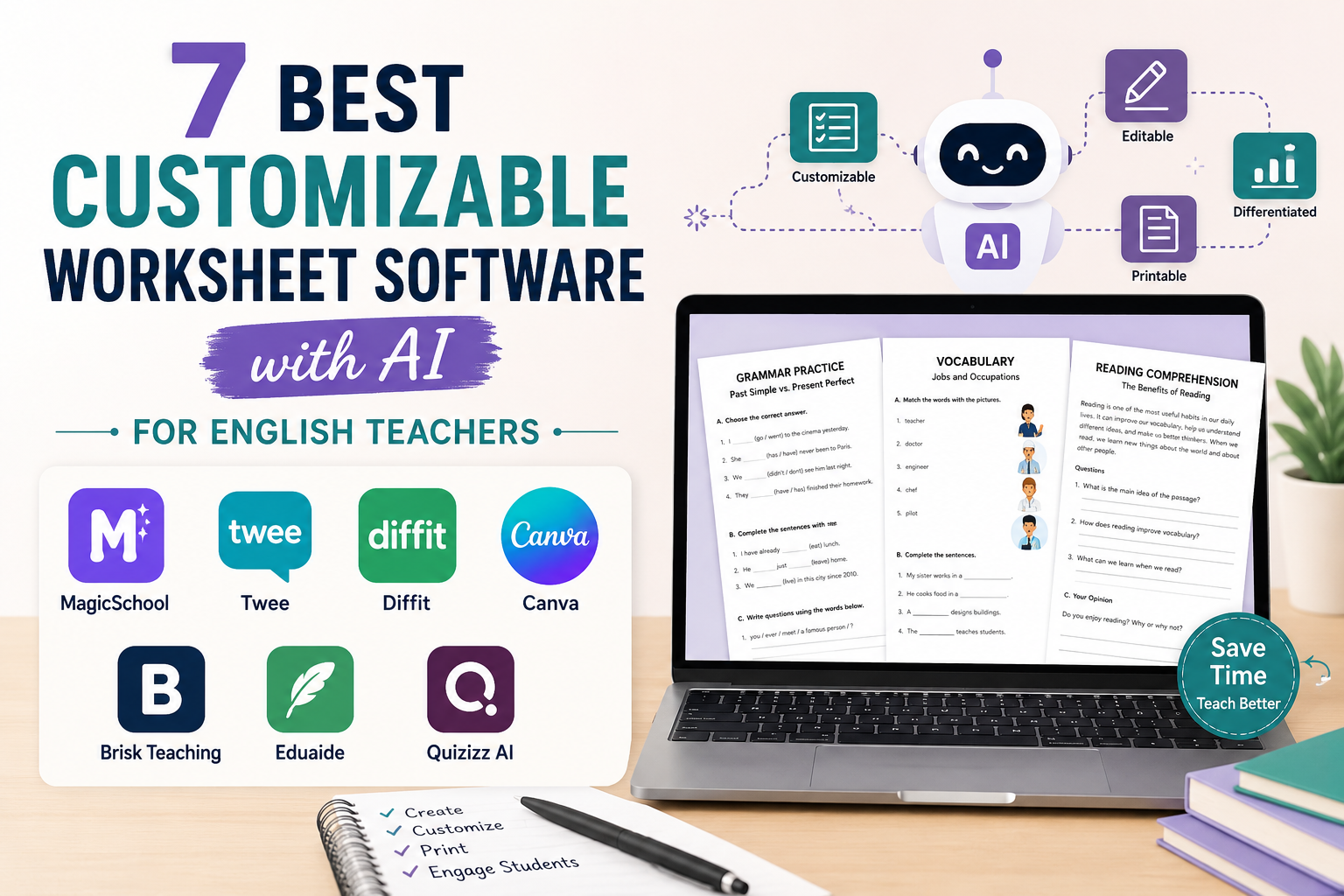
    If you want fast AI-generated worksheet drafts, tools such as MagicSchool, Twee, Diffit, Brisk Teaching, and Eduaide are worth exploring.

    If you want beautiful printable worksheet layouts, Canva is especially useful. If you want quizzes and interactive practice, Quizizz can help you turn questions into digital activities.

    For most English teachers, the best option is not one single tool. A practical workflow is to generate the worksheet content with an AI tool, edit it for your learners, and then format it for print or digital use.

    Quick Comparison: Customizable Worksheet Software for Teachers

    ToolBest forCustomization strengthGood for ESL teachers?
    TweeESL/EFL exercises and language tasksHighYes
    MagicSchoolFast AI worksheet draftsHighYes
    DiffitReading worksheets and differentiated textsHighYes
    Brisk TeachingCreating materials from web pages, docs, and classroom resourcesHighYes
    CanvaPrintable design and visual worksheetsVery high for layoutYes
    QuizizzDigital quizzes and interactive practiceMedium to highYes
    EduaideTeacher resources, worksheets, and classroom materialsHighYes

    This table gives you a quick starting point. The best choice depends on whether you need worksheet content, printable design, quiz features, reading differentiation, or an all-in-one teacher workspace.

    What to Look for in Teacher Worksheet Customization Software

    Before choosing a tool, think about what “customizable” really means.

    A good worksheet tool should let you change:

    • the student level;
    • the topic;
    • the grammar point;
    • the vocabulary list;
    • the number of questions;
    • the question type;
    • the instructions;
    • the examples;
    • the answer key;
    • the layout;
    • the export format.

    For ESL teachers, customization is especially important because one worksheet rarely fits every class. A worksheet for A2 students should look different from a worksheet for B2 students. A worksheet for young learners should look different from a worksheet for adult learners.

    When you create reading or vocabulary tasks, you may also want to adapt the text level. For this kind of workflow, you can connect your software choice with the ideas in Reading Worksheet Generator and Spelling Worksheet Maker.

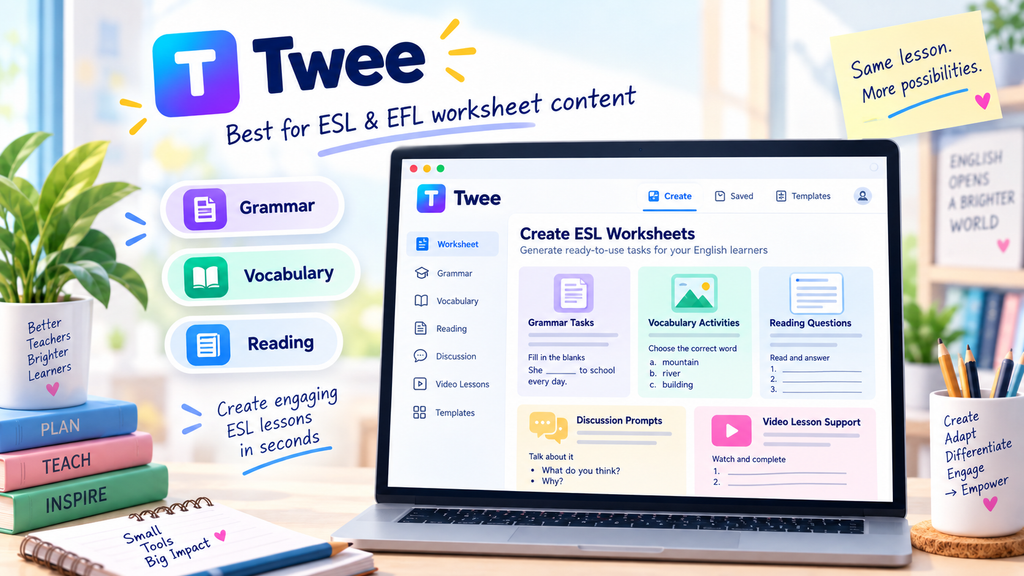
    1. Twee: Best Customizable Worksheet Software for ESL and EFL Teachers

    Best customizable worksheet software with AI for English teachers
    Twee is useful for creating ESL grammar, vocabulary, reading, speaking, and video-based worksheet activities.

    Twee is one of the most relevant tools for English teachers because it is built around language teaching tasks. It can help teachers create grammar exercises, vocabulary activities, discussion questions, reading tasks, listening materials, video-based activities, and other classroom resources.

    For ESL/EFL teachers, Twee is useful because the tool categories match what English teachers often prepare:

    • grammar practice;
    • vocabulary exercises;
    • reading comprehension;
    • discussion questions;
    • video and audio tasks;
    • writing activities;
    • classroom prompts.

    This makes it a strong choice if you want customizable worksheet software that feels close to actual English teaching.

    Why English teachers may like it

    Twee is useful when you already know your lesson topic and need several task types quickly. For example, if your lesson is about travel problems, you can create vocabulary practice, discussion questions, grammar tasks, and reading questions around the same topic.

    If you are preparing an ESL lesson plan, you can use Twee to create the worksheet activities, then connect them to a lesson structure using Lesson Plan Generator.

    Best use case

    Use Twee when you want language-focused worksheet tasks, especially for grammar, vocabulary, reading, speaking, and video lessons.

    Possible limitation

    You still need to review the worksheet carefully. AI-generated exercises can be useful, but teachers should check the level, answer key, wording, and classroom suitability before using them.

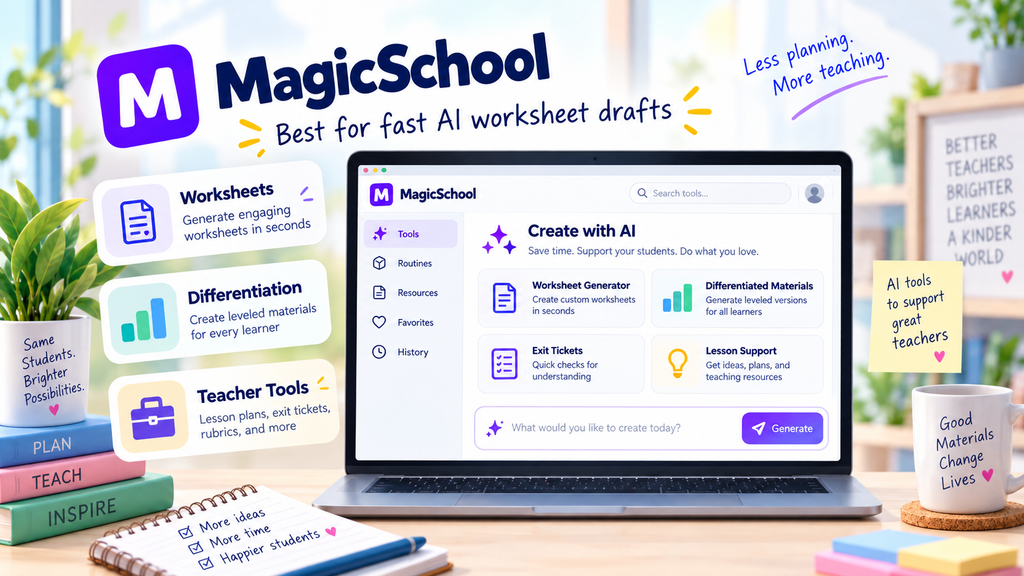
    2. MagicSchool: Best for Fast AI Worksheet Drafts

    MagicSchool AI worksheet generator for teachers
    MagicSchool helps teachers create fast AI worksheet drafts, differentiated materials, exit tickets, and classroom resources.

    MagicSchool offers an AI worksheet generator and many other teacher tools. It is useful when you want to create a worksheet draft quickly from a topic, grade level, or learning objective.

    For English teachers, MagicSchool can be helpful when you need a quick starting point for:

    • grammar worksheets;
    • vocabulary practice;
    • reading comprehension;
    • short quizzes;
    • exit tickets;
    • lesson activities;
    • differentiated tasks.

    It is also useful if you want one teacher platform with many AI tools, not only worksheet generation.

    Why English teachers may like it

    MagicSchool can help reduce blank-page time. Instead of writing every question manually, you can generate a first draft and then edit it for your students.

    For example, after reading AI Worksheet Generator for English Teachers, you could use MagicSchool to create a first draft and then revise the worksheet with the prompts from that guide.

    Best use case

    Use MagicSchool when you want quick AI-generated worksheet drafts and a wider collection of teacher tools in one place.

    Possible limitation

    The output may still need teacher editing. For ESL learners, always check that the language level, examples, and instructions match your class.

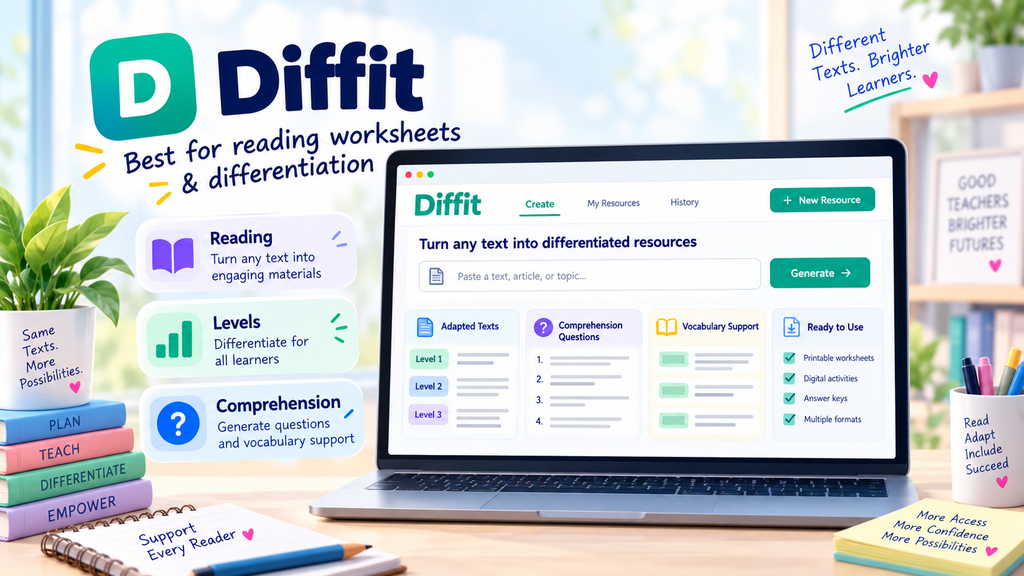
    3. Diffit: Best for Reading Worksheets and Differentiation

    Diffit reading worksheet customization tool for teachers
    Diffit is especially useful for adapting reading texts, generating comprehension questions, and supporting differentiated reading tasks.

    Diffit is especially useful when you want to create reading materials and differentiated resources. It can help teachers create adapted texts, comprehension questions, vocabulary activities, and classroom-ready materials.

    This makes Diffit a strong choice if your main need is reading-based worksheets.

    For English teachers, it can support:

    • reading passages;
    • comprehension questions;
    • vocabulary support;
    • different reading levels;
    • classroom handouts;
    • student-friendly texts.

    Why English teachers may like it

    Reading worksheets often take a long time to prepare because teachers need a suitable text, level-appropriate vocabulary, fair comprehension questions, and an answer key. Diffit can help create a more complete reading resource faster.

    If you publish or teach reading lessons often, Diffit works well alongside your Reading Worksheet Generator workflow.

    Best use case

    Use Diffit when you want to create reading worksheets, adapt texts to different levels, or prepare differentiated reading tasks.

    Possible limitation

    Diffit may be less focused on general ESL speaking or grammar tasks than tools designed specifically for language teachers. It is strongest when the worksheet is built around text and reading comprehension.

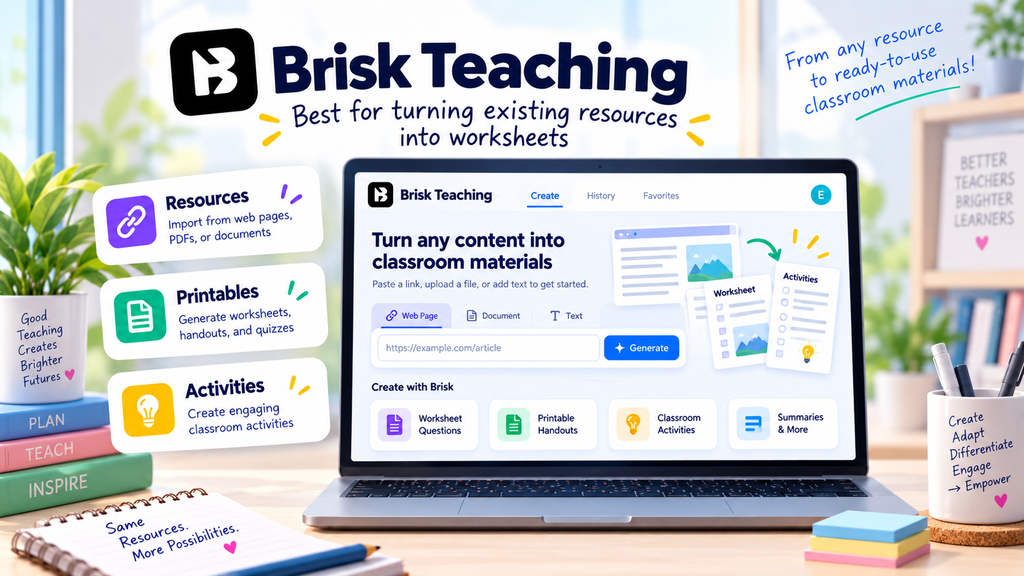
    4. Brisk Teaching: Best for Turning Existing Resources into Worksheets

    Brisk Teaching tool for turning resources into worksheets
    Brisk Teaching helps teachers turn existing articles, documents, web pages, and videos into classroom-ready materials.

    Brisk Teaching is useful when you want to create teaching materials from resources you already use, such as web pages, documents, videos, or classroom content. Its printables and classroom material features can help teachers create worksheets, questions, activities, and other resources.

    For English teachers, Brisk can be helpful when you already have a text, article, video, or lesson source and want to turn it into a worksheet.

    It can support:

    • worksheets;
    • printables;
    • questions and answers;
    • vocabulary practice;
    • exit tickets;
    • classroom activities;
    • resource adaptation.

    Why English teachers may like it

    Brisk is practical because many teachers do not start from zero. They often start with a web page, a reading text, a Google Doc, a video, or an existing resource. Brisk can help transform that material into something more teachable.

    If you use videos in class, you can combine this kind of tool with AI Video Question Maker to create comprehension questions, vocabulary tasks, and discussion prompts.

    Best use case

    Use Brisk when you want to transform existing content into classroom materials.

    Possible limitation

    As with any AI tool, you should check accuracy, answer keys, copyright issues, and student level before sharing the final worksheet.

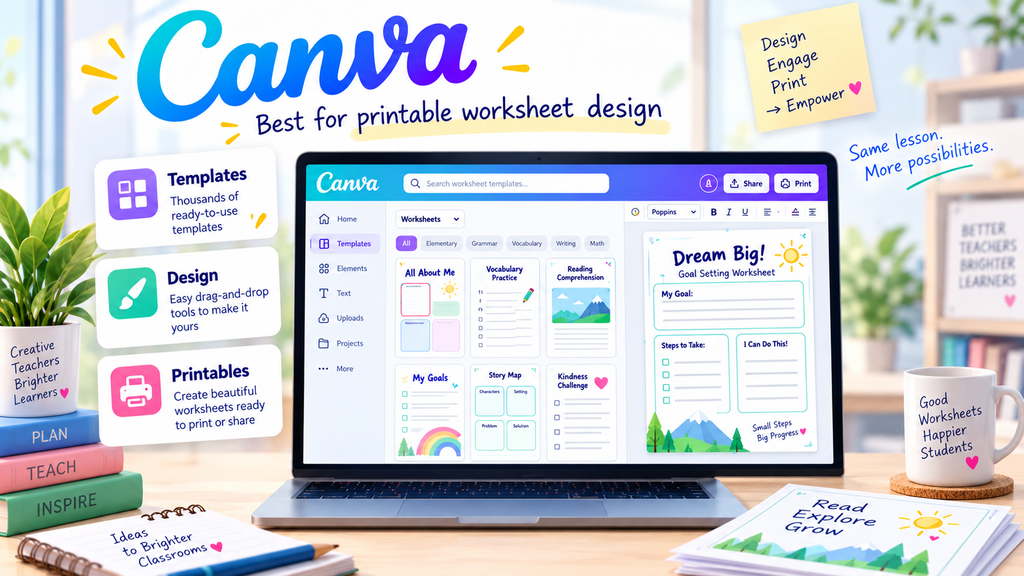
    5. Canva: Best for Printable Worksheet Design

    Canva worksheet design tool for printable teacher resources
    Canva is useful for designing polished printable worksheets, handouts, quizzes, and classroom materials.

    Canva is not only an AI worksheet tool. It is also a design platform with worksheet templates. This makes it useful when you already have worksheet content but want the final version to look clean, professional, and printable.

    For English teachers, Canva can help with:

    • printable worksheets;
    • vocabulary worksheets;
    • reading handouts;
    • grammar practice pages;
    • quiz sheets;
    • classroom posters;
    • lesson materials;
    • student-friendly layouts.

    Why English teachers may like it

    Many AI tools create useful text but plain formatting. Canva helps you turn that content into a worksheet students actually want to use.

    For example, you can generate a quiz using ESL Quiz Templates, then paste the questions into Canva and format them with headings, answer spaces, icons, and sections.

    Best use case

    Use Canva when design, layout, printing, and visual clarity matter.

    Possible limitation

    Canva is strongest for design. If you need deep ESL-specific question generation, you may want to create the content with another AI tool first and then format it in Canva.

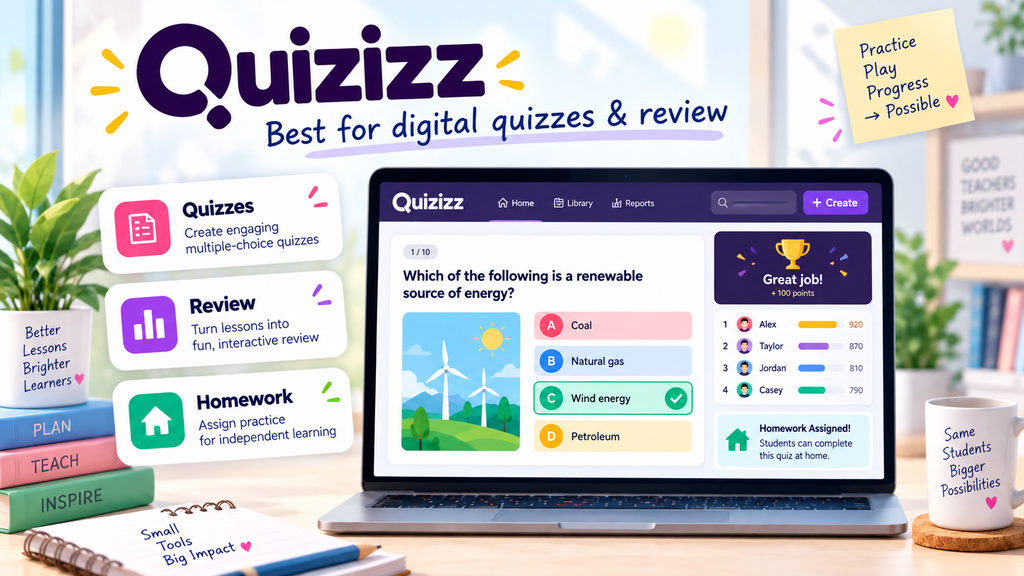
    6. Quizizz: Best for Turning Worksheets into Digital Quizzes

    Quizizz digital quiz tool for English teachers
    Quizizz works well for turning worksheet questions into interactive quizzes, homework, and review activities.

    Quizizz is useful when you want to turn questions into interactive quizzes, digital practice, or review activities. It is not the same as a printable worksheet design tool, but it can be a strong option when your worksheet is quiz-based.

    For English teachers, Quizizz can support:

    • grammar quizzes;
    • vocabulary review;
    • reading checks;
    • listening comprehension questions;
    • homework practice;
    • revision games;
    • low-stakes assessment.

    Why English teachers may like it

    Some worksheets work better as interactive quizzes. If you want students to practise repeatedly, answer questions online, or complete a quick review activity, Quizizz can be more engaging than a paper worksheet.

    This is especially useful after creating questions with ESL Quiz Templates.

    Best use case

    Use Quizizz when your worksheet is mainly a quiz, review task, or digital assessment activity.

    Possible limitation

    Quizizz is not always the best choice for long-form worksheets, writing practice, or printable design. It works best when the activity is question-based.

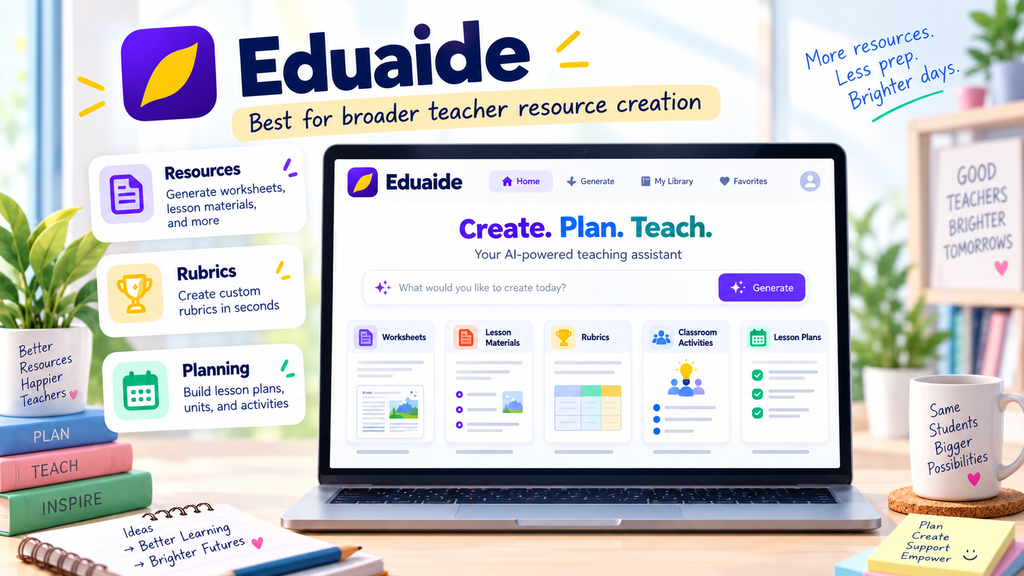
    7. Eduaide: Best for Teacher Resource Creation and Classroom Materials

    Eduaide AI teaching resource generator for worksheets and lesson materials
    Eduaide helps teachers create worksheets, rubrics, lesson materials, activities, and broader classroom resources.

    Eduaide is an AI teaching platform that can help teachers create worksheets, lesson materials, discussion activities, rubrics, assessments, and classroom resources. It is useful if you want a broader teacher workspace rather than a single-purpose worksheet generator.

    For English teachers, Eduaide can help create:

    • worksheets;
    • lesson materials;
    • classroom activities;
    • assessment tasks;
    • graphic organizers;
    • differentiated resources;
    • support materials.

    Why English teachers may like it

    Eduaide can be useful when worksheet creation is part of a larger planning workflow. For example, you may want to create the lesson aim, classroom activity, worksheet, exit ticket, and homework in one planning process.

    This connects naturally with ChatGPT Lesson Planning if you want to build a full teaching workflow rather than one isolated worksheet.

    Best use case

    Use Eduaide when you want worksheet creation inside a broader teacher planning and resource-generation platform.

    Possible limitation

    For ESL-specific tasks, you may still need to adjust the language level, examples, and instructions carefully.

    Where to Find the Best Customizable Worksheet Software

    If you are wondering where to find best customizable worksheet software, start by thinking about the type of worksheet you want to create.

    You can find customizable worksheet software in four main places:

    1. AI worksheet generators;
    2. ESL/EFL teacher tools;
    3. quiz and assessment platforms;
    4. design platforms.

    AI worksheet generators are useful when you want fast content. ESL/EFL teacher tools are useful when you need language-focused tasks. Quiz platforms are useful when the worksheet is mainly for checking understanding. Design platforms are useful when you want the final worksheet to look polished and printable.

    For English teachers, the best place to start is with tools that allow editing. A worksheet is only useful if you can adjust the level, instructions, question types, examples, and answer key for your learners.

    Best Tool by Teaching Need

    Best for ESL grammar and vocabulary worksheets

    Use Twee if you want language-focused activities for grammar, vocabulary, reading, speaking, and listening.

    Best for fast worksheet drafts

    Use MagicSchool if you want a quick AI-generated worksheet draft that you can edit.

    Best for reading worksheets

    Use Diffit if you want adapted reading passages, comprehension questions, and vocabulary support.

    Best for existing resources

    Use Brisk Teaching if you already have an article, document, video, or classroom resource and want to turn it into a worksheet or printable.

    Best for worksheet design

    Use Canva if you want printable layouts, visual design, and clean student handouts.

    Best for digital quizzes

    Use Quizizz if your worksheet is better as an interactive quiz or review activity.

    Best for broader teacher planning

    Use Eduaide if you want worksheet creation together with lesson materials, classroom activities, rubrics, and other teaching resources.

    How to Choose the Best Worksheet Software for English Teachers

    Before choosing a tool, ask yourself these questions:

    1. Do I need a printable worksheet or a digital activity?
    2. Do I need ESL-specific grammar and vocabulary tasks?
    3. Do I need reading-level adaptation?
    4. Do I need a beautiful design?
    5. Do I need answer keys?
    6. Do I need quizzes?
    7. Do I need to edit every part of the worksheet?
    8. Do I want to reuse the worksheet later?
    9. Do I need free access or paid features?
    10. Does the tool fit my teaching workflow?

    For example, if you teach a B1 reading lesson, you might create the reading task in Diffit, add extra questions using the Reading Worksheet Generator prompts, and then format the final handout in Canva.

    If you teach grammar and vocabulary, you might use Twee or MagicSchool to create the worksheet draft, then use your own examples to make the tasks more relevant to your students.

    A Practical Workflow for Customizable Worksheets

    Here is a simple workflow English teachers can use.

    Step 1: Start with the lesson aim

    Do not start with the tool. Start with the purpose.

    Example:

    Students will be able to use past simple verbs to describe weekend activities.

    Step 2: Choose the worksheet type

    Decide whether you need:

    • grammar practice;
    • vocabulary review;
    • reading comprehension;
    • listening questions;
    • video questions;
    • speaking preparation;
    • writing support;
    • quiz practice.

    Step 3: Generate the first draft

    Use an AI worksheet tool or prompt to create the first version.

    Step 4: Customize the worksheet

    Edit the:

    • level;
    • examples;
    • instructions;
    • number of questions;
    • difficulty;
    • answer key;
    • classroom context.

    Step 5: Format the final version

    Use a design tool such as Canva if you want the worksheet to look more polished.

    Step 6: Test the worksheet quickly

    Before using it in class, ask:

    • Are the instructions clear?
    • Is the level suitable?
    • Is the answer key correct?
    • Are there enough examples?
    • Can students complete it in the available time?

    This is where teacher judgement matters most. AI can create the draft, but the teacher makes it useful.

    Example: Choosing Worksheet Software for a B1 ESL Lesson

    Imagine you are teaching a B1 lesson about travel problems.

    Your lesson aim is:

    Students will be able to describe common travel problems and make simple complaints using past simple verbs.

    You could use:

    • Twee to create vocabulary and grammar exercises;
    • MagicSchool to generate a worksheet draft;
    • Diffit to create a short reading text about a travel problem;
    • Quizizz to make a review quiz;
    • Canva to design the final printable worksheet.

    Then you could connect the worksheet to a complete class using Lesson Plan Generator.

    This workflow is stronger than simply asking AI to “make a worksheet” because each tool has a clear role.

    Common Mistakes When Choosing Worksheet Software

    Mistake 1: Choosing the tool before the lesson aim

    A tool cannot fix an unclear lesson aim. Decide what students should practise first.

    Mistake 2: Using AI output without editing

    AI worksheet drafts often need revision. Check the level, instructions, examples, and answers.

    Mistake 3: Choosing design over learning value

    A worksheet can look beautiful but still be weak. The activities must support the lesson aim.

    Mistake 4: Forgetting answer keys

    Answer keys save time and help teachers check the worksheet before class.

    Mistake 5: Ignoring student level

    The best customizable worksheet software should help you adapt the worksheet to A1, A2, B1, B2, or another level.

    Mistake 6: Creating too many activities

    A worksheet does not need to include everything. A focused worksheet is usually better than an overloaded one.

    Mistake 7: Not checking tool limitations

    Some tools are better for content generation. Others are better for design or quizzes. Choose based on your teaching need.

    FAQ: Teacher Worksheet Customization Software

    What is the best software for teacher worksheet customization?

    The best software for teacher worksheet customization is software that lets teachers create, edit, adapt, and export worksheets for their own learners. English teachers should look for level control, editable questions, answer keys, printable layouts, and support for grammar, vocabulary, reading, listening, writing, and quiz tasks.

    Where can I find the best customizable worksheet software?

    You can find the best customizable worksheet software in AI worksheet generators, ESL teacher tools, quiz platforms, teacher productivity platforms, and design tools. Good places to start include tools such as Twee, MagicSchool, Diffit, Brisk Teaching, Canva, Quizizz, and Eduaide.

    What should English teachers look for in worksheet customization software?

    English teachers should look for editable instructions, different question types, learner-level adaptation, answer keys, export options, and the ability to adapt worksheets for ESL grammar, vocabulary, reading, writing, speaking, and listening lessons.

    Is AI worksheet software better than normal worksheet templates?

    AI worksheet software is better for speed and adaptation, while normal worksheet templates are useful for structure and design. The best workflow is often to generate the worksheet content with AI, edit it carefully, and then format it with a clean template.

    What is the best AI worksheet generator for ESL teachers?

    For ESL teachers, the best AI worksheet generator depends on the task. Twee is strong for language-teaching activities, MagicSchool is useful for fast worksheet drafts, Diffit is helpful for reading worksheets, and Canva is useful for printable design.

    Can I use customizable worksheet software for quizzes?

    Yes. Many worksheets can become quizzes. If you want digital quizzes, you can use a platform such as Quizizz. If you want printable quiz worksheets, you can use the prompts in ESL Quiz Templates and then format the result in Canva or another worksheet tool.

    Should teachers use AI-generated worksheets without checking them?

    No. Teachers should always check AI-generated worksheets before using them. Review the instructions, level, examples, answer key, timing, and suitability for your students.

    Final Recommendation

    The best software for teacher worksheet customization is the tool that fits your teaching workflow.

    For ESL and English teachers:

    • use Twee for language-focused ESL activities;
    • use MagicSchool for fast worksheet drafts;
    • use Diffit for reading and differentiation;
    • use Brisk Teaching for turning existing resources into classroom materials;
    • use Canva for printable worksheet design;
    • use Quizizz for digital quizzes;
    • use Eduaide for broader teacher resource creation.

    The best workflow is often to combine tools. Generate the content with AI, customize it for your learners, check the answer key, and format the final worksheet clearly.

    AI can help you save preparation time, but your teacher judgement is what makes the worksheet effective.

  • AI Worksheet Generator for English Teachers: 7 Ways to Create Better ESL Worksheets

    AI Worksheet Generator for English Teachers: 7 Ways to Create Better ESL Worksheets

    An AI worksheet generator can help English teachers create vocabulary, grammar, reading, writing, and speaking worksheets faster. But the best results do not come from simply asking AI to “make a worksheet.” They come from giving the tool clear teaching context: the level, lesson aim, target language, activity type, timing, and answer key format.

    For ESL/EFL teachers and language tutors, AI can be especially useful because worksheets often need to be adapted for different levels, topics, skills, and classroom situations. A worksheet for A2 teenagers is not the same as a worksheet for B2 adult learners, even if both lessons teach the same grammar point.

    This guide shows you how to use AI practically, safely, and professionally to create better English worksheets without producing generic filler.

    What Is an AI Worksheet Generator?

    An AI worksheet generator is any AI tool or chatbot that helps teachers produce worksheet content from instructions. This could include vocabulary exercises, grammar practice, reading comprehension questions, gap-fill tasks, matching activities, speaking prompts, writing tasks, or review quizzes.

    Some teachers use dedicated worksheet tools. Others use general AI tools such as ChatGPT to design worksheet content, adapt texts, create answer keys, or differentiate activities. OpenAI’s education resources describe ChatGPT as useful for teaching workflows such as lesson planning and feedback, but teachers still need to review and adapt the output before using it with students.

    The important point is this: AI should support your teaching judgement, not replace it.

    A good teacher still decides:

    • what students need to practise;
    • whether the task matches the lesson aim;
    • whether the language level is appropriate;
    • whether the instructions are clear;
    • whether the worksheet is useful in a real classroom.

    Why English Teachers Should Use an AI Worksheet Generator

    English teachers often create or adapt worksheets under time pressure. You may need a quick vocabulary review, a grammar worksheet, a reading task, or extra practice for fast finishers.

    An AI worksheet generator can help you:

    • turn a lesson aim into practice activities;
    • create different versions for different levels;
    • generate answer keys;
    • adapt texts for ESL/EFL learners;
    • create vocabulary and grammar exercises quickly;
    • prepare homework or revision sheets;
    • build worksheets around students’ interests.

    For example, instead of spending 30 minutes creating a worksheet on the present perfect, you can ask AI to draft a first version in two minutes. Then you spend your time improving, checking, and adapting it.

    That is the best use of AI: not replacing the teacher, but reducing repetitive preparation work.

    The Best AI Worksheet Generator Workflow for English Teachers

    The biggest mistake teachers make is using prompts that are too general. A weak prompt gives you a weak worksheet.

    Compare these two prompts:

    Weak prompt:

    Create a worksheet about the present perfect.
    

    Better prompt:

    Create an ESL worksheet for B1 learners practising the present perfect for life experiences. The lesson context is travel and personal achievements. Include:
    1. a short warm-up question section;
    2. a controlled gap-fill activity;
    3. a sentence transformation activity;
    4. a short speaking task;
    5. an answer key.
    Use clear instructions and avoid difficult vocabulary.
    

    The second prompt gives the AI a teaching situation. That produces a much more useful result.

    Step 1: Define the Teaching Aim

    Before using an AI worksheet maker, write one clear teaching aim.

    Examples:

    • Students will practise using past simple vs present perfect.
    • Students will learn 10 vocabulary items related to travel problems.
    • Students will read a short text and answer gist and detail questions.
    • Students will practise giving advice using should and shouldn’t.
    • Students will write a short opinion paragraph using linking words.

    If you cannot explain the aim, the AI will probably create a random worksheet.

    Step 2: Add the Learner Level

    Always include the learner level. For English teaching, CEFR levels can be helpful because they give you a common language for difficulty, such as A1, A2, B1, B2, C1, and C2. The Council of Europe’s CEFR Companion Volume is the official reference for updated CEFR descriptors and language education guidance.

    Example:

    The students are A2 ESL learners. Keep sentences short and use familiar vocabulary.
    

    Or:

    The students are B2 EFL learners. Include more natural expressions and a short discussion task.
    

    This helps the AI control vocabulary, grammar, sentence length, and task difficulty.

    Step 3: Choose the Worksheet Type

    Different worksheet types serve different purposes. Tell the AI exactly what you want.

    Useful worksheet types for English teachers include:

    • vocabulary matching worksheet;
    • grammar gap-fill worksheet;
    • reading comprehension worksheet;
    • spelling worksheet;
    • pronunciation practice sheet;
    • speaking cards;
    • writing practice worksheet;
    • error correction worksheet;
    • multiple-choice quiz;
    • exit ticket;
    • homework review sheet.

    If you want to create worksheets with AI for a complete lesson, ask for a sequence: controlled practice, semi-controlled practice, then freer practice.

    Step 4: Give the AI Your Content

    The best worksheets come from your lesson material, not from random AI-generated examples.

    You can provide:

    • a reading text;
    • a vocabulary list;
    • a grammar point;
    • a coursebook unit topic;
    • student errors;
    • a video transcript;
    • a dialogue;
    • a list of exam skills;
    • a lesson objective.

    For example:

    Use these vocabulary items: delayed, cancelled, luggage, boarding pass, gate, passenger, refund, accommodation. Create an A2 travel vocabulary worksheet with matching, gap-fill, and a short speaking task.
    

    This gives you a worksheet that fits your actual lesson.

    Copy-Paste AI Worksheet Prompts for English Teachers

    Below are practical prompts you can copy, paste, and adapt.

    Prompt 1: General ESL Worksheet Generator

    Act as an experienced ESL worksheet designer.
    
    Create a worksheet for [LEVEL] learners on [TOPIC / LANGUAGE POINT].
    
    Lesson aim:
    [WRITE AIM]
    
    Include:
    1. a short warm-up activity;
    2. a controlled practice task;
    3. a semi-controlled practice task;
    4. a communicative activity;
    5. an answer key.
    
    Make the instructions clear and teacher-friendly. Keep the language appropriate for [LEVEL] learners.
    

    Prompt 2: Vocabulary Worksheet Generator

    Create an ESL vocabulary worksheet for [LEVEL] learners.
    
    Target vocabulary:
    [PASTE WORD LIST]
    
    Topic:
    [TOPIC]
    
    Include:
    1. a matching activity;
    2. a gap-fill activity;
    3. a sentence-writing task;
    4. a speaking task using the vocabulary;
    5. an answer key.
    
    Avoid unnatural example sentences. Make the worksheet useful for a real English lesson.
    

    Prompt 3: Grammar Worksheet Generator

    Create a grammar worksheet for [LEVEL] English learners practising [GRAMMAR POINT].
    
    Context:
    [TOPIC]
    
    Include:
    1. a short explanation in simple English;
    2. 8 controlled practice questions;
    3. 6 sentence transformation questions;
    4. 5 personalised speaking questions;
    5. an answer key.
    
    Use examples that sound natural in everyday English.
    

    Prompt 4: Reading Worksheet Generator

    Create a reading worksheet for [LEVEL] ESL learners based on the text below.
    
    Text:
    [PASTE TEXT]
    
    Include:
    1. 3 pre-reading discussion questions;
    2. 5 gist/detail comprehension questions;
    3. 5 vocabulary-in-context questions;
    4. 3 follow-up speaking questions;
    5. an answer key.
    
    Make sure the questions test understanding, not only word matching.
    

    Prompt 5: Spelling Worksheet Generator for English Words

    Create a spelling worksheet for English learners using these words:
    [PASTE SPELLING WORDS]
    
    Level:
    [LEVEL]
    
    Include:
    1. word unscramble;
    2. missing letters;
    3. sentence completion;
    4. a short dictation section;
    5. an answer key.
    
    Use clear formatting and simple instructions.
    

    This prompt works well if you are targeting future articles around “worksheet generator for spelling words” or “spelling worksheet maker.”

    Practical Example: Creating a Vocabulary Worksheet with AI

    Imagine you are teaching a B1 lesson about job interviews. Your target vocabulary is:

    • apply for;
    • candidate;
    • qualification;
    • experience;
    • strengths;
    • weaknesses;
    • deadline;
    • employer.

    A strong prompt would be:

    Create a B1 ESL vocabulary worksheet about job interviews.
    
    Target vocabulary:
    apply for, candidate, qualification, experience, strengths, weaknesses, deadline, employer
    
    Include:
    1. a matching activity with simple definitions;
    2. a gap-fill activity using realistic sentences;
    3. a short dialogue completion task;
    4. 5 speaking questions for pair work;
    5. an answer key.
    
    Make the worksheet suitable for adult learners.
    

    The AI may produce a solid first draft. But your job is to check it.

    Ask yourself:

    • Are the definitions accurate?
    • Are the example sentences natural?
    • Is the level really B1?
    • Are the speaking questions useful?
    • Would my students understand the instructions?
    • Does the worksheet connect to the lesson aim?

    If the answer is no, ask AI to revise.

    For example:

    Revise this worksheet. Make the example sentences more natural, reduce difficult vocabulary, and make the speaking questions more useful for adult ESL learners.
    

    How to Improve AI-Generated Worksheets

    AI can create a worksheet quickly, but the first version is rarely the best version. Use follow-up prompts to improve it.

    Ask AI to Simplify the Language

    Simplify this worksheet for A2 learners. Keep the same activities, but use shorter sentences and easier vocabulary.
    

    Ask AI to Make It More Communicative

    Add a communicative pair-work activity at the end of this worksheet so students use the target language in a realistic conversation.
    

    Ask AI to Add Differentiation

    Create two versions of this worksheet: one easier version for lower-level students and one challenge version for faster finishers.
    

    Ask AI to Add an Answer Key

    Create a clear answer key for this worksheet. If more than one answer is possible, mention that.
    

    Ask AI to Check for Level

    Review this worksheet for B1 ESL learners. Identify any vocabulary, grammar, or instructions that may be too difficult.
    

    These follow-up prompts are often more important than the first prompt.

    AI Worksheet Ideas by English Teaching Skill

    An AI worksheet generator for teachers becomes more useful when you connect it to specific language skills.

    Vocabulary Worksheets

    Use AI to create:

    • matching tasks;
    • word families;
    • collocations;
    • gap-fill sentences;
    • vocabulary review quizzes;
    • speaking questions using target words.

    Example prompt:

    Create a B1 vocabulary worksheet on travel problems. Include collocations, gap-fill sentences, and a speaking task where students describe a bad travel experience.
    

    Grammar Worksheets

    Use AI to practise:

    • tense contrast;
    • conditionals;
    • modals;
    • passive voice;
    • reported speech;
    • articles;
    • prepositions.

    Example prompt:

    Create an A2 grammar worksheet practising should and shouldn’t for health advice. Include controlled practice and a final role-play.
    

    Reading Worksheets

    Use AI to generate questions from a text you already have. This is better than asking AI to invent a reading passage from nothing.

    Example prompt:

    Create reading comprehension questions for this text. Include 3 gist questions, 5 detail questions, and 4 vocabulary-in-context questions.
    

    Speaking Worksheets

    Use AI to create:

    • discussion cards;
    • role-play cards;
    • information-gap tasks;
    • debate prompts;
    • problem-solving tasks.

    Example prompt:

    Create 12 speaking cards for B1 learners practising giving opinions about technology in education.
    

    Writing Worksheets

    Use AI to design:

    • paragraph planning sheets;
    • model text analysis;
    • sentence starters;
    • linking word practice;
    • peer review checklists.

    Example prompt:

    Create a B1 writing worksheet that helps students write an opinion paragraph about online learning. Include a planning table, useful phrases, and a checklist.
    

    Common Mistakes to Avoid When Using AI to Create Worksheets

    Mistake 1: Using Prompts That Are Too Short

    “Make a worksheet about food” is not enough. Add level, aim, topic, activity type, number of questions, and answer key requirements.

    Mistake 2: Trusting the First Draft

    AI can make mistakes. It may create unnatural sentences, unclear instructions, wrong answers, or tasks that do not match the level. Always review before using the worksheet.

    Mistake 3: Creating Worksheets Without a Lesson Aim

    A worksheet should not just fill time. It should help students practise something specific.

    Mistake 4: Making Everything Written Practice

    English learners need communication. Add speaking, pair work, personalisation, or discussion whenever possible.

    Mistake 5: Ignoring Student Context

    A worksheet for young learners, university students, business English learners, and private tutoring clients should look different. Give AI the context.

    Mistake 6: Forgetting the Answer Key

    Always ask for an answer key. It saves time and helps you notice weak or ambiguous questions.

    A Simple Quality Checklist for AI-Generated Worksheets

    Before using an AI-generated worksheet, check these points:

    • Does it match the lesson aim?
    • Is the level appropriate?
    • Are the instructions clear?
    • Are the examples natural?
    • Are the answers correct?
    • Is there enough progression from easy to harder tasks?
    • Is there at least one communicative or personalised activity?
    • Does the worksheet avoid unnecessary complexity?
    • Is the formatting easy to read?
    • Would I be comfortable giving this to students?

    This checklist is what separates a useful AI-assisted worksheet from generic AI content.

    FAQ: AI Worksheet Generator for English Teachers

    What is the best AI worksheet generator for English teachers?

    The best option depends on what you need. Some teachers prefer dedicated worksheet tools, while others use general AI tools with strong prompts. For English teachers, the most important feature is not the tool name; it is whether you can control the level, language point, activity type, and answer key.

    Can ChatGPT create ESL worksheets?

    Yes, ChatGPT can help draft ESL worksheet content, including vocabulary tasks, grammar practice, reading questions, speaking prompts, and answer keys. However, teachers should review the output carefully before using it with students.

    How do I create worksheets with AI?

    Start with a clear teaching aim, add the learner level, specify the worksheet type, provide your target language or text, and ask for an answer key. Then revise the output for accuracy, level, and classroom usefulness.

    Can AI create worksheets for different CEFR levels?

    AI can help adapt worksheets for CEFR levels such as A1, A2, B1, and B2, but the teacher should still check the difficulty. CEFR descriptors can guide level expectations, but AI output is not automatically accurate.

    Is an AI worksheet maker better than a traditional worksheet template?

    Not always. A traditional template is useful for structure. AI is useful for generating examples, adapting language, creating variations, and saving preparation time. The best approach is to combine both.

    Can AI make spelling worksheets?

    Yes. You can give AI a spelling list and ask it to create missing-letter tasks, word unscrambles, dictation sentences, sentence completion exercises, and an answer key.

    Should teachers use AI-generated worksheets without editing?

    No. AI-generated worksheets should be checked and edited before classroom use. Teachers should verify accuracy, level, instructions, answer keys, and suitability for their students.

    Conclusion

    An AI worksheet generator can save English teachers a lot of preparation time, but only when it is used with clear teaching purpose. The quality of the worksheet depends on the quality of your prompt, your lesson aim, and your final review.

    For ESL/EFL teachers and language tutors, the best approach is simple: use AI to create a strong first draft, then use your teaching judgement to improve it. Add the learner level, target language, activity type, examples, and answer key. Then check whether the worksheet is clear, accurate, communicative, and useful for your real students.

    Used well, AI does not replace your teaching. It gives you more time to focus on what matters most: helping learners practise English in a meaningful way.