Tag: Multiple Choice Questions

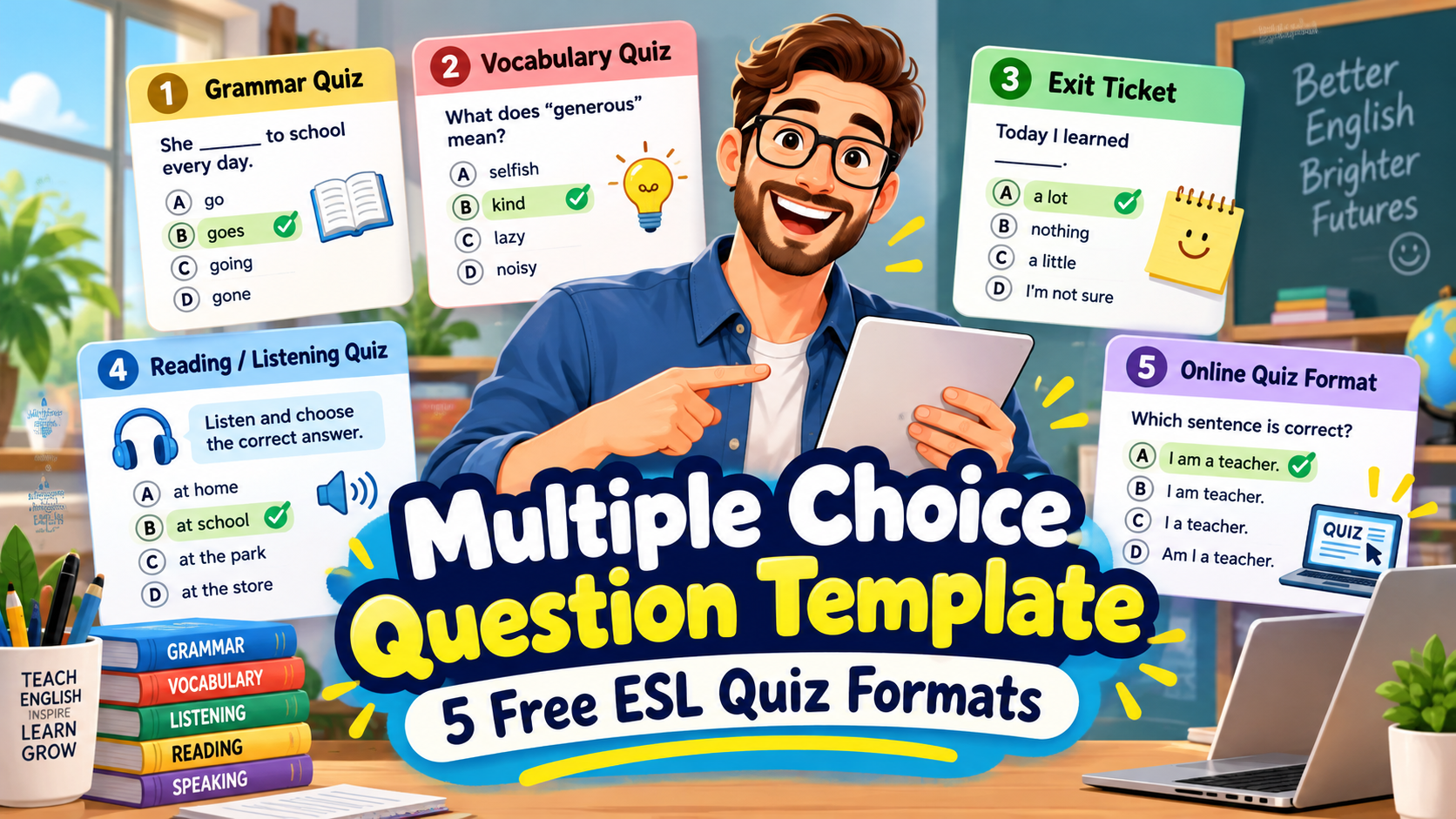
  • Multiple Choice Question Template: 5 Free ESL Quiz Formats

    Multiple Choice Question Template: 5 Free ESL Quiz Formats

    You’ve finished teaching a grammar point, and you want to check whether students have understood it. Nothing complicated. Just five questions before they leave.

    Then you open a blank document.

    How should you word the questions? Should there be three or four answers? What should the wrong answers look like? And how do you avoid spending half an hour preparing a quiz that students will complete in five minutes?

    A good multiple choice question template can take care of much of that preparation.

    Instead of building every quiz from scratch, you start with a structure, replace the content, check the answers, and adapt the difficulty to your students.

    The trick is to choose the right template for what you’re assessing. A quick grammar check needs a different structure from a reading comprehension quiz, and an online self-check activity needs more than a list of correct answers.

    Below, you’ll find five free, copy-ready ESL quiz formats. Each includes a reusable template, completed classroom examples, an answer key, and a ChatGPT prompt for creating your own version.

    You can copy the templates directly into Google Docs, adapt them into printable worksheets, or enter the questions into Google Forms.

    No download or registration is required to use these templates.

    What Makes a Good Multiple Choice Question Template?

    A multiple-choice question usually contains three essential elements: a question or incomplete statement, one correct answer, and several plausible incorrect options known as distractors.

    That sounds straightforward. Writing effective distractors is often the difficult part.

    Consider this question:

    She _____ English every evening.

    A. studies
    B. elephant
    C. yesterday
    D. beautiful

    Students can choose the correct answer without understanding the target grammar. Three options obviously don’t belong.

    Now consider:

    She _____ English every evening.

    A. study
    B. studies
    C. studying
    D. studied

    This version is more useful because the incorrect options represent grammatical forms learners might genuinely confuse.

    When you use a multiple choice question template, keep three principles in mind.

    Clarity: Students should understand what the question is asking.

    Plausibility: Incorrect answers should be believable but unambiguously wrong in the given context.

    Alignment: The question should test something students have learned or are expected to know.

    The British Council’s guidance on multiple-choice questions explains that these items can assess distinctions involving meaning, collocation, and language use.

    Meanwhile, Yale University’s guide to designing assessment questions recommends clear stems, plausible distractors, and avoiding clues that reveal the correct answer.

    With those principles in mind, let’s look at five useful formats.


    Template 1: Basic Multiple Choice Question Template

    Best for: Vocabulary and grammar checks
    Suggested level: A1–B1
    Preparation time: Approximately 5–10 minutes once the content is ready

    This is the format you’ll probably use most often.

    It’s simple, adaptable, and suitable for a worksheet, quick classroom quiz, or homework assignment.

    Copy-and-Paste Template

    Quiz Title: [TOPIC]

    Student Level: [CEFR LEVEL]

    Instructions: Read each question and choose the best answer.

    Question 1

    [WRITE YOUR QUESTION OR SENTENCE.]

    A. [OPTION 1]
    B. [OPTION 2]
    C. [OPTION 3]
    D. [OPTION 4]

    Question 2

    [WRITE YOUR QUESTION OR SENTENCE.]

    A. [OPTION 1]
    B. [OPTION 2]
    C. [OPTION 3]
    D. [OPTION 4]

    Question 3

    [WRITE YOUR QUESTION OR SENTENCE.]

    A. [OPTION 1]
    B. [OPTION 2]
    C. [OPTION 3]
    D. [OPTION 4]

    Teacher Answer Key

    1. [CORRECT LETTER] — [BRIEF EXPLANATION]
    2. [CORRECT LETTER] — [BRIEF EXPLANATION]
    3. [CORRECT LETTER] — [BRIEF EXPLANATION]

    Duplicate the question structure as many times as necessary. For a short review, three to eight questions may be enough.

    Completed ESL Example

    Topic: Past Simple and Everyday Vocabulary
    Level: A2

    1. Yesterday, we _____ to the museum.

    A. go
    B. went
    C. going
    D. goes

    2. She usually _____ breakfast at seven.

    A. have
    B. having
    C. has
    D. had

    3. The train was crowded. What does “crowded” mean?

    A. Almost empty
    B. Full of people
    C. Very quiet
    D. Far away

    Answer key: 1-B, 2-C, 3-B.

    The first two questions assess grammar in context, while the third checks vocabulary meaning.

    AI Prompt to Generate Your Own Version

    Copy this into ChatGPT:

    Act as an experienced ESL teacher.

    Create a multiple choice question template filled with 8 questions for [LEVEL] learners.

    Topic: [TOPIC]

    Target language: [GRAMMAR POINT OR VOCABULARY]

    Requirements:

    • Use four options per question.
    • Make exactly one answer correct.
    • Use natural, level-appropriate language.
    • Make incorrect options reflect common learner mistakes.
    • Vary the position of correct answers.
    • Provide a separate answer key with short explanations.

    Check every question for ambiguity before presenting the final quiz.

    This template is especially useful when you have already taught the language and want a quick way to check it.

    For a more detailed explanation of question construction, see our Online Multiple Choice Questions guide.


    Template 2: Five-Question Exit Quiz

    Best for: End-of-lesson checks
    Suggested level: A1–B2
    Classroom time: Approximately 3–5 minutes

    There is something useful about ending a lesson with a small question instead of simply asking, “Does everyone understand?”

    Students usually say yes.

    That doesn’t necessarily mean they can use the language independently.

    A five-question exit quiz gives you a quick look at what has stuck and what might need attention tomorrow.

    The multiple choice question template below is designed for the end of a lesson rather than a formal test.

    Copy-and-Paste Template

    Exit Quiz: [LESSON TOPIC]

    Learning Objective: [WHAT STUDENTS SHOULD NOW BE ABLE TO DO]

    Instructions: Choose the best answer. Work independently.

    Q1 — Basic recall

    [QUESTION ABOUT A KEY IDEA OR FORM]

    A. [OPTION]
    B. [OPTION]
    C. [OPTION]

    Q2 — Meaning

    [QUESTION CHECKING UNDERSTANDING]

    A. [OPTION]
    B. [OPTION]
    C. [OPTION]

    Q3 — Correct language use

    [SHORT SENTENCE COMPLETION]

    A. [OPTION]
    B. [OPTION]
    C. [OPTION]

    Q4 — Application

    [SHORT REALISTIC SITUATION]

    A. [OPTION]
    B. [OPTION]
    C. [OPTION]

    Q5 — Common mistake

    [QUESTION TARGETING A FREQUENT ERROR]

    A. [OPTION]
    B. [OPTION]
    C. [OPTION]

    Teacher Answer Key: [INSERT ANSWERS]

    Completed A2 Example: Giving Advice

    Instructions: Choose the best answer.

    1. You look tired. You _____ go to bed earlier.

    A. should
    B. shouldn’t
    C. mustn’t

    2. You _____ stay up all night before an important exam.

    A. should
    B. shouldn’t
    C. can

    3. Which sentence is correct?

    A. You should to rest.
    B. You should resting.
    C. You should rest.

    4. Your friend wants to improve their English vocabulary. Which advice is most helpful?

    A. You should practise new words regularly.
    B. You should avoid reading anything in English.
    C. You shouldn’t review vocabulary.

    5. Which sentence gives negative advice?

    A. You should drink more water.
    B. You shouldn’t spend all night on your phone.
    C. You should ask your teacher.

    Answer key: 1-A, 2-B, 3-C, 4-A, 5-B.

    Question 3 reveals whether students understand the verb form after should. Questions 4 and 5 check whether they can recognise appropriate advice.

    What to Do With the Results

    Suppose most students answer Questions 1, 2, 4, and 5 correctly, but half choose the wrong answer for Question 3.

    That’s useful information.

    You probably don’t need to repeat the whole lesson. You may only need a short follow-up on should + base verb.

    A small exit quiz can reveal that far more clearly than a general question about understanding.

    AI Prompt

    Create a five-question multiple-choice exit ticket for [LEVEL] ESL students.

    Today’s lesson objective: [OBJECTIVE]

    Include:

    • one recall question;
    • one meaning question;
    • one language-use question;
    • one application question;
    • one question targeting a common mistake.

    Use three options per question.

    Provide the answer key and identify what a wrong answer might reveal about student understanding.

    Keep the entire activity suitable for the final five minutes of class.

    For more quick end-of-lesson ideas, see AI Classroom Activities: 10 Quick ESL Ideas.


    Template 3: Context-Based Grammar and Vocabulary Quiz

    Best for: Grammar accuracy, vocabulary usage, and collocations
    Suggested level: A2–B2
    Suggested length: 5–10 questions

    One problem with traditional vocabulary quizzes is that students can sometimes memorise definitions without knowing how words actually work.

    Consider the word decision.

    A student may understand what a decision is but still write:

    I did a decision.

    A context-based multiple choice question template helps you assess whether students know how language is used, not merely whether they recognise a word.

    Copy-and-Paste Template

    Quiz: Grammar and Vocabulary in Context

    Level: [LEVEL]

    Instructions: Read each sentence carefully and choose the word or phrase that fits best.

    1. Grammar in context

    [WRITE A SENTENCE WITH A GRAMMATICAL CLUE AND ONE GAP.]

    A. [GRAMMATICAL FORM]
    B. [GRAMMATICAL FORM]
    C. [GRAMMATICAL FORM]
    D. [GRAMMATICAL FORM]

    2. Vocabulary meaning

    [WRITE A SHORT SITUATION CONTAINING THE TARGET WORD.]

    What does [TARGET WORD] mean in this sentence?

    A. [MEANING]
    B. [MEANING]
    C. [MEANING]
    D. [MEANING]

    3. Collocation

    [WRITE A SENTENCE WITH A MISSING COLLOCATION.]

    A. [VERB OR WORD]
    B. [VERB OR WORD]
    C. [VERB OR WORD]
    D. [VERB OR WORD]

    4. Grammar application

    [WRITE A REALISTIC SENTENCE REQUIRING THE TARGET STRUCTURE.]

    A. [OPTION]
    B. [OPTION]
    C. [OPTION]
    D. [OPTION]

    Answer key: [INSERT CORRECT ANSWERS AND EXPLANATIONS]

    Completed B1 Example

    1. I’ve lived in this town _____ 2022.

    A. for
    B. during
    C. since
    D. ago

    2. The instructions were complicated, so several students felt confused. What does “complicated” mean here?

    A. Difficult to understand
    B. Quick to complete
    C. Interesting to hear
    D. Easy to remember

    3. We need to _____ a decision before Friday.

    A. do
    B. make
    C. build
    D. take

    4. If I _____ more free time, I would join the photography club.

    A. have
    B. will have
    C. having
    D. had

    Answer key

    1. C — Since introduces the starting point of a continuing situation.
    2. A — Complicated describes something difficult to understand or deal with.
    3. B — The standard collocation is make a decision.
    4. D — The second conditional uses a past form in the if-clause.

    Why Context Matters

    The question about make a decision is more revealing than asking students to match the word decision to a definition.

    Likewise, a question about since becomes meaningful when students encounter it in an actual sentence.

    This is particularly important when assessing learners who can explain grammatical rules but struggle to use them naturally.

    The British Council’s multiple-choice guidance highlights the value of asking learners to identify the best choice when dealing with language distinctions such as collocation and formality.

    AI Prompt

    Act as an ESL assessment designer.

    Create 10 context-based multiple-choice questions for [LEVEL] students.

    Target grammar: [GRAMMAR POINTS]

    Target vocabulary: [WORD LIST]

    Include:

    • 4 grammar questions;
    • 3 vocabulary-in-context questions;
    • 3 collocation questions.

    Use four plausible options per question.

    Avoid isolated word-definition questions where a meaningful sentence would work better.

    Include an answer key and a short explanation of the relevant language rule or usage.

    You can easily convert this format into a worksheet using the methods in our AI Worksheet Generator guide.


    Template 4: Reading and Listening Comprehension Quiz

    Best for: Reading and listening comprehension
    Suggested level: A2–B2
    Suggested length: 4–8 questions per text

    This format needs a slightly different approach.

    With grammar, students choose a form that fits a sentence. With reading or listening, they need to understand information from a passage or recording.

    A well-designed comprehension quiz should check more than whether students remember individual words.

    You may want questions about:

    • the main idea;
    • important details;
    • reasons and causes;
    • vocabulary in context;
    • inferences supported by the material.

    Cambridge English’s B2 teaching guidance discusses how distractors in listening questions can contain words heard in a recording without actually being correct. This is a useful reminder that students should focus on meaning, not merely matching familiar words.

    Copy-and-Paste Template

    Reading/Listening Quiz: [TITLE]

    Level: [LEVEL]

    Instructions: Read the text or listen to the recording. Then choose the best answer.

    Source Text or Audio: [INSERT TEXT, TRANSCRIPT, OR MEDIA]

    1. Main idea

    What is the text or recording mainly about?

    A. [OPTION]
    B. [OPTION]
    C. [OPTION]

    2. Detail

    According to the text, what happened when [EVENT]?

    A. [OPTION]
    B. [OPTION]
    C. [OPTION]

    3. Reason

    Why did [CHARACTER] decide to [ACTION]?

    A. [OPTION]
    B. [OPTION]
    C. [OPTION]

    4. Inference

    What can we reasonably understand from the text?

    A. [OPTION]
    B. [OPTION]
    C. [OPTION]

    5. Vocabulary in context

    What does [WORD OR PHRASE] mean in this context?

    A. [OPTION]
    B. [OPTION]
    C. [OPTION]

    Answer key: [INSERT ANSWERS]

    Completed Example: Community Library

    Level: A2–B1

    Read the text.

    Every Thursday, Lina volunteers at a community library. She helps younger children choose books and encourages them to read.

    Last month, Lina noticed that many children returned their books without finishing them. When she asked why, several said the stories were too difficult.

    Lina decided to organise ten-minute reading circles. She reads the first page aloud, explains a few unfamiliar words, and then lets the children decide whether to continue reading.

    After a month, the librarian noticed that more children were finishing their books. Lina now plans to invite older students to help with the reading circles.

    1. Why did Lina start the reading circles?

    A. The library needed more books.
    B. Some children found their books too difficult.
    C. The library was closing early.

    2. What does Lina read aloud?

    A. The first page
    B. The final chapter
    C. The entire book

    3. What changed after one month?

    A. The library became smaller.
    B. The children stopped visiting.
    C. More children finished their books.

    4. Who does Lina want to invite to help?

    A. Older students
    B. Parents from another town
    C. Professional writers

    5. Why might reading the first page aloud help children?

    A. It means they never need to read alone.
    B. It can make a difficult story easier to begin.
    C. It guarantees every book will be interesting.

    Answer key: 1-B, 2-A, 3-C, 4-A, 5-B.

    Notice that Question 5 requires some interpretation. The answer isn’t simply a sentence copied from the passage.

    Adapting the Same Template for Listening

    You could read the library text aloud or record it yourself, then use the same question structure as a listening activity.

    Let students listen once for the general meaning and again for details.

    For a real listening recording, however, write questions based on what students can actually hear. Don’t rely on an AI-generated summary that may leave out or change important details.

    AI Prompt

    Act as an experienced ESL reading and listening assessment designer.

    Student level: [LEVEL]

    Source text or transcript:
    [PASTE MATERIAL]

    Create:

    • 1 main-idea multiple-choice question;
    • 2 detail questions;
    • 1 inference question;
    • 1 vocabulary-in-context question.

    Use three options per question.

    Make sure every correct answer is supported by the material.

    Keep the distractors plausible but clearly incorrect.

    Provide an answer key and briefly identify the evidence supporting each correct response.

    For more listening and video-based tasks, explore our AI Video Question Maker guide.


    Template 5: Self-Checking Online Multiple Choice Quiz

    Best for: Independent revision, homework, and self-paced practice
    Suggested level: A2–B2
    Recommended platform: Google Forms or another quiz-capable learning platform

    A printable quiz tells students whether their answer is right or wrong once you mark it.

    A self-checking online quiz can go further by providing an explanation immediately or when you release the results.

    That difference is useful for homework and independent study.

    This multiple choice question template adds three fields that the previous formats don’t require:

    • the correct answer;
    • a short explanation;
    • feedback that addresses a likely misconception.

    Copy-and-Paste Template

    Online Quiz Title: [TOPIC]

    Level: [LEVEL]

    Instructions: Choose the best answer. Review the feedback after completing the quiz.

    Question 1

    [WRITE QUESTION.]

    A. [OPTION]
    B. [OPTION]
    C. [OPTION]
    D. [OPTION]

    Correct answer: [LETTER]

    Points: 1

    Correct-answer feedback: [SHORT EXPLANATION]

    Incorrect-answer feedback: [HINT OR RELEVANT RULE]

    Repeat this structure for every question.

    Completed B1 Example: Writing Polite Emails

    1. Could you _____ me the timetable, please?

    A. send
    B. to send
    C. sending
    D. sent

    Correct answer: A

    Feedback: After Could you, use the base form of the verb: Could you send…?

    2. I look forward to _____ from you.

    A. hear
    B. heard
    C. hearing
    D. have heard

    Correct answer: C

    Feedback: In look forward to, the word to is a preposition, so the following verb takes the -ing form.

    3. Which opening is most suitable for an email to a teacher you do not know well?

    A. Hey you!
    B. Dear Ms Lewis,
    C. Yo!
    D. What’s up?

    Correct answer: B

    Feedback: Dear Ms Lewis is appropriate for a polite, relatively formal message.

    4. Please let me know if you have any _____.

    A. question
    B. questions
    C. questioning
    D. asked

    Correct answer: B

    Feedback: Any questions is the natural expression in this context.

    5. Thank you _____ your help.

    A. for
    B. to
    C. at
    D. from

    Correct answer: A

    Feedback: Use thank you for followed by a noun or an -ing form.

    Why This Format Is Useful

    Students can complete the quiz outside class and review an explanation rather than seeing only a mark.

    You can also examine the results and identify questions that caused difficulty.

    If half the class misses Question 2, for example, you may want a short follow-up on look forward to + -ing.

    AI Prompt

    Act as a B1 ESL teacher.

    Create a self-checking multiple-choice quiz about [TOPIC].

    Generate 8 questions.

    For each question, provide:

    • four answer options;
    • exactly one correct answer;
    • a one-sentence explanation for the correct answer;
    • a short hint for learners who answer incorrectly;
    • one point per question.

    Make the output easy to transfer into Google Forms.

    Review the questions for ambiguous answers and unnatural English.

    This format works well for teachers who want students to practise independently without turning every activity into a formal examination.


    How to Turn a Multiple Choice Question Template into a Google Forms Quiz

    Once you have chosen a template, you can turn it into an online assessment.

    Google Forms supports multiple-choice questions, answer keys, point values, and answer feedback. The official Google Forms quiz instructions explain how to set these up and review responses.

    Here’s a straightforward workflow.

    Step 1: Create a new form

    Open Google Forms and create a blank form.

    Give your quiz a title, such as:

    B1 English — Writing Polite Emails

    Step 2: Enable quiz mode

    Open Settings and turn on Make this a quiz.

    This allows you to add correct answers and scores.

    Step 3: Add your questions

    Select Multiple choice as the question type.

    Copy your question stem and answer options into the appropriate fields.

    Step 4: Set the answer key

    Open Answer key, choose the correct option, and assign the points.

    Step 5: Add feedback

    Use Add answer feedback to include a brief explanation or useful reminder.

    For a grammar question, this might be:

    Remember: look forward to is followed by an -ing form.

    Step 6: Review the result settings

    Check whether students will see missed questions, correct answers, and point values.

    Also check whether scores are released immediately or after teacher review.

    Step 7: Preview the quiz

    Complete it yourself before sharing it.

    Check that the answers, feedback, and scoring work as expected.

    This final step is worth the extra minute. A small answer-key mistake can undermine an otherwise useful quiz.

    Teacher tip: If the quiz is only for formative practice, you may not need to collect student names or email addresses. Use the response settings that suit your teaching purpose and your institution’s privacy requirements.


    Which Multiple Choice Question Template Should You Use?

    All five templates are reusable, but they solve slightly different problems.

    TemplateMain purposeSuggested level
    Basic multiple-choiceQuick vocabulary and grammar checksA1–B1
    Five-question exit quizCheck the lesson objectiveA1–B2
    Context-based grammar and vocabularyAssess language useA2–B2
    Reading and listening comprehensionAssess understanding of source materialA2–B2
    Self-checking online quizIndependent practice and feedbackA2–B2

    The CEFR levels are suggestions, not strict limits. You can adapt each multiple choice question template for other levels by changing the language, task complexity, and amount of support.

    For example, a B2 grammar quiz may use subtle differences in meaning, while an A1 quiz should usually use shorter sentences and clearer contexts.

    The structure can remain familiar even when the difficulty changes.

    How to Improve Multiple Choice Templates with ChatGPT

    One of the most useful ways to work with AI is to give it an existing template and ask it to adapt the content, rather than requesting an entirely new assessment without any constraints.

    Suppose you’ve just taught B1 students a lesson about travel problems.

    You could use this prompt:

    I am an ESL teacher preparing a short B1 quiz.

    Lesson topic: Travel problems

    Target vocabulary: delayed flight, lost luggage, booking, refund, customer service

    Target grammar: Past simple

    Use the following multiple choice question template:

    [PASTE YOUR CHOSEN TEMPLATE]

    Fill it with realistic questions based only on the target content.

    Include plausible distractors reflecting common learner errors.

    Make sure each question has one clearly best answer.

    Provide an answer key and short explanations.

    Do not add advanced vocabulary unrelated to the lesson.

    You can then refine the output:

    If it is too easy: Ask for more meaningful contexts and stronger distractors.

    If it is too difficult: Ask for shorter sentences and fewer unfamiliar words.

    If the questions feel repetitive: Ask for a greater variety of situations without changing the learning objective.

    If the answer key seems questionable: Ask AI to justify each answer, then check those explanations yourself.

    You can find additional reusable prompts in our ChatGPT Prompts for ESL Teachers collection.

    AI can shorten preparation time, but the teacher still needs to decide whether the finished questions are fair, accurate, and appropriate for the class.

    Common Mistakes When Using a Multiple Choice Question Template

    A ready-made format makes preparation easier, but it doesn’t guarantee that the questions themselves are good.

    There are a few mistakes worth watching for.

    Making every correct answer obvious

    If the distractors are unrelated to the question, students may answer correctly through elimination alone.

    Use realistic grammatical errors, nearby meanings, or commonly confused expressions.

    Testing more than the lesson objective

    If the lesson focused on past-tense verbs, don’t fill the quiz with difficult vocabulary that students have never encountered.

    You may accidentally test vocabulary knowledge instead of grammar.

    Using two acceptable answers

    This is surprisingly easy to do, especially with vocabulary, collocations, and questions involving natural language.

    Always read every option in the complete sentence.

    Ask yourself whether another answer could also be reasonable.

    Making all correct answers the same letter

    A quiz with ten consecutive B answers may distract students and encourage guessing based on patterns.

    Vary the answer positions after you’ve checked that the options remain clear.

    Giving away answers through wording

    When creating reading and listening questions, avoid copying an entire sentence from the source text into the correct answer while all the distractors use different language.

    Students may recognise the repeated wording without understanding the meaning.

    Using too many questions

    A five-minute exit ticket doesn’t need twenty items.

    Match the quiz length to the purpose and available time.

    Trusting AI-generated answer keys

    AI can produce incorrect or ambiguous answers.

    Check every question and key yourself, particularly when preparing graded assessments.

    The British Council’s overview of test question types also discusses the advantages and limitations of multiple-choice testing, including the time required to create effective questions and the possibility of guessing.

    These are useful reminders that a multiple-choice format should be chosen because it suits the assessment objective, not simply because it is easy to mark.

    A Quick Quality-Check Template Before Publishing

    Before printing or sharing your quiz, run through this checklist.

    • Every question assesses something relevant to the lesson.
    • The instructions are appropriate for the students’ English level.
    • Every item has exactly one best answer.
    • Distractors represent realistic mistakes.
    • No answer is revealed by an obvious clue.
    • The correct answer positions are reasonably varied.
    • The answer key has been checked.
    • The number of questions fits the available time.
    • Feedback is included where it would help learning.
    • Any online quiz has been previewed from the student’s perspective.

    You don’t need to spend twenty minutes reviewing a five-question quiz. But a careful final check can save you from dealing with confusing or unfair questions during class.

    Frequently Asked Questions

    What is a multiple choice question template?

    A multiple choice question template is a reusable format containing a question stem, answer options, and usually an answer key. Teachers can replace the content to create quizzes for different topics, language levels, and assessment purposes.

    Can I use these multiple choice question templates for free?

    Yes. All five templates in this article are free to copy and adapt for classroom use. You can paste them into a document, create printable worksheets, or manually transfer them into an online quiz platform.

    How many answer options should a multiple-choice question have?

    Three or four options are common. What matters most is whether the incorrect choices are plausible and whether one answer is clearly best.

    Can I use a multiple choice question template in Google Forms?

    Yes. Create a quiz in Google Forms, add a multiple-choice question, enter the answer options, and set the answer key. You can also assign points and provide feedback.

    Can ChatGPT create multiple-choice questions for ESL learners?

    Yes. ChatGPT can generate question drafts, distractors, explanations, and different difficulty levels. You should review the results for accuracy, ambiguity, and appropriateness before using them.

    Which multiple choice question template is best for grammar?

    A context-based grammar template is often a good choice because it asks learners to select a grammatical form in a meaningful sentence instead of recognising isolated rules.

    Can multiple-choice questions assess reading and listening?

    Yes. They can assess main ideas, details, vocabulary in context, and reasonable inferences. However, speaking and extended writing usually require other forms of assessment when the goal is to evaluate students’ ability to produce language.

    How do I make multiple-choice questions more challenging?

    Use more meaningful contexts, realistic distractors, paraphrased answers, and questions requiring interpretation rather than simple recall. Difficulty should come from the intended language skill, not unnecessarily confusing wording.

    Should every multiple-choice quiz include feedback?

    Not necessarily, but feedback is particularly valuable in formative quizzes and independent practice. A short explanation can help students understand why an option was correct or incorrect.

    Final Thoughts

    The best quiz isn’t necessarily the longest or the most complicated.

    Sometimes, five well-written questions tell you everything you need to know about whether students understood a lesson.

    A reusable multiple choice question template makes that process faster. It gives you a consistent structure, keeps preparation manageable, and leaves more time for the part that requires genuine teacher judgment: choosing what to assess and interpreting what students’ answers mean.

    Start with the simplest template that fits your purpose.

    Use the basic format for quick checks. Choose the exit ticket when you need immediate feedback. Move to context-based questions when language use matters. Use comprehension templates when students need to interpret reading or listening material.

    And when students are working independently, consider a self-checking online quiz with explanations.

    You don’t need to reinvent the structure every time.

    You just need to make sure the questions are worth answering.

    Free Resource for English Teachers

    Want to create ESL worksheets and quiz activities without starting from scratch?

    Get our Free AI Worksheet Prompt Pack for English Teachers, featuring 25 copy-paste prompts for grammar, vocabulary, reading, speaking, quizzes, differentiation, and more.

    Use them to prepare classroom resources faster while keeping full control over what your students learn.
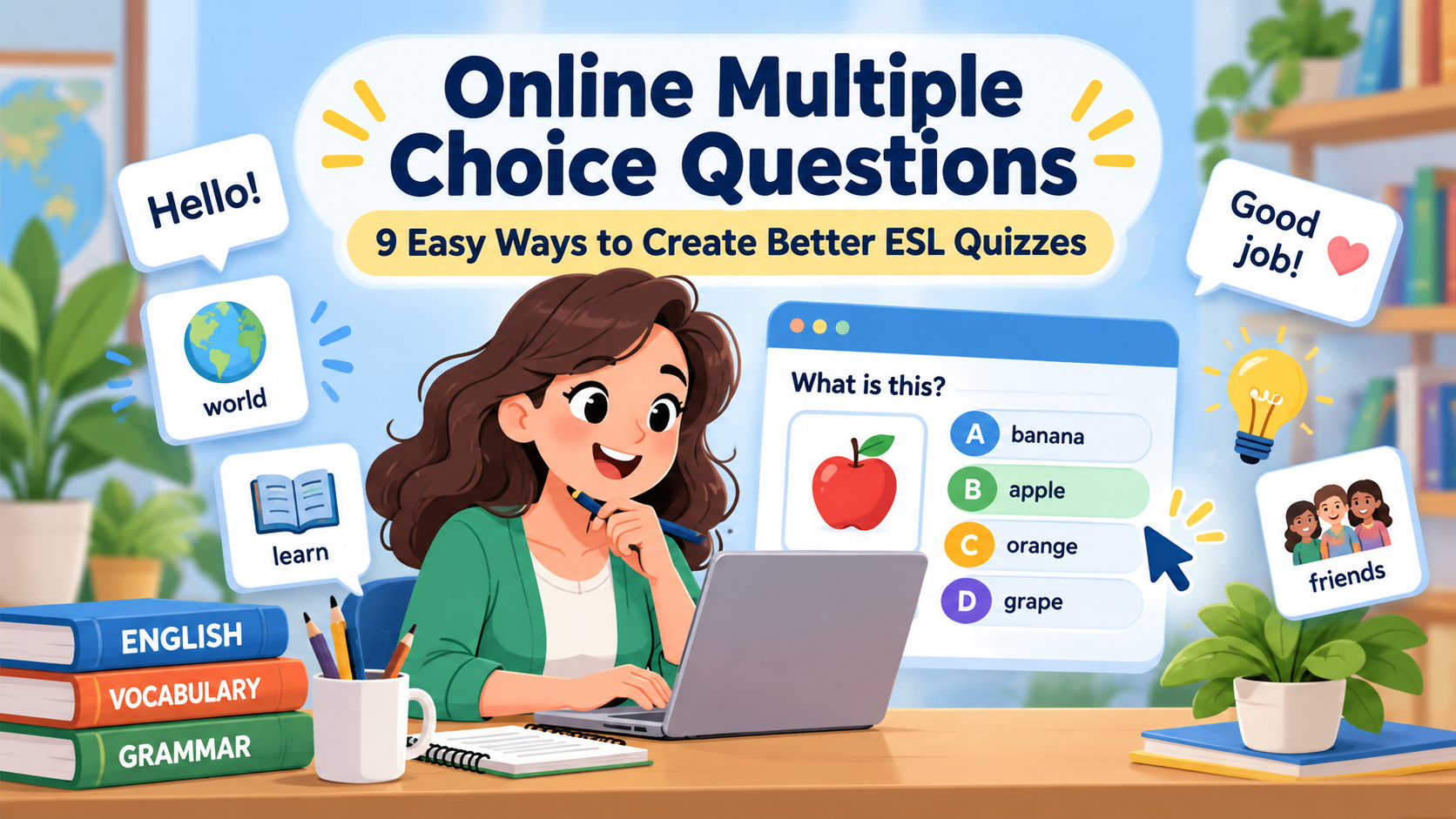
  • Online Multiple Choice Questions: 9 Easy Ways to Create Better ESL Quizzes

    Online Multiple Choice Questions: 9 Easy Ways to Create Better ESL Quizzes

    Online multiple choice questions can help English teachers check vocabulary, grammar, reading, listening, and language use quickly.

    But creating a useful multiple-choice quiz is not simply a matter of writing one correct answer and three random wrong answers.

    Good online multiple choice questions should make students think about the language or skill being assessed. The question should be clear, the correct answer should be defensible, and the distractors should be believable enough to reveal what students actually understand.

    That distinction becomes especially important when teachers use AI to generate quizzes. AI can produce a large number of questions quickly, but those questions still need teacher review.

    OpenAI’s guidance for educators similarly recommends treating generated material as a starting point rather than assuming that every output is automatically correct or appropriate for a particular class. OpenAI’s guidance for educators using ChatGPT

    In this guide, you will learn nine practical ways to create better online multiple choice questions, along with ESL examples and copy-paste AI prompts.

    If you want a broader bank of ready-to-use quiz prompts, see ESL Quiz Templates: AI Prompts for Grammar, Vocabulary, Reading, and Listening.


    What Are Online Multiple Choice Questions?

    Online multiple choice questions ask students to select an answer from a set of possible options in a digital quiz, form, learning platform, or assessment tool.

    A typical item contains:

    Stem: the question or incomplete sentence.

    Correct answer: the best answer.

    Distractors: incorrect alternatives designed to be plausible.

    For example:

    She _____ to university every morning.

    A. go
    B. goes
    C. going
    D. gone

    The correct answer is goes.

    The other answers are not random. Each represents a possible learner error.

    That is what makes the item useful.

    The British Council describes multiple-choice items as questions in which learners choose from several provided options, and notes that they can be designed so students identify the best answer rather than merely an obviously correct one. British Council: Multiple choice in language teaching


    1. Start Every Question with One Clear Learning Objective

    Before creating online multiple choice questions, decide exactly what you want to measure.

    Do not begin with:

    I need ten quiz questions.

    Begin with:

    I need ten questions that check whether B1 students can distinguish the past simple from the present perfect.

    That small change makes the quiz more focused.

    A question should normally test one main thing.

    For example, if the lesson objective is:

    Students can choose the correct past tense in a completed past-time context.

    A suitable item could be:

    We _____ the museum last Saturday.

    A. visit
    B. have visited
    C. visited
    D. are visiting

    Here, the phrase last Saturday provides a clear past-time context.

    The item directly tests the target language.

    A weaker question would include unnecessarily difficult vocabulary that distracts students from the grammar point.

    AI prompt

    Act as an experienced ESL assessment designer.
    
    Student level:
    [LEVEL]
    
    Learning objective:
    [OBJECTIVE]
    
    Create 8 online multiple choice questions that assess only this objective.
    
    For each question:
    - provide one correct answer;
    - provide three plausible distractors;
    - keep vocabulary appropriate for [LEVEL];
    - avoid testing unrelated language;
    - include the correct answer separately.
    
    Do not make the correct option noticeably longer than the distractors.

    When generating online multiple choice questions, defining the objective first is one of the easiest ways to prevent a quiz from becoming a collection of unrelated items.


    2. Write Clear Question Stems

    The stem should tell students exactly what they need to do.

    Avoid unnecessary wording.

    Compare these two examples.

    Weak

    Considering everything that we discussed in today’s lesson concerning the grammatical forms used to express situations that occurred at a particular time in the past, which of the following sentences would be considered grammatically correct?

    Better

    Which sentence is correct?

    The second version measures English rather than the student’s ability to decode the teacher’s instructions.

    For ESL learners, especially at lower levels, complicated instructions can distort assessment results.

    A student might understand the target grammar but misunderstand the question.

    Example

    Instead of:

    Which one of these alternatives would be considered the most suitable lexical selection to complete the sentence below?

    Use:

    Choose the best word.

    Then give the sentence.

    A useful rule

    When writing online multiple choice questions, try reading the stem without the answer choices.

    Students should still understand what they are being asked.


    3. Make Sure There Is One Clearly Best Answer

    One common problem with online multiple choice questions is accidental ambiguity.

    Consider:

    I _____ football yesterday.

    A. played
    B. enjoyed
    C. watched
    D. liked

    Depending on the intended meaning, several answers could work.

    That makes the item difficult to score fairly.

    Now compare:

    I _____ football with my friends yesterday.

    A. played
    B. made
    C. did
    D. took

    Played is clearly the best answer.

    Before publishing a question, ask:

    • Could another option also be correct?
    • Does the sentence contain enough context?
    • Am I testing the intended language point?
    • Would two experienced teachers choose the same answer?

    If not, revise the item.

    This is particularly important when AI generates online multiple choice questions, because grammatically possible alternatives can occasionally appear among the supposed distractors.


    4. Use Plausible Distractors

    Distractors are what make online multiple choice questions diagnostically useful.

    Consider:

    My sister _____ coffee every morning.

    A. drinks
    B. elephant
    C. yesterday
    D. quickly

    Only one option can grammatically fit.

    Students do not need to understand third-person singular -s. They only need to notice that three options are impossible.

    A better version is:

    My sister _____ coffee every morning.

    A. drink
    B. drinks
    C. drinking
    D. drank

    Now every distractor reflects a possible learner error.

    Sources of useful distractors

    You can build distractors from:

    • common grammatical errors;
    • similar vocabulary;
    • incorrect word forms;
    • confusing collocations;
    • false friends;
    • tense confusion;
    • spelling mistakes;
    • errors you have already observed in class.

    Vocabulary example

    We need to _____ a decision soon.

    A. make
    B. do
    C. create
    D. build

    The distractors are believable because students may know all four verbs.

    The item therefore tests knowledge of the collocation make a decision.

    The British Council specifically notes that multiple-choice questions can be useful for distinctions involving collocation, connotation, and formality when learners must select the best alternative.

    AI prompt for stronger distractors

    Act as an ESL assessment designer.
    
    Student level:
    [LEVEL]
    
    Correct answer:
    [ANSWER]
    
    Question:
    [QUESTION]
    
    Create three plausible distractors.
    
    The distractors should represent realistic errors that [LEVEL] English learners might make.
    
    Avoid:
    - obviously ridiculous options;
    - answers from unrelated word classes;
    - options much longer or shorter than the correct answer.
    
    Explain briefly what misconception each distractor represents.

    This prompt can significantly improve AI-generated online multiple choice questions.


    5. Avoid Giving Students Accidental Clues

    Sometimes students can answer online multiple choice questions without knowing the language because the question itself contains clues.

    Clue 1: One answer is much longer

    A. went
    B. saw
    C. made
    D. had been travelling to the city

    Students may assume D is correct simply because it looks more detailed.

    Clue 2: Grammar reveals the answer

    She bought _____ umbrella.

    A. a
    B. an
    C. some
    D. many

    This is fine if the target is articles.

    But if you are trying to test vocabulary related to weather, the article an may unintentionally reveal the answer.

    Clue 3: Repeated wording

    If the reading text says:

    The company decided to postpone the meeting because of severe weather.

    and the question asks:

    Why did the company postpone the meeting?

    A. Because of severe weather
    B. Because employees were tired
    C. Because the building was closed
    D. Because the manager was travelling

    Students can simply match identical wording.

    For stronger reading assessment, paraphrase the answer.

    A. Dangerous weather conditions made the meeting difficult to hold.

    That requires more comprehension.

    Clue 4: Correct answers follow a pattern

    If the answer sequence is:

    A
    B
    C
    D
    A
    B
    C
    D

    students may notice the pattern.

    Randomise the order when appropriate.


    6. Match the Question Type to the Language Skill

    You can use online multiple choice questions for much more than grammar.

    Cambridge English assessment formats, for example, use multiple-choice tasks across reading and listening, including questions based on longer texts and recordings. Cambridge English example assessment formats

    Here are several classroom applications.

    Vocabulary

    The word exhausted is closest in meaning to:

    A. very tired
    B. very angry
    C. very excited
    D. very hungry

    Grammar

    If I _____ more time, I would learn another language.

    A. have
    B. had
    C. will have
    D. am having

    Reading

    After a short text:

    Why did Lina decide to leave early?

    A. She felt unwell.
    B. She had finished her work.
    C. Her friend called her.
    D. The building was closing.

    Listening

    After students hear a conversation:

    What are the speakers mainly discussing?

    A. changing their travel plans
    B. buying a new car
    C. preparing for an exam
    D. choosing a restaurant

    Language use

    Which sentence sounds most natural?

    A. I made my homework.
    B. I did my homework.
    C. I created my homework.
    D. I worked my homework.

    Pragmatics

    Your classmate says, “I’m really nervous about tomorrow’s presentation.”

    Which response is most appropriate?

    A. Never mind.
    B. That’s impossible.
    C. I’m sure you’ll do well.
    D. You are nervous yesterday.

    This variety prevents online multiple choice questions from becoming nothing more than grammar drills.

    For listening and video assessment ideas, see AI Video Question Maker: 9 Prompts for Better ESL Listening Lessons.


    7. Include Some Questions That Require Thinking

    Not every question should test simple recall.

    Students can also interpret, compare, infer, or apply information.

    Compare:

    Recall question

    Where did the character go?

    Inference question

    Why was the character probably worried?

    The second question requires students to combine information from the text.

    You can therefore mix easier online multiple choice questions with questions that require deeper processing.

    A simple reading quiz could contain:

    • 2 gist questions;
    • 3 detail questions;
    • 2 vocabulary-in-context questions;
    • 2 inference questions;
    • 1 main-idea question.

    That creates a more balanced assessment.

    AI prompt

    Act as an experienced ESL reading assessment designer.
    
    Student level:
    [LEVEL]
    
    Reading text:
    [PASTE TEXT]
    
    Create 10 online multiple choice questions.
    
    Include:
    - 2 gist questions;
    - 3 detailed comprehension questions;
    - 2 vocabulary-in-context questions;
    - 2 inference questions;
    - 1 main-idea question.
    
    Each question should have:
    - one clearly correct answer;
    - three plausible distractors;
    - an answer key;
    - a one-sentence explanation.
    
    Avoid copying full sentences directly from the text into the correct answers.

    If you are building reading materials first, you can combine this with Reading Worksheet Generator: 7 AI Prompts for Better ESL Reading Lessons.


    8. Add Feedback Instead of Showing Only a Score

    One advantage of digital assessment is that online multiple choice questions can potentially become learning activities rather than simple tests.

    Instead of showing:

    Incorrect.

    provide something more useful:

    Correct answer: B — has lived

    We use the present perfect because the situation began in the past and continues now.

    That feedback helps students understand why the answer was wrong.

    Google Forms, for example, allows teachers to turn a form into a quiz, identify correct answers, assign points, and add answer feedback. Teachers can also control which information respondents see after the quiz. Google’s official guide to creating quizzes in Google Forms

    AI prompt for feedback

    For the following online multiple choice questions, create concise feedback for each item.
    
    Student level:
    [LEVEL]
    
    Questions:
    [PASTE QUESTIONS]
    
    For every question provide:
    
    Correct answer:
    [ANSWER]
    
    Explanation:
    Explain why the correct option works in 1-2 sentences.
    
    Common mistake:
    Explain why students might choose the most tempting distractor.
    
    Keep explanations appropriate for [LEVEL].

    This is particularly useful for self-study or low-stakes revision quizzes.


    9. Review AI-Generated Questions Before Publishing

    AI can generate online multiple choice questions quickly, but speed does not guarantee assessment quality.

    Before publishing, check:

    • Is the correct answer actually correct?
    • Could another answer also work?
    • Are the distractors plausible?
    • Is the vocabulary appropriate?
    • Does the question match the learning objective?
    • Is there an accidental clue?
    • Is the answer key correct?
    • Is the difficulty suitable?
    • Does the question require information students were actually taught?

    OpenAI’s educator guidance explicitly reminds teachers that model-generated information can be incorrect and that educators should review outputs based on their knowledge of their own class.

    AI quality-check prompt

    Act as an experienced ESL assessment reviewer.
    
    Review these online multiple choice questions:
    
    [PASTE QUESTIONS]
    
    For each question check:
    
    1. Is the stem clear?
    2. Is there exactly one best answer?
    3. Are the distractors plausible?
    4. Are there accidental clues?
    5. Is the vocabulary appropriate for [LEVEL]?
    6. Does the question assess the intended objective?
    7. Is the answer key correct?
    
    Rewrite only questions that genuinely need improvement.
    
    Explain each change briefly.

    This second-pass workflow is usually better than accepting the first AI-generated quiz unchanged.


    Example: Weak vs Better Online Multiple Choice Questions

    The difference between weak and effective online multiple choice questions becomes clearer when you compare them directly.

    Vocabulary

    Weak

    What does enormous mean?

    A. big
    B. sandwich
    C. yesterday
    D. walk

    Better

    The apartment was enormous. It had six bedrooms and three living rooms.

    What does enormous mean?

    A. extremely large
    B. unusually quiet
    C. very expensive
    D. recently built

    The second version provides context and believable alternatives.


    Grammar

    Weak

    Choose the past tense.

    A. go
    B. went
    C. going
    D. goes

    Better

    We _____ to the beach last Sunday.

    A. go
    B. went
    C. have gone
    D. are going

    The improved version requires students to interpret time context.


    Reading

    Weak

    Text:

    Tom missed the bus because he woke up late.

    Question:

    Why did Tom miss the bus?

    A. Because he woke up late
    B. Because he woke up early
    C. Because he likes buses
    D. Because he ate a sandwich

    Better

    What caused Tom to miss the bus?

    A. He did not get up on time.
    B. The bus arrived earlier than expected.
    C. He decided to walk instead.
    D. The bus route had changed.

    The stronger item tests comprehension rather than simple word matching.


    AI Prompts for Creating Online Multiple Choice Questions

    The following prompts can help you generate online multiple choice questions for common ESL teaching tasks.

    Vocabulary prompt

    Create 10 online multiple choice questions for [LEVEL] ESL students.
    
    Target vocabulary:
    [WORDS]
    
    For each item:
    - place the target word in a natural context;
    - ask students to identify meaning, usage, or collocation;
    - include one correct answer and three plausible distractors;
    - avoid dictionary-style questions where possible.
    
    Provide a separate answer key.

    Grammar prompt

    Create 10 online multiple choice questions for [LEVEL] students.
    
    Target grammar:
    [GRAMMAR POINT]
    
    Use meaningful sentence contexts.
    
    Distractors should reflect common learner errors.
    
    Do not make every question follow the same sentence pattern.
    
    Provide:
    - correct answer;
    - short explanation;
    - misconception represented by each distractor.

    Reading prompt

    Create 8 online multiple choice questions from this reading text:
    
    [PASTE TEXT]
    
    Student level:
    [LEVEL]
    
    Include:
    - gist;
    - detail;
    - vocabulary in context;
    - inference.
    
    Use three or four options per question.
    
    Paraphrase the correct answer instead of copying complete phrases from the text.
    
    Provide an answer key.

    Listening prompt

    Create online multiple choice questions from this listening transcript.
    
    Student level:
    [LEVEL]
    
    Transcript:
    [PASTE TRANSCRIPT]
    
    Create:
    - 2 gist questions;
    - 4 detail questions;
    - 2 inference questions.
    
    Each question should include:
    - one correct answer;
    - three plausible distractors.
    
    Do not ask about information that cannot be heard or reasonably inferred.

    Rewrite weak questions

    Improve these online multiple choice questions:
    
    [PASTE QUESTIONS]
    
    Keep the same learning objectives.
    
    Improve:
    - stem clarity;
    - distractor quality;
    - level appropriateness;
    - answer balance;
    - context.
    
    Remove accidental clues.
    
    Make sure every item has exactly one best answer.

    Differentiate a quiz

    Adapt these online multiple choice questions for a mixed-level ESL class.
    
    Original level:
    [LEVEL]
    
    Questions:
    [PASTE QUIZ]
    
    Create:
    
    SUPPORT VERSION
    - simpler wording;
    - more context;
    - slightly easier distractors.
    
    CORE VERSION
    - retain the original difficulty.
    
    CHALLENGE VERSION
    - more subtle distractors;
    - greater inference or language discrimination.
    
    Keep the same learning objectives across all versions.

    For more reusable teaching prompts, see ChatGPT Prompts for ESL Teachers: 30 Powerful Prompts by Language Skill.


    How to Put Online Multiple Choice Questions into Google Forms

    After you create the questions, you need somewhere students can answer them.

    Google Forms is one simple option for online multiple choice questions.

    According to Google’s current documentation, teachers can turn a form into a quiz, add question types, specify correct answers, assign points, and provide answer feedback.

    A basic workflow is:

    1. Create a new Google Form.
    2. Open Settings.
    3. Enable Make this a quiz.
    4. Add your multiple-choice question.
    5. Enter the answer options.
    6. Open the answer key.
    7. select the correct answer.
    8. Assign points.
    9. Add answer feedback if useful.
    10. Preview the quiz before sharing it.

    Google Forms official quiz instructions

    You do not have to use Google Forms. The same online multiple choice questions can be transferred into many LMSs and quiz platforms.

    The more important issue is question quality.

    A sophisticated platform cannot rescue a poorly designed question.


    A Simple ESL Online Quiz Structure

    If you want a balanced 15-question quiz, try this structure:

    Questions 1–3: vocabulary

    Questions 4–7: grammar or language use

    Questions 8–11: reading or listening comprehension

    Questions 12–13: vocabulary in context

    Questions 14–15: application or inference

    This prevents the quiz from relying entirely on one question type.

    For a shorter exit quiz, try:

    • 2 recall questions;
    • 2 language-use questions;
    • 1 application question.

    You can generate the initial quiz with AI and then review the online multiple choice questions manually before publishing.


    Common Mistakes with Online Multiple Choice Questions

    Mistake 1: Making the wrong answers ridiculous

    If three answers are obviously impossible, the question does not measure much.

    Use learner errors as distractors instead.

    Mistake 2: Testing difficult vocabulary unintentionally

    If the quiz is meant to assess grammar, the vocabulary should not become the real challenge.

    Mistake 3: Creating two correct answers

    Always check whether another option could work in a different interpretation.

    Mistake 4: Copying exact phrases from a reading text

    This may encourage word matching rather than comprehension.

    Paraphrase where appropriate.

    Mistake 5: Making every question simple recall

    Include some interpretation, inference, collocation, or application questions when appropriate.

    Mistake 6: Using AI output without review

    AI-generated online multiple choice questions should be checked for accuracy, ambiguity, difficulty, and distractor quality.

    Mistake 7: Creating too many questions

    A longer quiz is not automatically a better quiz.

    Ten focused questions may provide more useful information than thirty repetitive ones.

    Mistake 8: Giving only a final score

    For practice activities, short explanations can turn mistakes into learning opportunities.

    Mistake 9: Ignoring what wrong answers tell you

    Distractors can reveal misconceptions.

    If many students choose the same incorrect option, that may tell you something important about what needs reteaching.


    Teacher Checklist for Online Multiple Choice Questions

    Before publishing your quiz, check each item.

    Question

    • Is the stem clear?
    • Is unnecessary wording removed?
    • Is the language suitable for the students’ level?
    • Does the question test the intended objective?

    Answers

    • Is there one clearly best answer?
    • Are distractors believable?
    • Are options similar in length and style?
    • Have accidental clues been removed?

    Assessment

    • Is the difficulty appropriate?
    • Are several skills or cognitive demands represented where appropriate?
    • Are students being tested on material they had an opportunity to learn?

    Technical check

    • Is the answer key correct?
    • Are point values correct?
    • Does the quiz display properly?
    • Have you previewed it as a student?

    This checklist can catch many problems before students encounter the online multiple choice questions.


    FAQ: Online Multiple Choice Questions

    What are online multiple choice questions?

    Online multiple choice questions are digital assessment items in which learners select an answer from several options. They can be used for vocabulary, grammar, reading, listening, language use, revision, and formative assessment.

    How many options should online multiple choice questions have?

    Three or four options are common. What matters more than the number is whether the incorrect options are plausible and whether there is one clearly best answer.

    Can I create online multiple choice questions with AI?

    Yes. AI can generate drafts of online multiple choice questions, distractors, answer explanations, and differentiated versions. Teachers should still review the questions for accuracy and appropriateness before using them.

    What makes a good multiple-choice distractor?

    A good distractor is incorrect but believable. Common learner errors, confusing vocabulary, incorrect grammatical forms, and similar collocations can all provide useful distractors.

    Can online multiple choice questions assess reading?

    Yes. They can assess gist, detail, vocabulary in context, main ideas, inference, and interpretation. Major language assessments also use multiple-choice formats in reading tasks.

    Can online multiple choice questions assess listening?

    Yes. Students can listen to a recording and answer questions about main ideas, details, speaker purpose, attitudes, or inference. Cambridge English assessment formats include multiple-choice listening tasks.

    How do I create online multiple choice questions in Google Forms?

    Turn the form into a quiz in Settings, add your questions and answer options, then use the answer key to mark correct answers and assign points. Google Forms also supports answer feedback.

    Should I explain wrong answers?

    For formative assessment or independent practice, brief explanations can be valuable because they help students understand the reason for an error instead of seeing only a score.

    How many questions should an ESL quiz contain?

    It depends on the objective and available time. A focused review quiz may need only five to ten questions, while a broader assessment may require more.

    Should I use only multiple-choice questions?

    Not necessarily. Online multiple choice questions are efficient for many purposes, but speaking, extended writing, production, and open-ended reasoning may require other assessment formats as well.


    Final Recommendation

    Well-designed online multiple choice questions can do much more than produce a quick score.

    They can help English teachers identify:

    • vocabulary gaps;
    • grammar confusion;
    • reading problems;
    • listening difficulties;
    • common misconceptions;
    • areas that need reteaching.

    The key is to design the questions carefully.

    Start with a clear learning objective.

    Write a simple stem.

    Create one clearly best answer.

    Use realistic distractors.

    Remove accidental clues.

    Match the item to the skill being assessed.

    Add deeper-thinking questions where appropriate.

    Provide useful feedback.

    And review AI-generated online multiple choice questions before students see them.

    AI can dramatically reduce preparation time, but the teacher still decides whether the assessment actually measures what students are supposed to learn.

    For additional quiz workflows, explore ESL Quiz Templates for English Teachers and AI Teaching Assistant for English Teachers.