Tag: AI Quiz Generator

  • ESL Quiz Templates: AI Prompts for Grammar, Vocabulary, Reading, and Listening

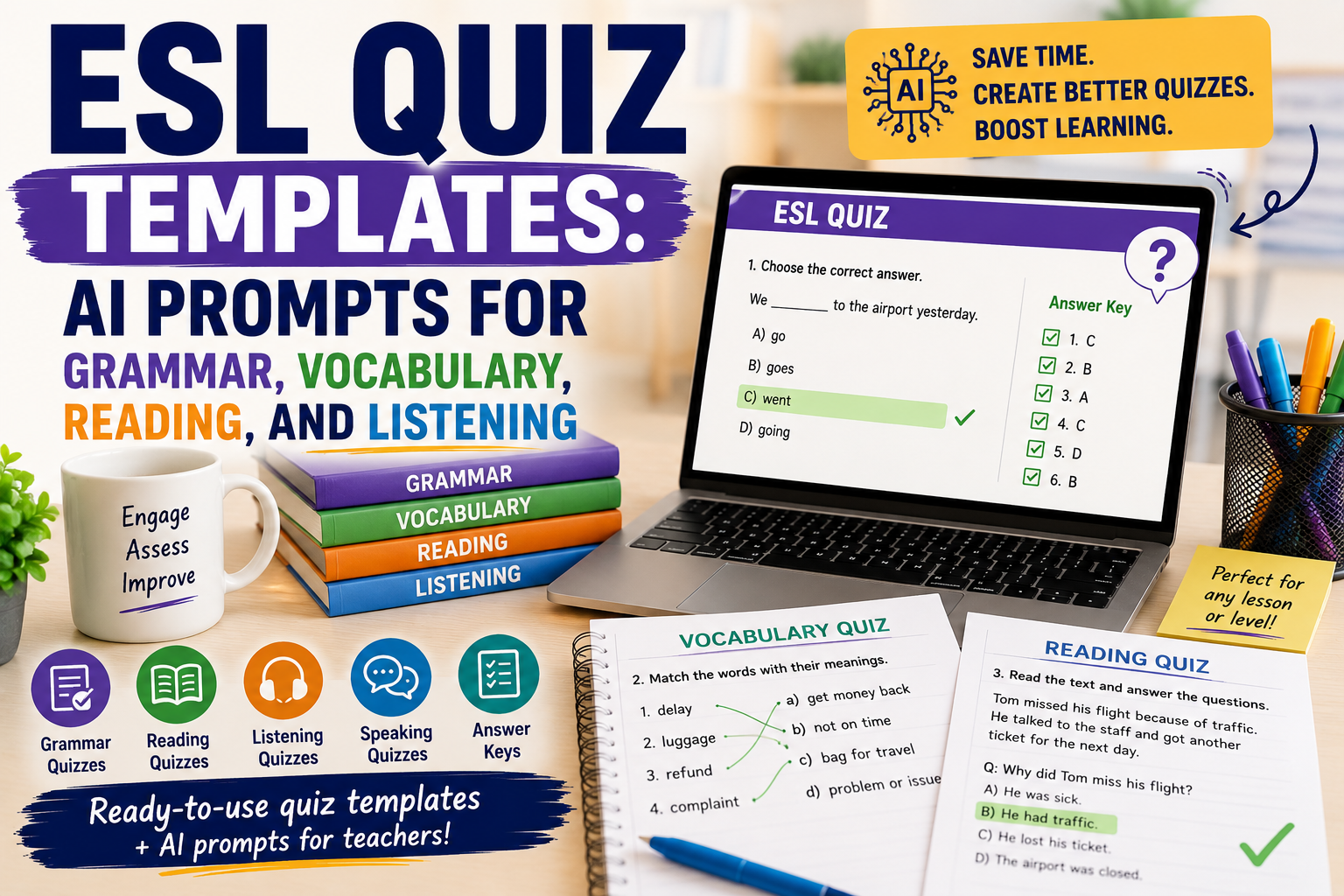
    ESL Quiz Templates: AI Prompts for Grammar, Vocabulary, Reading, and Listening

    An ESL quiz can do more than check answers. Used well, it can help English teachers review grammar, practise vocabulary, check reading comprehension, support listening lessons, and quickly see what students need next.

    The problem is that quiz preparation takes time. Teachers need clear questions, suitable difficulty, answer keys, distractors, instructions, and sometimes different versions for different levels. This is where AI can help.

    With the right prompt, you can create better ESL quiz templates faster. You can ask AI to generate grammar quizzes, vocabulary checks, reading comprehension questions, listening tasks, video quizzes, exit tickets, and review activities. The teacher still reviews the quiz, edits weak questions, and checks the answer key, but AI gives a useful first draft.

    In this guide, you will find practical ESL quiz templates and AI prompts you can copy, adapt, and use for your English classes.

    If you already use AI to create worksheets, you may also find these guides useful: AI Worksheet Generator for English Teachers: 7 Ways to Create Better ESL Worksheets, Reading Worksheet Generator: 7 AI Prompts for Better ESL Reading Lessons, and AI Video Question Maker: 9 Prompts for Better ESL Listening Lessons.

    What Makes a Good ESL Quiz?

    A good ESL quiz is not just a list of random questions. It should match the lesson aim, student level, and language skill you want to check.

    A useful ESL quiz should be:

    • clear enough for students to understand;
    • focused on one main skill or lesson goal;
    • suitable for the students’ English level;
    • short enough to complete without stress;
    • fair, with no confusing trick questions;
    • easy for the teacher to mark;
    • connected to what students studied recently.

    For example, if your lesson focused on the past simple, the quiz should not suddenly test advanced conditionals. If your students are A2 learners, the instructions should not be written at a B2 level.

    AI can help with quiz creation, but only when you give it enough context.

    How AI Can Help English Teachers Create ESL Quizzes

    AI can support quiz preparation by helping you create:

    • multiple-choice questions;
    • gap-fill questions;
    • matching activities;
    • true/false questions;
    • short-answer questions;
    • vocabulary quizzes;
    • grammar quizzes;
    • reading comprehension quizzes;
    • listening comprehension quizzes;
    • video-based quizzes;
    • answer keys;
    • easier or harder versions of the same quiz.

    The key is to avoid vague prompts like:

    Make an ESL quiz.
    

    That usually produces a generic quiz.

    A better prompt includes the level, topic, skill, target language, number of questions, question type, and answer key.

    Use this basic structure:

    Create an ESL quiz for [LEVEL] learners.
    
    Topic:
    [TOPIC]
    
    Skill or language focus:
    [GRAMMAR / VOCABULARY / READING / LISTENING / SPEAKING PREPARATION]
    
    Create:
    [NUMBER] questions.
    
    Question types:
    [QUESTION TYPES]
    
    Add:
    - clear student instructions;
    - an answer key;
    - simple language suitable for [LEVEL].
    

    Now let’s look at specific ESL quiz templates.

    ESL Quiz Template 1: Grammar Quiz

    A grammar quiz helps you check whether students can use a structure accurately. It works best when it focuses on one grammar point.

    Use this prompt:

    Act as an experienced ESL teacher.
    
    Create a grammar quiz for [LEVEL] English learners.
    
    Grammar focus:
    [GRAMMAR POINT]
    
    Lesson context:
    [BRIEF CONTEXT]
    
    Create:
    1. 5 multiple-choice questions;
    2. 5 gap-fill questions;
    3. 3 sentence correction questions;
    4. an answer key.
    
    Use clear, natural sentences.
    Avoid trick questions.
    Make the quiz suitable for [LEVEL] learners.
    

    Example

    Create a grammar quiz for A2 English learners.
    
    Grammar focus:
    Past simple regular and irregular verbs
    
    Lesson context:
    Students studied daily activities and weekend routines.
    
    Create:
    1. 5 multiple-choice questions;
    2. 5 gap-fill questions;
    3. 3 sentence correction questions;
    4. an answer key.
    

    Teacher tip

    Keep grammar quizzes focused. A short quiz on one grammar point is usually more useful than a long quiz that mixes too many structures.

    ESL Quiz Template 2: Vocabulary Quiz

    A vocabulary quiz should test meaning, use, and context — not only spelling or translation.

    Use this prompt:

    Create a vocabulary quiz for [LEVEL] ESL learners.
    
    Topic:
    [TOPIC]
    
    Target vocabulary:
    [PASTE WORD LIST]
    
    Create:
    1. 5 matching questions;
    2. 5 multiple-choice meaning questions;
    3. 5 gap-fill sentences;
    4. 3 short personalisation questions;
    5. an answer key.
    
    Use simple example sentences and make the vocabulary useful in context.
    

    Example

    Create a vocabulary quiz for B1 ESL learners.
    
    Topic:
    Healthy habits
    
    Target vocabulary:
    sleep well, drink water, exercise, screen time, routine, reduce, improve, energy
    
    Create:
    1. 5 matching questions;
    2. 5 multiple-choice meaning questions;
    3. 5 gap-fill sentences;
    4. 3 short personalisation questions;
    5. an answer key.
    

    This connects well with Spelling Worksheet Maker: 7 AI Prompts to Create Better English Worksheets article because spelling, vocabulary, and short quizzes often work together.

    ESL Quiz Template 3: Reading Comprehension Quiz

    A reading quiz should check different levels of understanding: main idea, details, vocabulary, and inference.

    Use this prompt:

    Act as an ESL reading teacher.
    
    Create a reading comprehension quiz for [LEVEL] learners.
    
    Reading text:
    [PASTE TEXT]
    
    Create:
    1. 3 main-idea questions;
    2. 5 detail questions;
    3. 4 vocabulary-in-context questions;
    4. 2 inference questions;
    5. an answer key.
    
    Make the questions clear and suitable for [LEVEL].
    Do not ask questions that cannot be answered from the text.
    

    Why this works

    This prompt avoids one common problem: AI sometimes creates questions that are too broad or not directly supported by the text. By telling it to use only the text, you get a fairer quiz.

    ESL Quiz Template 4: Listening Quiz

    A listening quiz should help students focus while listening. It should not overload them with too many details.

    Use this prompt:

    Create a listening comprehension quiz for [LEVEL] ESL learners.
    
    Listening topic:
    [TOPIC]
    
    Transcript or summary:
    [PASTE TRANSCRIPT OR SUMMARY]
    
    Create:
    1. 3 gist questions;
    2. 5 detail questions;
    3. 4 vocabulary-in-context questions;
    4. 2 short-answer questions;
    5. an answer key.
    
    Make the questions follow the order of the listening text.
    Use clear and simple wording.
    

    Teacher tip

    For listening, question order matters. If the questions follow the order of the audio or video, students can listen with a clear purpose.

    ESL Quiz Template 5: Video Quiz

    A video quiz combines listening, visual context, comprehension, and discussion.

    Use this prompt:

    Create an ESL video quiz for [LEVEL] learners.
    
    Video topic:
    [TOPIC]
    
    Video transcript or summary:
    [PASTE TRANSCRIPT OR SUMMARY]
    
    Create:
    1. 3 pre-watching prediction questions;
    2. 5 while-watching comprehension questions;
    3. 4 vocabulary questions;
    4. 3 post-watching discussion questions;
    5. an answer key.
    
    Make the quiz suitable for a classroom or online lesson.

    ESL Quiz Template 6: Multiple Choice Question Template

    Multiple-choice questions are useful, but weak answer options can make the quiz too easy or confusing. AI can help you create better distractors.

    Use this prompt:

    Create a multiple-choice ESL quiz for [LEVEL] learners.
    
    Topic:
    [TOPIC]
    
    Language focus:
    [FOCUS]
    
    Create 10 multiple-choice questions.
    
    For each question:
    - write one clear question;
    - give 4 answer options;
    - make only one answer correct;
    - make the wrong options realistic but fair;
    - avoid confusing trick options.
    
    Add an answer key and a short explanation for each answer.
    

    Example

    Create a multiple-choice ESL quiz for B1 learners.
    
    Topic:
    Travel problems
    
    Language focus:
    Past simple and travel vocabulary
    
    Create 10 multiple-choice questions.
    

    Teacher tip

    Always check the wrong answers. Good distractors should be possible mistakes, not silly answers.

    ESL Quiz Template 7: Exit Ticket Quiz

    An exit ticket is a very short quiz at the end of a lesson. It helps you see what students understood before they leave.

    Use this prompt:

    Create a 5-minute ESL exit ticket for [LEVEL] learners.
    
    Lesson topic:
    [TOPIC]
    
    Today’s lesson aim:
    [LESSON AIM]
    
    Create:
    1. 2 quick checking questions;
    2. 1 short production task;
    3. 1 self-assessment question;
    4. 1 question students can ask if they need help.
    
    Make it easy to complete at the end of class.
    

    Example

    Create a 5-minute ESL exit ticket for A2 learners.
    
    Lesson topic:
    Giving advice
    
    Today’s lesson aim:
    Students can use should and shouldn’t to give simple advice.
    

    This kind of quiz is useful because it gives you fast feedback on the lesson. For a quick digital version, you can transfer the questions into Google Forms, which is useful for collecting responses and reviewing results.

    ESL Quiz Template 8: Review Quiz

    A review quiz helps students remember language from previous lessons. It is especially useful before a test or after finishing a unit.

    Use this prompt:

    Create an ESL review quiz for [LEVEL] learners.
    
    Unit topics:
    [LIST TOPICS]
    
    Grammar covered:
    [LIST GRAMMAR POINTS]
    
    Vocabulary covered:
    [LIST VOCABULARY AREAS]
    
    Create:
    1. 5 grammar questions;
    2. 5 vocabulary questions;
    3. 3 reading or sentence-context questions;
    4. 2 short writing questions;
    5. an answer key.
    
    Mix the questions, but keep them suitable for [LEVEL].
    

    Teacher tip

    Review quizzes should help students revise, not punish them. Keep the tone supportive and use questions that reflect what you actually taught. Platforms such as Quizizz can make review practice more interactive, especially when students need repeated low-stakes practice.

    ESL Quiz Template 9: Speaking Preparation Quiz

    A speaking quiz does not have to be a traditional test. You can use it to prepare students for discussion, role play, or oral practice.

    Use this prompt:

    Create a speaking preparation quiz for [LEVEL] ESL learners.
    
    Speaking topic:
    [TOPIC]
    
    Lesson goal:
    [GOAL]
    
    Create:
    1. 5 useful vocabulary questions;
    2. 5 sentence starter completion items;
    3. 4 opinion questions;
    4. 3 pair-work follow-up questions.
    
    Do not make it a grammar-only quiz.
    Help students prepare ideas and language for speaking.
    

    Example

    Create a speaking preparation quiz for B1 ESL learners.
    
    Speaking topic:
    Online learning
    
    Lesson goal:
    Students can express opinions about the advantages and disadvantages of online learning.
    

    This type of quiz helps students prepare before speaking, especially if they need vocabulary and sentence starters. For a lively whole-class warm-up or review round, Kahoot can turn selected questions into a live quiz game.

    ESL Quiz Template 10: Error Correction Quiz

    Error correction quizzes are useful when students keep making the same mistakes.

    Use this prompt:

    Create an ESL error correction quiz for [LEVEL] learners.
    
    Common student errors:
    [LIST ERRORS]
    
    Create 10 sentences.
    Some sentences should contain one error.
    Some sentences should be correct.
    
    Students must:
    1. decide if the sentence is correct or incorrect;
    2. correct the mistake if there is one.
    
    Add an answer key with short explanations.
    

    Example

    Create an ESL error correction quiz for B1 learners.
    
    Common student errors:
    - missing third-person -s;
    - incorrect past simple verbs;
    - article mistakes;
    - word order in questions.
    

    This can also connect to your AI Writing Feedback: 7 Ways English Teachers Can Give Better Student Feedback article, especially if you turn repeated writing errors into future practice.

    How to Improve AI-Generated ESL Quizzes

    AI-generated quizzes are useful, but they are not always ready to use. You should review and improve them before giving them to students.

    Use these follow-up prompts.

    Make the quiz easier

    Simplify this ESL quiz for [LEVEL] learners.
    Use shorter sentences, easier vocabulary, and clearer instructions.
    

    Make the quiz more challenging

    Make this ESL quiz more challenging for [LEVEL] learners.
    Add more context, better distractors, and questions that require understanding, not guessing.
    

    Add an answer key

    Add an answer key to this ESL quiz.
    For each answer, include a short teacher explanation.
    

    Check if the quiz matches the level

    Review this ESL quiz for level suitability.
    
    Student level:
    [LEVEL]
    
    Tell me:
    1. which questions are too easy;
    2. which questions are too difficult;
    3. which instructions need simplification;
    4. what changes you recommend.
    

    Turn the quiz into a printable worksheet

    Format this ESL quiz as a printable worksheet.
    
    Include:
    - title;
    - level;
    - student instructions;
    - sections;
    - space for answers;
    - answer key on a separate section.
    

    This links naturally to your AI Worksheet Generator for English Teachers post.

    Common Mistakes to Avoid When Creating ESL Quizzes with AI

    Mistake 1: Asking for a quiz without a level

    Always include the student level. A quiz for A2 learners should look very different from a quiz for B2 learners.

    Mistake 2: Testing too many things at once

    One quiz should have a clear purpose. Do not mix grammar, reading, vocabulary, listening, speaking, and writing unless it is a review quiz.

    Mistake 3: Trusting the answer key automatically

    AI can make mistakes. Always check the answer key before using the quiz.

    Mistake 4: Making multiple-choice questions too obvious

    If the wrong answers are silly, students do not need to understand the language. Ask AI to create realistic but fair distractors.

    Mistake 5: Forgetting instructions

    Students need to know exactly what to do. Add short instructions before each section.

    Mistake 6: Ignoring student anxiety

    Quizzes can help learning, but they can also make students nervous. Use low-stakes quizzes, review quizzes, and exit tickets to support learning.

    Mistake 7: Using AI output without teacher judgement

    AI can create a draft. The teacher makes it suitable, fair, accurate, and useful.

    Simple ESL Quiz Planning Checklist

    Before using an AI-generated quiz, check:

    • Is the quiz level appropriate?
    • Does it match the lesson aim?
    • Are the instructions clear?
    • Are the questions fair?
    • Are the wrong options realistic?
    • Is the answer key correct?
    • Is the quiz short enough?
    • Does it help students learn, not only test them?
    • Can the results help me decide what to teach next?

    Practical Example: Creating a B1 ESL Quiz with AI

    Imagine you taught a B1 lesson about travel problems. Your students learned vocabulary such as delayed flight, lost luggage, booking, complaint, refund, and customer service. They also practised the past simple.

    You could use this prompt:

    Create a B1 ESL quiz about travel problems.
    
    Lesson focus:
    - travel problem vocabulary;
    - past simple;
    - short complaint sentences.
    
    Create:
    1. 5 vocabulary matching questions;
    2. 5 multiple-choice grammar questions;
    3. 3 short reading comprehension questions based on a short travel complaint;
    4. 2 short writing questions;
    5. an answer key.
    
    Use clear instructions and natural English.
    

    The result could become a short classroom quiz, homework task, or printable worksheet. If you want to turn it into a polished handout, Canva can help you arrange the questions, answer spaces, headings, and visual elements in a printable format.

    FAQ: ESL Quiz Templates and AI Prompts

    What is an ESL quiz?

    An ESL quiz is a short assessment activity used to check English learners’ understanding of grammar, vocabulary, reading, listening, speaking preparation, or lesson content.

    How can AI help create ESL quizzes?

    AI can help teachers create question drafts, answer keys, different quiz versions, multiple-choice options, vocabulary tasks, grammar questions, and reading or listening comprehension checks.

    What should I include in an ESL quiz prompt?

    Include the learner level, topic, skill, target language, number of questions, question type, and whether you want an answer key.

    Can AI create grammar quizzes for ESL students?

    Yes. AI can create grammar quizzes if you provide the grammar point, student level, and preferred question types.

    Can AI create vocabulary quizzes?

    Yes. You can give AI a vocabulary list and ask it to create matching questions, gap-fill sentences, multiple-choice questions, and personalisation tasks.

    Can I use AI to create multiple-choice questions?

    Yes. AI can create multiple-choice questions, but you should check that only one answer is correct and that the distractors are fair.

    Should I use AI-generated ESL quizzes without editing?

    No. Always review the questions, instructions, level, and answer key before using them with students.

    Conclusion

    An ESL quiz can be a powerful teaching tool when it is clear, focused, level-appropriate, and connected to the lesson. With AI, English teachers can create quiz drafts faster for grammar, vocabulary, reading, listening, video lessons, speaking preparation, review, and exit tickets.

    The best results come from specific prompts. Tell AI the student level, topic, skill, language focus, question type, and quiz purpose. Then review the output carefully and adapt it for your learners.

    AI can save preparation time, but teacher judgement is what makes the quiz useful. Used well, AI helps you create quizzes that check understanding, guide revision, and support better English learning.
  • AI Video Question Maker: 9 Prompts for Better ESL Listening Lessons

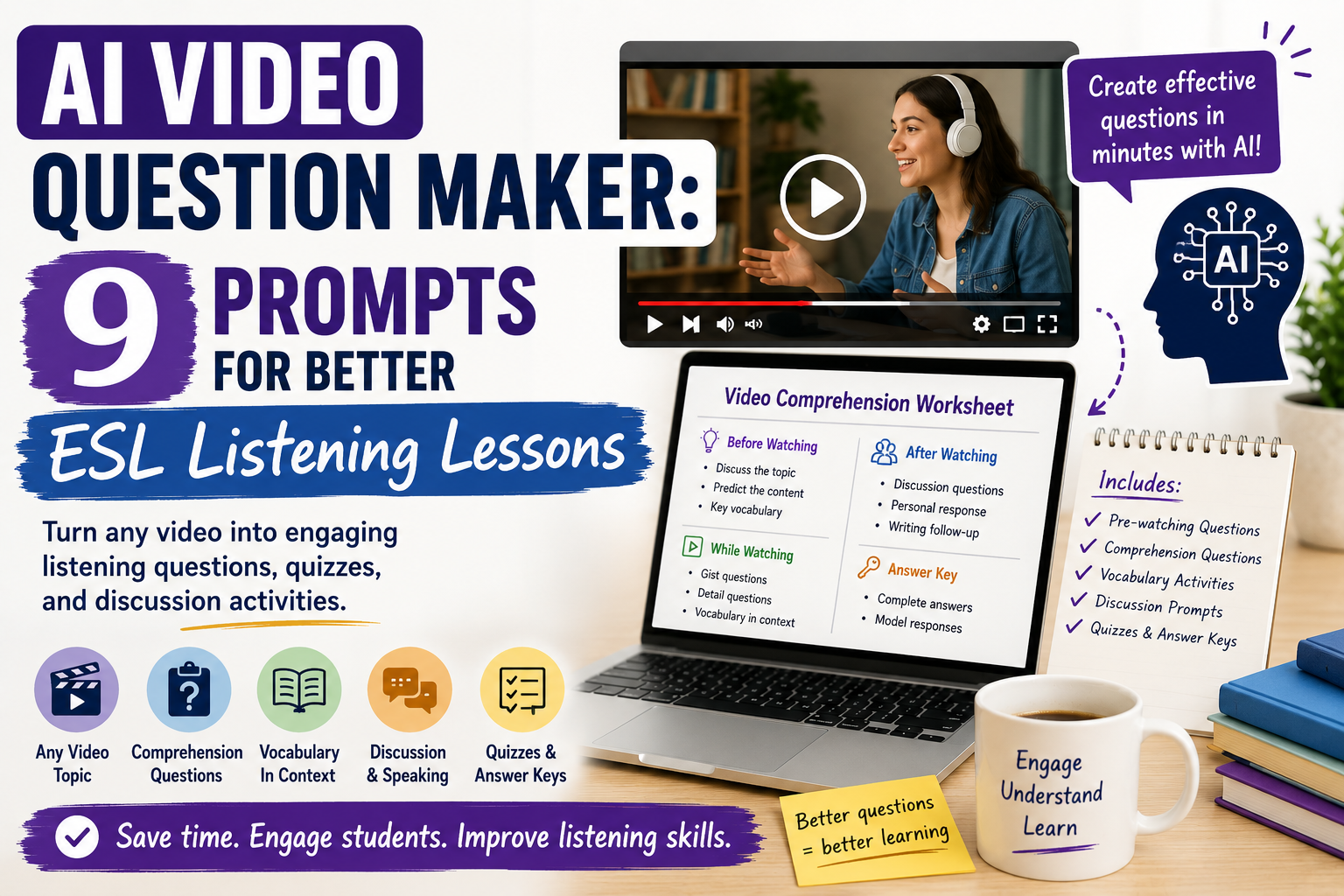
    AI Video Question Maker: 9 Prompts for Better ESL Listening Lessons

    An AI video question maker can help English teachers turn videos into listening tasks, comprehension questions, vocabulary activities, discussion prompts, quizzes, and full classroom worksheets. Instead of watching a video several times and manually writing every question, teachers can use AI to create a strong first draft faster.

    For ESL/EFL teachers and language tutors, video lessons are powerful because students hear natural speech, see context, and respond to real-world topics. However, preparing video-based lessons can take time. You need pre-watching questions, gist tasks, detailed comprehension questions, vocabulary support, post-watching discussion, and sometimes an answer key.

    AI can help with all of this, but only if you guide it properly. A weak prompt creates generic questions. A clear, teacher-focused prompt creates useful classroom material.

    If you already use AI for worksheets, you may also want to read AI Worksheet Generator for English Teachers: 7 Ways to Create Better ESL Worksheets and Reading Worksheet Generator: 7 AI Prompts for Better ESL Reading Lessons.

    What Is an AI Video Question Maker?

    An AI video question maker is a tool or prompt workflow that helps teachers create questions from a video topic, transcript, summary, or lesson objective.

    For English teachers, it can help create:

    • pre-watching discussion questions;
    • gist listening questions;
    • detailed comprehension questions;
    • vocabulary-in-context tasks;
    • true/false questions;
    • multiple-choice quizzes;
    • prediction activities;
    • post-watching speaking tasks;
    • writing follow-ups;
    • answer keys.

    The best results usually come when you provide a transcript, short summary, or clear description of the video. If you only say “make questions for this video,” the AI may not know the content accurately.

    Why English Teachers Should Use AI for Video Questions

    Video lessons are useful, but they can be preparation-heavy. Teachers often need to pause, replay, write questions, check answers, simplify language, and design follow-up tasks.

    An AI video question maker can help you:

    • save preparation time;
    • create different question types quickly;
    • adapt questions for different levels;
    • build listening worksheets from video content;
    • create quizzes from video transcripts;
    • generate discussion questions;
    • prepare homework or flipped-learning tasks;
    • turn video lessons into printable or digital activities.

    This is especially useful for private tutors, online teachers, and classroom teachers who use YouTube clips, short educational videos, interviews, presentations, or coursebook videos.

    For reliable listening and video resources, teachers can also explore British Council LearnEnglish, which offers level-appropriate materials and classroom ideas. TED-Ed is another useful source of short educational videos that can support discussion and listening lessons.

    How to Use an AI Video Question Maker Effectively

    The best workflow is simple:

    1. Choose a short video.
    2. Get or write a transcript or summary.
    3. Decide the student level.
    4. Choose the listening skill.
    5. Ask AI to create questions.
    6. Review the output.
    7. Add an answer key.
    8. Turn the result into a worksheet or quiz.

    Do not rely on AI to guess video content. If possible, provide the transcript. If you do not have a transcript, write a short summary yourself.

    When selecting videos, check the source, length, language level, and suitability for your learners. YouTube can help you find authentic clips, but always preview a video before using it in class.

    Prompt 1: Basic AI Video Question Maker Prompt

    Use this prompt when you have a transcript or clear video summary.

    Act as an experienced ESL listening teacher.
    
    Create a video comprehension worksheet for [LEVEL] English learners.
    
    Video topic:
    [TOPIC]
    
    Transcript or summary:
    [PASTE TRANSCRIPT OR SUMMARY]
    
    Include:
    1. 3 pre-watching questions;
    2. 3 gist questions;
    3. 6 detailed comprehension questions;
    4. 5 vocabulary-in-context questions;
    5. 3 post-watching discussion questions;
    6. an answer key.
    
    Use clear instructions and make the questions suitable for [LEVEL] learners.
    

    This gives students a complete video lesson, not just random comprehension questions.

    Prompt 2: Gist Listening Questions

    Gist questions help students understand the main idea before focusing on details.

    Create gist listening questions for [LEVEL] ESL learners.
    
    Video summary or transcript:
    [PASTE TEXT]
    
    Create:
    1. 4 main-idea questions;
    2. 3 title prediction options;
    3. 2 questions about the speaker’s general message.
    
    Avoid tiny details. Focus on overall understanding.
    Add an answer key.
    

    This works well for the first viewing. Students should not need to understand every word.

    Prompt 3: Detailed Comprehension Questions

    Use this after students understand the general meaning.

    Create detailed comprehension questions for a video-based ESL lesson.
    
    Student level:
    [LEVEL]
    
    Transcript:
    [PASTE TRANSCRIPT]
    
    Create 8 questions that check important details from the video.
    Use a mix of short-answer and multiple-choice questions.
    Make the questions clear and fair.
    Add an answer key.
    

    Teacher tip: make sure the questions follow the order of the video. This helps students listen with purpose.

    Prompt 4: Vocabulary from the Video

    Videos are great for vocabulary learning because words appear in context.

    Create a vocabulary-in-context activity from this video transcript.
    
    Student level:
    [LEVEL]
    
    Transcript:
    [PASTE TRANSCRIPT]
    
    Choose 8 useful words or phrases for English learners.
    For each item:
    1. show the sentence from the transcript;
    2. ask students to guess the meaning;
    3. give 3 answer choices;
    4. include the correct answer.
    
    Choose useful vocabulary, not rare or unnecessary words.
    

    This connects naturally with your post Spelling Worksheet Maker: 7 AI Prompts to Create Better English Worksheets, especially when you want students to practise vocabulary after watching.

    Prompt 5: True/False Video Questions

    True/false questions are easy to use, but they become stronger when students correct false statements.

    Create a true/false video comprehension task for [LEVEL] English learners.
    
    Video transcript:
    [PASTE TRANSCRIPT]
    
    Create 8 statements.
    Some should be true and some should be false.
    For false statements, students must correct the information.
    Add an answer key with the corrected false statements.
    

    This is useful for listening practice because students must understand meaning, not only guess.

    Prompt 6: Multiple-Choice Video Quiz

    Use this when you want a quick quiz or homework activity.

    Create a multiple-choice quiz from this video transcript.
    
    Student level:
    [LEVEL]
    
    Transcript:
    [PASTE TRANSCRIPT]
    
    Create 10 multiple-choice questions.
    Each question should have 4 options.
    Only one option should be correct.
    Avoid trick questions.
    Add an answer key.
    

    You can later turn this into a digital quiz using Google Forms, which allows teachers to create quizzes, collect responses, and review student answers.

    Prompt 7: Discussion Questions After Watching

    Video lessons should not stop with comprehension. Students need to react, discuss, and use English.

    Create post-watching discussion questions for [LEVEL] ESL learners.
    
    Video topic:
    [TOPIC]
    
    Video summary:
    [SUMMARY]
    
    Create:
    1. 5 personal response questions;
    2. 3 opinion questions;
    3. 2 pair-work follow-up tasks.
    
    Make the questions communicative and suitable for English learners.
    

    Example question types:

    • Do you agree with the speaker? Why or why not?
    • Have you ever experienced something similar?
    • What advice would you give the person in the video?
    • What would you do in this situation?

    Prompt 8: Different Levels from the Same Video

    This is useful for mixed-level classes.

    Create two versions of a video worksheet from the same transcript.
    
    Transcript:
    [PASTE TRANSCRIPT]
    
    Version A:
    For A2 learners. Include simple gist questions, basic detail questions, and easy vocabulary.
    
    Version B:
    For B1/B2 learners. Include detail questions, inference questions, vocabulary-in-context, and discussion questions.
    
    Add answer keys for both versions.
    

    This helps you use one video with different learners without preparing everything from zero.

    Prompt 9: Turn a Video into a Full ESL Worksheet

    Use this when you want a complete printable or digital worksheet.

    Create a full ESL video worksheet for [LEVEL] learners.
    
    Video title/topic:
    [TOPIC]
    
    Transcript or summary:
    [PASTE TRANSCRIPT OR SUMMARY]
    
    Include:
    1. lesson aim;
    2. before-watching questions;
    3. key vocabulary;
    4. first-watch gist task;
    5. second-watch detail questions;
    6. vocabulary-in-context task;
    7. post-watching speaking activity;
    8. short writing follow-up;
    9. answer key.
    
    Make it classroom-ready and easy to print.
    

    This is the best prompt if you want to create a complete resource.

    Practical Example: Turning a Short Video into an ESL Lesson

    Imagine you want to use a short video about healthy habits with B1 learners.

    Your prompt could be:

    Create a B1 ESL video worksheet about healthy habits.
    
    Video summary:
    The video explains how small daily habits can improve health. It mentions sleeping well, drinking water, walking every day, eating simple meals, and reducing screen time before bed.
    
    Include:
    1. 3 pre-watching questions;
    2. 3 gist questions;
    3. 6 detail questions;
    4. 5 vocabulary-in-context questions;
    5. 4 discussion questions;
    6. a short writing task;
    7. an answer key.
    

    The AI might create a worksheet with sections such as:

    • Before you watch
    • Watch for the main idea
    • Watch again for details
    • Vocabulary from the video
    • Discuss with a partner
    • Write about your habits

    This becomes a complete ESL video activity, not just a quiz.

    How to Improve AI-Generated Video Questions

    AI questions are not always perfect. Use follow-up prompts to improve them.

    Make the questions easier

    Simplify these video questions for A2 learners. Use shorter sentences and easier vocabulary.
    

    Make the questions more communicative

    Add a speaking task after the video so students use the topic vocabulary in pairs.
    

    Improve the answer key

    Check the answer key and explain any answers that may have more than one acceptable response.
    

    Turn the questions into a worksheet

    Format these video questions as a printable ESL worksheet with clear headings and student instructions.
    

    Turn mistakes into follow-up practice

    Create a short follow-up worksheet based on likely student mistakes from this video lesson.
    

    For extra worksheet structure, link readers to your AI Worksheet Generator for English Teachers article.

    Common Mistakes to Avoid

    Mistake 1: Not giving AI the video content

    AI cannot reliably create accurate questions from a video title alone. Provide a transcript, summary, or key points.

    Mistake 2: Creating too many detail questions

    Students need gist, vocabulary, and discussion too. Do not make the lesson only about small details.

    Mistake 3: Ignoring the learner level

    Video language can be fast and difficult. Always specify the student level and simplify questions if needed.

    Mistake 4: Forgetting pre-watching support

    Pre-watching questions prepare students for the topic and reduce listening anxiety.

    Mistake 5: Skipping post-watching communication

    After watching, students should speak, write, react, or connect the topic to their lives.

    Mistake 6: Trusting the answer key without checking

    AI can create incorrect or unclear answers. Always review the answer key before using it.

    Mistake 7: Using copyrighted material carelessly

    Be careful when using transcripts, clips, or video content. Use videos appropriately for your teaching context and avoid republishing copyrighted material without permission. Review the copyright guidance provided by YouTube before downloading, editing, or redistributing video content.

    Simple Video Worksheet Template

    You can reuse this structure:

    Title: Video Worksheet: [Topic]
    Level: [A2/B1/B2]
    Lesson aim: Students will practise listening for [gist/details/vocabulary] and discuss [topic].

    Before Watching

    1. Discuss the topic.
    2. Predict the content.
    3. Learn key vocabulary.

    While Watching

    1. First watch: answer gist questions.
    2. Second watch: answer detail questions.
    3. Listen for useful phrases.

    After Watching

    1. Discuss your opinion.
    2. Complete a short writing task.
    3. Review vocabulary.

    Answer Key

    Include answers for comprehension and vocabulary questions. For opinion questions, mention that answers may vary.

    FAQ: AI Video Question Maker

    What is an AI video question maker?

    An AI video question maker is a tool or prompt workflow that helps teachers create questions from video content, transcripts, summaries, or lesson aims.

    Can AI create questions from a video?

    Yes, but it works best when you provide a transcript, summary, or key points from the video. AI should not be expected to guess the video accurately from the title alone.

    How can English teachers use AI for video lessons?

    English teachers can use AI to create pre-watching questions, gist tasks, comprehension questions, vocabulary activities, discussion prompts, quizzes, and answer keys.

    Can AI create listening comprehension questions?

    Yes. AI can help create listening comprehension questions if you provide the level, transcript or summary, and question type.

    Can I turn video questions into a worksheet?

    Yes. Ask AI to format the questions as a printable ESL worksheet with headings, instructions, space for answers, and an answer key. You can then design the final resource in a tool such as Canva.

    Is an AI video question maker useful for private tutors?

    Yes. Tutors can use it to prepare quick video-based lessons, homework tasks, discussion lessons, and listening practice for individual students.

    Should I use AI-generated video questions without editing?

    No. Always check accuracy, level, clarity, and answer keys before using AI-generated questions with students.

    Conclusion

    An AI video question maker can save English teachers time and help turn videos into stronger ESL listening lessons. It can create gist questions, detailed comprehension tasks, vocabulary activities, discussion prompts, quizzes, worksheets, and answer keys.

    But the best results come from clear teacher input. Give AI the video transcript or summary, student level, lesson aim, and question types. Then review the output carefully before using it in class.

    Used well, AI can help you turn a short video into a complete English lesson that supports listening, vocabulary, speaking, writing, and classroom interaction.