Category: AI Assessment Tools

  • ESL Quiz Templates: AI Prompts for Grammar, Vocabulary, Reading, and Listening

    ESL Quiz Templates: AI Prompts for Grammar, Vocabulary, Reading, and Listening

    An ESL quiz can do more than check answers. Used well, it can help English teachers review grammar, practise vocabulary, check reading comprehension, support listening lessons, and quickly see what students need next.

    The problem is that quiz preparation takes time. Teachers need clear questions, suitable difficulty, answer keys, distractors, instructions, and sometimes different versions for different levels. This is where AI can help.

    With the right prompt, you can create better ESL quiz templates faster. You can ask AI to generate grammar quizzes, vocabulary checks, reading comprehension questions, listening tasks, video quizzes, exit tickets, and review activities. The teacher still reviews the quiz, edits weak questions, and checks the answer key, but AI gives a useful first draft.

    In this guide, you will find practical ESL quiz templates and AI prompts you can copy, adapt, and use for your English classes.

    If you already use AI to create worksheets, you may also find these guides useful: AI Worksheet Generator for English Teachers: 7 Ways to Create Better ESL Worksheets, Reading Worksheet Generator: 7 AI Prompts for Better ESL Reading Lessons, and AI Video Question Maker: 9 Prompts for Better ESL Listening Lessons.

    What Makes a Good ESL Quiz?

    A good ESL quiz is not just a list of random questions. It should match the lesson aim, student level, and language skill you want to check.

    A useful ESL quiz should be:

    • clear enough for students to understand;
    • focused on one main skill or lesson goal;
    • suitable for the students’ English level;
    • short enough to complete without stress;
    • fair, with no confusing trick questions;
    • easy for the teacher to mark;
    • connected to what students studied recently.

    For example, if your lesson focused on the past simple, the quiz should not suddenly test advanced conditionals. If your students are A2 learners, the instructions should not be written at a B2 level.

    AI can help with quiz creation, but only when you give it enough context.

    How AI Can Help English Teachers Create ESL Quizzes

    AI can support quiz preparation by helping you create:

    • multiple-choice questions;
    • gap-fill questions;
    • matching activities;
    • true/false questions;
    • short-answer questions;
    • vocabulary quizzes;
    • grammar quizzes;
    • reading comprehension quizzes;
    • listening comprehension quizzes;
    • video-based quizzes;
    • answer keys;
    • easier or harder versions of the same quiz.

    The key is to avoid vague prompts like:

    Make an ESL quiz.
    

    That usually produces a generic quiz.

    A better prompt includes the level, topic, skill, target language, number of questions, question type, and answer key.

    Use this basic structure:

    Create an ESL quiz for [LEVEL] learners.
    
    Topic:
    [TOPIC]
    
    Skill or language focus:
    [GRAMMAR / VOCABULARY / READING / LISTENING / SPEAKING PREPARATION]
    
    Create:
    [NUMBER] questions.
    
    Question types:
    [QUESTION TYPES]
    
    Add:
    - clear student instructions;
    - an answer key;
    - simple language suitable for [LEVEL].
    

    Now let’s look at specific ESL quiz templates.

    ESL Quiz Template 1: Grammar Quiz

    A grammar quiz helps you check whether students can use a structure accurately. It works best when it focuses on one grammar point.

    Use this prompt:

    Act as an experienced ESL teacher.
    
    Create a grammar quiz for [LEVEL] English learners.
    
    Grammar focus:
    [GRAMMAR POINT]
    
    Lesson context:
    [BRIEF CONTEXT]
    
    Create:
    1. 5 multiple-choice questions;
    2. 5 gap-fill questions;
    3. 3 sentence correction questions;
    4. an answer key.
    
    Use clear, natural sentences.
    Avoid trick questions.
    Make the quiz suitable for [LEVEL] learners.
    

    Example

    Create a grammar quiz for A2 English learners.
    
    Grammar focus:
    Past simple regular and irregular verbs
    
    Lesson context:
    Students studied daily activities and weekend routines.
    
    Create:
    1. 5 multiple-choice questions;
    2. 5 gap-fill questions;
    3. 3 sentence correction questions;
    4. an answer key.
    

    Teacher tip

    Keep grammar quizzes focused. A short quiz on one grammar point is usually more useful than a long quiz that mixes too many structures.

    ESL Quiz Template 2: Vocabulary Quiz

    A vocabulary quiz should test meaning, use, and context — not only spelling or translation.

    Use this prompt:

    Create a vocabulary quiz for [LEVEL] ESL learners.
    
    Topic:
    [TOPIC]
    
    Target vocabulary:
    [PASTE WORD LIST]
    
    Create:
    1. 5 matching questions;
    2. 5 multiple-choice meaning questions;
    3. 5 gap-fill sentences;
    4. 3 short personalisation questions;
    5. an answer key.
    
    Use simple example sentences and make the vocabulary useful in context.
    

    Example

    Create a vocabulary quiz for B1 ESL learners.
    
    Topic:
    Healthy habits
    
    Target vocabulary:
    sleep well, drink water, exercise, screen time, routine, reduce, improve, energy
    
    Create:
    1. 5 matching questions;
    2. 5 multiple-choice meaning questions;
    3. 5 gap-fill sentences;
    4. 3 short personalisation questions;
    5. an answer key.
    

    This connects well with Spelling Worksheet Maker: 7 AI Prompts to Create Better English Worksheets article because spelling, vocabulary, and short quizzes often work together.

    ESL Quiz Template 3: Reading Comprehension Quiz

    A reading quiz should check different levels of understanding: main idea, details, vocabulary, and inference.

    Use this prompt:

    Act as an ESL reading teacher.
    
    Create a reading comprehension quiz for [LEVEL] learners.
    
    Reading text:
    [PASTE TEXT]
    
    Create:
    1. 3 main-idea questions;
    2. 5 detail questions;
    3. 4 vocabulary-in-context questions;
    4. 2 inference questions;
    5. an answer key.
    
    Make the questions clear and suitable for [LEVEL].
    Do not ask questions that cannot be answered from the text.
    

    Why this works

    This prompt avoids one common problem: AI sometimes creates questions that are too broad or not directly supported by the text. By telling it to use only the text, you get a fairer quiz.

    ESL Quiz Template 4: Listening Quiz

    A listening quiz should help students focus while listening. It should not overload them with too many details.

    Use this prompt:

    Create a listening comprehension quiz for [LEVEL] ESL learners.
    
    Listening topic:
    [TOPIC]
    
    Transcript or summary:
    [PASTE TRANSCRIPT OR SUMMARY]
    
    Create:
    1. 3 gist questions;
    2. 5 detail questions;
    3. 4 vocabulary-in-context questions;
    4. 2 short-answer questions;
    5. an answer key.
    
    Make the questions follow the order of the listening text.
    Use clear and simple wording.
    

    Teacher tip

    For listening, question order matters. If the questions follow the order of the audio or video, students can listen with a clear purpose.

    ESL Quiz Template 5: Video Quiz

    A video quiz combines listening, visual context, comprehension, and discussion.

    Use this prompt:

    Create an ESL video quiz for [LEVEL] learners.
    
    Video topic:
    [TOPIC]
    
    Video transcript or summary:
    [PASTE TRANSCRIPT OR SUMMARY]
    
    Create:
    1. 3 pre-watching prediction questions;
    2. 5 while-watching comprehension questions;
    3. 4 vocabulary questions;
    4. 3 post-watching discussion questions;
    5. an answer key.
    
    Make the quiz suitable for a classroom or online lesson.

    ESL Quiz Template 6: Multiple Choice Question Template

    Multiple-choice questions are useful, but weak answer options can make the quiz too easy or confusing. AI can help you create better distractors.

    Use this prompt:

    Create a multiple-choice ESL quiz for [LEVEL] learners.
    
    Topic:
    [TOPIC]
    
    Language focus:
    [FOCUS]
    
    Create 10 multiple-choice questions.
    
    For each question:
    - write one clear question;
    - give 4 answer options;
    - make only one answer correct;
    - make the wrong options realistic but fair;
    - avoid confusing trick options.
    
    Add an answer key and a short explanation for each answer.
    

    Example

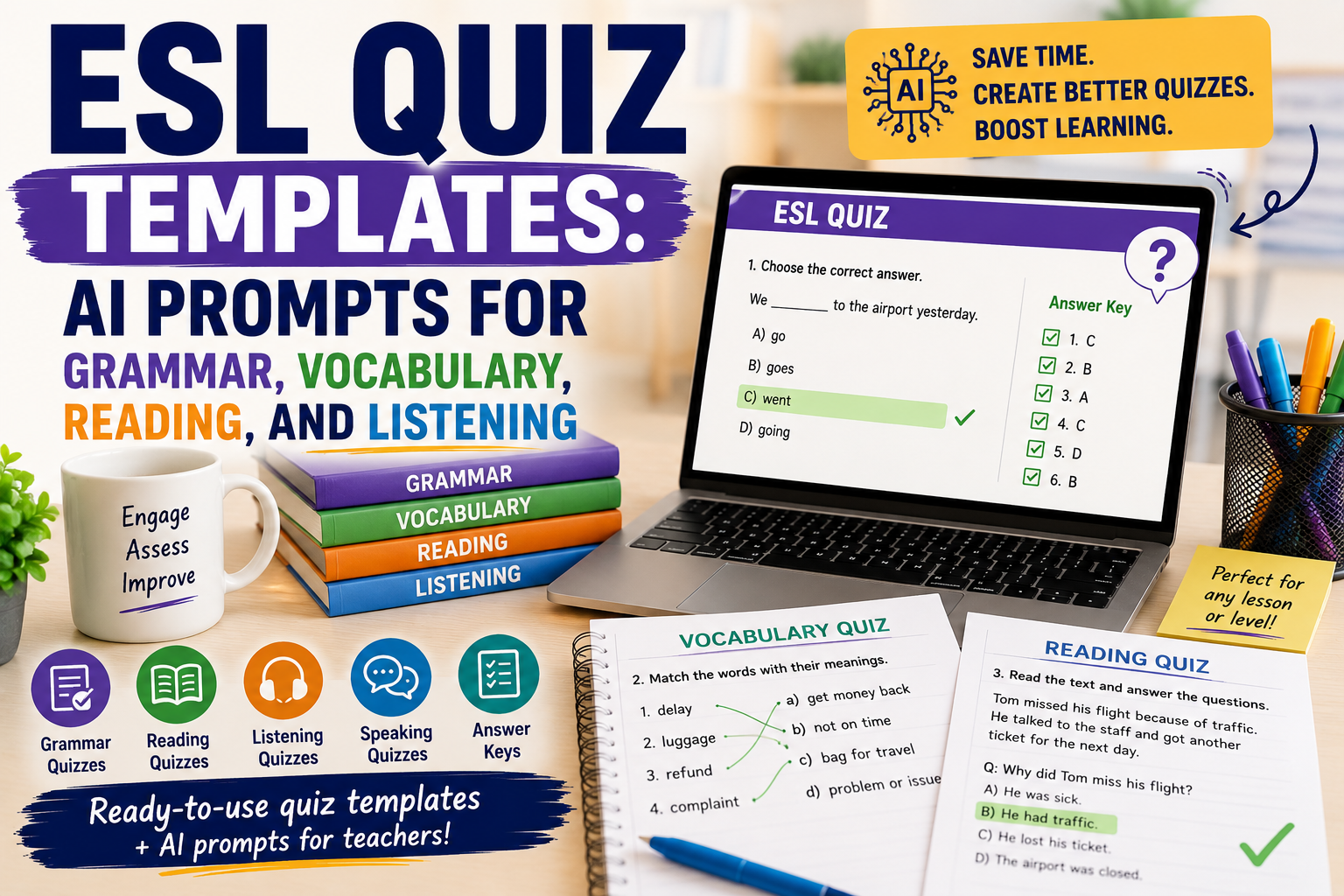
    Create a multiple-choice ESL quiz for B1 learners.
    
    Topic:
    Travel problems
    
    Language focus:
    Past simple and travel vocabulary
    
    Create 10 multiple-choice questions.
    

    Teacher tip

    Always check the wrong answers. Good distractors should be possible mistakes, not silly answers.

    ESL Quiz Template 7: Exit Ticket Quiz

    An exit ticket is a very short quiz at the end of a lesson. It helps you see what students understood before they leave.

    Use this prompt:

    Create a 5-minute ESL exit ticket for [LEVEL] learners.
    
    Lesson topic:
    [TOPIC]
    
    Today’s lesson aim:
    [LESSON AIM]
    
    Create:
    1. 2 quick checking questions;
    2. 1 short production task;
    3. 1 self-assessment question;
    4. 1 question students can ask if they need help.
    
    Make it easy to complete at the end of class.
    

    Example

    Create a 5-minute ESL exit ticket for A2 learners.
    
    Lesson topic:
    Giving advice
    
    Today’s lesson aim:
    Students can use should and shouldn’t to give simple advice.
    

    This kind of quiz is useful because it gives you fast feedback on the lesson. For a quick digital version, you can transfer the questions into Google Forms, which is useful for collecting responses and reviewing results.

    ESL Quiz Template 8: Review Quiz

    A review quiz helps students remember language from previous lessons. It is especially useful before a test or after finishing a unit.

    Use this prompt:

    Create an ESL review quiz for [LEVEL] learners.
    
    Unit topics:
    [LIST TOPICS]
    
    Grammar covered:
    [LIST GRAMMAR POINTS]
    
    Vocabulary covered:
    [LIST VOCABULARY AREAS]
    
    Create:
    1. 5 grammar questions;
    2. 5 vocabulary questions;
    3. 3 reading or sentence-context questions;
    4. 2 short writing questions;
    5. an answer key.
    
    Mix the questions, but keep them suitable for [LEVEL].
    

    Teacher tip

    Review quizzes should help students revise, not punish them. Keep the tone supportive and use questions that reflect what you actually taught. Platforms such as Quizizz can make review practice more interactive, especially when students need repeated low-stakes practice.

    ESL Quiz Template 9: Speaking Preparation Quiz

    A speaking quiz does not have to be a traditional test. You can use it to prepare students for discussion, role play, or oral practice.

    Use this prompt:

    Create a speaking preparation quiz for [LEVEL] ESL learners.
    
    Speaking topic:
    [TOPIC]
    
    Lesson goal:
    [GOAL]
    
    Create:
    1. 5 useful vocabulary questions;
    2. 5 sentence starter completion items;
    3. 4 opinion questions;
    4. 3 pair-work follow-up questions.
    
    Do not make it a grammar-only quiz.
    Help students prepare ideas and language for speaking.
    

    Example

    Create a speaking preparation quiz for B1 ESL learners.
    
    Speaking topic:
    Online learning
    
    Lesson goal:
    Students can express opinions about the advantages and disadvantages of online learning.
    

    This type of quiz helps students prepare before speaking, especially if they need vocabulary and sentence starters. For a lively whole-class warm-up or review round, Kahoot can turn selected questions into a live quiz game.

    ESL Quiz Template 10: Error Correction Quiz

    Error correction quizzes are useful when students keep making the same mistakes.

    Use this prompt:

    Create an ESL error correction quiz for [LEVEL] learners.
    
    Common student errors:
    [LIST ERRORS]
    
    Create 10 sentences.
    Some sentences should contain one error.
    Some sentences should be correct.
    
    Students must:
    1. decide if the sentence is correct or incorrect;
    2. correct the mistake if there is one.
    
    Add an answer key with short explanations.
    

    Example

    Create an ESL error correction quiz for B1 learners.
    
    Common student errors:
    - missing third-person -s;
    - incorrect past simple verbs;
    - article mistakes;
    - word order in questions.
    

    This can also connect to your AI Writing Feedback: 7 Ways English Teachers Can Give Better Student Feedback article, especially if you turn repeated writing errors into future practice.

    How to Improve AI-Generated ESL Quizzes

    AI-generated quizzes are useful, but they are not always ready to use. You should review and improve them before giving them to students.

    Use these follow-up prompts.

    Make the quiz easier

    Simplify this ESL quiz for [LEVEL] learners.
    Use shorter sentences, easier vocabulary, and clearer instructions.
    

    Make the quiz more challenging

    Make this ESL quiz more challenging for [LEVEL] learners.
    Add more context, better distractors, and questions that require understanding, not guessing.
    

    Add an answer key

    Add an answer key to this ESL quiz.
    For each answer, include a short teacher explanation.
    

    Check if the quiz matches the level

    Review this ESL quiz for level suitability.
    
    Student level:
    [LEVEL]
    
    Tell me:
    1. which questions are too easy;
    2. which questions are too difficult;
    3. which instructions need simplification;
    4. what changes you recommend.
    

    Turn the quiz into a printable worksheet

    Format this ESL quiz as a printable worksheet.
    
    Include:
    - title;
    - level;
    - student instructions;
    - sections;
    - space for answers;
    - answer key on a separate section.
    

    This links naturally to your AI Worksheet Generator for English Teachers post.

    Common Mistakes to Avoid When Creating ESL Quizzes with AI

    Mistake 1: Asking for a quiz without a level

    Always include the student level. A quiz for A2 learners should look very different from a quiz for B2 learners.

    Mistake 2: Testing too many things at once

    One quiz should have a clear purpose. Do not mix grammar, reading, vocabulary, listening, speaking, and writing unless it is a review quiz.

    Mistake 3: Trusting the answer key automatically

    AI can make mistakes. Always check the answer key before using the quiz.

    Mistake 4: Making multiple-choice questions too obvious

    If the wrong answers are silly, students do not need to understand the language. Ask AI to create realistic but fair distractors.

    Mistake 5: Forgetting instructions

    Students need to know exactly what to do. Add short instructions before each section.

    Mistake 6: Ignoring student anxiety

    Quizzes can help learning, but they can also make students nervous. Use low-stakes quizzes, review quizzes, and exit tickets to support learning.

    Mistake 7: Using AI output without teacher judgement

    AI can create a draft. The teacher makes it suitable, fair, accurate, and useful.

    Simple ESL Quiz Planning Checklist

    Before using an AI-generated quiz, check:

    • Is the quiz level appropriate?
    • Does it match the lesson aim?
    • Are the instructions clear?
    • Are the questions fair?
    • Are the wrong options realistic?
    • Is the answer key correct?
    • Is the quiz short enough?
    • Does it help students learn, not only test them?
    • Can the results help me decide what to teach next?

    Practical Example: Creating a B1 ESL Quiz with AI

    Imagine you taught a B1 lesson about travel problems. Your students learned vocabulary such as delayed flight, lost luggage, booking, complaint, refund, and customer service. They also practised the past simple.

    You could use this prompt:

    Create a B1 ESL quiz about travel problems.
    
    Lesson focus:
    - travel problem vocabulary;
    - past simple;
    - short complaint sentences.
    
    Create:
    1. 5 vocabulary matching questions;
    2. 5 multiple-choice grammar questions;
    3. 3 short reading comprehension questions based on a short travel complaint;
    4. 2 short writing questions;
    5. an answer key.
    
    Use clear instructions and natural English.
    

    The result could become a short classroom quiz, homework task, or printable worksheet. If you want to turn it into a polished handout, Canva can help you arrange the questions, answer spaces, headings, and visual elements in a printable format.

    FAQ: ESL Quiz Templates and AI Prompts

    What is an ESL quiz?

    An ESL quiz is a short assessment activity used to check English learners’ understanding of grammar, vocabulary, reading, listening, speaking preparation, or lesson content.

    How can AI help create ESL quizzes?

    AI can help teachers create question drafts, answer keys, different quiz versions, multiple-choice options, vocabulary tasks, grammar questions, and reading or listening comprehension checks.

    What should I include in an ESL quiz prompt?

    Include the learner level, topic, skill, target language, number of questions, question type, and whether you want an answer key.

    Can AI create grammar quizzes for ESL students?

    Yes. AI can create grammar quizzes if you provide the grammar point, student level, and preferred question types.

    Can AI create vocabulary quizzes?

    Yes. You can give AI a vocabulary list and ask it to create matching questions, gap-fill sentences, multiple-choice questions, and personalisation tasks.

    Can I use AI to create multiple-choice questions?

    Yes. AI can create multiple-choice questions, but you should check that only one answer is correct and that the distractors are fair.

    Should I use AI-generated ESL quizzes without editing?

    No. Always review the questions, instructions, level, and answer key before using them with students.

    Conclusion

    An ESL quiz can be a powerful teaching tool when it is clear, focused, level-appropriate, and connected to the lesson. With AI, English teachers can create quiz drafts faster for grammar, vocabulary, reading, listening, video lessons, speaking preparation, review, and exit tickets.

    The best results come from specific prompts. Tell AI the student level, topic, skill, language focus, question type, and quiz purpose. Then review the output carefully and adapt it for your learners.

    AI can save preparation time, but teacher judgement is what makes the quiz useful. Used well, AI helps you create quizzes that check understanding, guide revision, and support better English learning.
  • AI Writing Feedback: 7 Ways English Teachers Can Give Better Student Feedback

    AI Writing Feedback: 7 Ways English Teachers Can Give Better Student Feedback

    AI writing feedback can help English teachers respond to student writing faster, more clearly, and more consistently. But it should not replace the teacher’s judgement. The best use of AI is not to let it “grade everything automatically.” It is to help teachers draft clearer comments, connect feedback to rubrics, identify patterns, and give students practical next steps.

    For ESL/EFL teachers, writing feedback can be time-consuming because student writing involves many layers: grammar, vocabulary, organisation, task response, spelling, punctuation, coherence, and meaning. A teacher may want to help, but marking a full set of paragraphs or essays can take hours.

    AI can reduce part of that workload. However, teachers still need to protect student privacy, check accuracy, and make sure feedback is useful rather than generic.

    In this guide, you will learn seven practical ways to use AI writing feedback with English learners, including copy-paste prompts and classroom examples.

    If you want to build the rubric before giving feedback, read Rubric Creator: 7 AI Prompts to Build Better English Marking Rubrics and AI Rubric Generator: 7 Ways English Teachers Can Create Better Assessment Rubrics. For free rubric workflows, see Free Rubric Maker: 7 Ways English Teachers Can Create Better Rubrics.

    What Is AI Writing Feedback?

    AI writing feedback means using an AI tool or prompt workflow to help review student writing and generate useful comments. This may include feedback on grammar, vocabulary, organisation, clarity, task response, paragraph structure, or writing style.

    For English teachers, AI can help with:

    • identifying common writing problems;
    • drafting rubric-based comments;
    • suggesting clearer feedback;
    • creating student-friendly next steps;
    • generating grammar practice from student errors;
    • making feedback shorter and easier to understand;
    • producing feedback comment banks;
    • helping students revise their own work.

    However, AI feedback should always be reviewed by the teacher. AI can misunderstand student meaning, overcorrect, miss context, or give comments that are too vague.

    The teacher remains responsible for the final feedback.

    Why English Teachers Should Use AI Writing Feedback Carefully

    Writing feedback is one of the most valuable parts of English teaching, but it can also become overwhelming.

    Teachers often face problems such as:

    • too many papers to mark;
    • repeated grammar mistakes;
    • vague comments like “improve grammar”;
    • limited time for individual feedback;
    • difficulty giving clear next steps;
    • students not reading long comments;
    • inconsistent feedback across assignments.

    AI can help solve some of these problems by creating a first draft of feedback. But the word “carefully” matters.

    Before using AI with student writing, consider:

    • Does your school allow AI tools for assessment support?
    • Are you allowed to upload student work?
    • Can you remove student names and personal details?
    • Are you checking the AI feedback before sharing it?
    • Is the feedback supportive and level-appropriate?

    A safe workflow is to avoid uploading personal information and to use short anonymised samples when possible.

    1. Use AI Writing Feedback with a Rubric

    The strongest way to use AI writing feedback is with a rubric. Without a rubric, AI may give random comments. With a rubric, the feedback becomes more focused.

    Use this prompt after creating a writing rubric:

    Act as an ESL writing feedback assistant.
    
    Use the rubric below to draft feedback on this student writing.
    
    Student level:
    [LEVEL]
    
    Writing task:
    [PASTE TASK]
    
    Rubric:
    [PASTE RUBRIC]
    
    Student writing:
    [PASTE ANONYMISED STUDENT TEXT]
    
    Write feedback in three parts:
    1. What the student did well;
    2. What needs improvement;
    3. One clear next step.
    
    Use supportive, student-friendly language. Do not give a final grade.
    

    Why this works

    This prompt keeps AI focused on the assessment criteria. It also avoids letting AI make the final grading decision.

    Teacher tip

    Do not paste student names, email addresses, school details, or private information into the prompt. Use anonymised text.

    2. Use AI to Create Shorter, Clearer Feedback Comments

    Teachers often write comments that are accurate but too long. Students may not read them carefully. AI can help turn long feedback into clear, student-friendly comments.

    Use this prompt:

    Rewrite this teacher feedback for [LEVEL] ESL learners.
    
    Make it:
    - shorter;
    - clearer;
    - supportive;
    - easy to act on.
    
    Keep the meaning, but avoid technical language.
    
    Teacher feedback:
    [PASTE FEEDBACK]
    

    Example

    Original feedback:

    Your paragraph shows some awareness of the topic, but the argument is underdeveloped and coherence is affected by weak organisation and repeated grammatical inaccuracies.

    Student-friendly version:

    You have a clear topic, but you need to develop your ideas more. Next time, organise your paragraph with one main opinion, two reasons, and examples. Also check your verb forms carefully.

    This kind of feedback is more likely to help students revise.

    3. Use AI for Grammar-Focused Writing Feedback

    Sometimes students need focused grammar feedback, not a full correction of every mistake. AI can help identify patterns.

    Use this prompt:

    Review this ESL student writing for grammar patterns.
    
    Student level:
    [LEVEL]
    
    Student writing:
    [PASTE ANONYMISED TEXT]
    
    Do not rewrite the full text.
    
    Identify:
    1. the three most important grammar problems;
    2. one example of each problem;
    3. a simple explanation;
    4. one practice sentence for each problem.
    
    Use language suitable for [LEVEL] learners.
    

    Why this is better than correcting everything

    If you correct every mistake, students may feel overwhelmed. Focusing on the most important patterns gives them something they can actually improve.

    Example feedback focus

    For a B1 paragraph, AI might identify:

    • past tense errors;
    • missing articles;
    • sentence fragments.

    You can then decide whether those are really the most important issues or whether another problem matters more for your lesson aim.

    4. Use AI for Organisation and Content Feedback

    Writing is not only grammar. Many students need help with paragraph structure, idea development, and organisation.

    Use this prompt:

    Review this student paragraph for content and organisation only.
    
    Student level:
    [LEVEL]
    
    Writing task:
    [PASTE TASK]
    
    Student writing:
    [PASTE ANONYMISED TEXT]
    
    Give feedback on:
    1. whether the student answered the task;
    2. whether the main idea is clear;
    3. whether the ideas are organised logically;
    4. whether the student needs more reasons or examples.
    
    Do not focus on grammar unless it prevents understanding.
    Give one clear revision suggestion.
    

    When to use this

    Use this when the lesson focus is writing structure, opinion paragraphs, essays, or task response.

    For example, if students are writing about online learning, you may want feedback like:

    Your opinion is clear, but you need more support. Add one example from your own learning experience.

    That is often more useful than only marking grammar mistakes.

    5. Use AI to Create Feedback Comment Banks

    If you mark many similar writing tasks, you probably repeat the same feedback many times. AI can help you build a comment bank linked to your rubric.

    Use this prompt:

    Create a feedback comment bank for ESL writing.
    
    Task:
    [DESCRIBE WRITING TASK]
    
    Level:
    [LEVEL]
    
    Rubric criteria:
    [PASTE CRITERIA]
    
    For each criterion, write:
    1. 3 positive comments;
    2. 3 improvement comments;
    3. 2 next-step suggestions.
    
    Keep comments short, specific, and supportive.
    

    Example comment bank

    For organisation:

    • Your ideas are in a clear order.
    • Try to start with a stronger topic sentence.
    • Next time, use linking words such as because, but, so, and however.

    For vocabulary:

    • You used useful words from the lesson.
    • Try not to repeat the same word too often.
    • Next time, add two new topic words from your vocabulary list.

    This saves time while keeping feedback consistent.

    6. Use AI to Turn Feedback into Revision Tasks

    Good feedback should lead to revision. AI can help you convert comments into short practice tasks.

    Use this prompt:

    Turn this writing feedback into a short revision task for [LEVEL] ESL learners.
    
    Feedback:
    [PASTE FEEDBACK]
    
    Create:
    1. one clear revision instruction;
    2. one example;
    3. one checklist students can use before resubmitting.
    

    Example

    Feedback:

    Your paragraph needs clearer organisation and more examples.

    Revision task:

    Revise your paragraph. Add one topic sentence, two reasons, and one example. Use at least two linking words.

    Checklist:

    • I gave my opinion clearly.
    • I added two reasons.
    • I included one example.
    • I used linking words.
    • I checked my verbs and punctuation.

    This makes feedback more actionable.

    7. Use AI to Help Students Self-Review Their Writing

    AI writing feedback is not only for teachers. You can also teach students how to use AI responsibly to review their own writing before submitting it.

    Give students a safe, limited prompt like this:

    I am an English learner at [LEVEL].
    
    Review my paragraph and help me improve it.
    
    Do not rewrite the whole paragraph for me.
    
    Give feedback on:
    1. one thing I did well;
    2. two things I should improve;
    3. three grammar or vocabulary mistakes I should check;
    4. one question to help me develop my ideas.
    
    Here is my paragraph:
    [PASTE TEXT]
    

    Why this matters

    Students can become more independent when they learn how to ask for feedback, not just answers. The instruction “Do not rewrite the whole paragraph for me” is important because it keeps the student involved in the learning process.

    Teacher tip

    If students use AI for self-review, give clear rules. For example:

    • AI can help you notice problems.
    • AI should not write the full assignment for you.
    • You must understand and explain your revisions.
    • You should check AI suggestions carefully.

    Practical Example: AI Writing Feedback for a B1 Paragraph

    Imagine a B1 student writes an opinion paragraph about this question:

    Should students use smartphones in class?

    You could use this feedback prompt:

    Act as an ESL writing feedback assistant.
    
    Student level:
    B1
    
    Writing task:
    Write a 120-word opinion paragraph answering:
    “Should students use smartphones in class?”
    
    Focus on:
    1. clear opinion;
    2. reasons and examples;
    3. paragraph organisation;
    4. grammar accuracy;
    5. vocabulary.
    
    Student writing:
    [PASTE ANONYMISED TEXT]
    
    Give feedback in this format:
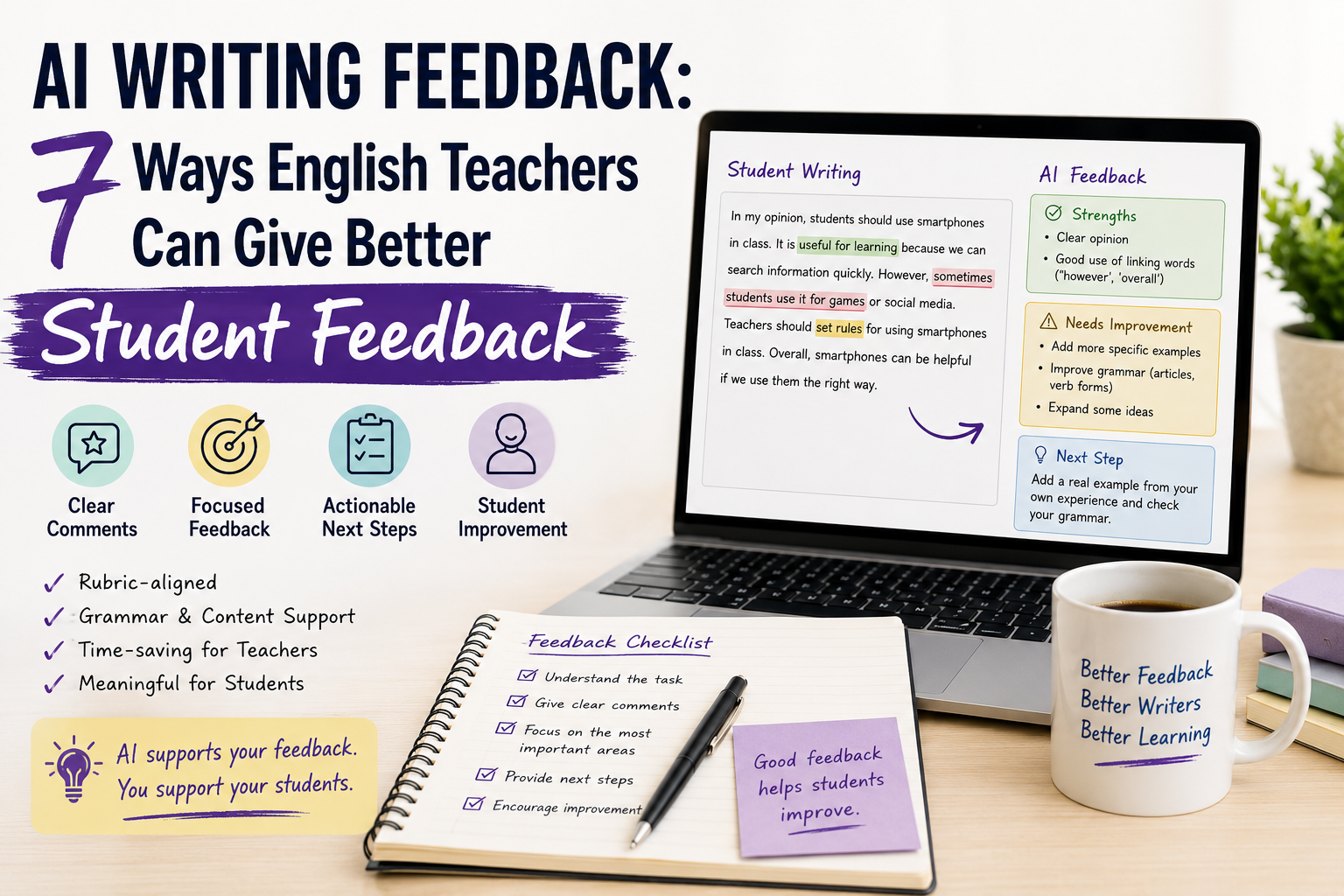
    - Strengths:
    - Needs improvement:
    - Next step:
    
    Use short, student-friendly language. Do not rewrite the full paragraph.
    

    This gives you a clear first draft of feedback. Then you can edit it before giving it to the student.

    Common Mistakes to Avoid with AI Writing Feedback

    Mistake 1: Letting AI grade the whole assignment alone

    AI should not replace teacher assessment. Use it to support comments, not to make final grading decisions.

    Mistake 2: Uploading private student information

    Remove names, emails, school details, and any personal information before using AI.

    Mistake 3: Asking AI to correct every mistake

    Too many corrections can overwhelm learners. Focus on the most important patterns.

    Mistake 4: Giving feedback that is too general

    Comments like “improve grammar” or “write better sentences” are not helpful. Ask for specific next steps.

    Mistake 5: Ignoring the rubric

    Feedback should match the rubric and task. Otherwise, students may feel confused about expectations.

    Mistake 6: Making the language too advanced

    Feedback should be understandable for the student’s level. B1 students need clear, direct comments, not technical assessment language.

    Mistake 7: Sharing AI feedback without checking it

    AI may give inaccurate, unfair, or irrelevant feedback. Always review and edit before giving it to students.

    A Simple AI Writing Feedback Workflow for Teachers

    Use this workflow to keep feedback useful and safe.

    Step 1: Start with the task and rubric

    Clarify what students were asked to do and what criteria matter.

    Step 2: Remove personal information

    Use anonymised student writing.

    Step 3: Ask AI for focused feedback

    Do not ask for everything. Choose grammar, organisation, vocabulary, or rubric-based comments.

    Step 4: Review the AI output

    Check accuracy, tone, level, and fairness.

    Step 5: Add your teacher judgement

    Include anything the AI missed. Remove anything that does not fit the student’s work.

    Step 6: Give one clear next step

    Students need to know what to do next, not only what was wrong.

    Step 7: Use repeated issues for future lessons

    If many students make the same mistake, turn it into a mini-lesson or worksheet.

    For example, if many students misuse linking words, you can create a short worksheet using your AI Worksheet Generator for English Teachers workflow.

    FAQ: AI Writing Feedback for English Teachers

    What is AI writing feedback?

    AI writing feedback is the use of AI to help review writing and generate comments on grammar, vocabulary, organisation, content, clarity, and next steps. Teachers should review AI feedback before sharing it with students.

    Can AI give feedback on ESL writing?

    Yes. AI can help draft feedback on ESL writing, especially when the teacher provides the level, task, rubric, and focus areas. However, teachers should check the feedback for accuracy and fairness.

    Should teachers use AI to grade student writing?

    AI can support feedback, but teachers should be careful about using it for final grades. Assessment should follow school policies, privacy rules, and teacher judgement.

    How can I make AI writing feedback more useful?

    Give AI a clear task, learner level, rubric, and feedback focus. Ask for strengths, areas for improvement, and one specific next step.

    Can AI correct grammar mistakes in student writing?

    Yes, but it is often better to ask AI to identify key grammar patterns rather than correct every mistake. This helps students focus on learning, not just receiving corrections.

    Is AI feedback good for student revision?

    It can be useful if it gives clear next steps. Teachers can also ask AI to turn feedback into revision tasks or checklists.

    How can students use AI feedback responsibly?

    Students can use AI to review their writing, identify problems, and ask for improvement suggestions. They should not use AI to write the full assignment for them.

    Conclusion

    AI writing feedback can help English teachers save time and give clearer comments, but it works best when the teacher stays in control. AI can draft feedback, identify grammar patterns, simplify comments, create revision tasks, and build feedback comment banks. But it should not replace careful teacher review.

    For ESL/EFL teachers and language tutors, the most useful feedback is specific, student-friendly, connected to the task, and focused on improvement. Use AI to support that process, not to remove your professional judgement.

    A good writing feedback workflow helps students understand what they did well, what they need to improve, and what step to take next. That is where AI can genuinely help English teachers teach writing more effectively.

  • AI Rubric Generator: 7 Ways English Teachers Can Create Better Assessment Rubrics

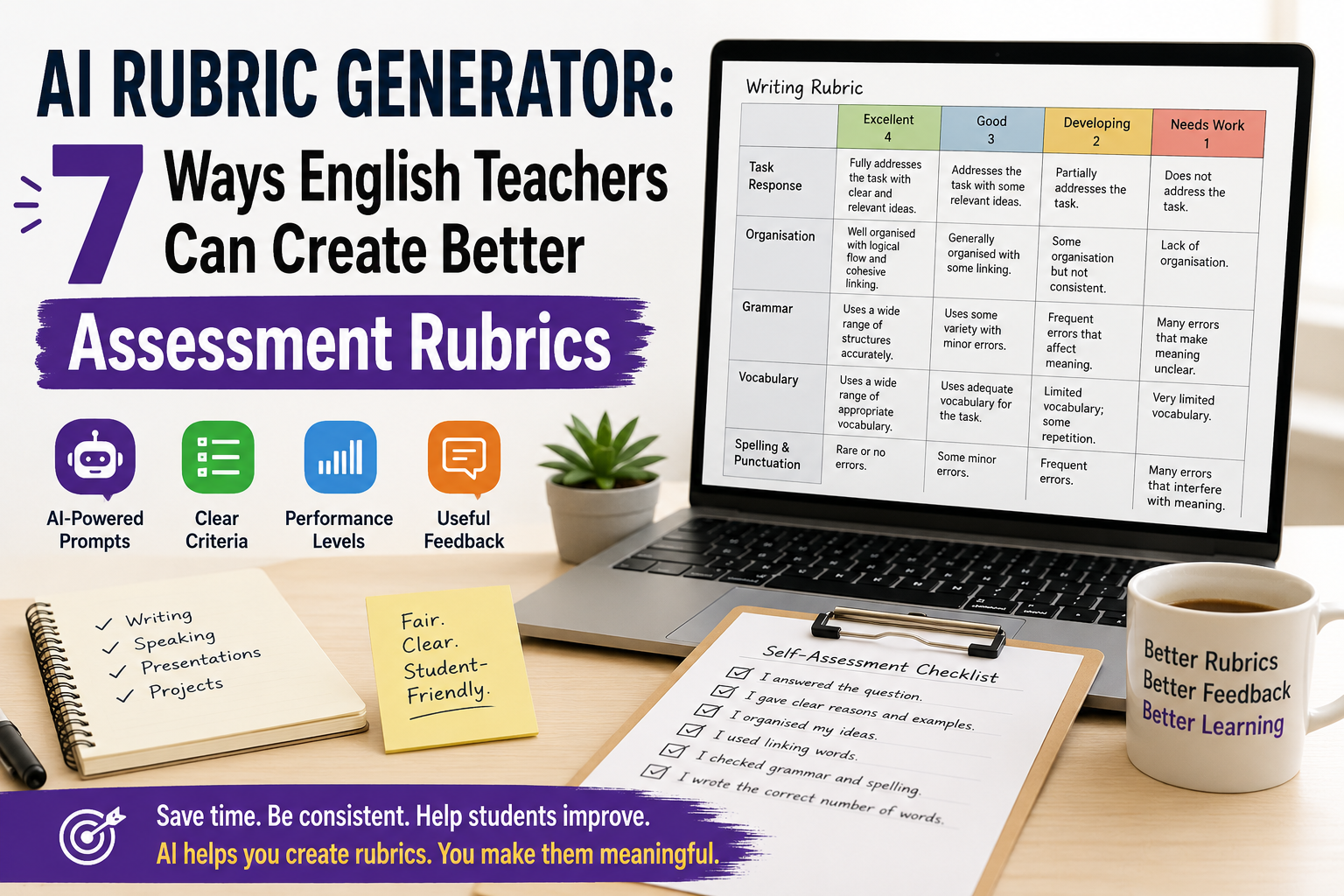
    AI Rubric Generator: 7 Ways English Teachers Can Create Better Assessment Rubrics

    An AI rubric generator can help English teachers create clearer assessment rubrics for writing, speaking, presentations, projects, and classroom tasks. Instead of starting from a blank table, you can use AI to draft criteria, performance levels, descriptors, scores, feedback comments, and student-friendly checklists.

    But AI should not decide your assessment for you. A rubric affects how students understand success, how teachers mark work, and how feedback is given. That means every AI-generated rubric needs teacher review.

    For ESL/EFL teachers and language tutors, the best use of an AI rubric generator is simple: use it to create a strong first draft, then adapt it to your lesson aim, learner level, task type, and classroom context.

    In this guide, you will learn seven practical ways to use AI to create better English assessment rubrics, with copy-paste prompts and teacher-friendly examples.

    If you want a broader prompt-based guide, read Rubric Creator: 7 AI Prompts to Build Better English Marking Rubrics. If you want free template workflows, see Free Rubric Maker: 7 Ways English Teachers Can Create Better Rubrics.

    What Is an AI Rubric Generator?

    An AI rubric generator is a tool or prompt workflow that uses artificial intelligence to create assessment rubrics from your instructions.

    For English teachers, it can help create rubrics for:

    • ESL writing tasks;
    • speaking assessments;
    • oral presentations;
    • role-plays;
    • reading responses;
    • listening tasks;
    • projects;
    • portfolios;
    • peer assessment;
    • student self-assessment.

    A typical rubric includes:

    • assessment criteria;
    • performance levels;
    • descriptors for each level;
    • points or bands;
    • feedback guidance;
    • sometimes a student checklist.

    For example, a writing rubric may include criteria such as task response, organisation, grammar, vocabulary, and spelling. A speaking rubric may include fluency, pronunciation, interaction, vocabulary, and task completion.

    AI can draft these quickly, but the teacher must decide whether they are fair, level-appropriate, and useful.

    Why English Teachers Should Use an AI Rubric Generator

    Creating rubrics takes time. Many teachers know what they want to assess, but turning that into clear descriptors can be difficult.

    An AI rubric generator can help English teachers:

    • save time when creating first drafts;
    • turn lesson aims into assessment criteria;
    • create writing and speaking rubrics;
    • simplify rubric language for students;
    • adapt rubrics for different CEFR levels;
    • create feedback comment banks;
    • make self-assessment checklists;
    • improve marking consistency.

    This is especially useful for ESL/EFL teachers because English assessment is often complex. A student may communicate well but make grammar mistakes. Another student may be accurate but lack fluency. A good rubric helps make these differences clearer.

    Still, AI should support your assessment decisions, not replace them.

    What Makes a Good AI-Generated Rubric?

    A good rubric should be clear, practical, and connected to the actual task.

    Before using any AI-generated rubric, check these questions:

    • Does it match the assignment?
    • Is it appropriate for the learner level?
    • Are the criteria clear?
    • Are the descriptors easy to understand?
    • Is the scoring fair?
    • Does it assess what you actually taught?
    • Can students use it to improve?

    Avoid vague descriptors such as:

    • “excellent language ability”;
    • “good performance”;
    • “weak understanding”;
    • “limited communication.”

    Use clearer descriptors such as:

    • “gives a clear opinion and two reasons”;
    • “uses topic vocabulary accurately”;
    • “speaks clearly enough to be understood”;
    • “organises ideas with basic linking words.”

    A good rubric should help students understand how to do better next time.

    1. Use AI to Create a First-Draft Writing Rubric

    Writing is one of the best uses for an AI rubric generator because writing assessment often includes several criteria at once.

    Use this prompt when you want a first-draft ESL writing rubric:

    Act as an experienced ESL writing teacher.
    
    Create an analytic writing rubric for [LEVEL] English learners.
    
    Writing task:
    [DESCRIBE THE WRITING TASK]
    
    Text length:
    [WORD COUNT]
    
    Assess:
    1. task response;
    2. organisation;
    3. grammar accuracy;
    4. vocabulary;
    5. spelling and punctuation.
    
    Use 4 performance levels:
    Excellent, Good, Developing, Needs Work.
    
    Give a total score out of [POINTS].
    Use clear, student-friendly language.
    

    Example

    Create an analytic writing rubric for B1 ESL learners writing a 120-word opinion paragraph about whether students should use smartphones in class.
    
    Assess task response, organisation, reasons and examples, grammar, vocabulary, and spelling/punctuation.
    
    Use 4 levels and a total score out of 24.
    Use student-friendly language.
    

    This gives you a useful first draft. Then you can shorten, simplify, or adapt it.

    For example:

    Make this rubric shorter and easier for B1 students to understand. Keep the same criteria and score.
    

    2. Use AI to Create a Speaking Assessment Rubric

    Speaking assessment can be difficult because teachers need to listen for fluency, pronunciation, grammar, vocabulary, interaction, and task completion.

    An AI rubric generator can help you create a simple speaking rubric that focuses on the most important criteria.

    Create a speaking assessment rubric for [LEVEL] ESL/EFL learners.
    
    Speaking task:
    [DESCRIBE SPEAKING TASK]
    
    Assess:
    1. task completion;
    2. fluency;
    3. pronunciation;
    4. vocabulary;
    5. interaction.
    
    Use 4 levels:
    Excellent, Good, Developing, Needs Work.
    
    Give a total score out of 20.
    Use practical teacher-friendly descriptors.
    

    Example classroom task

    Students discuss this question in pairs:

    Should students use AI tools for homework?

    The rubric could assess whether students:

    • answer the question;
    • give reasons;
    • respond to their partner;
    • use topic vocabulary;
    • speak clearly enough to be understood.

    Teacher tip

    For informal speaking practice, do not use too many criteria. A short rubric is easier to use while students are speaking.

    3. Use AI to Create a Presentation Rubric

    English presentations assess both language and communication. Students need to organise ideas, speak clearly, use visuals, and engage listeners.

    Use this prompt:

    Create a presentation rubric for [LEVEL] English learners.
    
    Presentation task:
    [DESCRIBE PRESENTATION TOPIC]
    
    Presentation length:
    [TIME LIMIT]
    
    Assess:
    1. content and task completion;
    2. organisation;
    3. spoken English;
    4. pronunciation and clarity;
    5. visual support;
    6. audience engagement.
    
    Use 4 performance levels and a total score out of 24.
    Use clear descriptors suitable for [LEVEL] learners.
    

    Example

    Create a presentation rubric for B2 EFL learners giving a 5-minute presentation about an environmental problem.
    
    Assess content, organisation, language accuracy, vocabulary, pronunciation, visual support, and audience engagement.
    

    Teacher tip

    If the presentation is mainly a language task, make language criteria important. If it is mainly a project task, give more weight to content and organisation.

    4. Use AI to Adapt a Rubric by CEFR Level

    A common problem with rubrics is that they expect too much from lower-level learners. AI can help you adapt criteria for A1, A2, B1, B2, or higher levels.

    Use this prompt:

    Adapt this rubric for [CEFR LEVEL] English learners.
    
    Rubric:
    [PASTE RUBRIC]
    
    Make the descriptors realistic for [CEFR LEVEL].
    Use simple and clear language.
    Remove expectations that are too advanced.
    Keep the same total score.
    

    Example

    For A2 learners, descriptors should include realistic expectations such as:

    • uses simple sentences;
    • gives basic information;
    • uses familiar vocabulary;
    • makes mistakes, but meaning is usually clear.

    For B2 learners, descriptors can include:

    • supports ideas with examples;
    • uses a range of linking words;
    • expresses opinions clearly;
    • uses topic vocabulary accurately.

    Teacher tip

    Do not ask AI to “make it CEFR-aligned” and stop there. Always read the descriptors carefully. AI may still produce criteria that are too broad or too advanced.

    5. Use AI to Make Rubrics Student-Friendly

    Many rubrics are written for teachers, not students. If students cannot understand the rubric, they cannot use it to improve.

    Use AI to rewrite the rubric in simpler language.

    Rewrite this rubric in student-friendly language for [LEVEL] English learners.
    
    Keep the same criteria and score, but simplify the descriptors.
    
    Avoid technical terms. If a technical term is necessary, explain it simply.
    
    Rubric:
    [PASTE RUBRIC]
    

    Example changes

    Instead of:

    Demonstrates effective use of cohesive devices.

    Use:

    Uses linking words such as because, but, so, first, and finally to connect ideas.

    Instead of:

    Shows limited lexical range.

    Use:

    Uses only basic words and repeats the same vocabulary often.

    This makes the rubric more useful before, during, and after the task.

    6. Use AI to Create Feedback Comments from a Rubric

    A rubric gives structure, but students still need feedback. AI can help create a comment bank connected to each rubric criterion.

    Create a feedback comment bank based on this English rubric.
    
    Rubric:
    [PASTE RUBRIC]
    
    For each criterion, write:
    1. 3 positive comments;
    2. 3 improvement comments;
    3. 2 next-step suggestions.
    
    Use supportive teacher language.
    Keep the comments specific, short, and useful.
    

    Example feedback comments

    For organisation:

    • Your ideas are in a clear order.
    • Try to start with a clearer topic sentence.
    • Next time, use linking words to connect your reasons.

    For vocabulary:

    • You used useful topic words from the lesson.
    • Try not to repeat the same word too often.
    • Next time, add two new words from the topic list.

    Teacher tip

    Do not paste AI comments without checking them. Edit them so they match the student’s actual work.

    7. Use AI to Create Student Self-Assessment Checklists

    A rubric is not only for grading. It can also help students check their own work before submission.

    Use this prompt:

    Create a student self-assessment checklist for [LEVEL] English learners.
    
    Task:
    [DESCRIBE TASK]
    
    Use these criteria:
    [PASTE CRITERIA]
    
    Write 6–8 simple checklist statements beginning with “I...”
    
    Add one reflection question:
    “What should I improve next time?”
    

    Example checklist for writing

    Before I submit my paragraph, I checked that:

    • I answered the question.
    • I gave my opinion clearly.
    • I gave at least two reasons.
    • I used linking words.
    • I checked my verbs.
    • I checked spelling and punctuation.
    • I wrote the correct number of words.

    Why this works

    Students become more independent when they know how to check their own work. A self-assessment checklist can also reduce repeated teacher feedback because students notice problems earlier.

    Practical Example: AI Rubric Generator for an ESL Writing Task

    Imagine you are teaching B1 students and the writing task is:

    Write a 120-word opinion paragraph: Should students use AI tools for homework?

    You can use this prompt:

    Act as an experienced ESL writing teacher.
    
    Create an analytic writing rubric for B1 learners.
    
    Task:
    Students write a 120-word opinion paragraph answering:
    “Should students use AI tools for homework?”
    
    Assess:
    1. clear opinion;
    2. reasons and examples;
    3. organisation;
    4. grammar;
    5. vocabulary;
    6. spelling and punctuation.
    
    Use 4 levels:
    Excellent, Good, Developing, Needs Work.
    
    Total score: 24 points.
    Use student-friendly language.
    

    Then improve it:

    Create a shorter student checklist version of this rubric that students can use before submitting their paragraph.
    

    Then create feedback support:

    Create a feedback comment bank for this rubric with positive comments, improvement comments, and next-step suggestions.
    

    This gives you a complete assessment workflow:

    1. teacher rubric;
    2. student checklist;
    3. feedback comments.

    Common Mistakes to Avoid When Using an AI Rubric Generator

    Mistake 1: Using the first output without editing

    AI can create a useful draft, but it may be too generic, too long, or too advanced. Always edit before using it.

    Mistake 2: Including too many criteria

    A rubric with ten criteria is difficult to use. For most English classroom tasks, four to six criteria are enough.

    Mistake 3: Using the same rubric for every task

    A writing task, speaking task, presentation, and project need different rubrics. Start from the task.

    Mistake 4: Forgetting the learner level

    A2 students should not be assessed with B2 expectations. Always specify the level and check the descriptors.

    Mistake 5: Making the rubric too technical

    Students need language they can understand. Create a teacher version and a student version if necessary.

    Mistake 6: Scoring things you did not teach

    If you did not teach presentation structure, do not heavily penalise students for weak presentation structure. Assessment should connect to instruction.

    Mistake 7: Treating AI as the assessor

    AI can help create the rubric, but the teacher remains responsible for fair assessment, feedback, and final grading.

    Simple AI Rubric Review Checklist

    Before using an AI-generated rubric, check:

    • Does it match the task?
    • Is it suitable for the student level?
    • Are the criteria clear?
    • Are there too many criteria?
    • Are performance levels clearly different?
    • Is the scoring fair?
    • Can students understand the language?
    • Does it support feedback, not only grading?
    • Would another teacher understand how to use it?
    • Does it assess what was actually taught?

    This checklist helps you avoid weak AI-generated assessment materials.

    FAQ: AI Rubric Generator for English Teachers

    What is an AI rubric generator?

    An AI rubric generator is a tool or prompt workflow that uses AI to create assessment rubrics. English teachers can use it to draft rubrics for writing, speaking, presentations, projects, and classroom tasks.

    Can AI create rubrics for ESL writing?

    Yes. AI can create first-draft ESL writing rubrics if you provide the learner level, writing task, criteria, performance levels, and scoring system. Teachers should review and adapt the rubric before using it.

    Can AI create speaking rubrics?

    Yes. AI can help create speaking rubrics for fluency, pronunciation, vocabulary, grammar, interaction, and task completion. For classroom use, keep the rubric short and practical.

    Is an AI-generated rubric reliable?

    An AI-generated rubric can be useful as a draft, but it should not be used without teacher review. Check the task fit, level, clarity, fairness, and scoring before using it.

    What should an English writing rubric include?

    A writing rubric often includes task response, organisation, grammar, vocabulary, and spelling or punctuation. The exact criteria should match the writing task and learner level.

    How can I make an AI rubric student-friendly?

    Ask AI to rewrite the rubric in simple language, remove technical terms, and create a checklist version students can use before submitting their work.

    Should I use AI to grade student work?

    This article focuses on using AI to create rubrics, not to replace teacher grading. Teachers should be careful with student privacy, school policies, and fairness if using AI for feedback or assessment.

    Conclusion

    An AI rubric generator can save English teachers time and help create clearer assessment rubrics for writing, speaking, presentations, projects, and classroom tasks. It can draft criteria, performance levels, descriptors, feedback comments, and student checklists much faster than starting from a blank page.

    But the teacher must stay in control. A strong rubric needs to match the task, learner level, lesson aim, and classroom context. AI can help you create the first version, but your professional judgement makes it fair, useful, and student-friendly.

    Used well, an AI rubric generator does more than speed up marking preparation. It helps students understand expectations, reflect on their work, and improve their English more clearly.

  • Free Rubric Maker: 7 Ways English Teachers Can Create Better Rubrics

    Free Rubric Maker: 7 Ways English Teachers Can Create Better Rubrics

    A free rubric maker can help English teachers create clearer assessment criteria without spending hours designing tables from scratch. Whether you teach ESL writing, speaking, presentations, projects, or classroom tasks, a good rubric helps students understand what is expected and helps teachers mark more consistently.

    But “free” does not automatically mean useful. Some rubric tools create generic criteria. Some templates look neat but do not fit your students’ level. Some AI-generated rubrics sound impressive but are too vague for real classroom use.

    For English teachers, ESL/EFL teachers, and private language tutors, the best approach is to combine simple free tools with clear teacher judgement. You can use AI prompts, Google Docs, Canva-style templates, spreadsheets, or basic tables to create rubrics that are practical, student-friendly, and connected to your lesson aims.

    In this guide, you will learn seven ways to create better English rubrics for free, with examples and copy-paste prompts you can adapt.

    If you want a deeper prompt-based guide, read Rubric Creator: 7 AI Prompts to Build Better English Marking Rubrics. If you are creating worksheets and assessment together, you may also find AI Worksheet Generator for English Teachers: 7 Ways to Create Better ESL Worksheets useful.

    What Is a Free Rubric Maker?

    A free rubric maker is any tool, template, or workflow that helps you create rubrics without paying for dedicated assessment software. It might be:

    • an AI chatbot;
    • a Google Docs table;
    • a spreadsheet;
    • a printable template;
    • a classroom resource generator;
    • a design tool;
    • a reusable rubric checklist;
    • a teacher-made prompt workflow.

    In English teaching, a rubric usually helps assess skills such as writing, speaking, presentations, projects, role-plays, or reading responses.

    A rubric commonly includes:

    • assessment criteria;
    • performance levels;
    • clear descriptors;
    • points or bands;
    • space for feedback;
    • sometimes a student self-assessment section.

    For example, a simple ESL writing rubric may assess:

    • task response;
    • organisation;
    • grammar;
    • vocabulary;
    • spelling and punctuation.

    A speaking rubric may assess:

    • fluency;
    • pronunciation;
    • grammar;
    • vocabulary;
    • interaction;
    • task completion.

    The tool you use matters less than the quality of the rubric you create.

    Why English Teachers Need Rubrics

    Rubrics are useful because they make assessment clearer. Instead of simply writing “good work” or “grammar problems,” a rubric shows students exactly what they did well and what they need to improve.

    For English teachers, rubrics help with:

    • more consistent marking;
    • clearer student expectations;
    • faster feedback;
    • better self-assessment;
    • fairer grading;
    • easier peer review;
    • stronger alignment between lesson aims and assessment.

    For example, if students write an opinion paragraph, the rubric can show that the task is not only about grammar. It may also assess whether students gave a clear opinion, used reasons, organised ideas, and checked punctuation.

    This is especially important in ESL/EFL classes because students may focus only on grammar accuracy. A good rubric helps them understand that communication, organisation, vocabulary, and task completion also matter.

    What a Free Rubric Maker Can and Cannot Do

    A free rubric maker can save time, but it cannot do everything for you.

    A free rubric maker can help you:

    • create a first draft;
    • format criteria in a table;
    • generate performance levels;
    • simplify rubric language;
    • adapt rubrics for different tasks;
    • create student checklists;
    • build feedback comment banks.

    A free rubric maker cannot fully decide:

    • what your students need most;
    • whether the rubric fits your exact lesson;
    • whether the level is fair;
    • whether the descriptors match your teaching context;
    • whether the final score reflects your school’s grading policy.

    This is why teacher review is essential. AI and free templates are useful starting points, not final authorities.

    1. Use AI as a Free Rubric Maker

    One of the fastest free or low-cost ways to create a rubric is to use AI. You can describe your task, student level, criteria, and scoring system, then ask AI to generate a rubric.

    This is especially useful when you need a first draft quickly.

    Copy-paste prompt

    Act as an experienced English teacher.
    
    Create an analytic rubric for [LEVEL] ESL/EFL learners.
    
    Task:
    [DESCRIBE THE TASK]
    
    Assess these criteria:
    1. task response;
    2. organisation;
    3. grammar;
    4. vocabulary;
    5. spelling/punctuation or pronunciation, depending on the task.
    
    Use 4 performance levels:
    Excellent, Good, Developing, Needs Work.
    
    Give a total score out of [POINTS].
    Use clear, student-friendly language.
    

    Example

    Create an analytic rubric for B1 ESL learners writing a 120-word opinion paragraph about online learning.
    
    Assess:
    1. clear opinion;
    2. organisation;
    3. reasons and examples;
    4. grammar;
    5. vocabulary;
    6. spelling and punctuation.
    
    Use 4 performance levels and a total score out of 24.
    Use language students can understand.
    

    Why this works

    This prompt gives AI enough detail to create something useful. It includes the level, task, criteria, score, and language style.

    Teacher tip

    Do not use the first AI output immediately. Ask AI to revise it.

    Make this rubric shorter, clearer, and easier for B1 ESL students to understand.
    

    Or:

    Create a compact teacher marking version of this rubric that fits on one page.
    

    For more prompt examples, link to your post on using a rubric creator for English marking rubrics.

    2. Use Google Docs as a Simple Free Rubric Maker

    Google Docs can work well as a free rubric maker because you can create simple tables, duplicate templates, and share rubrics with students.

    You do not need complex software. A clean table is often enough.

    Simple Google Docs rubric structure

    Use a table with these columns:

    CriteriaExcellentGoodDevelopingNeeds WorkScore

    Then add rows such as:

    • task response;
    • organisation;
    • grammar;
    • vocabulary;
    • mechanics.

    Example writing rubric row

    CriteriaExcellentGoodDevelopingNeeds WorkScore
    OrganisationIdeas are clearly ordered and easy to followIdeas are mostly clearSome ideas are hard to followIdeas are unclear or disconnected/4

    Best for

    Google Docs works well for:

    • writing rubrics;
    • speaking rubrics;
    • reusable templates;
    • student-friendly checklists;
    • peer review forms;
    • printable classroom handouts.

    Teacher tip

    Create one master rubric template and duplicate it for each task. This saves time and keeps your assessment style consistent.

    3. Use a Spreadsheet for Scoring Rubrics

    A spreadsheet can also work as a free rubric maker, especially when you want automatic totals.

    This is useful if you mark many students or want a simple scoring grid.

    Basic spreadsheet rubric columns

    You can create columns such as:

    • student name;
    • task response;
    • organisation;
    • grammar;
    • vocabulary;
    • mechanics;
    • total score;
    • feedback comment.

    For each criterion, use a score from 1 to 4 or 1 to 5.

    Example scoring system

    StudentTask Response /4Organisation /4Grammar /4Vocabulary /4Mechanics /4Total /20

    This is practical for classroom assessment because you can quickly record scores and identify common weaknesses.

    Best for

    Spreadsheets work well for:

    • class marking;
    • tracking student progress;
    • scoring speaking tasks quickly;
    • comparing performance across criteria;
    • storing feedback records.

    Teacher tip

    Use short descriptors in the spreadsheet and keep the full rubric in a separate document. This keeps your marking sheet clean.

    4. Use Free Rubric Templates, Then Adapt Them

    Free templates can be useful, but many are too generic. The key is to adapt them to your English lesson.

    A generic writing rubric may include broad criteria like:

    • content;
    • organisation;
    • grammar;
    • vocabulary.

    That is a good start, but you should make it task-specific.

    Generic criterion

    Content is clear and complete.

    Better English-task criterion

    The paragraph gives a clear opinion and includes at least two reasons.

    Generic criterion

    Uses good vocabulary.

    Better English-task criterion

    Uses topic vocabulary about online learning accurately.

    Generic criterion

    Grammar is good.

    Better English-task criterion

    Uses because, but, and so to connect ideas clearly.

    Best for

    Free templates are useful when you need:

    • a starting structure;
    • a printable layout;
    • a quick rubric for a familiar task;
    • a student-friendly version.

    Teacher tip

    Never use a template without adapting it to the task, level, and lesson aim.

    5. Create a Student-Friendly Rubric Checklist

    Sometimes students do not need a full scoring rubric. They need a checklist they can understand before submitting work.

    A student-friendly checklist can be more useful than a complex teacher rubric.

    Example: ESL writing checklist

    Before I submit my paragraph, I checked that:

    • I answered the question.
    • I gave my opinion clearly.
    • I gave at least two reasons.
    • I used linking words such as because, but, and so.
    • I checked my verbs.
    • I checked spelling and punctuation.
    • I wrote the correct number of words.

    Copy-paste prompt

    Create a student-friendly self-assessment checklist for [LEVEL] ESL learners.
    
    Task:
    [DESCRIBE TASK]
    
    The checklist should include 6–8 simple statements beginning with “I...”
    
    Use clear language and avoid technical terms.
    Add one reflection question: “What should I improve next time?”
    

    Best for

    Student-friendly checklists work well for:

    • writing tasks;
    • speaking presentations;
    • projects;
    • peer review;
    • homework submission;
    • exam preparation.

    Teacher tip

    Give students the checklist before they start. This turns the rubric into a learning tool, not just a grading tool.

    6. Create a Free Speaking Rubric for ESL/EFL Classes

    Speaking assessment can be difficult because teachers need to judge fluency, pronunciation, grammar, vocabulary, and interaction at the same time.

    A simple speaking rubric makes this easier.

    Example speaking rubric criteria

    For a B1 pair discussion, you might assess:

    • task completion;
    • fluency;
    • pronunciation;
    • vocabulary;
    • interaction.

    Copy-paste prompt

    Create a simple speaking rubric for [LEVEL] ESL learners.
    
    Speaking task:
    [DESCRIBE TASK]
    
    Assess:
    1. task completion;
    2. fluency;
    3. pronunciation;
    4. vocabulary;
    5. interaction.
    
    Use 4 levels:
    Excellent, Good, Developing, Needs Work.
    
    Total score: 20 points.
    Use teacher-friendly descriptors and simple language.
    

    Example task

    Students discuss this question in pairs:

    Should students use AI tools for homework?

    The rubric can help you assess whether students:

    • answer the question;
    • give reasons;
    • respond to their partner;
    • speak clearly;
    • use useful topic vocabulary.

    Teacher tip

    For informal speaking practice, use a short rubric. Too many criteria can make speaking assessment stressful and slow.

    7. Create a Free Feedback Comment Bank from Your Rubric

    A rubric helps with scoring, but students also need comments. You can use AI as a free rubric maker and feedback assistant by asking it to create a comment bank.

    This helps you avoid repeating the same comments again and again.

    Copy-paste prompt

    Create a feedback comment bank for this English rubric.
    
    Rubric:
    [PASTE RUBRIC]
    
    For each criterion, write:
    1. 3 positive comments;
    2. 3 improvement comments;
    3. 2 next-step suggestions.
    
    Use supportive teacher language. Keep the comments specific and useful.
    

    Example feedback comments

    For organisation:

    • Your ideas are in a clear order.
    • Try to start with a clearer topic sentence.
    • Next time, use linking words to connect your reasons.

    For vocabulary:

    • You used useful topic words.
    • Try to avoid repeating the same word many times.
    • Next time, add two new words from the lesson.

    Best for

    A comment bank is useful when marking:

    • essays;
    • opinion paragraphs;
    • speaking tasks;
    • presentations;
    • projects;
    • reading responses.

    Teacher tip

    Do not copy comments blindly. Adapt them to the student’s actual work.

    Example: Free Rubric for a B1 ESL Opinion Paragraph

    Here is a simple rubric structure you can adapt.

    Task: Write a 120-word opinion paragraph about this question:
    Should students use smartphones in class?

    Level: B1
    Total score: 20 points

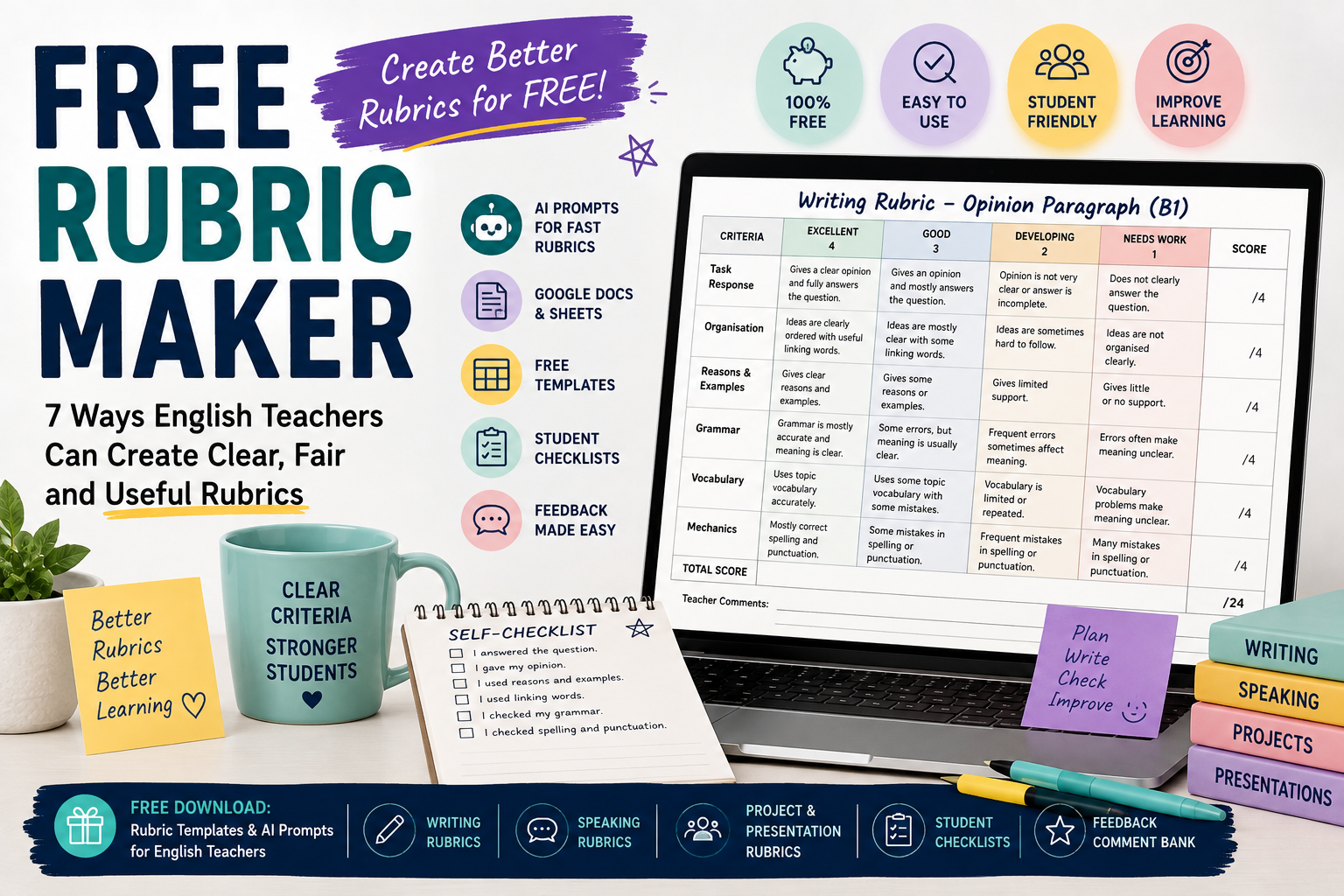
    CriterionExcellent – 4Good – 3Developing – 2Needs Work – 1
    Task ResponseGives a clear opinion and fully answers the questionGives an opinion and mostly answers the questionOpinion is not very clear or answer is incompleteDoes not clearly answer the question
    OrganisationIdeas are clearly ordered with useful linking wordsIdeas are mostly clear with some linking wordsIdeas are sometimes hard to followIdeas are not organised clearly
    Reasons and ExamplesGives clear reasons and examplesGives some reasons or examplesGives limited supportGives little or no support
    GrammarGrammar is mostly accurate and meaning is clearSome errors, but meaning is usually clearFrequent errors sometimes affect meaningErrors often make meaning unclear
    Vocabulary and MechanicsUses topic vocabulary and mostly correct spelling/punctuationUses some topic vocabulary with some mistakesVocabulary is limited or repeatedVocabulary/spelling problems make meaning unclear

    This rubric is simple, but it gives students more guidance than a general score.

    How to Choose the Right Free Rubric Maker Workflow

    Choose your workflow based on what you need.

    Use AI when:

    • you need a first draft quickly;
    • you want descriptors for different performance levels;
    • you want to simplify language;
    • you want a student checklist;
    • you want a feedback comment bank.

    Use Google Docs when:

    • you want a clean printable rubric;
    • you want to share the rubric with students;
    • you want a reusable template;
    • you want to edit the rubric easily.

    Use spreadsheets when:

    • you are marking many students;
    • you want automatic totals;
    • you want to track performance;
    • you want to compare class results.

    Use templates when:

    • you need a quick structure;
    • you already know the criteria;
    • you want a printable design.

    The best free rubric maker is often not one tool. It is a workflow: AI for drafting, Google Docs for editing, and a spreadsheet for scoring if needed.

    Common Mistakes to Avoid When Using a Free Rubric Maker

    Mistake 1: Using generic criteria

    “Grammar,” “content,” and “vocabulary” are not enough. Make criteria specific to the task.

    Mistake 2: Making the rubric too long

    A rubric with too many criteria is hard to use. For most English classroom tasks, four to six criteria are enough.

    Mistake 3: Using teacher-only language

    Students may not understand technical terms. Create a simpler student version if needed.

    Mistake 4: Ignoring the learner level

    A rubric for A2 learners should not expect B2-level writing or speaking. Keep descriptors realistic.

    Mistake 5: Forgetting the lesson aim

    If the lesson aim is fluency, do not over-focus on small grammar mistakes. If the aim is accurate use of past tense, grammar should have more weight.

    Mistake 6: Not giving students the rubric before the task

    Rubrics are more useful when students see them before they work. This helps them understand expectations.

    Mistake 7: Treating AI output as final

    AI can create a helpful draft, but teachers should always review the rubric for clarity, fairness, and level.

    FAQ: Free Rubric Maker for English Teachers

    What is the best free rubric maker for English teachers?

    The best free rubric maker depends on your workflow. AI is useful for drafting rubric criteria, Google Docs is useful for formatting and sharing, and spreadsheets are useful for scoring and tracking. For many teachers, a combination of these works best.

    Can I create a rubric for free?

    Yes. You can create rubrics for free using AI prompts, Google Docs tables, spreadsheets, or downloadable templates. The most important part is adapting the rubric to your task and learner level.

    Can AI create rubrics for ESL writing?

    Yes. AI can create first-draft rubrics for ESL writing tasks. You should specify the level, task, word count, criteria, performance levels, and total score.

    What should an ESL writing rubric include?

    An ESL writing rubric often includes task response, organisation, grammar, vocabulary, and spelling or punctuation. The exact criteria should match the assignment.

    What should an ESL speaking rubric include?

    An ESL speaking rubric may include task completion, fluency, pronunciation, vocabulary, grammar, and interaction. For informal speaking tasks, use fewer criteria to keep assessment manageable.

    Should students see the rubric before the task?

    Yes. Rubrics are more useful when students see them before completing the task. This helps them understand what good performance looks like.

    Is a free rubric maker enough for serious assessment?

    For many classroom tasks, yes, if the teacher reviews and adapts the rubric carefully. For official exams or institutional assessment, follow your school’s required criteria and grading policy.

    Conclusion

    A free rubric maker can save English teachers time, but the real value comes from how you use it. AI, Google Docs, spreadsheets, and templates can all help you create rubrics without expensive software. However, your teaching judgement is what makes the rubric fair, clear, and useful.

    For ESL/EFL teachers and language tutors, the best rubrics are task-specific, level-appropriate, and easy for students to understand. Use AI to create a first draft, then revise the criteria, simplify the wording, add a clear scoring system, and create a student checklist when needed.

    A good rubric does more than help you mark faster. It helps students understand expectations, improve their work, and become more independent English learners.

  • Rubric Creator: 7 AI Prompts to Build Better English Marking Rubrics

    Rubric Creator: 7 AI Prompts to Build Better English Marking Rubrics

    A rubric creator can help English teachers build clear marking criteria for writing tasks, speaking activities, presentations, projects, and classroom assessment. Instead of grading students with vague comments like “good grammar” or “needs more detail,” a rubric gives both the teacher and the student a clearer picture of what good performance looks like.

    For ESL/EFL teachers and language tutors, rubrics are especially useful because language performance is complex. A student’s writing or speaking may involve grammar, vocabulary, fluency, pronunciation, organisation, task achievement, interaction, and accuracy at the same time. Without a rubric, assessment can become inconsistent or unclear.

    AI can help you create rubrics faster, but it should not replace your judgement. A good AI-generated rubric still needs teacher review. You need to check whether the criteria match the task, the level is appropriate, the descriptors are clear, and the scoring system is fair.

    In this guide, you will learn how to use AI as a practical rubric creator for English teaching, with seven copy-paste prompts you can adapt for your own classes.

    If you are also creating lesson materials, you may want to read AI Worksheet Generator for English Teachers: 7 Ways to Create Better ESL Worksheets. For reading lessons, see Reading Worksheet Generator: 7 AI Prompts for Better ESL Reading Lessons. If you are comparing worksheet tools, read 7 Best Customizable Worksheet Software with AI for English Teachers.

    What Is a Rubric Creator?

    A rubric creator is a tool or workflow that helps teachers create assessment criteria for student work. In English teaching, a rubric can be used to assess writing, speaking, presentations, projects, role-plays, reading responses, listening tasks, or portfolios.

    A rubric usually includes:

    • assessment criteria;
    • performance levels;
    • clear descriptors;
    • point values or bands;
    • teacher comments;
    • sometimes a student self-assessment section.

    For example, a writing rubric may assess:

    • task response;
    • organisation;
    • grammar accuracy;
    • vocabulary range;
    • mechanics such as spelling and punctuation.

    A speaking rubric may assess:

    • fluency;
    • pronunciation;
    • grammar;
    • vocabulary;
    • interaction;
    • task completion.

    With AI, teachers can generate a first draft quickly. But the rubric should always be adapted to your learners, task, level, and teaching context.

    Why English Teachers Should Use AI as a Rubric Creator

    Creating a good rubric takes time. You need to decide what matters, describe performance clearly, avoid vague wording, and make sure the rubric is fair for the level.

    AI can help English teachers:

    • create a first draft of a rubric;
    • adapt a rubric for different levels;
    • simplify rubric language for students;
    • create analytic or holistic rubrics;
    • build speaking and writing assessment criteria;
    • turn lesson aims into assessment criteria;
    • create self-assessment checklists;
    • make feedback more consistent.

    For example, if your B1 students are writing an opinion paragraph, you can ask AI to create a simple writing rubric with criteria for content, organisation, grammar, vocabulary, and mechanics. Then you can revise the rubric to fit your exact assignment.

    The goal is not to let AI decide grades. The goal is to use AI to save preparation time and make your assessment clearer.

    What Makes a Good English Marking Rubric?

    A good English marking rubric should be clear, level-appropriate, and directly connected to the task.

    A useful rubric should answer these questions:

    • What exactly are students being assessed on?
    • What does excellent work look like?
    • What does acceptable work look like?
    • What does weak work look like?
    • Are the criteria suitable for the learner level?
    • Can students understand the descriptors?
    • Can the teacher use it consistently?

    For ESL/EFL classes, rubric language should be practical. Avoid unclear phrases such as:

    • “excellent linguistic competence”;
    • “sophisticated lexical control”;
    • “adequate communicative performance.”

    Instead, use clearer language:

    • “uses topic vocabulary accurately”;
    • “organises ideas in a clear order”;
    • “speaks clearly enough to be understood”;
    • “uses simple linking words such as because, but, and so.”

    A good rubric should help students improve, not only give them a score.

    Analytic vs Holistic Rubrics

    Before using AI as a rubric creator, decide whether you need an analytic rubric or a holistic rubric.

    Analytic rubric

    An analytic rubric separates performance into different criteria. For example, a writing rubric may include content, organisation, grammar, vocabulary, and spelling.

    This is useful when you want detailed feedback.

    Example:

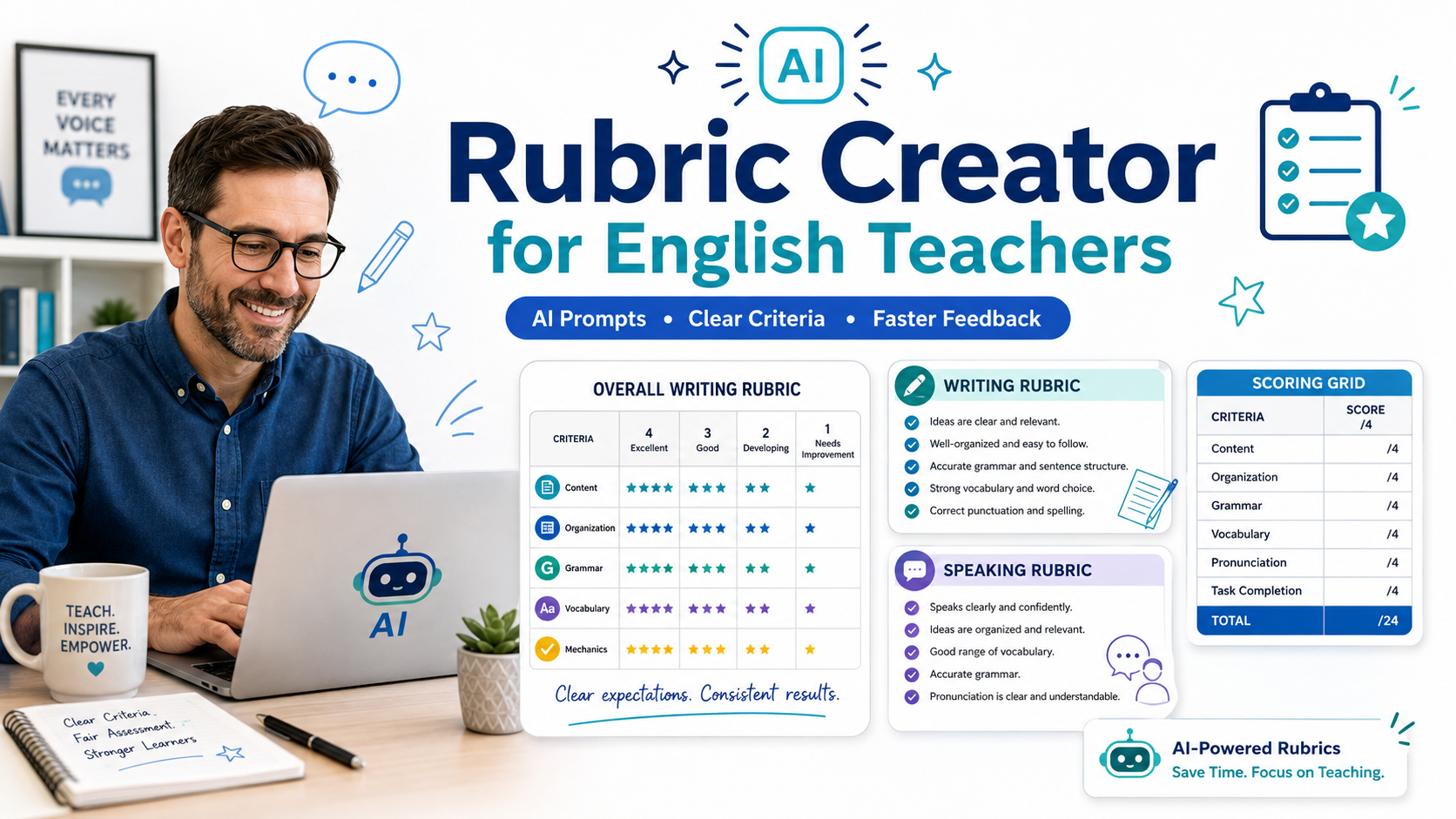
    CriteriaExcellentGoodNeeds Work
    ContentIdeas are clear and fully answer the taskIdeas mostly answer the taskIdeas are unclear or incomplete
    OrganisationParagraph is well organisedParagraph has some organisationParagraph is difficult to follow
    GrammarUses target grammar accuratelySome grammar errors, but meaning is clearFrequent errors make meaning unclear

    Holistic rubric

    A holistic rubric gives one overall score or band for the whole task. It is faster to use but gives less detailed feedback.

    This is useful for quick assessment, speaking fluency tasks, or classroom observation.

    For English teachers, analytic rubrics are usually better for writing and formal speaking tasks. Holistic rubrics are useful for quick classroom assessment.

    How to Use AI as a Rubric Creator

    The quality of your rubric depends on the prompt. A weak prompt gives generic criteria.

    A weak prompt would be:

    Create a rubric for writing.
    

    A stronger prompt would be:

    Create an analytic writing rubric for B1 ESL learners writing a 120-word opinion paragraph about online learning.
    
    Assess these criteria:
    1. task response;
    2. organisation;
    3. grammar accuracy;
    4. vocabulary;
    5. spelling and punctuation.
    
    Use 4 performance levels: Excellent, Good, Developing, Needs Work.
    Use student-friendly language and include points out of 20.
    

    The second prompt gives AI the level, task, criteria, performance bands, language style, and scoring system.

    Prompt 1: Basic Rubric Creator Prompt

    Use this prompt when you want a general rubric for an English task.

    Act as an experienced English teacher.
    
    Create an analytic rubric for [LEVEL] ESL/EFL learners completing this task:
    
    [TASK DESCRIPTION]
    
    The rubric should include:
    1. 4–5 assessment criteria;
    2. 4 performance levels;
    3. clear descriptors for each level;
    4. total score out of [POINTS];
    5. student-friendly language.
    
    Make the rubric practical, fair, and appropriate for [LEVEL] learners.
    

    Example

    Create an analytic rubric for B1 ESL learners writing a 120-word opinion paragraph about social media.
    
    Use 5 criteria:
    1. task response;
    2. organisation;
    3. grammar;
    4. vocabulary;
    5. spelling and punctuation.
    
    Use 4 performance levels and a total score out of 20.
    

    This prompt is useful for most writing, speaking, and project-based tasks.

    Prompt 2: ESL Writing Rubric Prompt

    Writing rubrics are very useful for English teachers because writing assessment can feel subjective. A rubric helps students understand what they need to improve.

    Create a writing rubric for [LEVEL] ESL learners.
    
    Writing task:
    [DESCRIBE WRITING TASK]
    
    Text length:
    [WORD COUNT]
    
    Assess:
    1. task response;
    2. organisation and paragraph structure;
    3. grammar accuracy;
    4. vocabulary range and accuracy;
    5. spelling and punctuation.
    
    Use 4 levels:
    Excellent, Good, Developing, Needs Work.
    
    Give points for each criterion and include a total score out of 20.
    Use clear language students can understand.
    

    Example classroom use

    For a B1 opinion paragraph, the rubric could include:

    • Does the student clearly give an opinion?
    • Does the paragraph have a topic sentence?
    • Are ideas supported with reasons or examples?
    • Is the grammar accurate enough for clear meaning?
    • Is vocabulary appropriate for the topic?

    This gives students a clear target before they write and clearer feedback after they submit.

    Teacher tip

    Give the rubric before the writing task, not only after marking. Students can use it as a planning checklist.

    Prompt 3: ESL Speaking Rubric Prompt

    Speaking assessment can be difficult because teachers need to listen to many things at once. A speaking rubric helps you focus on specific criteria.

    Create a speaking rubric for [LEVEL] ESL/EFL learners.
    
    Speaking task:
    [DESCRIBE SPEAKING TASK]
    
    Assess:
    1. fluency;
    2. pronunciation;
    3. grammar accuracy;
    4. vocabulary;
    5. interaction or task completion.
    
    Use 4 performance levels:
    Excellent, Good, Developing, Needs Work.
    
    Use teacher-friendly descriptors and a total score out of 20.
    Add a short student self-reflection section at the end.
    

    Example speaking task

    Students work in pairs and discuss this question:

    Should students use AI tools for homework?

    The rubric might assess whether students:

    • speak clearly;
    • use topic vocabulary;
    • give reasons;
    • respond to their partner;
    • keep the conversation going.

    Teacher tip

    For lower-level learners, do not over-assess. If the task is simple, use fewer criteria. For example: fluency, vocabulary, pronunciation, and task completion.

    Prompt 4: Student-Friendly Rubric Prompt

    Sometimes AI-generated rubrics sound too formal. Students may not understand phrases like “cohesive devices” or “lexical resource.”

    Use this prompt to simplify rubric language.

    Rewrite this rubric in student-friendly language for [LEVEL] English learners.
    
    Keep the same criteria and scores, but make the descriptors easier to understand.
    
    Avoid technical terms unless they are explained simply.
    
    Rubric:
    [PASTE RUBRIC]
    

    Example

    Instead of:

    Demonstrates effective control of cohesive devices.

    Use:

    Uses linking words such as first, because, but, and finally to connect ideas clearly.

    Instead of:

    Shows limited lexical range.

    Use:

    Uses only basic words and repeats the same vocabulary often.

    This makes the rubric more useful for students.

    Prompt 5: CEFR-Level Rubric Prompt

    If you teach using CEFR levels, you can ask AI to adapt a rubric to A2, B1, B2, or another level. However, you should still review the descriptors carefully.

    Create a rubric for [A1/A2/B1/B2/C1] English learners.
    
    Task:
    [DESCRIBE TASK]
    
    Make the descriptors appropriate for this CEFR level.
    
    Include:
    1. task achievement;
    2. grammar;
    3. vocabulary;
    4. organisation or fluency;
    5. pronunciation, spelling, or mechanics if relevant.
    
    Use clear teacher-friendly language and a total score out of [POINTS].
    

    Example

    For A2 learners, descriptors should focus on simple, achievable language:

    • uses simple sentences;
    • gives basic information;
    • uses familiar vocabulary;
    • makes some mistakes, but meaning is usually clear.

    For B2 learners, descriptors can include more complexity:

    • supports ideas with examples;
    • uses a range of linking words;
    • expresses opinions clearly;
    • uses topic vocabulary accurately.

    Teacher tip

    Do not make the rubric too advanced for the level. If A2 students are expected to write like B2 students, the rubric becomes unfair.

    Prompt 6: Rubric + Feedback Comments Prompt

    A rubric gives scores, but students also need comments. AI can help you create a feedback bank connected to rubric criteria.

    Create a feedback comment bank for this English rubric.
    
    Rubric:
    [PASTE RUBRIC]
    
    For each criterion, write:
    1. 3 positive feedback comments;
    2. 3 improvement comments;
    3. 2 short next-step suggestions.
    
    Use supportive teacher language. Keep comments specific and useful.
    

    Example feedback comments

    For organisation:

    • Your ideas are in a clear order.
    • Try to use linking words to connect your sentences.
    • Next time, add a clearer topic sentence.

    For vocabulary:

    • You used useful topic words.
    • Try not to repeat the same word too often.
    • Next time, add two new words from the lesson.

    This is useful if you mark many similar assignments and want consistent feedback.

    Prompt 7: Self-Assessment Rubric Prompt

    Rubrics are not only for teachers. Students can use simplified rubrics to check their own work before submitting it.

    Create a student self-assessment checklist for [LEVEL] ESL learners.
    
    Task:
    [DESCRIBE TASK]
    
    Base it on these criteria:
    [PASTE CRITERIA]
    
    Use simple yes/no checklist statements.
    
    Add one reflection question:
    “What should I improve next time?”
    

    Example self-assessment checklist

    For an opinion paragraph:

    • I gave my opinion clearly.
    • I gave at least two reasons.
    • I used linking words.
    • I checked my verbs.
    • I checked spelling and punctuation.
    • I wrote the correct number of words.

    This helps students take more responsibility for their work.

    Practical Example: AI Rubric for an ESL Writing Task

    Imagine your B1 students are writing a 120-word opinion paragraph:

    Do you think students should use smartphones in class?

    You can use this prompt:

    Create an analytic writing rubric for B1 ESL learners.
    
    Task:
    Students write a 120-word opinion paragraph answering this question:
    “Do you think students should use smartphones in class?”
    
    Assess:
    1. opinion and task response;
    2. organisation;
    3. reasons and examples;
    4. grammar;
    5. vocabulary;
    6. spelling and punctuation.
    
    Use 4 levels:
    Excellent, Good, Developing, Needs Work.
    
    Total score: 24 points.
    Use student-friendly language.
    

    The AI may create a useful first version. Then you should improve it with follow-up prompts:

    Make the rubric shorter and easier for B1 students to understand.
    

    Or:

    Add a student checklist version of this rubric that students can use before submitting their paragraph.
    

    This creates a full assessment workflow: rubric, teacher marking criteria, and student self-check.

    How to Improve an AI-Generated Rubric

    The first AI-generated rubric may be too long, too formal, or too generic. Use follow-up prompts to refine it.

    Make the rubric simpler

    Simplify this rubric. Keep the same criteria, but make the descriptors shorter and easier to use while marking.
    

    Make it more specific

    Make this rubric more specific to the task. Remove generic criteria and connect the descriptors directly to the assignment.
    

    Add point values

    Add point values to this rubric. The total score should be 20 points.
    

    Create a student version

    Create a student-friendly version of this rubric as a checklist before submission.
    

    Create a teacher marking version

    Create a compact teacher marking version of this rubric that fits on one page.
    

    These follow-up prompts help turn a generic rubric into a useful classroom tool.

    Common Mistakes to Avoid When Using AI as a Rubric Creator

    Mistake 1: Using a generic rubric for every task

    A speaking presentation, opinion paragraph, role-play, and reading response need different rubrics. Start from the task, not from a generic template.

    Mistake 2: Including too many criteria

    If you include ten criteria, marking becomes slow and students become confused. For most classroom tasks, four to six criteria are enough.

    Mistake 3: Using language students cannot understand

    If students do not understand the rubric, they cannot use it to improve. Create a teacher version and a student-friendly version if needed.

    Mistake 4: Making the rubric too difficult for the level

    Do not expect A2 students to use complex grammar, advanced vocabulary, or sophisticated argument structure. Keep criteria level-appropriate.

    Mistake 5: Forgetting the task aim

    If the aim is fluency practice, do not over-focus on tiny grammar errors. If the aim is accurate use of past tense, grammar should be more important.

    Mistake 6: Using AI comments without checking them

    AI feedback may sound nice but still be vague. Make comments specific, accurate, and connected to the rubric.

    Mistake 7: Not showing students the rubric before the task

    A rubric is more useful when students see it before they complete the assignment. It helps them understand expectations.

    A Simple Rubric Template for English Teachers

    You can reuse this structure for many English tasks:

    Task: [Describe task]
    Level: [A1/A2/B1/B2]
    Total score: [20 points]

    CriterionExcellentGoodDevelopingNeeds Work
    Task ResponseFully answers the taskMostly answers the taskPartly answers the taskDoes not answer the task clearly
    OrganisationIdeas are clear and well orderedIdeas are mostly clearIdeas are sometimes hard to followIdeas are unclear
    GrammarUses target grammar accuratelySome errors, but meaning is clearFrequent errors sometimes affect meaningErrors often make meaning unclear
    VocabularyUses useful topic vocabularyUses some topic vocabularyUses limited vocabularyVocabulary is too limited or unclear
    Mechanics / PronunciationMostly accurate and clearSome mistakes, but understandableMistakes sometimes distractMistakes make meaning difficult

    You can adapt the final criterion depending on the task. For writing, use spelling and punctuation. For speaking, use pronunciation and fluency.

    FAQ: Rubric Creator for English Teachers

    What is a rubric creator?

    A rubric creator is a tool or workflow that helps teachers build assessment criteria for student work. In English teaching, it can be used for writing, speaking, presentations, projects, role-plays, and classroom tasks.

    Can AI create rubrics for English teachers?

    Yes. AI can create first-draft rubrics for ESL/EFL writing, speaking, projects, and assessment tasks. Teachers should review and adapt the rubric before using it.

    What should an English writing rubric include?

    An English writing rubric usually includes task response, organisation, grammar, vocabulary, and spelling or punctuation. The exact criteria should match the writing task and learner level.

    What should an ESL speaking rubric include?

    An ESL speaking rubric may include fluency, pronunciation, grammar, vocabulary, interaction, and task completion. For lower-level learners, fewer criteria may be easier to use.

    Is an analytic rubric better than a holistic rubric?

    An analytic rubric is better when you want detailed feedback on separate criteria. A holistic rubric is faster when you want one overall score. For English writing and formal speaking assessment, analytic rubrics are usually more useful.

    Can students use rubrics for self-assessment?

    Yes. Student-friendly rubrics and checklists help learners review their own work before submitting it. This can improve independence and make expectations clearer.

    Should teachers use AI-generated rubrics without editing?

    No. AI-generated rubrics should always be checked for task fit, level, fairness, clarity, and scoring accuracy before classroom use.

    Conclusion

    A rubric creator can save English teachers time and make assessment clearer, but the best rubrics still need teacher judgement. AI can help you create a first draft, simplify descriptors, adapt criteria by level, build feedback comments, and create student self-assessment checklists.

    For ESL/EFL teachers and language tutors, the most useful rubrics are specific, clear, level-appropriate, and connected to the task. Whether you are assessing a writing paragraph, speaking activity, presentation, or project, AI can help you build a better starting point.

    Use the prompts in this guide to create rubrics faster, but always review the final version before using it with students. A strong rubric does more than produce a grade. It helps students understand what they did well, what they need to improve, and how to perform better next time.