You have twenty minutes left in an English lesson. The students have finished the textbook exercise, and you want them to practise what they’ve learned.
You could give them another worksheet or ask a few questions and hope everyone participates.
But sometimes you need something better: an activity that gives students a real reason to use English.
Good ESL activities don’t need elaborate materials, expensive subscriptions, or hours of preparation. Some of the most useful classroom tasks begin with something as simple as two different worksheets, a short conversation, or a sentence that needs improving.
What matters is what students actually do with the language.
Do they explain something? Ask a question? Interpret what they’ve heard? Make a decision? Work with someone else to solve a problem?
Those are the experiences worth building into a language lesson.
Below are 15 practical classroom activities organised around speaking, listening, reading, writing, grammar, and vocabulary. Each includes the suggested CEFR level, approximate classroom time, preparation, teaching procedure, and a ready-to-copy AI prompt if you’d like to adapt the material.
The activities work particularly well with teenagers, university students, and adult English learners, although several can be simplified for younger students.
How to Choose the Right ESL Activity
Before choosing an activity, think about what students should be able to do afterwards.
If the objective is to ask for information, choose an information-gap task. If students need to understand announcements, practise listening for specific details. If you’re working on narrative writing, let them develop a story rather than complete another isolated grammar exercise.
The Council of Europe’s CEFR descriptors provide useful reference points because they describe language proficiency in terms of communicative abilities.
Here’s a quick overview of the activities in this guide.
| # | Activity | Main skill | Suggested level | Time |
|---|---|---|---|---|
| 1 | Missing Timetable | Speaking | A1–A2 | 15 min |
| 2 | Opinion Corners | Speaking | B1–B2 | 15–20 min |
| 3 | Customer Service Challenge | Speaking | A2–B1 | 15 min |
| 4 | Predict, Listen, Check | Listening | A2–B1 | 10–15 min |
| 5 | Missing Details | Listening | A2–B1 | 15 min |
| 6 | Audio Detectives | Listening | B1–B2 | 15 min |
| 7 | Jigsaw Reading | Reading | B1 | 20 min |
| 8 | Rebuild the Story | Reading | A2–B1 | 15 min |
| 9 | Reading Scavenger Hunt | Reading | A2–B1 | 15 min |
| 10 | Collaborative Storytelling | Writing | B1–B2 | 20–25 min |
| 11 | Sentence Expansion Challenge | Writing | A2–B1 | 10–15 min |
| 12 | Real-World Email Writing | Writing | B1 | 20 min |
| 13 | Vocabulary Auction | Vocabulary | B1–B2 | 15 min |
| 14 | Error Detectives | Grammar | A2–B1 | 15 min |
| 15 | Collocation Match and Speak | Vocabulary | A2–B1 | 15 min |
These levels are starting points, not strict requirements. The difficulty depends on the language you choose and the support you give students.
Speaking ESL Activities
Speaking practice works best when students have a reason to communicate.
Simply telling learners to “talk about holidays” can lead to interesting conversations, but it can also result in a lot of silence.
A task with missing information, a decision to make, or a problem to solve gives students something more concrete to work toward.
1. Missing Timetable: An Information-Gap Challenge
Level: A1–A2
Time: 15 minutes
Materials: Two different timetable worksheets
Language focus: Days, times, school subjects, asking for information
An information-gap activity gives two students different pieces of information. Neither can complete the task alone.
That creates a genuine reason to ask questions.
For this activity, prepare two versions of a weekly timetable.
Student A
| Day | Time | Subject | Room |
|---|---|---|---|
| Monday | 09:00 | Grammar | 2 |
| Tuesday | 11:00 | ? | ? |
| Wednesday | 10:00 | Listening | 3 |
| Thursday | 14:00 | ? | ? |
Student B
| Day | Time | Subject | Room |
|---|---|---|---|
| Monday | 09:00 | ? | ? |
| Tuesday | 11:00 | Reading | 5 |
| Wednesday | 10:00 | ? | ? |
| Thursday | 14:00 | Speaking | 1 |
Give each student one sheet.
They must complete the missing information by asking their partner questions. They aren’t allowed to show each other their papers.
How to run it
First, model the exchange with one student.
Student A: What class do we have on Tuesday at eleven?
Student B: Reading, in Room Five.
Student A: Thank you. What room is the Monday grammar class in?
Then allow students to work independently.
Circulate and listen for errors involving days, time expressions, and question formation.
At the end, pairs compare their completed timetables.
This is a good example of a classroom activity where the language is genuinely necessary to finish the task.
The British Council’s explanation of information-gap activities describes the value of learners exchanging missing information and practising clarification and communication.
AI prompt
Create an information-gap speaking activity for [LEVEL] ESL learners.
Topic: [TOPIC]
Prepare Student A and Student B worksheets.
Each student should have information the other student needs.
Include:
- two complementary information tables;
- 5 useful question structures;
- short teacher instructions;
- one completed answer sheet.
Make sure students cannot complete the task without speaking to each other.
2. Opinion Corners: Get Students to Take a Position
Level: B1–B2
Time: 15–20 minutes
Materials: Four signs or a presentation slide
Language focus: Giving opinions, agreeing, disagreeing, giving reasons
Some speaking activities fail because students don’t have much to say.
Opinion Corners addresses that problem by asking them to make a decision before speaking.
Put four signs around the classroom:
Strongly Agree — Agree — Disagree — Strongly Disagree
Display a statement:
Students should be allowed to use smartphones during lessons.
Ask students to move toward the position that represents their opinion.
Give them one minute to think of a reason.
Students then discuss their reasons with someone who chose the same position. Afterwards, invite them to explain their views to someone from a different corner.
Useful expressions include:
In my opinion…
One reason is…
I understand your point, but…
I partly agree because…
Keep the discussion moving
The first statement is rarely enough for a full activity.
After a few minutes, introduce another statement:
Homework should be optional.
Or:
Online classes are more effective than face-to-face classes.
Students may change corners for each statement.
If you teach in a crowded classroom where moving around is difficult, ask students to hold up cards numbered 1–4 instead.
AI prompt
Generate 8 opinion statements for [LEVEL] ESL learners.
General theme: [THEME]
The statements should encourage discussion without requiring specialised knowledge.
Avoid questions with one obvious correct answer.
For each statement, provide:
- 2 follow-up questions;
- 3 useful opinion expressions;
- one way to make the discussion more challenging.
For more speaking prompts, see our AI Discussion Questions Generator guide.
3. Customer Service Challenge: Role-Play with a Goal
Level: A2–B1
Time: 15 minutes
Materials: Situation cards
Language focus: Requests, complaints, apologies, problem-solving
Role-play can be awkward when students aren’t sure what they’re supposed to achieve.
Giving each character a clear goal makes the exchange more natural.
In this activity, students work in pairs as customers and employees.
Student A: Customer
You ordered a vegetarian sandwich at a café.
Unfortunately, the sandwich contains chicken.
You have only ten minutes before you must leave.
Your goal is to explain the problem politely and ask for a solution.
Student B: Café employee
A customer says their order is incorrect.
You can offer a replacement sandwich, but it will take fifteen minutes.
You can also offer a refund.
Your goal is to apologise and solve the problem politely.
Classroom procedure
Give students two minutes to read their cards.
Before they begin, review useful phrases:
Excuse me, I think there’s a problem with…
I’m sorry about that.
Would it be possible to…?
We can offer you…
That would be fine, thank you.
Students perform the role-play without reading a prepared script.
After five minutes, partners exchange roles and receive a different problem.
For stronger learners, add complications: an unavailable product, a misunderstanding, or a limited budget.
AI prompt
Create 5 realistic customer-service role-play scenarios for [LEVEL] ESL learners.
Each scenario must include:
- a separate Student A card;
- a separate Student B card;
- different goals for each character;
- one small complication;
- useful expressions;
- a clear outcome students should try to achieve.
Do not write complete dialogues. Students should create their own conversations.
Listening ESL Activities
Listening lessons can become frustrating when students hear an unfamiliar recording and are immediately asked detailed questions.
A better sequence often starts with preparing them for what they might hear.
The British Council’s pre-listening guidance recommends activities such as prediction, brainstorming, and preparing relevant vocabulary.
The next three activities take slightly different approaches: prediction, listening for specific information, and understanding speakers’ intentions.
4. Predict, Listen, Check
Level: A2–B1
Time: 10–15 minutes
Materials: Short audio recording or teacher-read script
Language focus: Listening for gist and identifying events
Before playing an audio recording, write three predictions on the board.
For example:
The recording will be about:
A. A student who loses something
B. A student who misses an examination
C. A student planning a holiday
Students choose the most likely answer based on a title or image.
Then play or read the following short text.
Ready-to-use listening script
On Tuesday evening, Maya went to the library to study for her history exam. When she left, she forgot her blue umbrella beside a reading table.
The next morning, she noticed it was missing. She called the library and spoke to the receptionist.
Luckily, someone had found the umbrella and handed it in. Maya collected it after her afternoon class.
Now ask students to check their prediction.
Correct answer: A.
Play or read the text a second time.
This time, ask:
- Where did Maya leave her umbrella?
- When did she notice it was missing?
- Who helped her find it?
Answers: Beside a reading table at the library; the following morning; the library receptionist, after someone had handed it in.
Why this works
Students have a reason to listen the first time: confirming or rejecting a prediction.
The second listening has a different purpose: identifying details.
That distinction is more useful than playing the same audio twice without changing the task.
AI prompt
Write a short listening script for [LEVEL] ESL students.
Topic: [TOPIC]
Length: approximately [WORD COUNT] words.
Create:
- 3 possible predictions about the content;
- 1 gist question;
- 4 detail questions;
- an answer key.
Ensure that the questions can be answered from the script.
Use natural, level-appropriate English.
5. Missing Details: Listen for Specific Information
Level: A2–B1
Time: 15 minutes
Materials: Short announcement and information sheet
Language focus: Times, places, instructions, dates
Imagine students need to understand a voicemail announcing a change to a meeting.
Rather than asking them to remember the whole message, give them an information sheet with several gaps.
Student worksheet
English Club Announcement
Original meeting time: 3:30 PM
New meeting time: __________
New location: __________
Students should bring: __________
Listening script
Read the following message aloud twice at a natural but accessible pace.
Hello, everyone. This is a reminder about tomorrow’s English Club meeting.
We originally planned to meet at half past three, but the meeting will now begin at quarter past four.
We won’t be using Classroom Eight. Instead, please come to the school library.
And don’t forget to bring a short poem you’d like to share.
See you tomorrow!
Students complete the missing information.
Answer key
- New time: 4:15 PM
- New location: School library
- Bring: A short poem
Make it more challenging
For B1 learners, remove the original meeting time from the worksheet and ask students to identify both the original and updated arrangements.
For lower-level students, offer three possible answers for each gap.
AI prompt
Create a realistic short announcement for [LEVEL] ESL students.
Setting: [SCHOOL / TRAIN STATION / WORKPLACE / EVENT]
Include four or five important details involving times, places, instructions, or changes.
Then create an information-gap listening worksheet.
Students should complete missing details while listening.
Provide:
- the complete listening script;
- a student worksheet;
- an answer key.
Check that every missing detail appears clearly in the script.
This format also works with recorded videos. Our AI Video Question Maker guide explains how to develop comprehension questions from video material.
6. Audio Detectives: What Does the Speaker Really Mean?
Level: B1–B2
Time: 15 minutes
Materials: Short spoken exchanges
Language focus: Speaker intention, tone, implied meaning
Listening isn’t only about recognising words.
Students also need to understand what a speaker is trying to communicate.
Consider:
“It’s a little cold in here, isn’t it?”
Depending on the situation, the speaker might simply be making an observation—or indirectly asking someone to close the window.
In Audio Detectives, students listen to short exchanges and decide what the speaker means.
Example exchanges
Conversation 1
A: Could you turn the music down a little? I’m trying to study.
B: Oh, sorry. Of course.
Question: What does Speaker A want?
A. Someone to change the music
B. Someone to reduce the volume
C. Someone to stop studying
Correct answer: B.
Conversation 2
A: Are you coming to the café with us?
B: I’d love to, but I’ve got an assignment due tomorrow.
Question: What does Speaker B mean?
A. They are politely declining.
B. They want to invite someone else.
C. They have already finished the assignment.
Correct answer: A.
Conversation 3
A: Have you finished the project?
B: Not quite. I just need to check the references.
Question: What can we understand?
A. The project has not been started.
B. The project has been cancelled.
C. The project is nearly complete.
Correct answer: C.
Read the exchanges aloud before showing the transcript. If possible, vary your tone naturally.
After students answer, ask them what words helped them decide.
A useful follow-up is to have pairs create one new exchange containing an indirect request or polite refusal.
AI prompt
Create 6 short listening dialogues for [LEVEL] ESL students.
Focus on understanding speaker intention.
Include situations involving:
- polite requests;
- refusals;
- suggestions;
- uncertainty;
- agreement or disagreement.
For each dialogue, write one multiple-choice comprehension question with three plausible answers.
Include an answer key and a brief explanation of the implied meaning.
Reading ESL Activities
Reading doesn’t have to mean handing students a passage followed by ten comprehension questions.
You can also use texts as the basis for collaboration, reconstruction, or information searches.
These three ESL activities are useful when you want students to engage with a text more actively.
7. Jigsaw Reading: Each Student Has Part of the Answer
Level: B1
Time: 20 minutes
Materials: Two short texts, printed separately
Language focus: Reading for information, summarising, speaking
A jigsaw reading gives students different texts and asks them to combine information through discussion.
The British Council’s jigsaw reading activity describes this approach as a way to bring genuine communication into a reading lesson.
Here’s a complete example.
Student A: City Food Festival
The City Food Festival takes place on Saturday from 10 AM until 6 PM in Central Square.
Visitors can try traditional dishes from different countries, watch cooking demonstrations, and enjoy live music.
Entry is free, although food and drinks must be purchased separately.
The festival is especially popular with families and visitors interested in discovering new foods.
Student B: Creative Art Workshop
The Creative Art Workshop takes place on Sunday from 11 AM until 3 PM at the Community Arts Centre.
Visitors can try painting, drawing, and simple pottery activities. All materials are provided.
Tickets cost $5 per person, and advance registration is recommended.
The workshop is designed for beginners and people who enjoy making things.
The task
Explain:
Two visitors are spending a weekend in the city.
Sara loves cooking and wants to avoid spending money on entry fees.
Daniel prefers practical creative activities and doesn’t mind paying a small fee.
Which activity would you recommend to each person?
Students first read their own text.
They underline the most important information, then explain it to their partner without exchanging papers.
Finally, they make their recommendations together.
Suggested answers: Sara — City Food Festival; Daniel — Creative Art Workshop.
For a more demanding task, ask pairs to recommend only one activity for both visitors and justify their decision.
AI prompt
Create a jigsaw reading activity for [LEVEL] ESL students.
Topic: [TOPIC]
Write two different texts, approximately [WORD COUNT] words each.
Each text must contain useful information that the other student does not have.
Create a shared problem or decision task that requires students to exchange information.
Include:
- Student A text;
- Student B text;
- discussion questions;
- a final decision task;
- teacher answer notes.
Make sure neither student can complete the task using only their own text.
8. Rebuild the Story: A Text Reconstruction Challenge
Level: A2–B1
Time: 15 minutes
Materials: Sentence strips or a scrambled paragraph
Language focus: Text organisation, sequencing, cohesion
Give students a short story with the sentences in the wrong order.
Their task is to reconstruct the text using clues such as time expressions, pronouns, and cause-and-effect relationships.
Student worksheet
Put these sentences in the correct order.
A. Finally, he found his classroom and arrived just before the lesson began.
B. On his first day at university, Adam arrived early because he didn’t know the campus.
C. Unfortunately, he entered the wrong building and couldn’t find his classroom.
D. A student noticed that he looked confused and offered to help.
E. At first, he followed the signs toward the language department.
F. After checking Adam’s timetable, she showed him the correct building.
Correct order: B → E → C → D → F → A.
What students should notice
Don’t simply reveal the correct order.
Ask:
Which sentence introduces the character and situation?
What does at first tell us?
Why must the sentence about checking the timetable come after the student offers help?
Which expression signals the ending?
Students are now examining how connected writing works.
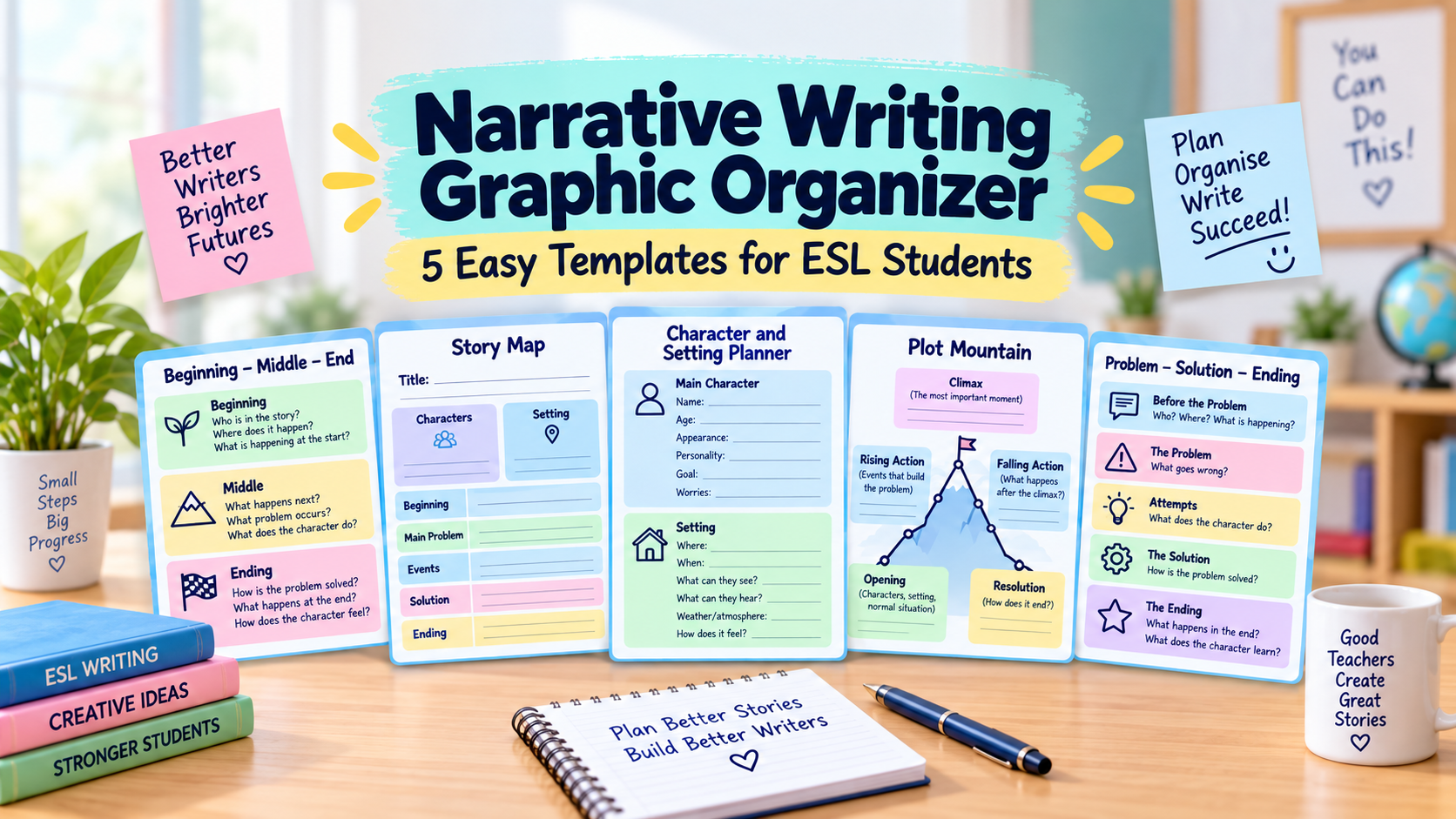
This can also serve as preparation for narrative writing. Our Narrative Writing Graphic Organizer guide includes additional planning structures for stories.
AI prompt
Write a coherent narrative of 100–130 words for [LEVEL] ESL learners.
Divide it into 6 sentences that can be reordered logically.
Scramble the sentence order.
Include meaningful sequencing clues.
Provide:
- the student version;
- the correct order;
- short explanations of the clues.
Ensure that the reconstruction has one defensible intended sequence.
9. Reading Scavenger Hunt: Find the Information
Level: A2–B1
Time: 15 minutes
Materials: Notice, timetable, webpage extract, or information poster
Language focus: Scanning for specific information
Not every reading task requires students to understand every sentence in detail.
In real life, we often read to find something specific: a time, a price, an instruction, or a contact detail.
This activity develops that skill.
Sample text: Community Library Notice
Riverside Community Library
Opening hours:
Monday–Friday: 9 AM–6 PM
Saturday: 10 AM–2 PM
Sunday: Closed
Summer Reading Club
Every Wednesday, 4–5 PM
Open to students aged 12–16.
Participation is free.
Please register at the library desk before Friday, June 12.
For more information, contact the library reception.
Student challenges
Find the answers as quickly and accurately as possible.
- What time does the library close on weekdays?
- Is the library open on Sunday?
- When does the reading club meet?
- How much does the club cost?
- Where should students register?
- Can a 17-year-old student join the club?
- When must students register?
Answer key
- 6 PM
- No
- Wednesdays, 4–5 PM
- Free
- At the library desk
- No, the stated age range is 12–16
- Before Friday, June 12
You can run this individually or in pairs.
For a less competitive version, give students ten minutes and ask them to underline the evidence supporting each answer.
AI prompt
Create a realistic information text for [LEVEL] ESL learners.
Format: [EVENT POSTER / LIBRARY NOTICE / TIMETABLE / WEBSITE PAGE]
Include clear details about dates, times, locations, costs, and instructions.
Create 8 reading-scavenger questions that require students to locate information.
Provide an answer key.
Make sure every answer is explicitly supported by the text.
For additional text-based tasks, explore our Reading Worksheet Generator article.
Writing ESL Activities
Writing practice doesn’t always require a complete essay.
Short, purposeful tasks can help students develop specific writing skills before they tackle longer assignments.
These ESL activities focus on storytelling, sentence development, and functional writing.
10. Collaborative Storytelling: One Story, Several Writers
Level: B1–B2
Time: 20–25 minutes
Materials: Paper or shared document
Language focus: Narrative development, sequencing, past tenses
Give each group a story opening:
When Noor opened her schoolbag, she found someone else’s train ticket.
Ask the first student to continue the story with two sentences.
After three minutes, they pass the paper to the next student.
The next writer must continue the story using the information already provided.
Repeat this process until each group has a complete narrative.
Add a structure
To prevent the story from becoming a collection of unrelated events, give each round a purpose.
Round 1 — Setting: Introduce the situation.
Round 2 — Problem: Something unexpected happens.
Round 3 — Complication: The problem becomes more difficult.
Round 4 — Resolution: Bring the story to an ending.
Groups reread their finished stories and make small corrections before sharing them.
You can also ask them to underline all the past-tense verbs.
A useful variation
Instead of passing paper around the room, students can work in a shared digital document.
This is especially convenient in an online or blended class.
AI prompt
Generate 5 creative but realistic story openings for [LEVEL] ESL learners.
Each opening should contain a character, setting, and unusual event.
The stories must be suitable for collaborative writing.
Avoid complicated vocabulary and overly dramatic fantasy situations.
For each opening, suggest a four-stage structure:
setting, problem, complication, and resolution.
11. Sentence Expansion Challenge
Level: A2–B1
Time: 10–15 minutes
Materials: Board or worksheet
Language focus: Sentence development and descriptive language
Some students struggle to develop ideas because they write only very short sentences.
You might see:
The girl waited.
She was tired.
The bus arrived.
There’s nothing grammatically wrong with these sentences, but students could often communicate more.
Sentence Expansion gives them a manageable way to add information.
Write:
The girl waited.
Ask students to answer:
Who?
The young girl waited.
Where?
The young girl waited at the bus stop.
When?
The young girl waited at the bus stop early in the morning.
Why?
The young girl waited at the bus stop early in the morning because she had an important exam.
Students can then try the same process with:
The man opened the door.
The children played.
The teacher smiled.
Encourage students to improve meaning, not simply produce the longest sentence possible.
Sometimes two clear sentences are better than one overloaded sentence.
AI prompt
Create a sentence expansion activity for [LEVEL] ESL learners.
Provide 8 short, simple sentences.
For each sentence, suggest questions that help students add useful details about:
- who;
- where;
- when;
- why;
- how.
Include one sample expanded sentence per item.
Keep the final sentences natural and grammatically correct.
12. Real-World Email Writing
Level: B1
Time: 20 minutes
Materials: Writing prompt and checklist
Language focus: Functional writing, tone, organisation
Students are often more motivated when they can imagine actually using the language outside the classroom.
A practical email-writing task gives them that opportunity.
Student task
You recently joined an English course, but you cannot attend next Monday’s lesson.
Write an email to your teacher.
In your email:
- explain why you cannot attend;
- apologise politely;
- ask whether you can receive the lesson materials;
- thank the teacher.
Write approximately 80–100 words.
Before students write
Elicit expressions such as:
Dear…
Unfortunately, I won’t be able to attend…
I apologise for…
Would it be possible to…?
Thank you for your understanding.
Students then plan the content and write their emails.
Peer review
Before collecting the work, ask students to exchange drafts and check:
- Is the reason for the absence clear?
- Is the tone appropriate?
- Has the writer made a polite request?
- Is the email easy to follow?
For stronger students, introduce less familiar situations such as requesting an appointment, asking for clarification, or making a formal complaint.
AI prompt
Create a realistic email-writing task for [LEVEL] ESL learners.
Situation: [SITUATION]
Include:
- a clear communicative purpose;
- 3–4 content requirements;
- a suggested word count;
- 6 useful expressions;
- a student-friendly self-assessment checklist.
Do not write the complete email.
Students should produce their own responses.
You can use the feedback techniques in our AI Writing Feedback guide when reviewing the completed emails.
Grammar and Vocabulary ESL Activities
Grammar and vocabulary practice doesn’t need to involve repetitive gap-fill worksheets.
A small amount of challenge, discussion, or decision-making can make familiar language more memorable.
13. Vocabulary Auction: Buy the Correct Sentences
Level: B1–B2
Time: 15 minutes
Materials: Sentence list and imaginary points
Language focus: Collocations, grammar, language accuracy
Give each team 100 imaginary points.
Display eight sentences. Some are correct, and others contain errors.
Teams must decide which sentences are worth “buying.”
They should bid only when they believe a sentence is correct.
Sentences for the auction
- I made a decision yesterday.
- She did her homework before dinner.
- We had a strong rain yesterday.
- He is interested in learning Spanish.
- Could you borrow me your pen?
- Let’s take a break.
- It depends of the weather.
- Please pay attention to the instructions.
Answer key
Correct: 1, 2, 4, 6, 8.
Incorrect:
- More natural: We had heavy rain yesterday.
- Could you lend me your pen?
- It depends on the weather.
How to run it
Start each team with 100 points.
Display one sentence at a time and let teams decide whether to bid.
If the highest bidder buys a correct sentence, they earn the amount they bid as points.
If the sentence is incorrect, they lose those points.
Ask teams to explain their reasoning before revealing the answer.
There is no real money involved, and you can make the game cooperative rather than competitive if that better suits the class.
The real learning happens when students justify their decisions.
AI prompt
Create a vocabulary and grammar auction for [LEVEL] ESL students.
Target language: [GRAMMAR OR VOCABULARY]
Write 10 natural sentences.
Include 6 correct sentences and 4 with realistic learner errors.
Mix them in random order.
Provide a separate answer key explaining every incorrect sentence.
Avoid ambiguous cases where more than one interpretation is acceptable.
14. Error Detectives: Find the Pattern
Level: A2–B1
Time: 15 minutes
Materials: Sentence worksheet
Language focus: Grammar correction and explanation
Students often recognise a grammar rule when you explain it but struggle to apply it to unfamiliar sentences.
Error Detectives turns that problem into a task.
Instead of asking students to complete gaps, present a mixture of correct and incorrect sentences.
Example: Past Simple vs Present Perfect
Instructions: Some sentences are correct. Others contain one grammar error. Identify the incorrect sentences and rewrite them.
- I have visited London last year.
- She has lived here since 2020.
- We went to the cinema yesterday.
- He has finished his homework two hours ago.
- They have never tried sushi.
- I didn’t saw him at the meeting.
Answer key
- Incorrect — I visited London last year.
- Correct
- Correct
- Incorrect — He finished his homework two hours ago.
- Correct
- Incorrect — I didn’t see him at the meeting.
The discussion stage
Students first work individually.
Then pairs compare answers and explain their corrections.
Ask:
Which time expression helped you choose the tense?
Why is the verb after didn’t in its base form?
It’s the explanation that tells you whether students understand the rule.
AI prompt
Create an error-detection activity for [LEVEL] ESL learners.
Target grammar:
[GRAMMAR POINT]Write 10 sentences:
- 6 containing one realistic grammatical error;
- 4 fully correct.
Mix the sentences randomly.
Give clear student instructions.
Include a separate teacher answer key explaining every error.
Ensure there are no ambiguous or accidentally incorrect sentences.
15. Collocation Match and Speak
Level: A2–B1
Time: 15 minutes
Materials: Word cards or worksheet
Language focus: Collocations and spoken production
Students can know the meanings of individual words without knowing which words naturally go together.
They may say:
do a decision
or:
make homework
because the individual verbs are familiar.
This activity combines recognition with actual use.
Part 1: Match the expressions
Match each verb with a suitable phrase.
| Verbs | Phrases |
|---|---|
| 1. Make | A. A bus |
| 2. Do | B. A photo |
| 3. Take | C. In touch |
| 4. Catch | D. Homework |
| 5. Pay | E. A decision |
| 6. Keep | F. Attention |
Answer key: 1-E, 2-D, 3-B, 4-A, 5-F, 6-C.
Part 2: Use the expressions
Now ask students to discuss:
Tell your partner about a time you had to make an important decision.
What homework did you do yesterday?
When do you usually take photos?
Have you ever missed a bus you wanted to catch?
How do you keep in touch with old friends?
What helps you pay attention during a difficult lesson?
Students must use at least three collocations in their answers.
The activity now moves beyond matching words on paper.
AI prompt
Create a collocation matching activity for [LEVEL] ESL students.
Topic: [TOPIC]
Include:
- 10 useful collocations;
- a scrambled matching worksheet;
- an answer key;
- 6 personalised speaking questions using the collocations.
Choose natural, common English expressions.
Avoid awkward or uncommon combinations.
How to Adapt ESL Activities for Different Student Levels
You don’t always need a different activity for every class.
Often, the same activity can work at several levels if you adjust the language and support.
Take the information-gap timetable activity.
A1 version
Students exchange simple information:
What time is English?
Where is the class?
Give them model questions and a small vocabulary box.
B1 version
Students compare two event schedules and arrange a meeting.
They might say:
I can’t attend on Thursday because I have a class until four. Would Friday afternoon work for you?
The basic task is the same.
The language demand is very different.
For lower levels, reduce the amount of information, simplify instructions, provide useful expressions, and model the first exchange.
For stronger students, introduce more complex situations, require explanations, or remove some scaffolding.
You can adapt most ESL activities this way without redesigning everything.
A Reusable AI Prompt for Any Classroom Activity
If you use ChatGPT to prepare materials, you don’t need fifteen different tools or subscriptions.
One well-written prompt can help you adapt the activities in this article.
Master prompt
Act as an experienced ESL/EFL teacher.
I want to prepare the following activity:
[ACTIVITY NAME]
Student level: [CEFR LEVEL]
Learner age or context: [CONTEXT]
Lesson topic: [TOPIC]
Main learning objective: [OBJECTIVE]
Available classroom time: [TIME]
Class size: [NUMBER]
Materials available: [MATERIALS]
Create a classroom-ready version of this activity.
Include:
- concise teacher instructions;
- student-facing instructions;
- all worksheets, cards, or texts needed;
- a realistic example;
- an answer key where appropriate;
- one easier variation;
- one more challenging variation.
Make the activity practical for the classroom.
Do not add unnecessary stages or unrelated content.
Check the materials for language accuracy before presenting them.
For more prompts organised by language skill, visit our ChatGPT Prompts for ESL Teachers library.
How to Fit These ESL Activities into a 50-Minute Lesson
You don’t have to use several activities simply because they’re available.
In fact, using too many can make a lesson feel disjointed.
Imagine you’re teaching B1 students a lesson about travel experiences.
Your main objective is:
Students will be able to describe a past travel problem and explain how it was resolved.
A simple lesson could look like this:
| Stage | Activity | Time |
|---|---|---|
| Lead-in | Discuss common travel problems | 5 min |
| Listening | Predict, Listen, Check | 10 min |
| Language focus | Review useful past-tense forms | 10 min |
| Speaking | Customer Service Challenge | 15 min |
| Writing | Write a short summary of the problem | 7 min |
| Reflection | Identify one new expression | 3 min |
| Total | 50 min |
The activities complement one another because they serve the same objective.
That’s more valuable than squeezing five unrelated games into one lesson.
If you want help building complete lessons rather than selecting individual activities, see ESL Lesson Plans: How to Build a Full Week of Lessons with AI.
Making Activities Work in Large or Mixed-Ability Classes
A classroom activity might look excellent when demonstrated with twelve students.
With forty students, limited space, and uneven language levels, it needs a little adjustment.
Here are a few things I would prioritise.
Keep the instructions short. Explain what students must produce, model one example, and then start.
Use pairs before whole-class sharing. More students get a chance to practise, and quieter learners have space to prepare their thoughts.
Prepare an easier entry point. Sentence starters, sample answers, and vocabulary banks are often enough to help learners begin.
Give faster students a meaningful extension. Ask for a justification, follow-up question, or alternative solution rather than simply more questions of the same type.
Use paper when paper is easier. Most of the activities in this guide don’t require laptops, internet access, or expensive software.
Digital tools can be helpful, but they shouldn’t become a barrier to participation.
The Cambridge English teaching resources collection also offers additional classroom and independent-practice ideas across different learner levels.
Common Mistakes When Choosing ESL Activities
One of the easiest traps is choosing an activity because it looks fun.
Fun is welcome. It just isn’t enough on its own.
A vocabulary game can be lively while giving students almost no opportunity to use the target words in meaningful sentences.
A discussion can last twenty minutes while two students do nearly all the talking.
And a beautifully designed worksheet can still be too difficult for the class.
Before teaching, ask yourself:
- Does this activity support today’s learning objective?
- Will students actually use or process English?
- Is the challenge appropriate for their level?
- Can I explain the task clearly in under two minutes?
- Is the timing realistic?
- What will I do if students struggle or finish early?
These questions make it much easier to select worthwhile ESL activities and avoid wasting preparation time.
ESL Activity Planning Checklist
Use this before trying a new classroom task.
- The activity has one clear learning purpose.
- The target language or skill is appropriate for the class.
- Students know what they must do or produce.
- Instructions and examples are ready.
- Materials are complete and accurate.
- Timing is realistic.
- Students have enough language support.
- Everyone has a reasonable opportunity to participate.
- There is a way to check whether the task was successful.
- I have one small adjustment ready for learners who need more support.
You don’t need to tick every box mechanically for every short task. Treat the checklist as a reminder of what makes an activity work in a real classroom.
FAQ: ESL Activities for English Teachers
What are ESL activities?
ESL activities are classroom or independent-learning tasks designed to help students develop their English language abilities. They may focus on speaking, listening, reading, writing, vocabulary, grammar, pronunciation, or a combination of skills.
What are some easy ESL classroom activities?
Information-gap tasks, opinion discussions, role-plays, listening prediction, sentence reconstruction, error correction, and collocation matching are relatively simple to prepare and can be adapted for different levels.
Which ESL activities work best for adults?
Adult learners often respond well to realistic communication tasks, such as arranging meetings, handling customer-service problems, writing emails, discussing opinions, and understanding announcements. The topic should match their interests and language needs.
What are good ESL speaking activities?
Information-gap activities, role-plays, decision-making tasks, and opinion discussions are useful because they provide students with reasons to communicate. Offering preparation time and useful expressions can make the tasks more accessible.
How can I make ESL activities more engaging?
Give students a clear challenge, problem, decision, or communicative goal. Use meaningful topics, vary interaction patterns, and make sure everyone has an opportunity to participate rather than simply watch.
Can ESL activities work in large classes?
Yes. Many activities can be adapted for pairs or small groups. Information gaps, sentence reconstruction, peer review, and grammar challenges are particularly adaptable when space and technology are limited.
Can ChatGPT create ESL activities?
Yes. ChatGPT can help generate role-play cards, short reading passages, listening scripts, grammar tasks, vocabulary exercises, and level-based variations. Teachers should check the output for accuracy, appropriateness, and alignment with their learning objectives.
Do all ESL activities need technology?
No. Most classroom language activities can be completed with paper, a board, and student interaction. Technology can help with preparation or delivery, but it is not essential.
How long should an ESL activity last?
It depends on the purpose. A vocabulary review might take five to ten minutes, while a jigsaw reading or collaborative writing task may need twenty minutes or more. Give students enough time to complete the communication or learning task meaningfully.
Final Thoughts
The most useful ESL activities aren’t necessarily the most original ones.
They’re the activities that create opportunities for students to use English with a clear purpose.
A simple information gap can generate more meaningful speaking than a complicated classroom game. A short listening task can teach students to focus on the information they need. And a five-minute sentence expansion exercise can help a reluctant writer express an idea more clearly.
You don’t have to try all fifteen activities in one week.
Choose one that matches your next lesson. Prepare it carefully, see how students respond, and adjust it for the next class.
Over time, you’ll develop a small collection of reliable tasks you can reuse with different topics, language levels, and groups of students.
That collection is often more valuable than a folder full of impressive activities you’ve never had time to teach.
And when you’re short on preparation time, AI can help you adapt what already works rather than reinventing the whole lesson.
Free AI Worksheet Prompt Pack for English Teachers
Want to prepare classroom activities faster?
Download our Free AI Worksheet Prompt Pack for English Teachers, featuring 25 ready-to-copy prompts for vocabulary, grammar, reading, speaking, quizzes, differentiation, and more.
Use the prompts to develop classroom resources around your own lesson objectives while keeping control over what your students learn.