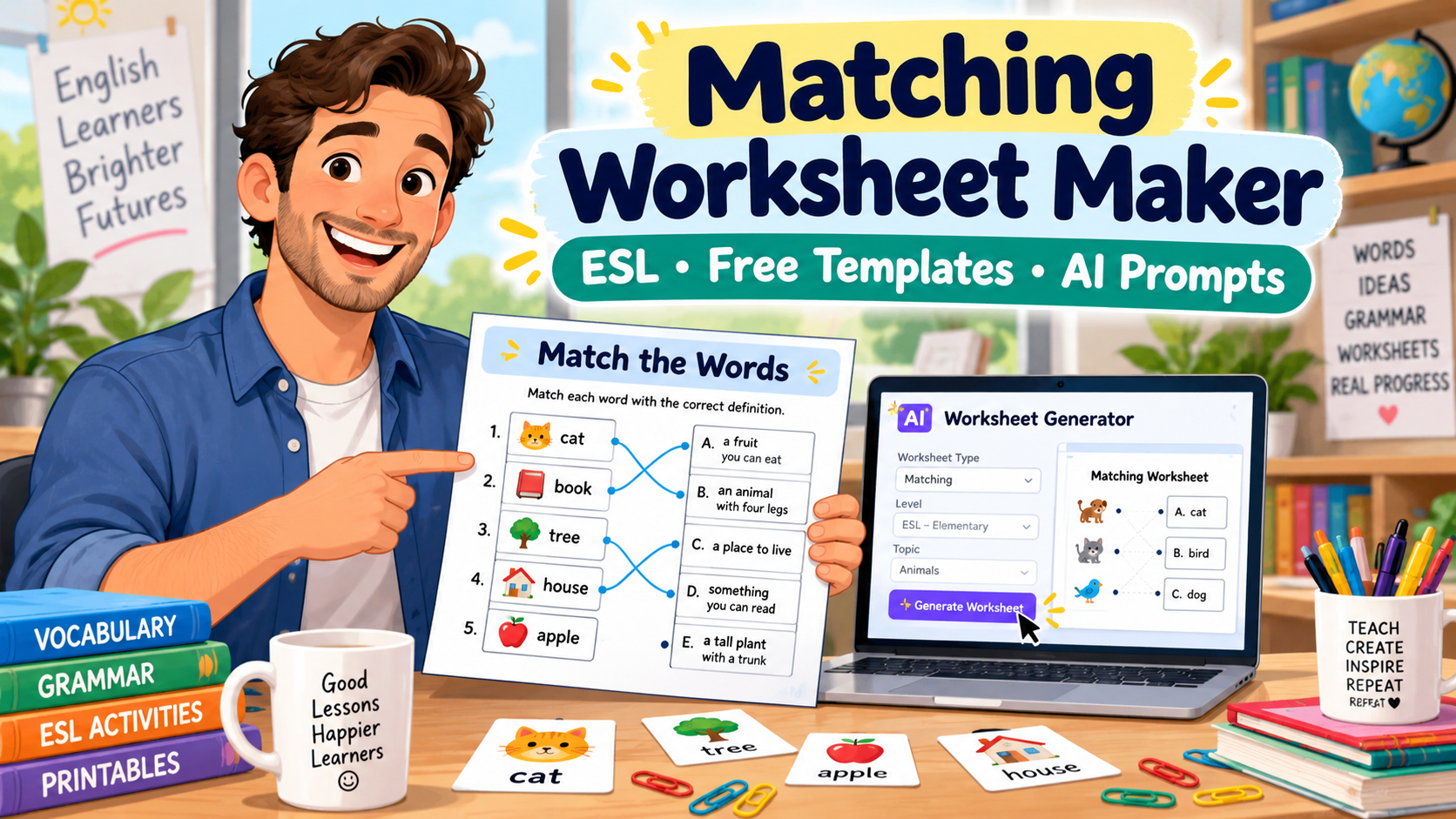
A matching worksheet maker can turn a simple vocabulary list, a set of phrasal verbs, or a collection of grammar examples into a useful classroom activity. Instead of spending time arranging two columns in Word and manually shuffling the answers, you can create a matching exercise in minutes using a free online tool or an AI assistant.
But making a worksheet quickly is only half the job.
If you’ve ever given students a matching activity and watched them finish it in less than a minute, you know that not every exercise encourages meaningful language learning. Some pairs are too obvious. Others are confusing because two answers seem equally correct.
The trick is choosing the right items and making students think about the language, not just connect words at random.
In this guide, we’ll compare free matching worksheet makers, walk through the creation process, and share three complete ESL activities for A2, B1, and B2 learners. You’ll also find reusable AI prompts, editable templates, and answer keys you can adapt for your own lessons.
What Is a Matching Worksheet Maker?
A matching worksheet maker is a tool that helps teachers create exercises where students connect items from two columns.
Usually, one column contains words, expressions, questions, or sentence beginnings. The other contains definitions, answers, examples, or sentence endings.
For instance:
| Column A | Column B |
|---|---|
| 1. Delicious | A. Very large |
| 2. Enormous | B. Very tasty |
| 3. Exhausted | C. Extremely tired |
Students write the appropriate letter next to each number.
Answer key: 1–B, 2–A, 3–C.
That’s the basic idea. However, matching exercises can support more than vocabulary recall.
English teachers can use them to practise:
- Words and definitions.
- Phrasal verbs and meanings.
- Collocation halves.
- Questions and appropriate responses.
- Sentence beginnings and endings.
- Grammar rules and examples.
- Causes and consequences in a reading passage.
- Expressions and communicative functions.
A good matching worksheet generator saves formatting time, while the teacher remains responsible for choosing suitable language and checking that each pair has a clear, defensible answer.
Best Free Matching Worksheet Makers for Teachers
You don’t need expensive software to create a matching activity. Several online tools let teachers work with their own content.
The following options serve slightly different purposes. Some produce printable PDFs, while others are designed primarily for interactive exercises.
1. Puzzone — Best for Simple Printable Matching Worksheets
Puzzone’s Matching Worksheet Maker is a straightforward option when you already know the words and definitions you want to use.
You enter pairs in a simple text format, such as:
- generous: willing to give or share
- reliable: someone you can depend on
- curious: wanting to learn or know more
The tool shuffles the matching column and generates a two-column exercise.
You can download a PDF containing the worksheet and answer key.
Why it works for ESL teaching: It’s useful for quick vocabulary revision, definitions, and short language quizzes without having to manually arrange a printable page.
Free access: The tool advertises free classroom use without requiring an account.
Limitation: It’s a worksheet generator rather than a complete AI lesson-planning assistant. You need to prepare or supply suitable pairs.
2. EdCreate — Best for No-Signup Printable Worksheets
EdCreate’s Free Matching Worksheet Maker is another practical option for teachers who want printable exercises.
You enter each word and clue, separated by an equals sign:
- crowded = full of people
- peaceful = quiet and calm
- expensive = costing a lot of money
You can choose whether students should draw lines between items or write the matching letters.
The tool also offers shuffled matching items, an optional answer-key page, and spaces for names and dates.
Why it works for ESL teaching: It’s particularly convenient for short, teacher-controlled matching activities that students can complete on paper.
Free access: Creating and printing the worksheet does not require an account.
Limitation: You still need to check that the definitions are accurate and appropriate for your learners.
3. MakeLesson — Best for Interactive Matching Exercises
MakeLesson’s Matching Worksheet Generator takes a more digital approach.
Instead of only producing a printable sheet, it lets teachers create matching activities that students can complete online.
You can start with word pairs, an existing text, a topic, or a supported uploaded document. Students open the exercise through a link and check their answers.
For example, you might create a phrasal-verb activity and assign it as independent practice.
Why it works for ESL teaching: It offers an alternative when students have access to phones, tablets, or computers and you want an activity they can complete digitally.
Free access: Basic exercise creation and sharing are free. The platform indicates that a free account is required for functions such as saving, printing, or assigning exercises.
Limitation: You’ll need to account for device access and connectivity when using online matching activities.
4. Canva — Best for Visually Customizable Worksheets
Canva’s Worksheet Templates are worth considering when layout and visual design are important.
Canva isn’t primarily an automatic matching exercise maker. Instead, it gives you editable worksheet designs into which you can place your own matching items.
You can create picture-and-word exercises, illustrated vocabulary activities, or printable matching tasks with more space for handwriting.
Why it works for ESL teaching: It’s particularly useful for younger learners, visual vocabulary activities, and worksheets that need additional design elements.
Free access: Canva provides free worksheet templates, although some design assets and features may require a paid plan.
Limitation: You’ll usually need to arrange and check the matching pairs yourself.
Quick Comparison: Which Matching Worksheet Maker Should You Choose?
| Tool | Best for | Worksheet format | Main advantage |
|---|---|---|---|
| Puzzone | Vocabulary and definition pairs | Printable PDF | Automatically shuffles answers and creates an answer key |
| EdCreate | Fast printable classroom exercises | Browser printout | No-signup creation with letter or line matching |
| MakeLesson | Digital practice and homework | Interactive online activity; printing with account | Students can check answers online |
| Canva | Illustrated and custom-designed worksheets | Editable designs and printable PDF | Greater visual flexibility |
These comparisons are based on the providers’ published features, not a formal hands-on test. Check current free-plan conditions before choosing a tool.
If you want the fastest route to a printable vocabulary activity, Puzzone or EdCreate may be enough.
If your students complete exercises online, MakeLesson is worth exploring. And if you need pictures, colours, and a more polished layout, Canva offers greater control over the presentation.
For a broader comparison of worksheet creation platforms, see our guide to the best customizable worksheet software with AI for English teachers.
How to Create a Matching Worksheet in 5 Steps
Whether you’re using an online matching exercise maker or AI, the process should begin with the language you want students to practise.
Step 1: Choose One Clear Learning Objective
Start with a small, specific goal.
For example:
By the end of this activity, A2 learners will be able to recognise six common words related to train travel.
Or:
B1 learners will match eight common phrasal verbs with their meanings and use selected expressions in sentences.
These objectives help you decide which pairs to include.
Avoid mixing unrelated vocabulary, grammar structures, and cultural knowledge in the same short exercise unless that combination serves a particular learning purpose.
Step 2: Prepare Your Matching Pairs
Create a list of words or expressions with accurate matches.
For vocabulary exercises, you might use words and definitions. For grammar practice, you could match sentence beginnings with endings.
A useful starting point is six to eight pairs, although the right number depends on students’ proficiency, task complexity, and lesson time.
Before generating the worksheet, look for possible ambiguity.
For example, if one column includes happy and pleased, a definition like feeling good might reasonably match both.
Make the meanings more specific or select different items.
Step 3: Choose Printable or Interactive Output
Consider how the activity will be used.
A printable worksheet is suitable for paper-based lessons, independent seatwork, or situations with limited internet access.
An interactive activity can work well for digital homework, quick revision, or lessons where students use their own devices.
The format should support the lesson rather than determine the lesson.
Step 4: Generate and Review the Exercise
Enter your pairs into the matching worksheet maker and generate the activity.
Check that:
- Every item has one intended match.
- Answers have been shuffled.
- Definitions and examples are accurate.
- The language matches students’ level.
- The layout is clear and readable.
- The answer key corresponds to the displayed worksheet.
Pay particular attention if you regenerate or reshuffle the worksheet. The answer letters may change.
Step 5: Add a Short Follow-Up Activity
This is where a simple matching task becomes more useful.
After students complete the worksheet, ask them to use three matched words in sentences, explain an answer to a partner, or write a short dialogue.
For example, students who match run out of with have none left could write:
“We ran out of milk this morning.”
This short extension encourages students to move from recognising meanings towards using the expressions.
Free Printable Matching Worksheets for ESL Students
Here are three classroom-ready activities you can copy into Word, Google Docs, or a worksheet generator.
They cover vocabulary, phrasal verbs, and collocations at different levels.
Worksheet 1: A2 Vocabulary Matching — At the Train Station
Level: A2
Topic: Travel and Transport
Learning objective: Recognise common vocabulary used when travelling by train.
Student instructions: Match the words in Column A with their meanings in Column B. Write the correct letter next to each number.
| Column A — Word | Column B — Meaning |
|---|---|
| 1. Platform | A. The time when a train or bus leaves |
| 2. Ticket | B. The area beside a railway track where passengers wait |
| 3. Luggage | C. A list showing when trains or buses leave |
| 4. Departure | D. Bags and suitcases that someone takes on a journey |
| 5. Passenger | E. A person travelling on a train, bus, or other vehicle |
| 6. Timetable | F. A document or digital record showing that a journey has been paid for |
Write your answers:
Teacher Answer Key
| Number | Correct answer |
|---|---|
| 1 | B |
| 2 | F |
| 3 | D |
| 4 | A |
| 5 | E |
| 6 | C |
Follow-Up Activity
Ask students to imagine they’re at a train station.
In pairs, they should create a short dialogue using at least three of the words.
For example:
Student A: “Excuse me, which platform does the train leave from?”
Student B: “Platform four. You can check the departure time on the timetable.”
This helps learners practise the words in a familiar communicative situation.
Worksheet 2: B1 Phrasal Verb Matching
Level: B1
Topic: Everyday Phrasal Verbs
Learning objective: Recognise the meanings of eight common phrasal verbs.
Student instructions: Match each phrasal verb with its meaning.
| Column A — Phrasal Verb | Column B — Meaning |
|---|---|
| 1. Put off | A. Continue doing something |
| 2. Look after | B. Refuse an offer or request |
| 3. Run out of | C. Discover or learn information |
| 4. Turn down | D. Postpone something until a later time |
| 5. Carry on | E. Stop trying to do something |
| 6. Find out | F. Create or organise something new |
| 7. Set up | G. Have none of something left |
| 8. Give up | H. Take care of someone or something |
Write your answers:
Teacher Answer Key
| Number | Correct answer |
|---|---|
| 1 | D |
| 2 | H |
| 3 | G |
| 4 | B |
| 5 | A |
| 6 | C |
| 7 | F |
| 8 | E |
Follow-Up Activity
Have students choose three phrasal verbs and write sentences about everyday situations.
For example:
- “We had to put off the meeting until Friday.”
- “Can you look after my bag for a minute?”
- “I need to find out when the library closes.”
For an additional challenge, students can exchange sentences with a partner and explain each phrasal verb’s meaning.
Worksheet 3: B2 Academic Collocation Matching
Level: B2
Topic: Academic English
Learning objective: Recognise and use common academic collocations.
Unlike the previous activities, this worksheet asks students to connect word combinations rather than words and definitions.
Student instructions: Match each verb in Column A with the appropriate expression in Column B to form a natural academic collocation.
| Column A — Verb | Column B — Expression |
|---|---|
| 1. Draw | A. awareness |
| 2. Pose | B. research |
| 3. Conduct | C. a conclusion |
| 4. Reach | D. a distinction |
| 5. Gather | E. a challenge |
| 6. Take | F. evidence |
| 7. Address | G. the context into account |
| 8. Raise | H. an issue |
Write your answers:
Teacher Answer Key
| Number | Correct answer | Complete collocation |
|---|---|---|
| 1 | D | Draw a distinction |
| 2 | E | Pose a challenge |
| 3 | B | Conduct research |
| 4 | C | Reach a conclusion |
| 5 | F | Gather evidence |
| 6 | G | Take the context into account |
| 7 | H | Address an issue |
| 8 | A | Raise awareness |
Follow-Up Activity
Ask students to choose four collocations and write a short paragraph about an educational or environmental issue.
For example:
“Researchers need to gather evidence before they reach a conclusion. They should also take the context into account when interpreting their results.”
This makes the worksheet especially relevant for students working towards more formal written English.
For additional vocabulary-related worksheet ideas, visit our Spelling Worksheet Maker guide.
How to Use AI as a Matching Worksheet Generator
Free worksheet tools are convenient when you’ve already prepared your word pairs.
But what if you only have a topic, a lesson objective, or a reading passage?
This is where an AI assistant such as ChatGPT can help.
You can ask it to suggest suitable matching pairs, write level-appropriate definitions, organise the exercise into two shuffled columns, and produce an answer key.
The important part is giving precise instructions.
A vague prompt such as “Make a matching worksheet about food” might produce an activity that’s too easy, too difficult, or unrelated to your lesson.
The prompts below give you more control over the output.
AI Prompt 1: A2 Vocabulary Matching Worksheet
Use this prompt when introducing or reviewing vocabulary around a familiar topic.
Copy-and-paste prompt:
Act as an experienced ESL teacher designing materials for A2 learners.
Create a printable vocabulary matching worksheet.
Lesson details:
- Topic: [INSERT TOPIC]
- Student level: A2
- Learning objective: Recognise and understand key vocabulary related to the topic.
- Target vocabulary: [PASTE YOUR WORD LIST OR ASK AI TO SUGGEST ONE]
Requirements:
- Select eight useful vocabulary items appropriate for A2 learners.
- Create one clear, simple definition for each word.
- Organise the words in Column A and the definitions in Column B.
- Label the words 1–8 and the definitions A–H.
- Shuffle the definitions so their order differs from the words.
- Make sure each definition has one intended correct match.
- Use natural, learner-friendly English.
- Include a separate answer key.
- Add two short follow-up speaking questions using the vocabulary.
Before finalising, check that the answer key accurately matches the displayed columns.
Format the worksheet so it can be copied directly into Microsoft Word or Google Docs.
Teacher tip: If your students have limited vocabulary, ask AI to use concrete words and short explanations. Consider adding pictures where appropriate.
AI Prompt 2: B1 Phrasal Verb Matching Worksheet
This prompt is useful for teaching everyday expressions.
Copy-and-paste prompt:
Act as an experienced B1 ESL teacher.
Create a matching worksheet to help students understand common English phrasal verbs.
Topic: [INSERT TOPIC OR CONTEXT]
Requirements:
- Choose eight useful phrasal verbs related to the topic.
- Create a short, accurate meaning for each expression.
- Present the phrasal verbs in Column A and the meanings in Column B.
- Shuffle the meanings.
- Avoid definitions that could reasonably match more than one phrasal verb.
- Use language suitable for B1 learners.
- Provide a separate, accurate answer key.
- Add a follow-up activity requiring students to use at least four of the expressions in original sentences.
Where a phrasal verb has multiple meanings, choose one meaning relevant to the lesson and make that meaning clear.
Check that every match is correct and unambiguous before presenting the final worksheet.
Teacher tip: You can adapt this prompt to expressions from a reading passage. Instead of asking AI to invent a list, provide the phrasal verbs your students actually encountered.
AI Prompt 3: B2 Collocation Matching Worksheet
At B2 level, matching activities can go beyond definitions and help students notice natural word combinations.
Copy-and-paste prompt:
Act as an experienced academic English teacher preparing materials for B2 ESL/EFL learners.
Create a collocation matching worksheet.
Topic: [ACADEMIC WRITING / ENVIRONMENT / EDUCATION / WORK / ANOTHER TOPIC]
Requirements:
- Select eight common, natural English collocations appropriate for B2 learners.
- Split each collocation into two meaningful parts.
- Present the first halves in Column A and the second halves in Column B.
- Shuffle Column B so students must identify the correct combinations.
- Ensure that each pair has one intended answer in this particular exercise.
- Avoid ambiguous combinations or explain any alternative pairings that are also valid.
- Provide a correct answer key showing the complete collocations.
- Add four example sentences using selected collocations.
- Include a short writing task that asks students to use at least three collocations in context.
Prefer common, authentic combinations rather than unusual expressions.
Check the naturalness and accuracy of all collocations before presenting the worksheet.
Teacher tip: Ask students to underline the complete collocations in the follow-up example sentences. This helps them notice how the expressions operate in context.
Create Matching Worksheets from Existing Reading Passages
Sometimes you don’t want a general vocabulary activity. You want students to practise the words and ideas from a specific text.
In that situation, provide the reading passage to your AI assistant.
For example, suppose your B1 class is reading about recycling. You might ask the AI to identify six important vocabulary items and create matching definitions based on the passage.
Use this additional instruction:
“Using only the reading passage below, select six important vocabulary items and turn them into a matching exercise. Keep the meanings appropriate to the context. Do not introduce definitions unrelated to the passage, and provide a verified answer key.”
This approach helps keep the worksheet connected to what students are actually learning.
You can also combine matching activities with comprehension questions, short summaries, or guided note-taking.
For more possibilities, see our AI Worksheet Generator for English Teachers.
Free Editable Matching Worksheet Template
If you prefer making worksheets manually, copy the following structure into a document and replace the placeholders.
Worksheet Title: [TOPIC]
Student Level: [A1 / A2 / B1 / B2]
Name: ______________________
Date: ______________________
Instructions: Match each item in Column A with the correct answer in Column B. Write the matching letter next to the number.
| Column A | Column B |
|---|---|
| 1. [ITEM 1] | A. [SHUFFLED MATCH] |
| 2. [ITEM 2] | B. [SHUFFLED MATCH] |
| 3. [ITEM 3] | C. [SHUFFLED MATCH] |
| 4. [ITEM 4] | D. [SHUFFLED MATCH] |
| 5. [ITEM 5] | E. [SHUFFLED MATCH] |
| 6. [ITEM 6] | F. [SHUFFLED MATCH] |
Answers:
Extra Practice:
Choose two matched items and write a sentence using each.
Teacher Answer Key:
[INSERT CORRECT MATCHES AFTER SHUFFLING COLUMN B]
The template is intentionally simple so you can adapt it for different language skills.
For a digital version, you can transfer the same pairs into an online matching worksheet maker.
For a more visual printable version, copy the content into Canva or another worksheet editor.
How to Make Matching Worksheets More Effective for ESL Learners
Creating an activity is easy. Designing one that helps students learn requires a little more thought.
Use Age-Appropriate Content
Matching exercises aren’t only for beginners or children.
University students might match academic expressions with communicative functions, while adult learners might practise workplace vocabulary or expressions used in everyday services.
Choose topics and presentation styles that respect your learners’ age and interests.
Avoid Ambiguous Answers
This is especially important with synonyms and collocations.
Two words may share a similar meaning, and some sentence halves may combine naturally in more than one way.
If the exercise depends on one correct answer per item, review the possible combinations carefully.
When more than one answer is genuinely acceptable, either revise the activity or explain the alternatives.
Include a Small Challenge
A basic matching activity might take only a few minutes.
You can extend it by asking students to explain their answers, write example sentences, create a short dialogue, or identify how the expressions are used in a text.
For instance, after matching academic collocations, B2 learners could write a paragraph using three of them.
The extension can be more valuable than simply increasing the number of pairs.
Differentiate the Worksheet
For learners who need more support, use fewer items, shorter definitions, familiar vocabulary, or helpful pictures.
For stronger students, remove some of the hints, choose more abstract language, or require explanations after matching.
You can also prepare two versions of the same worksheet while keeping the learning objective unchanged.
Check the Layout Before Printing
A crowded worksheet can be frustrating even when the content is good.
Use readable fonts, sufficient spacing, and a clear distinction between both columns.
If students are drawing lines, leave enough room between the columns to avoid confusing crossings.
If you’re using letter matching, provide a clear space for answers.
Before distributing printable matching worksheets, check the PDF or print preview rather than assuming the layout will transfer perfectly from the editor.
Common Mistakes When Using a Matching Worksheet Generator
1. Creating Too Many Pairs
A worksheet with twenty unfamiliar items may be overwhelming, particularly for beginners.
Better approach: Start with a manageable number of meaningful pairs and expand only when it serves the lesson objective.
2. Using Definitions Above Students’ Level
If the definition is harder than the target word, students may be unable to demonstrate what they know.
Better approach: Simplify the language of the clues without making them inaccurate.
3. Forgetting to Shuffle the Answers
When the first word matches A, the second matches B, and so on, the exercise becomes predictable.
Better approach: Shuffle the answer column and verify the answer key afterwards.
4. Accepting AI-Generated Answers Without Checking
AI may produce an incorrect definition, an unnatural collocation, or a key that no longer matches the final worksheet.
Better approach: Verify every pair and every answer against the worksheet students will receive.
5. Relying Only on Recognition
Students may be able to match an expression to its meaning without knowing how to use it.
Better approach: Add a short production task such as sentence writing, speaking practice, or contextualised gap-filling.
6. Using Matching Activities for Every Lesson
Matching is useful, but it shouldn’t replace speaking, listening, reading, writing, or more demanding comprehension activities.
Better approach: Treat matching as one activity within a varied lesson sequence.
Free Resource: AI Worksheet Prompt Pack for English Teachers
Want to create more than matching exercises?
Our Free AI Worksheet Prompt Pack for English Teachers includes 25 reusable prompts designed to support classroom preparation.
Use them to develop materials for vocabulary, grammar, reading, and other teaching activities without writing every prompt from scratch.
Whether you’re creating a vocabulary matching worksheet or a full reading lesson, a reusable prompt can make preparation more consistent.
Get the free AI Worksheet Prompt Pack and start building your own collection of ESL teaching materials.
[WORDPRESS EDITOR NOTE: Insert your existing MailerLite AI Worksheet Prompt Pack signup form here. Remove this note before publishing.]
Frequently Asked Questions
What is the best free matching worksheet maker?
It depends on the format you need. Puzzone and EdCreate are suitable for printable matching worksheets, while MakeLesson supports interactive matching activities. Canva is useful when you want to design the worksheet layout yourself. Check each tool’s current features and access conditions.
Can ChatGPT create a matching worksheet?
Yes. You can provide vocabulary items, phrasal verbs, or collocations and ask ChatGPT to arrange them into shuffled matching columns. You can also request an answer key, level-specific instructions, and a short follow-up activity.
How do I create a printable matching worksheet?
Choose your target words or expressions, prepare accurate matches, enter them into a worksheet maker, and download or print the output. Review the layout and answer key before distributing it.
Can I make a matching worksheet from a PDF?
Some tools, including MakeLesson, support creating exercises from uploaded PDFs or other source materials. You should still check that the generated pairs accurately represent the original material.
What can ESL students match besides vocabulary?
Students can match phrasal verbs with meanings, collocation halves, grammar rules with examples, questions with responses, or causes with consequences. The activity should reflect the lesson objective.
Are matching worksheets appropriate for advanced ESL students?
Yes. At B2 and above, teachers can use matching activities for academic collocations, discourse markers, formal expressions, and relationships between ideas. More demanding follow-up tasks can encourage deeper language use.
How many matching pairs should I include?
There is no fixed rule. Six to eight pairs can be a practical starting point for a short activity, but you should adjust the number according to students’ proficiency, the complexity of the material, and available lesson time.
Can students complete matching activities online?
Yes. Some matching exercise makers produce interactive activities students can open on their devices. This can be convenient for homework, revision, or digitally supported lessons.
Can I use a matching worksheet maker for grammar?
Yes. For example, you can match sentence beginnings with endings, grammar rules with sample sentences, or time expressions with suitable tense forms. Check for alternative combinations that may also be grammatically correct.
Conclusion: Create Better ESL Matching Worksheets in Less Time
A matching worksheet maker can simplify lesson preparation, whether you’re creating a quick vocabulary review, a phrasal-verb activity, or an academic collocation exercise.
For printable materials, free tools such as Puzzone and EdCreate can handle the formatting and shuffling. For interactive practice, MakeLesson offers a digital approach. And when you need more control over the content, AI assistants can help draft matching pairs, definitions, and activity instructions.
Still, the most important decisions belong to the teacher.
Choose language that fits your students, check for ambiguous answers, and include opportunities for learners to use the matched expressions in context.
A good worksheet doesn’t have to be complicated. It just needs to help students practise the right language in a purposeful way.
Ready to create more ESL activities? Explore our AI Worksheet Generator guide or get the Free AI Worksheet Prompt Pack to make your next lesson easier to prepare.