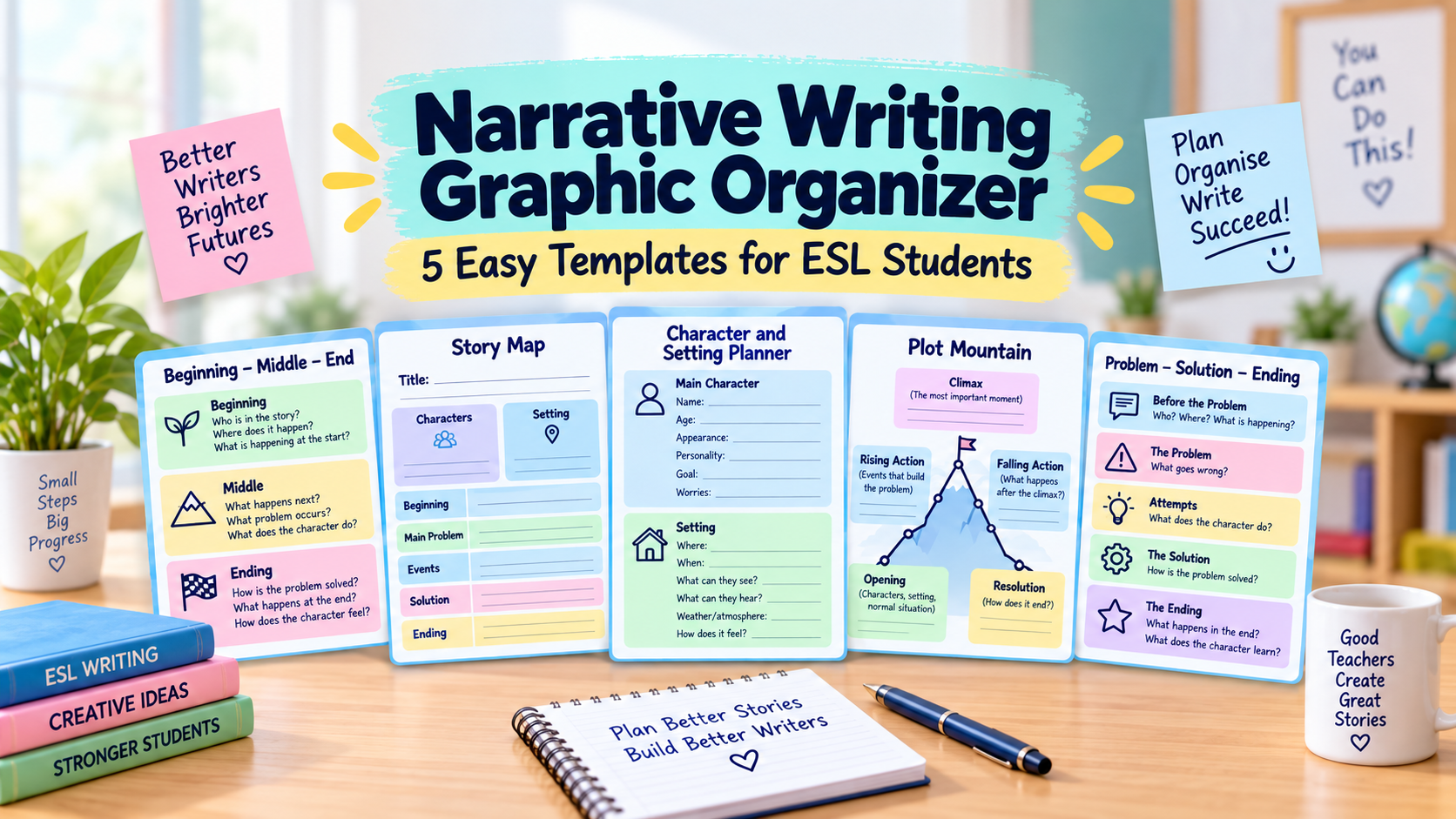
A narrative writing graphic organizer can help ESL students with story writing.
Rather than asking learners to start from scratch and instantly come up with a story, a graphic organizer allows them to break down the writing process in smaller steps and make several important decisions first.
They will have to think about:
- the characters;
- the setting;
- what happens first;
- what problem emerges;
- how events unfold;
- how the problem is resolved;
- how the story ends.
For English language learners, it will be particularly helpful since writing a narrative involves managing ideas, organisation, vocabulary, grammar, and sequencing simultaneously.
A graphic organizer relieves some of the pressure.
It gives students a place to organise ideas before drafting them in full sentences.
In this guide, you will find five narrative writing graphic organizers for ESL students, as well as example applications and AI prompts you can use to adapt each graphic organizer to the needs of your students.
If you already use AI to generate your classroom materials, you may find the article AI Worksheet Generator for English Teachers helpful for creating printable worksheets out of the organisers below.
What Is a Narrative Writing Graphic Organizer?
A narrative writing graphic organizer is a tool that enables students to organise the essential elements of a story before starting to write the narrative.
Depending on the graphic organizer, the student will have to plan:
- characters;
- setting;
- beginning;
- middle;
- ending;
- problem;
- solution;
- events;
- climax;
- feelings;
- dialogue;
- reflection at the end of the story.
The graphic organizer is an intermediate step between ideas and writing.
Without a planning stage, students might immediately start writing a narrative, which could lead to problems like:
- lack of a logical flow;
- repetitive ideas;
- omission of some important parts of the story;
- unnecessary changes in tenses;
- unclear ending;
- loss of the main problem.
A graphic organizer will allow the students to see the structure of the narrative in advance.
Why Narrative Writing Can Be Difficult for ESL Students
Narrative writing is not just about imagination.
It involves language, which students need to manage.
In a narrative, the learners may need to use:
- the past simple;
- the past continuous;
- sequencing expressions;
- descriptive adjectives;
- adverbs;
- dialogue;
- pronouns;
- time expressions;
- cohesive devices.
On top of that, students have to keep the logical order of events.
For instance, they may come up with an interesting idea but fail to link the events of the story together:
I went to the park. I saw a dog. The dog was afraid. I called my friend. We went home.
The language will be correct, but there won’t be any development in the story.
A graphic organizer will force the student to ask themselves the following questions:
Who is the main character?
Why is the dog important?
What problem is there?
What does the character do?
What happens because of that?
How does the story end?
It is the solid base for writing the story.
Template 1: Beginning–Middle–End Organizer
The Beginning–Middle–End organizer is the simplest narrative graphic organizer.
It works best for:
- A1–A2 learners;
- younger students;
- students new to narrative writing;
- short stories;
- picture-based writing;
- simple personal narratives.
The student breaks the story into three main parts.
Template
BEGINNING
Who is in the story?
Where does the story happen?
What is happening at the start?
MIDDLE
What happens next?
What problem or surprising event occurs?
What does the character do?
ENDING
How is the problem solved?
What happens at the end?
How does the character feel?
Example
Let’s imagine the writing topic is:
Write about a day when something unexpected happened.
Then the student can plan the story:
Beginning
I went to school in the morning.
It was raining.
I was carrying my school bag.
Middle
I saw a small dog near the school gate.
The dog was wet and frightened.
I called my teacher.
Ending
We found the dog’s owner.
The owner thanked us.
I felt happy because we helped the dog.
The student will get a logically organised story sequence.
The next step is turning those notes into coherent sentences.
AI prompt for this organizer
Act as an experienced ESL writing teacher.

Create a Beginning-Middle-End narrative writing graphic organizer for [LEVEL] English learners.

Writing topic:
[TOPIC]

Include simple planning questions for:

BEGINNING
- characters;
- setting;
- opening situation.

MIDDLE
- important events;
- problem;
- character actions.

ENDING
- solution;
- final event;
- character feelings.

Use short, student-friendly questions.

Do not write the story for the student.
This is useful when you want the planning questions to match a particular writing task.
Template 2: Story Map Graphic Organizer
A story map graphic organizer will give the students more detail compared to the Beginning–Middle–End format.
It works well for A2–B1 learners who are able to plan more elements of the narrative.
Template
Title:
Main character:
Other characters:
Setting — Where?
Setting — When?
Beginning:
Main problem:
Event 1:
Event 2:
Event 3:
Solution:
Ending:
How does the main character feel at the end?
Why this organizer works
Many students understand the structure of the story but forget one crucial aspect.
For example, they may list several events but fail to create a problem, or they may list a problem but suddenly end the story.
The story map forces the students to consider all aspects of the story structure before drafting the narrative.
Classroom example
The topic is:
Write a story about someone who loses something important.
The student might plan the story as follows:
Main character: Adam
Setting: city centre, Saturday afternoon
Problem: Adam loses his phone
Event 1: He checks his bag
Event 2: He returns to a café
Event 3: He asks a waiter for help
Solution: The waiter finds the phone under a chair
Ending: Adam thanks him and becomes more careful
It is a complete pathway of a story.
AI prompt for this organizer
Create a story map graphic organizer for [LEVEL] ESL learners.

Writing topic:
[TOPIC]

Include sections for:
- title;
- main character;
- other characters;
- setting;
- beginning;
- main problem;
- three important events;
- solution;
- ending;
- final feeling.

Use clear, simple English.

After the organizer, provide 5 useful sequencing phrases suitable for [LEVEL].

Do not write the student's story.
You could also turn this into a printable classroom resource using the workflow in AI Worksheet Generator for English Teachers.
Template 3: Character and Setting Planner
There are cases when students begin writing without knowing enough information about their characters and setting.
This could make the story vague.
A Character and Setting Planner helps the students to develop the story’s world before considering the events.
This is especially useful for:
- B1 learners;
- creative writing;
- descriptive writing;
- longer stories;
- narrative projects.
Template
Main Character
Name:
Age:
Appearance:
Personality:
What does this character want?
What is this character worried about?
Setting
Where does the story happen?
When does it happen?
What can the character see?
What can the character hear?
What is the weather or atmosphere like?
How does the place make the character feel?
Story Connection
What problem happens in this setting?
Why is this place important to the story?
Example
Let’s say the topic is:
Write a story that begins in an empty train station.
The students could plan it in the following way:
Character: Sara, 19, university student
Personality: independent but impatient
Goal: catch the last train home
Setting: an old station late at night
Sound: rain hitting the windows
Atmosphere: quiet and uncomfortable
Problem: the train is cancelled
All these details would help to create descriptive writing later on.
AI prompt for character and setting planning
Create a character and setting planning worksheet for [LEVEL] ESL learners.

Narrative topic:
[TOPIC]

Include student-friendly questions about:

CHARACTER
- name;
- appearance;
- personality;
- goal;
- problem;
- feelings.

SETTING
- place;
- time;
- weather;
- sounds;
- sights;
- atmosphere.

STORY CONNECTION
- what happens;
- why the setting matters.

Add 8 useful descriptive adjectives suitable for [LEVEL].

Do not generate the complete story.
This type of planning can also be useful before giving students feedback on their first drafts. For feedback workflows, see AI Writing Feedback for English Teachers.
Template 4: Plot Mountain Graphic Organizer
The Plot Mountain is particularly helpful for students who are ready to write developed narratives.
It will enable learners to see that the story needs to move towards an important event rather than just list unrelated events.
A plot mountain includes:
Beginning → Rising Action → Climax → Falling Action → Resolution
This is best for B1–B2 learners.
Template
1. Opening / Introduction
Who is the main character?
Where and when does the story begin?
What is normal at the beginning?
2. Problem
What changes?
What challenge does the character face?
3. Rising Action
What happens first?
What happens next?
What makes the problem harder?
4. Climax
What is the most important or dramatic moment?
What decision does the character make?
5. Falling Action
What happens immediately after the climax?
6. Resolution
How does the story end?
What changes for the main character?
Example
The topic is:
Write a story about a journey that does not go as planned.
The student could plan the story as follows:
Opening: Two friends begin a hiking trip.
Problem: They realise they are on the wrong trail.
Rising Action 1: Their phone battery becomes low.
Rising Action 2: It begins raining.
Rising Action 3: They cannot find the main path.
Climax: They hear someone calling and must decide whether to follow the voice.
Falling Action: A park guide finds them.
Resolution: They return safely and decide to prepare better next time.
This will create a much more developed story than just listing events chronologically.
AI prompt for a Plot Mountain
Create a Plot Mountain graphic organizer for [LEVEL] ESL students.

Writing topic:
[TOPIC]

Include these stages:

1. Opening
2. Problem
3. Rising Action
4. Climax
5. Falling Action
6. Resolution

For each stage, include 2-3 short guiding questions.

Add useful sequencing expressions students could use when writing.

Keep the language appropriate for [LEVEL].

Do not provide a completed story.
Template 5: Problem–Solution–Ending Organizer
There are situations when students have problems with traditional story structures because there are too many elements to organize.
A Problem–Solution–Ending organizer focuses on the central challenge of the story.
It works well for A2–B1 learners.
Template
Before the Problem
Who is the main character?
Where is the character?
What is happening normally?
The Problem
What goes wrong?
Why is this a problem?
How does the character feel?
Attempt 1
What does the character try first?
Does it work?
Attempt 2
What does the character try next?
What happens?
The Solution
How is the problem finally solved?
The Ending
What happens afterwards?
What does the character learn or feel?
Example
The topic is:
Write about a difficult situation you solved.
Then the student could plan it in the following way:
Situation: Nadia is travelling to another town.
Problem: She misses her bus.
Attempt 1: She tries to buy another ticket.
Result: The next bus is full.
Attempt 2: She calls her cousin.
Solution: Her cousin drives her.
Ending: She arrives late but safely.
This structure naturally leads to cause and effect.
AI prompt for this organizer
Create a Problem-Solution-Ending narrative graphic organizer for [LEVEL] ESL learners.

Writing topic:
[TOPIC]

Include planning boxes for:
- situation before the problem;
- main problem;
- feelings;
- first attempt;
- second attempt;
- final solution;
- ending;
- lesson or reflection.

Keep the questions short and clear.

Add 6 useful sequencing phrases for narrative writing.

Do not write the story for the student.
Which Narrative Writing Graphic Organizer Should You Use?
The choice depends on the student’s level and the complexity of the writing task.
Beginning–Middle–End
Best for:
- A1–A2;
- beginners;
- short narratives;
- younger learners.
Story Map
Best for:
- A2–B1;
- structured story writing;
- students who have problems with narrative elements.
Character and Setting Planner
Best for:
- B1 and higher;
- descriptive narratives;
- creative stories;
- pre-writing development.
Plot Mountain
Best for:
- B1–B2;
- longer narratives;
- stories requiring stronger plot development.
Problem–Solution–Ending
Best for:
- A2–B1;
- personal narratives;
- problem-based stories;
- students who need a simple cause-and-effect structure.
You do not have to use the same organizer with each class.
The organizer should fit the writing task, not complicate it unnecessarily.
How to Use a Narrative Writing Graphic Organizer in Class
A graphic organizer works best as part of a writing process, not as a single worksheet.
A typical sequence of classroom activities could look like this.
Step 1: Present the writing topic
Provide the students with a clear situation.
For example:
Write a story about a day when your plans suddenly changed.
Step 2: Brainstorm ideas
Have the students generate ideas for:
- characters;
- places;
- problems;
- events;
- endings.
The students can work individually or in pairs.
Step 3: Fill the organizer
Choose the organizer that will work best for the level.
The students should fill the template with notes, not with full sentences.
For example:
missed train
raining
phone battery dead
stranger helps
Short notes make planning faster.
Step 4: Compare ideas
Have the students discuss their plans with the partner.
Have the partners ask each other the following questions:
Is the problem clear?
Does the story have a logical ending?
Is anything missing?
This gives the students the opportunity to refine their plans before drafting.
Step 5: Write the first draft
The students use their organizers as a guide.
The students do not have to stick to their notes literally; their ideas can develop during the writing process.
Step 6: Review and revise
The students can check:
- the story structure;
- the sequencing;
- the verb tenses;
- the vocabulary;
- the paragraphing;
- the clarity.
For teacher-supported revision, see AI Writing Feedback and learn how to use prompts to generate feedback without making decisions instead of your students.
How to Turn a Graphic Organizer into a Writing Task with AI
Once the students complete the graphic organizer, use AI to provide them with supplementary resources without generating a narrative for them.
For instance,
Act as an experienced ESL writing teacher.

My students are [LEVEL].

They are going to create a narrative about:
[TOPIC]

They are using this graphic organizer:
[PASTE ORGANIZER]

Create:

1. 8 useful sequencing expressions;
2. 8 useful descriptive words;
3. 5 sentence starters;
4. a simple narrative writing checklist;
5. a self-editing checklist.

Do not write the narrative itself.
It will provide language support without taking the writing part away from the students.
If you need more prompts for your classes, read ChatGPT Prompts for ESL Teachers: 30 Powerful Prompts by Language Skill.
Useful Sequencing Language for Narrative Writing
Organisers help students organise their ideas but they also need language to connect them.
Expressions for A2–B1 students are:
Beginning
- One day…
- Last weekend…
- It all started when…
- At first…
- Early that morning…
Moving the story forward
- Then…
- Next…
- A few minutes later…
- After that…
- Suddenly…
- While…
- When…
Building tension
- Unfortunately…
- To my surprise…
- Suddenly…
- Just then…
- The problem was…
Ending
- Eventually…
- In the end…
- Finally…
- Luckily…
- From that day on…
You can include a small “useful language” box along with the organiser rather than requiring students to memorise these expressions.
Example: From Organiser to Narrative
Here is a simple outline:
- Character: Yasmine
- Setting: train station
- Problem: left her bag on the train
- First action: told a station employee
- Second action: called the train company
- Climax: the next train arrived with her bag
- Ending: got the bag back
In response, students can write:
Last Saturday, Yasmine travelled by train to meet her cousin. When she reached the station, she suddenly realised that her bag was left on the train. She immediately talked to a station employee and explained the situation. He tried to reach the next station but the station employees could not find her bag there. Yasmine became worried since she had her phone and wallet in the bag. About half an hour later, another train came to the station. To her surprise, the driver carried her bag with him. Some passenger found it and gave it to him. In the end, Yasmine got everything back and promised herself to check the seat before leaving a train next time.
The organiser did not write the story for students.
It just provided a base for them.
How to Differentiate Narrative Organisers
Students do not all need the same level of support.
For students who need more help
Provide more support in your organisers, including:
- sentence starters,
- vocabulary banks,
- example ideas,
- pictures,
- fewer planning boxes,
- guiding questions,
- sequencing phrases.
For example:
- The story begins when…
- Suddenly…
- The main problem is…
- In the end…
For stronger students
Reduce the level of scaffolding.
Instead of asking:
- What does the character do first?
ask:
- How does the situation become more complicated?
You can also add:
- dialogues,
- flashbacks,
- multiple characters,
- better description,
- character motivation,
- alternative endings.
AI differentiation prompt
Differentiate this narrative writing graphic organizer for a mixed-level ESL class.

Main level:
[LEVEL]

Organizer:
[PASTE ORGANIZER]

Create:

SUPPORT VERSION
- simpler questions;
- sentence starters;
- vocabulary support;
- fewer planning elements.

CORE VERSION
- keep the original level of support.

CHALLENGE VERSION
- remove some scaffolding;
- require stronger description;
- add character motivation;
- add a complex plot element.

Keep the same writing objective for all students.
Common Mistakes in Narrative Organisers
Mistake 1: Organising the story in a too complicated way
An A2 narrative does not require 15 planning boxes.
Make sure the organisers are proportional to the task.
Mistake 2: Asking students to write complete paragraphs inside the organisers
Organisers are planning tools.
Short notes are enough.
Mistake 3: Treating the organiser as a formula
Although students can use it as a guide, the story should not follow the box-to-box format.
Mistake 4: Not paying attention to language support
Sometimes students have good story ideas but do not know how to say them in English.
Provide more language support:
- useful verbs,
- sequencing phrases,
- adjectives,
- sentence starters.
Mistake 5: Missing out peer discussion
Often, students spot possible problems in the story easier if they share the plan with someone.
Discuss it briefly in pairs before starting the draft.
Mistake 6: Letting AI write the story
AI can help you generate:
- organisers,
- prompts,
- vocabulary,
- models,
- checklists,
- feedback.
However, if the writing is the objective, let the students produce the story.
Narrative Writing Checklist for ESL Students
Before writing a narrative, students can ask themselves:
- Who is my main character?
- Where and when does the story take place?
- Is there any problem or important event in it?
- Are my events logical?
- Is there a climactic moment in it?
- Does the story have an ending?
- Do I know what tense I will use?
- Do I have useful expressions?
After writing:
- Did I divide the story into paragraphs?
- Did I use past tenses consistently?
- Did I connect events clearly?
- Did I describe important characters or settings?
- Did I proofread for spelling and punctuation?
- Does my ending make sense?
FAQ: Narrative Writing Organiser
What is a narrative writing graphic organiser?
Narrative writing graphic organiser is a tool that helps students organise elements of their future story like characters, setting, problem, events, climax, solution, and ending.
How does a graphic organiser help ESL students?
It reduces the amount of information that learners have to cope with. They can organise ideas first and focus on language after they start the drafting.
What is the easiest narrative organiser?
A Beginning-Middle-End organiser is usually the simplest one because students only need to organise three stages of the story.
What is a story map organiser?
The story map organiser includes the main character, setting, problem, important events, solution, and ending.
What is a Plot Mountain?
A Plot Mountain shows how the story develops through its stages: opening, problem, rising action, climax, falling action, resolution.
Which narrative organiser is suitable for A2 students?
Beginning-Middle-End and Problem-Solution-Ending organisers are usually sufficient for A2 students.
Which organiser is suitable for B1 or B2 students?
Story maps, character and setting planners, and Plot Mountains can be used for B1-B2 students because they allow organising a more complicated narrative and descriptions.
Can AI create narrative graphic organisers?
Yes. AI can help teachers to create or adapt organisers for a particular level, topic, and writing task. The teacher should review the output and make sure that the organiser suits the objective.
Should students use the organiser while writing?
Yes. They can use the organiser as a planning guide while drafting although they can change or improve ideas during the writing process.
Can the narrative organiser be used for personal writing?
Yes. The organiser is useful not only for fictional stories but also for the personal ones.
Final recommendation
A narrative writing graphic organiser can make the writing process easier for ESL students.
Instead of asking students to come up with ideas, organise the story, choose vocabulary, control grammar and write paragraphs, provide them with the starting point.
Start with:
Beginning → Middle → End
When the students feel more confident, use other organisers:
- Story Maps;
- Character and Setting Planners;
- Plot Mountains;
- Problem–Solution structure.
The purpose is not to create the same stories for all students.
The purpose is to provide them with enough structure to compose their narratives.
AI can help to create these organisers quickly.
The student should remain the storyteller.