A free rubric maker can help English teachers create clearer assessment criteria without spending hours designing tables from scratch. Whether you teach ESL writing, speaking, presentations, projects, or classroom tasks, a good rubric helps students understand what is expected and helps teachers mark more consistently.
But “free” does not automatically mean useful. Some rubric tools create generic criteria. Some templates look neat but do not fit your students’ level. Some AI-generated rubrics sound impressive but are too vague for real classroom use.
For English teachers, ESL/EFL teachers, and private language tutors, the best approach is to combine simple free tools with clear teacher judgement. You can use AI prompts, Google Docs, Canva-style templates, spreadsheets, or basic tables to create rubrics that are practical, student-friendly, and connected to your lesson aims.
In this guide, you will learn seven ways to create better English rubrics for free, with examples and copy-paste prompts you can adapt.
If you want a deeper prompt-based guide, read Rubric Creator: 7 AI Prompts to Build Better English Marking Rubrics. If you are creating worksheets and assessment together, you may also find AI Worksheet Generator for English Teachers: 7 Ways to Create Better ESL Worksheets useful.
What Is a Free Rubric Maker?
A free rubric maker is any tool, template, or workflow that helps you create rubrics without paying for dedicated assessment software. It might be:
- an AI chatbot;
- a Google Docs table;
- a spreadsheet;
- a printable template;
- a classroom resource generator;
- a design tool;
- a reusable rubric checklist;
- a teacher-made prompt workflow.
In English teaching, a rubric usually helps assess skills such as writing, speaking, presentations, projects, role-plays, or reading responses.
A rubric commonly includes:
- assessment criteria;
- performance levels;
- clear descriptors;
- points or bands;
- space for feedback;
- sometimes a student self-assessment section.
For example, a simple ESL writing rubric may assess:
- task response;
- organisation;
- grammar;
- vocabulary;
- spelling and punctuation.
A speaking rubric may assess:
- fluency;
- pronunciation;
- grammar;
- vocabulary;
- interaction;
- task completion.
The tool you use matters less than the quality of the rubric you create.
Why English Teachers Need Rubrics
Rubrics are useful because they make assessment clearer. Instead of simply writing “good work” or “grammar problems,” a rubric shows students exactly what they did well and what they need to improve.
For English teachers, rubrics help with:
- more consistent marking;
- clearer student expectations;
- faster feedback;
- better self-assessment;
- fairer grading;
- easier peer review;
- stronger alignment between lesson aims and assessment.
For example, if students write an opinion paragraph, the rubric can show that the task is not only about grammar. It may also assess whether students gave a clear opinion, used reasons, organised ideas, and checked punctuation.
This is especially important in ESL/EFL classes because students may focus only on grammar accuracy. A good rubric helps them understand that communication, organisation, vocabulary, and task completion also matter.
What a Free Rubric Maker Can and Cannot Do
A free rubric maker can save time, but it cannot do everything for you.
A free rubric maker can help you:
- create a first draft;
- format criteria in a table;
- generate performance levels;
- simplify rubric language;
- adapt rubrics for different tasks;
- create student checklists;
- build feedback comment banks.
A free rubric maker cannot fully decide:
- what your students need most;
- whether the rubric fits your exact lesson;
- whether the level is fair;
- whether the descriptors match your teaching context;
- whether the final score reflects your school’s grading policy.
This is why teacher review is essential. AI and free templates are useful starting points, not final authorities.
1. Use AI as a Free Rubric Maker
One of the fastest free or low-cost ways to create a rubric is to use AI. You can describe your task, student level, criteria, and scoring system, then ask AI to generate a rubric.
This is especially useful when you need a first draft quickly.
Copy-paste prompt
Act as an experienced English teacher.

Create an analytic rubric for [LEVEL] ESL/EFL learners.

Task:
[DESCRIBE THE TASK]

Assess these criteria:
1. task response;
2. organisation;
3. grammar;
4. vocabulary;
5. spelling/punctuation or pronunciation, depending on the task.

Use 4 performance levels:
Excellent, Good, Developing, Needs Work.

Give a total score out of [POINTS].
Use clear, student-friendly language.
Example
Create an analytic rubric for B1 ESL learners writing a 120-word opinion paragraph about online learning.

Assess:
1. clear opinion;
2. organisation;
3. reasons and examples;
4. grammar;
5. vocabulary;
6. spelling and punctuation.

Use 4 performance levels and a total score out of 24.
Use language students can understand.
Why this works
This prompt gives AI enough detail to create something useful. It includes the level, task, criteria, score, and language style.
Teacher tip
Do not use the first AI output immediately. Ask AI to revise it.
Make this rubric shorter, clearer, and easier for B1 ESL students to understand.
Or:
Create a compact teacher marking version of this rubric that fits on one page.
For more prompt examples, link to your post on using a rubric creator for English marking rubrics.
2. Use Google Docs as a Simple Free Rubric Maker
Google Docs can work well as a free rubric maker because you can create simple tables, duplicate templates, and share rubrics with students.
You do not need complex software. A clean table is often enough.
Simple Google Docs rubric structure
Use a table with these columns:
| Criteria | Excellent | Good | Developing | Needs Work | Score |
|---|
Then add rows such as:
- task response;
- organisation;
- grammar;
- vocabulary;
- mechanics.
Example writing rubric row
| Criteria | Excellent | Good | Developing | Needs Work | Score |
|---|---|---|---|---|---|
| Organisation | Ideas are clearly ordered and easy to follow | Ideas are mostly clear | Some ideas are hard to follow | Ideas are unclear or disconnected | /4 |
Best for
Google Docs works well for:
- writing rubrics;
- speaking rubrics;
- reusable templates;
- student-friendly checklists;
- peer review forms;
- printable classroom handouts.
Teacher tip
Create one master rubric template and duplicate it for each task. This saves time and keeps your assessment style consistent.
3. Use a Spreadsheet for Scoring Rubrics
A spreadsheet can also work as a free rubric maker, especially when you want automatic totals.
This is useful if you mark many students or want a simple scoring grid.
Basic spreadsheet rubric columns
You can create columns such as:
- student name;
- task response;
- organisation;
- grammar;
- vocabulary;
- mechanics;
- total score;
- feedback comment.
For each criterion, use a score from 1 to 4 or 1 to 5.
Example scoring system
| Student | Task Response /4 | Organisation /4 | Grammar /4 | Vocabulary /4 | Mechanics /4 | Total /20 |
|---|
This is practical for classroom assessment because you can quickly record scores and identify common weaknesses.
Best for
Spreadsheets work well for:
- class marking;
- tracking student progress;
- scoring speaking tasks quickly;
- comparing performance across criteria;
- storing feedback records.
Teacher tip
Use short descriptors in the spreadsheet and keep the full rubric in a separate document. This keeps your marking sheet clean.
4. Use Free Rubric Templates, Then Adapt Them
Free templates can be useful, but many are too generic. The key is to adapt them to your English lesson.
A generic writing rubric may include broad criteria like:
- content;
- organisation;
- grammar;
- vocabulary.
That is a good start, but you should make it task-specific.
Generic criterion
Content is clear and complete.
Better English-task criterion
The paragraph gives a clear opinion and includes at least two reasons.
Generic criterion
Uses good vocabulary.
Better English-task criterion
Uses topic vocabulary about online learning accurately.
Generic criterion
Grammar is good.
Better English-task criterion
Uses because, but, and so to connect ideas clearly.
Best for
Free templates are useful when you need:
- a starting structure;
- a printable layout;
- a quick rubric for a familiar task;
- a student-friendly version.
Teacher tip
Never use a template without adapting it to the task, level, and lesson aim.
5. Create a Student-Friendly Rubric Checklist
Sometimes students do not need a full scoring rubric. They need a checklist they can understand before submitting work.
A student-friendly checklist can be more useful than a complex teacher rubric.
Example: ESL writing checklist
Before I submit my paragraph, I checked that:
- I answered the question.
- I gave my opinion clearly.
- I gave at least two reasons.
- I used linking words such as because, but, and so.
- I checked my verbs.
- I checked spelling and punctuation.
- I wrote the correct number of words.
Copy-paste prompt
Create a student-friendly self-assessment checklist for [LEVEL] ESL learners.

Task:
[DESCRIBE TASK]

The checklist should include 6–8 simple statements beginning with “I...”

Use clear language and avoid technical terms.
Add one reflection question: “What should I improve next time?”
Best for
Student-friendly checklists work well for:
- writing tasks;
- speaking presentations;
- projects;
- peer review;
- homework submission;
- exam preparation.
Teacher tip
Give students the checklist before they start. This turns the rubric into a learning tool, not just a grading tool.
6. Create a Free Speaking Rubric for ESL/EFL Classes
Speaking assessment can be difficult because teachers need to judge fluency, pronunciation, grammar, vocabulary, and interaction at the same time.
A simple speaking rubric makes this easier.
Example speaking rubric criteria
For a B1 pair discussion, you might assess:
- task completion;
- fluency;
- pronunciation;
- vocabulary;
- interaction.
Copy-paste prompt
Create a simple speaking rubric for [LEVEL] ESL learners.

Speaking task:
[DESCRIBE TASK]

Assess:
1. task completion;
2. fluency;
3. pronunciation;
4. vocabulary;
5. interaction.

Use 4 levels:
Excellent, Good, Developing, Needs Work.

Total score: 20 points.
Use teacher-friendly descriptors and simple language.
Example task
Students discuss this question in pairs:
Should students use AI tools for homework?
The rubric can help you assess whether students:
- answer the question;
- give reasons;
- respond to their partner;
- speak clearly;
- use useful topic vocabulary.
Teacher tip
For informal speaking practice, use a short rubric. Too many criteria can make speaking assessment stressful and slow.
7. Create a Free Feedback Comment Bank from Your Rubric
A rubric helps with scoring, but students also need comments. You can use AI as a free rubric maker and feedback assistant by asking it to create a comment bank.
This helps you avoid repeating the same comments again and again.
Copy-paste prompt
Create a feedback comment bank for this English rubric.

Rubric:
[PASTE RUBRIC]

For each criterion, write:
1. 3 positive comments;
2. 3 improvement comments;
3. 2 next-step suggestions.

Use supportive teacher language. Keep the comments specific and useful.
Example feedback comments
For organisation:
- Your ideas are in a clear order.
- Try to start with a clearer topic sentence.
- Next time, use linking words to connect your reasons.
For vocabulary:
- You used useful topic words.
- Try to avoid repeating the same word many times.
- Next time, add two new words from the lesson.
Best for
A comment bank is useful when marking:
- essays;
- opinion paragraphs;
- speaking tasks;
- presentations;
- projects;
- reading responses.
Teacher tip
Do not copy comments blindly. Adapt them to the student’s actual work.
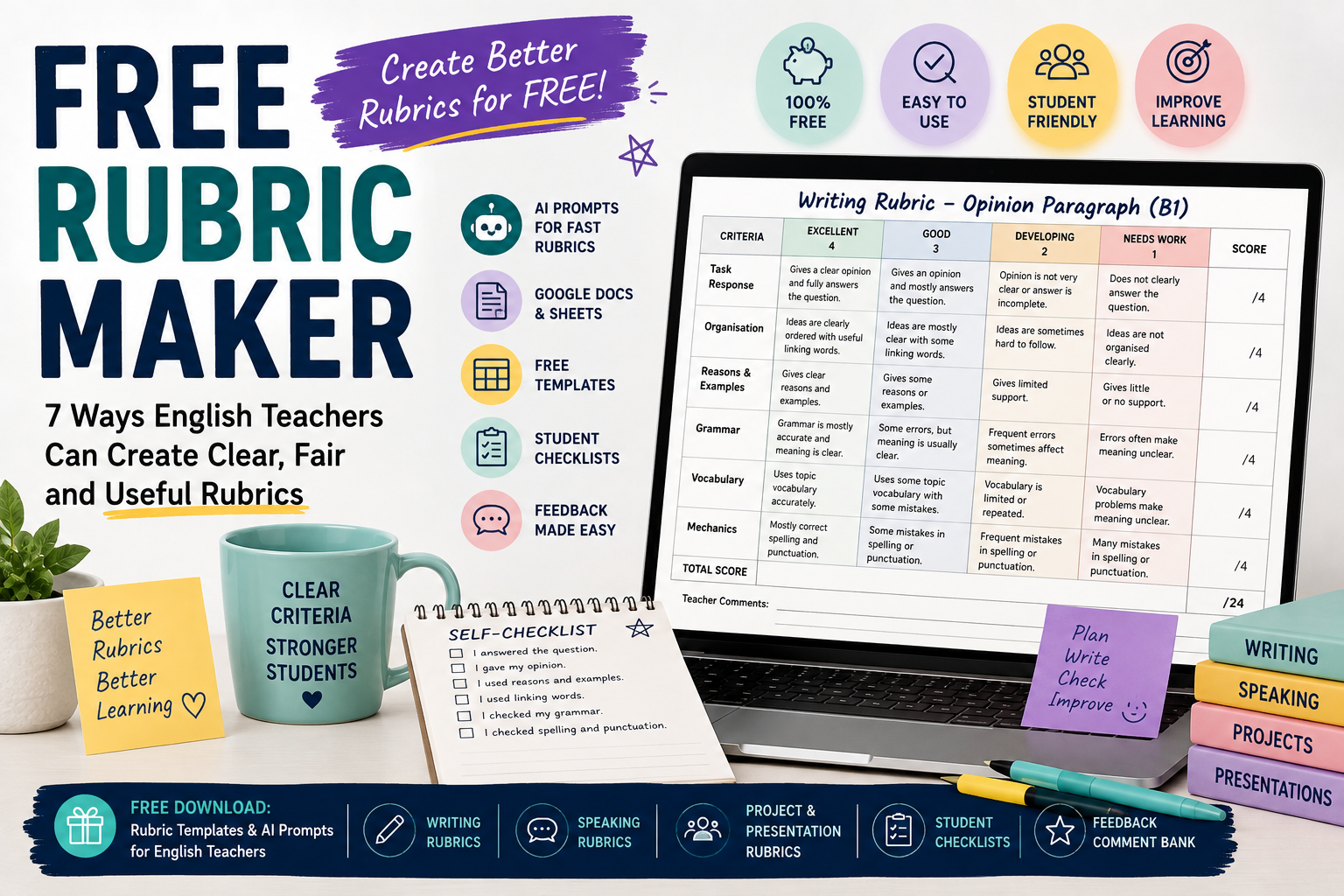
Example: Free Rubric for a B1 ESL Opinion Paragraph
Here is a simple rubric structure you can adapt.
Task: Write a 120-word opinion paragraph about this question:
Should students use smartphones in class?
Level: B1
Total score: 20 points
| Criterion | Excellent – 4 | Good – 3 | Developing – 2 | Needs Work – 1 |
|---|---|---|---|---|
| Task Response | Gives a clear opinion and fully answers the question | Gives an opinion and mostly answers the question | Opinion is not very clear or answer is incomplete | Does not clearly answer the question |
| Organisation | Ideas are clearly ordered with useful linking words | Ideas are mostly clear with some linking words | Ideas are sometimes hard to follow | Ideas are not organised clearly |
| Reasons and Examples | Gives clear reasons and examples | Gives some reasons or examples | Gives limited support | Gives little or no support |
| Grammar | Grammar is mostly accurate and meaning is clear | Some errors, but meaning is usually clear | Frequent errors sometimes affect meaning | Errors often make meaning unclear |
| Vocabulary and Mechanics | Uses topic vocabulary and mostly correct spelling/punctuation | Uses some topic vocabulary with some mistakes | Vocabulary is limited or repeated | Vocabulary/spelling problems make meaning unclear |
This rubric is simple, but it gives students more guidance than a general score.
Save time on rubrics and feedback.
Download the free Rubric & Feedback Templates for English Teachers and get ready-to-use templates, AI prompts, student checklists, and feedback comment banks.
How to Choose the Right Free Rubric Maker Workflow
Choose your workflow based on what you need.
Use AI when:
- you need a first draft quickly;
- you want descriptors for different performance levels;
- you want to simplify language;
- you want a student checklist;
- you want a feedback comment bank.
Use Google Docs when:
- you want a clean printable rubric;
- you want to share the rubric with students;
- you want a reusable template;
- you want to edit the rubric easily.
Use spreadsheets when:
- you are marking many students;
- you want automatic totals;
- you want to track performance;
- you want to compare class results.
Use templates when:
- you need a quick structure;
- you already know the criteria;
- you want a printable design.
The best free rubric maker is often not one tool. It is a workflow: AI for drafting, Google Docs for editing, and a spreadsheet for scoring if needed.
Common Mistakes to Avoid When Using a Free Rubric Maker
Mistake 1: Using generic criteria
“Grammar,” “content,” and “vocabulary” are not enough. Make criteria specific to the task.
Mistake 2: Making the rubric too long
A rubric with too many criteria is hard to use. For most English classroom tasks, four to six criteria are enough.
Mistake 3: Using teacher-only language
Students may not understand technical terms. Create a simpler student version if needed.
Mistake 4: Ignoring the learner level
A rubric for A2 learners should not expect B2-level writing or speaking. Keep descriptors realistic.
Mistake 5: Forgetting the lesson aim
If the lesson aim is fluency, do not over-focus on small grammar mistakes. If the aim is accurate use of past tense, grammar should have more weight.
Mistake 6: Not giving students the rubric before the task
Rubrics are more useful when students see them before they work. This helps them understand expectations.
Mistake 7: Treating AI output as final
AI can create a helpful draft, but teachers should always review the rubric for clarity, fairness, and level.
FAQ: Free Rubric Maker for English Teachers
What is the best free rubric maker for English teachers?
The best free rubric maker depends on your workflow. AI is useful for drafting rubric criteria, Google Docs is useful for formatting and sharing, and spreadsheets are useful for scoring and tracking. For many teachers, a combination of these works best.
Can I create a rubric for free?
Yes. You can create rubrics for free using AI prompts, Google Docs tables, spreadsheets, or downloadable templates. The most important part is adapting the rubric to your task and learner level.
Can AI create rubrics for ESL writing?
Yes. AI can create first-draft rubrics for ESL writing tasks. You should specify the level, task, word count, criteria, performance levels, and total score.
What should an ESL writing rubric include?
An ESL writing rubric often includes task response, organisation, grammar, vocabulary, and spelling or punctuation. The exact criteria should match the assignment.
What should an ESL speaking rubric include?
An ESL speaking rubric may include task completion, fluency, pronunciation, vocabulary, grammar, and interaction. For informal speaking tasks, use fewer criteria to keep assessment manageable.
Should students see the rubric before the task?
Yes. Rubrics are more useful when students see them before completing the task. This helps them understand what good performance looks like.
Is a free rubric maker enough for serious assessment?
For many classroom tasks, yes, if the teacher reviews and adapts the rubric carefully. For official exams or institutional assessment, follow your school’s required criteria and grading policy.
Conclusion
A free rubric maker can save English teachers time, but the real value comes from how you use it. AI, Google Docs, spreadsheets, and templates can all help you create rubrics without expensive software. However, your teaching judgement is what makes the rubric fair, clear, and useful.
For ESL/EFL teachers and language tutors, the best rubrics are task-specific, level-appropriate, and easy for students to understand. Use AI to create a first draft, then revise the criteria, simplify the wording, add a clear scoring system, and create a student checklist when needed.
A good rubric does more than help you mark faster. It helps students understand expectations, improve their work, and become more independent English learners.