You sit down to plan tomorrow’s class.
You have a textbook page, forty-five minutes, and a vague idea that your students need more speaking practice.
Twenty minutes later, you have collected a warm-up, a video, a worksheet, and a pair activity.
They all look useful.
But do they actually make a lesson?
That is the part of lesson planning that often takes longer than expected. Finding activities is usually easy. Deciding why each activity is there, how the stages connect, how long everything will take, and what students should be able to do by the end is harder.
If you are wondering how to create a lesson plan, the most useful place to start is not with activities.
Start with the destination.
A good lesson plan answers a simple question:
What should students be able to do by the end of this lesson that they could not do as confidently at the beginning?
Once that answer is clear, the rest of the plan becomes much easier to build.
The British Council’s TeachingEnglish resources make a similar point: a lesson plan should have a logical connection between activities, challenge learners appropriately, and remain flexible enough to respond to what actually happens in class.
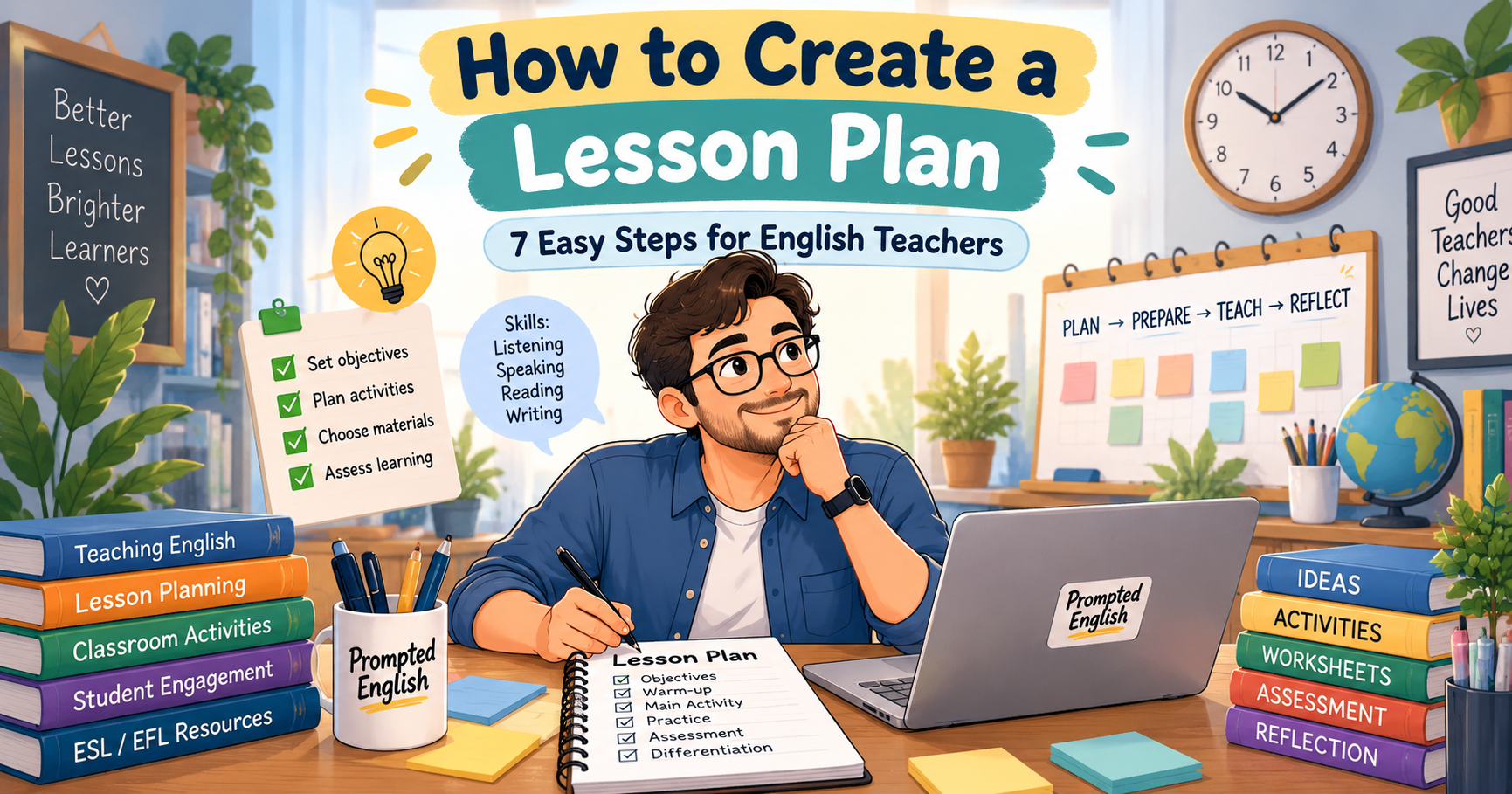
This guide shows how to create a lesson plan in seven practical steps, with examples for English and ESL teachers and a simple way to use AI without handing over the whole planning process.
For a more AI-focused workflow, you can also read Lesson Plan Generator: AI Prompts for Better ESL Lessons and ChatGPT Lesson Planning: A Prompt Sequence for Better ESL Lessons on Prompted English.
Step 1: Decide What Students Should Be Able to Do
When teachers ask how to create a lesson plan, they often begin with the topic:
Today’s lesson is about travel.
That is a topic.
It is not yet a learning objective.
A stronger starting point would be:
By the end of the lesson, students will be able to ask for and give simple travel information using Where is…?, How much is…?, and What time does…?
Now you know what the lesson is trying to achieve.
This distinction matters because a topic can lead almost anywhere.
A clear objective helps you reject activities that look interesting but do not serve the lesson.
A simple objective formula
Try:
By the end of the lesson, students will be able to [DO SOMETHING] using [LANGUAGE OR SKILL] in [CONTEXT].
Examples:
By the end of the lesson, students will be able to compare two places using comparative adjectives.
By the end of the lesson, students will be able to identify the main idea and two supporting details in a short B1 reading text.
By the end of the lesson, students will be able to give and justify an opinion using three target expressions.
The Council of Europe’s CEFR is useful here because it frames language ability through communicative “can-do” descriptors rather than simply lists of grammar points. The framework is designed to support learning objectives, curricula, teaching materials, and assessment.
Explore the official CEFR descriptors
A quick test for your objective
Ask yourself:
Can I observe it?
“Students will understand travel vocabulary” is difficult to observe.
“Students will use eight travel words correctly in a short pair conversation” is much easier.
The clearer your objective is, the easier every later decision becomes.
That is the first principle to remember when learning how to create a lesson plan.
Step 2: Check What Students Need Before They Can Reach the Objective
Once the objective is clear, work backwards.
Suppose your objective is:
Students will be able to give advice about everyday problems using should and shouldn’t.
Before they can do that successfully, they probably need:
- the meaning of should;
- the basic grammatical form;
- examples in context;
- useful vocabulary for common problems;
- controlled practice;
- an opportunity to use the structure more freely.
That list gives you the bones of the lesson.
This step is easy to skip.
You find a speaking activity you like and think:
Perfect. They’ll practise giving advice.
But then the lesson starts and students do not have enough language to complete it.
The activity was not necessarily bad.
It arrived too early.
Ask three questions
Before choosing activities, ask:
- What do students already know?
- What new language, information, or strategy do they need?
- What support will help them move from one to the other?
This is where knowing your particular class matters more than following a fixed lesson formula.
Two B1 classes may have the same textbook level but very different needs.
One may need more vocabulary support.
Another may already know the language but hesitate to speak.
Good planning responds to the learners in front of you.
That is also why the British Council recommends thinking about learners’ existing knowledge, appropriate challenge, and possible difficulties before the lesson rather than simply filling a timetable with activities.
Step 3: Build the Lesson in Stages
If you are still learning how to create a lesson plan, it helps to think of the lesson as a sequence rather than a list.
One simple sequence is:
Engage → Prepare → Practise → Use → Check
It is flexible enough for many English lessons.
1. Engage
Give students a reason to care about the topic.
For a lesson on travel problems, you might display a picture of someone standing beside a cancelled flight board and ask:
What do you think happened?
You are not teaching the target grammar yet.
You are opening the topic.
2. Prepare
Introduce or clarify the language, skill, or information students need.
For a lesson on giving advice:
You should call the airline.
You shouldn’t wait too long.
Keep this stage focused.
Teachers sometimes spend so long explaining that there is little time left for students to use the language.
3. Practise
Give students a safer opportunity to try the target language.
For example:
My friend has a headache. He _____ see a doctor.
Students choose should or shouldn’t.
This is controlled practice.
4. Use
Now create a reason to communicate.
Pairs receive problems:
I have an exam tomorrow, but I haven’t studied.
I want to improve my English speaking.
I lost my phone.
Students give advice and ask follow-up questions.
5. Check
Finish by finding out whether the objective was actually reached.
You might ask students to write:
Give one piece of advice to a student who wants to learn English faster.
A lesson can contain more stages than these, but the important point is movement.
Each stage should prepare students for the next one.
The British Council’s planning resources similarly emphasize coherent stages, interaction patterns, recycling learning, feedback, and differentiated activities rather than isolated tasks.
British Council: Planning lessons and courses
Step 4: Choose Activities That Earn Their Place
This is where lesson planning becomes surprisingly simple.
For every activity, ask:
Why is this here?
If you cannot answer in one sentence, reconsider it.
Suppose you find a fun vocabulary game.
It may be excellent.
But if today’s objective is reading for inference and the game takes fifteen minutes, it may not belong in this particular lesson.
When figuring out how to create a lesson plan, one of the most useful habits is learning to say no to activities.
You do not need more material.
You need the right material.
Example
Imagine a 50-minute B1 lesson with this objective:
Students will be able to express and support opinions about social media.
You might choose:
Warm-up poll: 5 minutes
Purpose: activate the topic and generate interest.
Useful language: 8 minutes
Purpose: provide phrases such as In my view, I agree because, and I see your point, but…
Short model dialogue: 7 minutes
Purpose: show the target expressions being used naturally.
Guided pair practice: 10 minutes
Purpose: give students support before freer speaking.
Small-group discussion: 15 minutes
Purpose: achieve the main communicative objective.
Exit check: 5 minutes
Purpose: see whether students can produce an opinion with a reason.
Everything has a job.
That is a much stronger lesson than six unrelated “engaging activities.”
If you need fast activity ideas for shorter gaps in a lesson, your AI Classroom Activities: 10 Easy ESL Ideas for the Last 10 Minutes of Class article is a better place to look than forcing extra activities into the main plan.
Step 5: Be Realistic About Timing
A lesson plan often looks beautifully efficient on paper.
Then students enter the room.
Someone cannot open the worksheet.
Another student asks an excellent question.
The pair activity that was supposed to take six minutes becomes ten because students are actually talking.
This is normal.
One of the most useful lessons in how to create a lesson plan is that timing is an estimate, not a contract.
British Council guidance explicitly encourages teachers to use plans flexibly: if a useful activity is working well, it may deserve more time; if an activity is failing, it can be shortened or abandoned.
Give transitions time
Do not plan:
Activity 1 — 10 minutes
Activity 2 — 10 minutes
Activity 3 — 10 minutes
Activity 4 — 10 minutes
for a 40-minute lesson.
Students need time to:
- move into pairs;
- understand instructions;
- ask questions;
- collect materials;
- change tasks;
- hear feedback.
A 50-minute lesson might contain only 42–45 minutes of planned activity.
That breathing space is useful.
Plan priorities
Mark activities as:
Essential
The lesson objective probably cannot be reached without them.
Useful
They strengthen the lesson but can be shortened.
Optional
Use them only if time allows.
This makes it much easier to adapt without panicking.
Step 6: Plan How You Will Know Whether Students Learned
A lesson plan is incomplete if it explains everything the teacher will do but never asks:
How will I know whether students can do the thing I planned?
Assessment does not have to mean a test.
It can be small.
For a vocabulary lesson:
Students use five target words in new sentences.
For a speaking lesson:
Students give an opinion and support it with one reason.
For reading:
Students identify the main idea and justify their choice with evidence from the text.
For grammar:
Students complete two new examples without support.
This is one of the most important parts of how to create a lesson plan, because it connects the final stage directly back to the objective.
Use the objective as the assessment
If the objective says:
Students will be able to ask for directions.
the end-of-lesson check should probably involve asking for directions.
It should not suddenly become:
Complete ten gap-fill sentences about prepositions.
The grammar exercise may be useful during the lesson, but it does not fully show whether students can perform the communicative task.
This is another place where CEFR-style “can-do” thinking can be useful: it encourages teachers to consider what learners can actually do with language rather than relying only on knowledge about language.
Step 7: Add Differentiation and a Backup Plan
Real classes are rarely level.
One student finishes in three minutes.
Another needs a sentence starter.
A third understands the grammar but cannot remember the vocabulary.
When learning how to create a lesson plan, you do not need to create a completely different lesson for every learner.
Usually, small adjustments are enough.
For students who need support
You might provide:
- vocabulary banks;
- sentence starters;
- model answers;
- fewer items;
- extra examples;
- pair support.
For a speaking task:
I think _____ because _____.
In my opinion, _____.
I agree/disagree because _____.
For stronger students
You might add:
- follow-up questions;
- justification;
- comparison;
- extra constraints;
- less scaffolding.
Instead of:
Which city is better?
ask:
Which city would be better for a university student, and what might be one disadvantage?
Same topic.
More demanding thinking.
Have one backup
Do not prepare five emergency activities.
One is usually enough.
For example:
If students finish early, write three personalised questions using today’s target language and interview a partner.
That gives you somewhere to go without adding much planning time.
A Complete Example: How to Create a Lesson Plan for a B1 Speaking Class
Let us put the seven steps together.
Class
B1 university EFL students
Lesson length
50 minutes
Topic
Online learning
Objective
By the end of the lesson, students will be able to express and support opinions about online learning using at least three opinion expressions.
Stage 1: Lead-in — 5 minutes
Write:
Online learning is better than face-to-face learning.
Students vote:
Agree / Not sure / Disagree
Ask two students for reasons.
Purpose: activate ideas and create a reason to speak.
Stage 2: Useful language — 8 minutes
Present:
In my opinion…
From my point of view…
I agree because…
I see your point, but…
One advantage is…
Students match each phrase to a function.
Purpose: give students language they will need later.
Stage 3: Model — 7 minutes
Students read a short dialogue in which two students disagree about online learning.
They underline opinion expressions.
Purpose: show the target language in context.
Stage 4: Guided practice — 8 minutes
Students complete sentence starters about:
- recorded lectures;
- online assignments;
- group work;
- studying from home.
Purpose: reduce pressure before freer speaking.
Stage 5: Pair discussion — 15 minutes
Pairs discuss:
Should universities offer more online classes?
They must:
- give an opinion;
- provide a reason;
- respond to their partner;
- ask one follow-up question.
Purpose: achieve the lesson objective.
Stage 6: Exit check — 5 minutes
Students write:
Give your opinion about online learning in two sentences. Use one expression from today’s lesson and support your opinion with a reason.
Purpose: collect individual evidence of learning.
Backup
If pairs finish early:
Think of one disadvantage of your own opinion and explain it to your partner.
That is a complete lesson.
Nothing particularly complicated happened.
The strength comes from the fact that each stage prepares students for the final task.
How to Create a Lesson Plan Faster with AI
AI can remove some of the repetitive work from lesson planning.
It can help you:
- brainstorm activities;
- generate examples;
- simplify instructions;
- create differentiation;
- produce exit tickets;
- suggest common learner difficulties;
- adapt material for different levels.
But there is an important difference between:
Help me develop this lesson.
and:
Create my whole lesson.
The first keeps the teacher’s objective at the centre.
The second can easily produce a polished-looking collection of activities that does not really fit your students.
OpenAI’s current educator guidance also stresses that teachers should review model output because generated information can be inaccurate and teachers understand their own classes and contexts better than the model does.
A useful AI prompt
Act as an experienced ESL lesson-planning assistant.

Student level:
[LEVEL]

Student context:
[AGE / SCHOOL / UNIVERSITY / ADULT]

Lesson length:
[TIME]

Main objective:
[OBJECTIVE]

Target language or skill:
[TARGET]

I already plan to use:
[EXISTING MATERIAL OR ACTIVITY]

Help me build a coherent lesson around this objective.

Suggest:
- a short lead-in;
- preparation/input;
- controlled or guided practice;
- meaningful student use;
- one learning check;
- one differentiation idea;
- one optional backup activity.

Give realistic timing.

Do not add activities unless they directly support the lesson objective.
Notice that you decide the objective first.
AI helps with the engineering.
It does not decide where the lesson is going.
For a more detailed AI workflow, see ChatGPT Lesson Planning: A Prompt Sequence for Better ESL Lessons and AI Teaching Assistant: How English Teachers Can Use AI Without Losing the Human Touch on Prompted English.
A Simple Lesson Plan Template
If you want a reusable format, keep it uncomplicated.
Lesson information
Level:
Class:
Lesson length:
Topic:
Main objective
By the end of the lesson, students will be able to:
Target language or skill
Possible difficulty
Planned support
Lesson stages
Stage 1
Activity:
Purpose:
Time:
Stage 2
Activity:
Purpose:
Time:
Stage 3
Activity:
Purpose:
Time:
Stage 4
Activity:
Purpose:
Time:
Final learning check
Differentiation
Support:
Challenge:
Backup activity
After the lesson
What worked?
What would I change next time?
The last two questions are worth keeping.
A lesson plan becomes more useful when it helps you plan the next lesson, not only the current one.
British Council guidance similarly suggests making notes about what worked and what did not so future planning improves over time.
Common Mistakes When Learning How to Create a Lesson Plan
Starting with activities instead of the objective
This creates the classic “busy lesson.”
Students do several things, but the lesson has no clear destination.
Choose the objective first.
Planning for yourself instead of the students
A plan can become a list of teacher actions:
Explain vocabulary.
Show slide.
Ask questions.
A better plan also asks:
What will students actually do?
Trying to cover too much
Three grammar points, twenty vocabulary items, a reading text, a video, and a debate probably do not belong in one 45-minute lesson.
Depth usually beats quantity.
Underestimating speaking time
If twenty students need to say something individually, two minutes is not realistic.
Timing should reflect how many people are participating.
Keeping an activity because you spent time preparing it
This is painful.
But sometimes the beautiful worksheet you created simply does not serve tomorrow’s objective.
Save it for another lesson.
Treating the plan as a script
Learning how to create a lesson plan does not mean learning how to predict every classroom moment.
A plan gives direction.
Teaching still requires decisions.
Using AI output without checking it
A generated lesson may contain:
- unrealistic timings;
- unsuitable vocabulary;
- duplicated activities;
- inaccurate answer keys;
- too many stages;
- tasks that do not match the objective.
Use AI as a planning assistant, not as an autopilot.
A 5-Minute Final Check Before You Teach
Before closing your laptop, read the plan once from the student’s point of view.
Ask:
Objective: Is it clear what students should be able to do?
Sequence: Does each stage prepare them for the next one?
Student activity: Are students actually using English?
Timing: Is the plan possible in the time available?
Challenge: Is it appropriate for this class?
Support: What will I do if students struggle?
Assessment: How will I know whether the objective was reached?
Flexibility: What can I remove if time runs short?
If you can answer those questions, your plan is probably ready.
FAQ: How to Create a Lesson Plan
How do I create a lesson plan for the first time?
Start with one clear learning objective. Then identify what students need in order to reach it, organise the lesson into logical stages, choose activities for each stage, estimate timing, plan a final learning check, and prepare simple differentiation.
What should a lesson plan include?
A practical lesson plan usually includes the class level, lesson length, topic, learning objective, target language or skill, lesson stages, activities, timing, assessment, differentiation, and an optional backup activity.
How long should a lesson plan be?
There is no universal length. New teachers or teachers being observed may need detailed plans, while experienced teachers often use shorter notes. British Council guidance similarly notes that the appropriate level of detail changes with experience and context.
What is the most important part of a lesson plan?
The learning objective. Without a clear objective, it becomes difficult to decide which activities belong in the lesson or whether students achieved what you intended.
Should every lesson have a warm-up?
Not necessarily. A warm-up is useful when it activates prior knowledge, creates interest, or prepares students for the lesson. It should have a purpose rather than being included automatically.
How do I create a lesson plan for ESL students?
When working out how to create a lesson plan for ESL learners, pay particular attention to language support, communicative practice, learner level, interaction patterns, and whether students have an opportunity to use the target language meaningfully.
Can I use CEFR levels when planning lessons?
Yes. CEFR descriptors can help frame communicative learning objectives across levels from A1 to C2, although they should be adapted to your particular learners and teaching context.
Can ChatGPT create a lesson plan?
Yes, but it is usually better to define the objective and learner context yourself and use ChatGPT to help develop activities, examples, differentiation, assessment, or timing. The final plan should still be reviewed by the teacher.
What if my lesson does not go according to plan?
Adapt it. A lesson plan is a guide, not a script. If students need more time on a useful task, give them more time. If an activity is not working, move on. Flexibility is part of effective lesson planning.
Final Thoughts
Learning how to create a lesson plan is less about mastering a perfect template and more about learning to make a series of sensible decisions.
Start with what students should be able to do.
Work backwards.
Give them the language or knowledge they need.
Let them practise.
Give them a meaningful opportunity to use it.
Then check whether they can actually do what you planned.
Everything else is support.
A good lesson plan does not need to look impressive.
It needs to make tomorrow’s lesson easier to teach and easier for students to follow.
And when the class takes an unexpected turn—which it eventually will—the plan should help you make a better decision, not prevent you from making one.
That is the real value of knowing how to create a lesson plan.