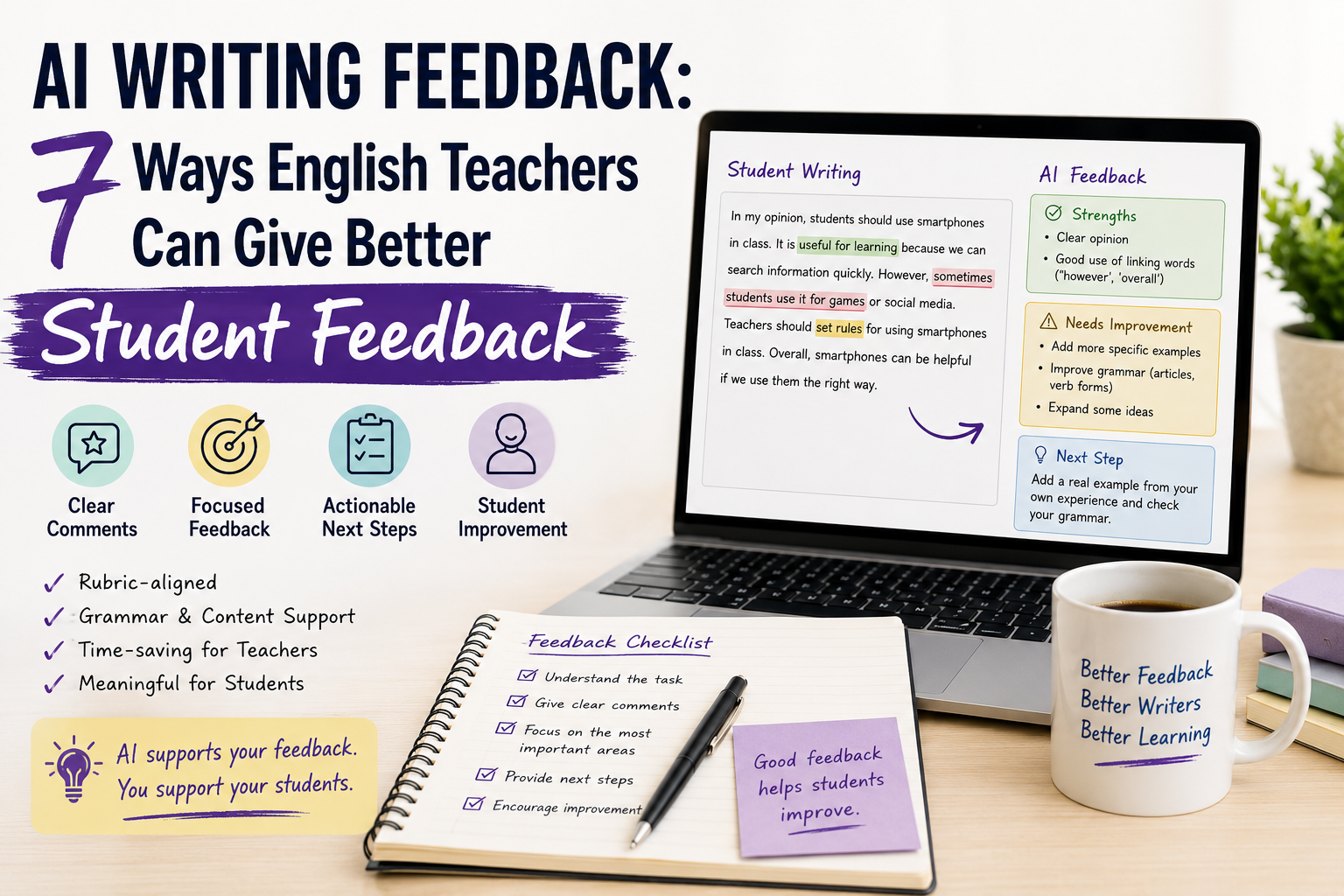
AI writing feedback can help English teachers respond to student writing faster, more clearly, and more consistently. But it should not replace the teacher’s judgement. The best use of AI is not to let it “grade everything automatically.” It is to help teachers draft clearer comments, connect feedback to rubrics, identify patterns, and give students practical next steps.
For ESL/EFL teachers, writing feedback can be time-consuming because student writing involves many layers: grammar, vocabulary, organisation, task response, spelling, punctuation, coherence, and meaning. A teacher may want to help, but marking a full set of paragraphs or essays can take hours.
AI can reduce part of that workload. However, teachers still need to protect student privacy, check accuracy, and make sure feedback is useful rather than generic.
In this guide, you will learn seven practical ways to use AI writing feedback with English learners, including copy-paste prompts and classroom examples.
If you want to build the rubric before giving feedback, read Rubric Creator: 7 AI Prompts to Build Better English Marking Rubrics and AI Rubric Generator: 7 Ways English Teachers Can Create Better Assessment Rubrics. For free rubric workflows, see Free Rubric Maker: 7 Ways English Teachers Can Create Better Rubrics.
What Is AI Writing Feedback?
AI writing feedback means using an AI tool or prompt workflow to help review student writing and generate useful comments. This may include feedback on grammar, vocabulary, organisation, clarity, task response, paragraph structure, or writing style.
For English teachers, AI can help with:
- identifying common writing problems;
- drafting rubric-based comments;
- suggesting clearer feedback;
- creating student-friendly next steps;
- generating grammar practice from student errors;
- making feedback shorter and easier to understand;
- producing feedback comment banks;
- helping students revise their own work.
However, AI feedback should always be reviewed by the teacher. AI can misunderstand student meaning, overcorrect, miss context, or give comments that are too vague.
The teacher remains responsible for the final feedback.
Why English Teachers Should Use AI Writing Feedback Carefully
Writing feedback is one of the most valuable parts of English teaching, but it can also become overwhelming.
Teachers often face problems such as:
- too many papers to mark;
- repeated grammar mistakes;
- vague comments like “improve grammar”;
- limited time for individual feedback;
- difficulty giving clear next steps;
- students not reading long comments;
- inconsistent feedback across assignments.
AI can help solve some of these problems by creating a first draft of feedback. But the word “carefully” matters.
Before using AI with student writing, consider:
- Does your school allow AI tools for assessment support?
- Are you allowed to upload student work?
- Can you remove student names and personal details?
- Are you checking the AI feedback before sharing it?
- Is the feedback supportive and level-appropriate?
A safe workflow is to avoid uploading personal information and to use short anonymised samples when possible.
1. Use AI Writing Feedback with a Rubric
The strongest way to use AI writing feedback is with a rubric. Without a rubric, AI may give random comments. With a rubric, the feedback becomes more focused.
Use this prompt after creating a writing rubric:
Act as an ESL writing feedback assistant.

Use the rubric below to draft feedback on this student writing.

Student level:
[LEVEL]

Writing task:
[PASTE TASK]

Rubric:
[PASTE RUBRIC]

Student writing:
[PASTE ANONYMISED STUDENT TEXT]

Write feedback in three parts:
1. What the student did well;
2. What needs improvement;
3. One clear next step.

Use supportive, student-friendly language. Do not give a final grade.
Why this works
This prompt keeps AI focused on the assessment criteria. It also avoids letting AI make the final grading decision.
Teacher tip
Do not paste student names, email addresses, school details, or private information into the prompt. Use anonymised text.
2. Use AI to Create Shorter, Clearer Feedback Comments
Teachers often write comments that are accurate but too long. Students may not read them carefully. AI can help turn long feedback into clear, student-friendly comments.
Use this prompt:
Rewrite this teacher feedback for [LEVEL] ESL learners.

Make it:
- shorter;
- clearer;
- supportive;
- easy to act on.

Keep the meaning, but avoid technical language.

Teacher feedback:
[PASTE FEEDBACK]
Example
Original feedback:
Your paragraph shows some awareness of the topic, but the argument is underdeveloped and coherence is affected by weak organisation and repeated grammatical inaccuracies.
Student-friendly version:
You have a clear topic, but you need to develop your ideas more. Next time, organise your paragraph with one main opinion, two reasons, and examples. Also check your verb forms carefully.
This kind of feedback is more likely to help students revise.
3. Use AI for Grammar-Focused Writing Feedback
Sometimes students need focused grammar feedback, not a full correction of every mistake. AI can help identify patterns.
Use this prompt:
Review this ESL student writing for grammar patterns.

Student level:
[LEVEL]

Student writing:
[PASTE ANONYMISED TEXT]

Do not rewrite the full text.

Identify:
1. the three most important grammar problems;
2. one example of each problem;
3. a simple explanation;
4. one practice sentence for each problem.

Use language suitable for [LEVEL] learners.
Why this is better than correcting everything
If you correct every mistake, students may feel overwhelmed. Focusing on the most important patterns gives them something they can actually improve.
Example feedback focus
For a B1 paragraph, AI might identify:
- past tense errors;
- missing articles;
- sentence fragments.
You can then decide whether those are really the most important issues or whether another problem matters more for your lesson aim.
4. Use AI for Organisation and Content Feedback
Writing is not only grammar. Many students need help with paragraph structure, idea development, and organisation.
Use this prompt:
Review this student paragraph for content and organisation only.

Student level:
[LEVEL]

Writing task:
[PASTE TASK]

Student writing:
[PASTE ANONYMISED TEXT]

Give feedback on:
1. whether the student answered the task;
2. whether the main idea is clear;
3. whether the ideas are organised logically;
4. whether the student needs more reasons or examples.

Do not focus on grammar unless it prevents understanding.
Give one clear revision suggestion.
When to use this
Use this when the lesson focus is writing structure, opinion paragraphs, essays, or task response.
For example, if students are writing about online learning, you may want feedback like:
Your opinion is clear, but you need more support. Add one example from your own learning experience.
That is often more useful than only marking grammar mistakes.
5. Use AI to Create Feedback Comment Banks
If you mark many similar writing tasks, you probably repeat the same feedback many times. AI can help you build a comment bank linked to your rubric.
Use this prompt:
Create a feedback comment bank for ESL writing.

Task:
[DESCRIBE WRITING TASK]

Level:
[LEVEL]

Rubric criteria:
[PASTE CRITERIA]

For each criterion, write:
1. 3 positive comments;
2. 3 improvement comments;
3. 2 next-step suggestions.

Keep comments short, specific, and supportive.
Example comment bank
For organisation:
- Your ideas are in a clear order.
- Try to start with a stronger topic sentence.
- Next time, use linking words such as because, but, so, and however.
For vocabulary:
- You used useful words from the lesson.
- Try not to repeat the same word too often.
- Next time, add two new topic words from your vocabulary list.
This saves time while keeping feedback consistent.
Save time on rubrics and feedback.
Download the free Rubric & Feedback Templates for English Teachers and get ready-to-use templates, AI prompts, student checklists, and feedback comment banks.
6. Use AI to Turn Feedback into Revision Tasks
Good feedback should lead to revision. AI can help you convert comments into short practice tasks.
Use this prompt:
Turn this writing feedback into a short revision task for [LEVEL] ESL learners.

Feedback:
[PASTE FEEDBACK]

Create:
1. one clear revision instruction;
2. one example;
3. one checklist students can use before resubmitting.
Example
Feedback:
Your paragraph needs clearer organisation and more examples.
Revision task:
Revise your paragraph. Add one topic sentence, two reasons, and one example. Use at least two linking words.
Checklist:
- I gave my opinion clearly.
- I added two reasons.
- I included one example.
- I used linking words.
- I checked my verbs and punctuation.
This makes feedback more actionable.
7. Use AI to Help Students Self-Review Their Writing
AI writing feedback is not only for teachers. You can also teach students how to use AI responsibly to review their own writing before submitting it.
Give students a safe, limited prompt like this:
I am an English learner at [LEVEL].

Review my paragraph and help me improve it.

Do not rewrite the whole paragraph for me.

Give feedback on:
1. one thing I did well;
2. two things I should improve;
3. three grammar or vocabulary mistakes I should check;
4. one question to help me develop my ideas.

Here is my paragraph:
[PASTE TEXT]
Why this matters
Students can become more independent when they learn how to ask for feedback, not just answers. The instruction “Do not rewrite the whole paragraph for me” is important because it keeps the student involved in the learning process.
Teacher tip
If students use AI for self-review, give clear rules. For example:
- AI can help you notice problems.
- AI should not write the full assignment for you.
- You must understand and explain your revisions.
- You should check AI suggestions carefully.
Practical Example: AI Writing Feedback for a B1 Paragraph
Imagine a B1 student writes an opinion paragraph about this question:
Should students use smartphones in class?
You could use this feedback prompt:
Act as an ESL writing feedback assistant.

Student level:
B1

Writing task:
Write a 120-word opinion paragraph answering:
“Should students use smartphones in class?”

Focus on:
1. clear opinion;
2. reasons and examples;
3. paragraph organisation;
4. grammar accuracy;
5. vocabulary.

Student writing:
[PASTE ANONYMISED TEXT]

Give feedback in this format:
- Strengths:
- Needs improvement:
- Next step:

Use short, student-friendly language. Do not rewrite the full paragraph.
This gives you a clear first draft of feedback. Then you can edit it before giving it to the student.
Common Mistakes to Avoid with AI Writing Feedback
Mistake 1: Letting AI grade the whole assignment alone
AI should not replace teacher assessment. Use it to support comments, not to make final grading decisions.
Mistake 2: Uploading private student information
Remove names, emails, school details, and any personal information before using AI.
Mistake 3: Asking AI to correct every mistake
Too many corrections can overwhelm learners. Focus on the most important patterns.
Mistake 4: Giving feedback that is too general
Comments like “improve grammar” or “write better sentences” are not helpful. Ask for specific next steps.
Mistake 5: Ignoring the rubric
Feedback should match the rubric and task. Otherwise, students may feel confused about expectations.
Mistake 6: Making the language too advanced
Feedback should be understandable for the student’s level. B1 students need clear, direct comments, not technical assessment language.
Mistake 7: Sharing AI feedback without checking it
AI may give inaccurate, unfair, or irrelevant feedback. Always review and edit before giving it to students.
A Simple AI Writing Feedback Workflow for Teachers
Use this workflow to keep feedback useful and safe.
Step 1: Start with the task and rubric
Clarify what students were asked to do and what criteria matter.
Step 2: Remove personal information
Use anonymised student writing.
Step 3: Ask AI for focused feedback
Do not ask for everything. Choose grammar, organisation, vocabulary, or rubric-based comments.
Step 4: Review the AI output
Check accuracy, tone, level, and fairness.
Step 5: Add your teacher judgement
Include anything the AI missed. Remove anything that does not fit the student’s work.
Step 6: Give one clear next step
Students need to know what to do next, not only what was wrong.
Step 7: Use repeated issues for future lessons
If many students make the same mistake, turn it into a mini-lesson or worksheet.
For example, if many students misuse linking words, you can create a short worksheet using your AI Worksheet Generator for English Teachers workflow.
FAQ: AI Writing Feedback for English Teachers
What is AI writing feedback?
AI writing feedback is the use of AI to help review writing and generate comments on grammar, vocabulary, organisation, content, clarity, and next steps. Teachers should review AI feedback before sharing it with students.
Can AI give feedback on ESL writing?
Yes. AI can help draft feedback on ESL writing, especially when the teacher provides the level, task, rubric, and focus areas. However, teachers should check the feedback for accuracy and fairness.
Should teachers use AI to grade student writing?
AI can support feedback, but teachers should be careful about using it for final grades. Assessment should follow school policies, privacy rules, and teacher judgement.
How can I make AI writing feedback more useful?
Give AI a clear task, learner level, rubric, and feedback focus. Ask for strengths, areas for improvement, and one specific next step.
Can AI correct grammar mistakes in student writing?
Yes, but it is often better to ask AI to identify key grammar patterns rather than correct every mistake. This helps students focus on learning, not just receiving corrections.
Is AI feedback good for student revision?
It can be useful if it gives clear next steps. Teachers can also ask AI to turn feedback into revision tasks or checklists.
How can students use AI feedback responsibly?
Students can use AI to review their writing, identify problems, and ask for improvement suggestions. They should not use AI to write the full assignment for them.
Conclusion
AI writing feedback can help English teachers save time and give clearer comments, but it works best when the teacher stays in control. AI can draft feedback, identify grammar patterns, simplify comments, create revision tasks, and build feedback comment banks. But it should not replace careful teacher review.
For ESL/EFL teachers and language tutors, the most useful feedback is specific, student-friendly, connected to the task, and focused on improvement. Use AI to support that process, not to remove your professional judgement.
A good writing feedback workflow helps students understand what they did well, what they need to improve, and what step to take next. That is where AI can genuinely help English teachers teach writing more effectively.